
1985 NATS: CL Navy Carrier
Dick Perry
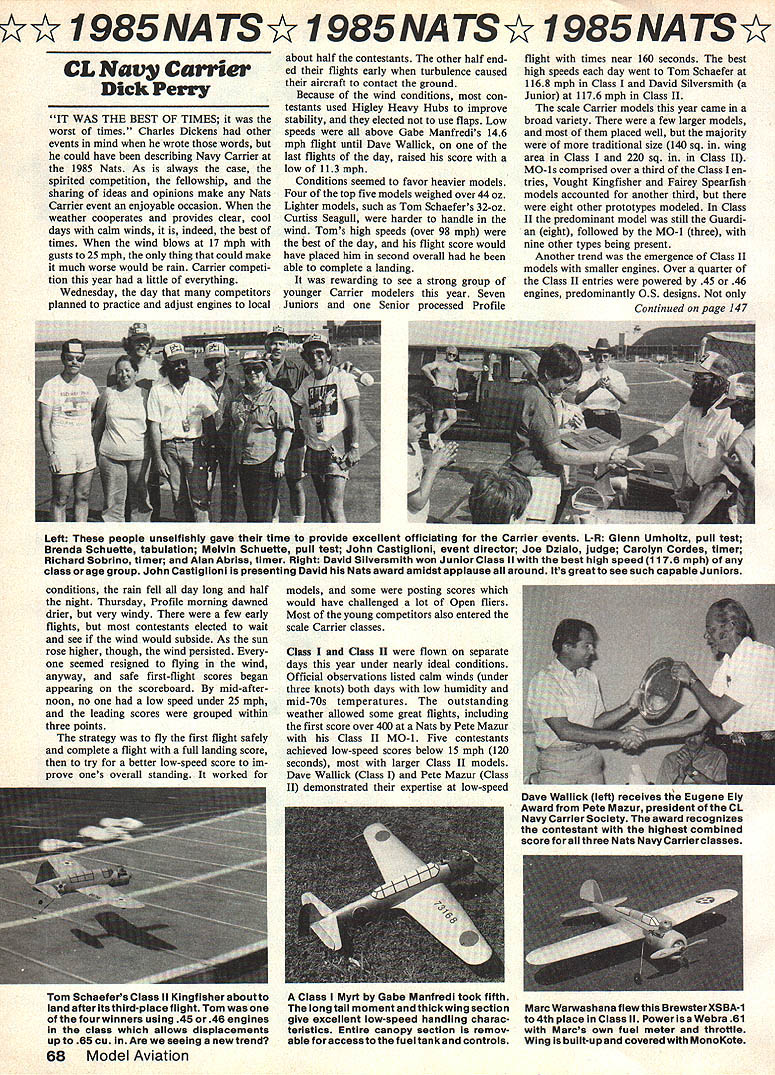
"It was the best of times; it was the worst of times." Charles Dickens had other events in mind when he wrote those words, but he could have been describing Navy Carrier at the 1985 Nats. As is always the case, the spirited competition, the fellowship, and the sharing of ideas and opinions make any Nats Carrier event an enjoyable occasion. When the weather cooperates and provides clear, cool days with calm winds, it is, indeed, the best of times. When the wind blows at 17 mph with gusts to 25 mph, the only thing that could make it much worse would be rain. Carrier competition this year had a little of everything.
Practice and early weather
Wednesday, the day that many competitors planned to practice and adjust engines, brought local turbulence that caused about half of the contestants to end their flights early when their aircraft contacted the ground.
Because of the wind conditions, most contestants used Higley heavy hubs to improve stability, and they elected not to use flaps. Low speeds were all above Gabe Manfredi's 14.6 mph flight until Dave Wallick, on one of the last flights of the day, raised his score with a low of 11.3 mph.
Conditions seemed to favor heavier models. Four of the top five models weighed over 44 oz. Lighter models, such as Tom Schaefer's 32-oz Curtiss Seagull, were harder to handle in the wind. Tom's high speeds (over 98 mph) were the best of the day, and his flight score would have placed him second overall had he been able to complete a landing.
Junior participation and high speeds
It was rewarding to see a strong group of younger Carrier modelers this year. Seven Juniors and one Senior posted profile flight times near 160 seconds; best high speeds of the day went to Tom Schaefer at 116.8 mph in Class I and David Silversmith (a Junior) at 117.6 mph in Class II.
Scale models and trends
The scale Carrier models this year came in a broad variety. There were a few larger models, and most of them placed well, but the majority were of more traditional size (about 140 sq. in. wing area in Class I and 220 sq. in. in Class II).
- MO-1 comprised over a third of the Class I entries.
- Vought Kingfisher and Fairey Spearfish models accounted for another third.
- Eight other prototypes were modeled in Class I.
- In Class II the predominant model was the Guardian (eight), followed by the MO-1 (three), with nine other types present.
Another trend was the emergence of Class II models with smaller engines. Over a quarter of the Class II entries were powered by .45 or .46 engines, predominantly O.S. designs.
Profile morning (Thursday)
Conditions the night before were poor; rain fell all day and half the night. Thursday, Profile morning dawned drier but very windy. There were a few early flights, but most contestants elected to wait and see if the wind would subside. As the sun rose higher, the wind persisted. Everyone seemed resigned to flying in the wind anyway, and safe first-flight scores began appearing on the scoreboard. By mid-afternoon, no one had a low speed under 25 mph, and the leading scores were grouped within three points.
The strategy was to fly the first flight safely and complete a flight with a full landing score, then try for a better low-speed score to improve one's overall standing. It worked for many models, and some were posting scores that would have challenged a lot of Open fliers. Most of the young competitors also entered the scale Carrier classes.
Class I and Class II competitions
Class I and Class II were flown on separate days this year under nearly ideal conditions. Official observations listed calm winds (under three knots) both days with low humidity and mid-70s temperatures. The outstanding weather allowed some great flights, including the first score over 400 at Nats by Pete Mazur with his Class II MO-1. Five contestants achieved low-speed scores below 15 mph (120 seconds), most with larger Class II models. Dave Wallick (Class I) and Pete Mazur (Class II) demonstrated their expertise at low-speed flight. Where they were entered, they also placed well, winning half of the trophies in Open and a third in Junior.
Awards and society meeting
Each year the Navy Carrier Society sponsors the Eugene Ely Award for the contestant who achieves the highest combined score for all three Carrier classes. This year the award was presented to Dave Wallick, who placed first in Profile and Class I and second in Class II. Runner-up for the award was Gabe Manfredi, a relative newcomer to the events, whose hard work over the past few years has made him highly competitive.
The annual meeting of the Navy Carrier Society was held Saturday evening under the leadership of President Pete Mazur. In addition to the Ely Award presentation, John Castiglioni (Carrier event director) and other officials were recognized for their outstanding contribution toward making this a very smooth-running and enjoyable Nats.
Discussion at the meeting covered a broad range of topics from rule interpretations to expanding the influence of the society and increasing the benefit to its members. The major item was plans to retain veterans and to recruit new ones.
Looking ahead
This year's Nats provided lots of good stories to last until the USS Smallfry returns for carrier operations in Lake Charles, LA next summer.
Transcribed from original scans by AI. Minor OCR errors may remain.

