
1985 NATS: RC Aerobatics
Ron Van Putte
Event overview
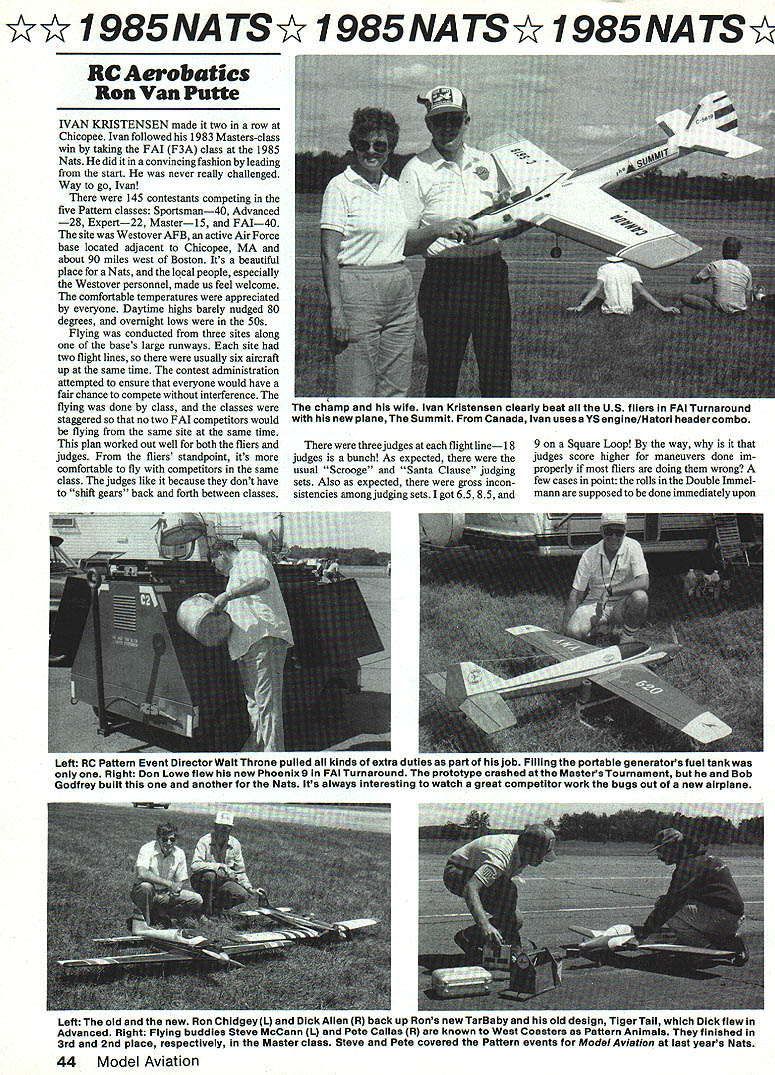
IVAN KRISTENSEN made it two in a row at Chicopee, following his 1983 Masters-class win by taking the FAI (F3A/turnaround) class at the 1985 Nats. He led from the start and was never seriously challenged.
One hundred forty-five contestants competed in five Pattern classes:
- Sportsman — 40
- Advanced — 28
- Expert — 22
- Master — 15
- FAI — 40
The site was Westover AFB, an active Air Force base adjacent to Chicopee, MA (about 90 miles west of Boston). The facilities and local people, especially Westover personnel, were welcoming. Temperatures were comfortable: daytime highs barely nudged 80°F and overnight lows dipped into the 50s.
Contest format and schedule
Flying was conducted from three sites along one of the base's large runways. Each site had two flight lines, so there were usually six aircraft up at the same time. Classes were flown separately and staggered so no two FAI competitors would use the same site simultaneously. This arrangement worked well for fliers and judges: competitors fly alongside the same-class pilots, and judges avoid frequently "shifting gears" between different skill levels.
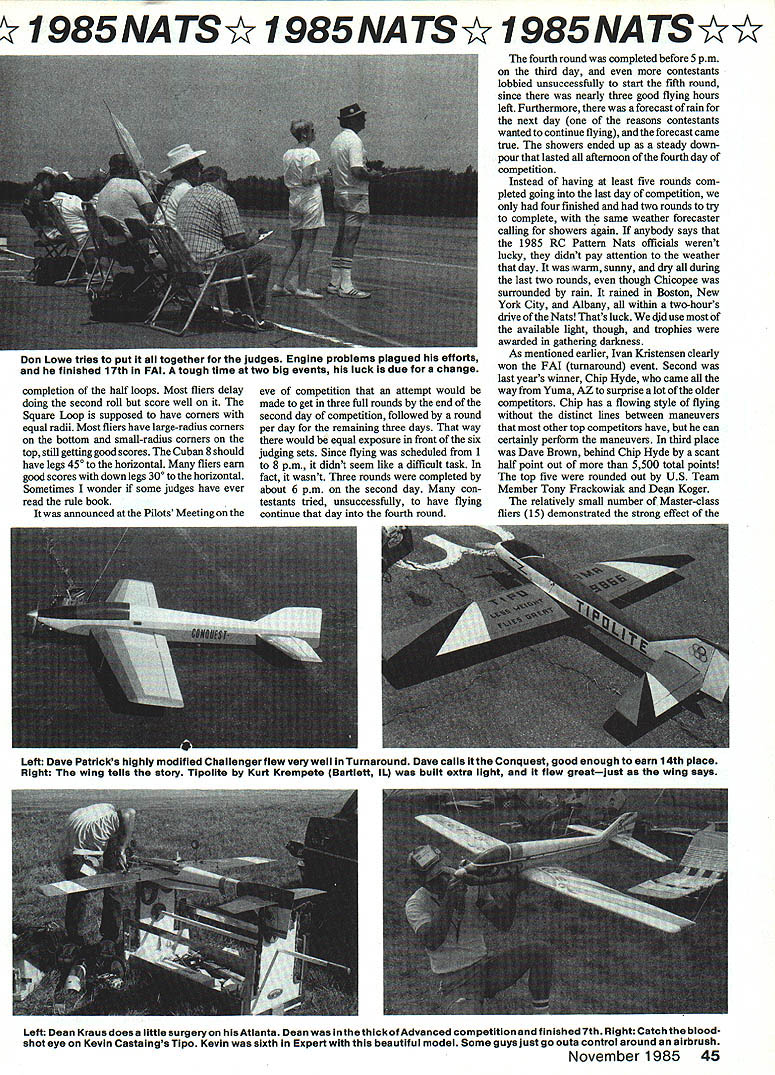
At the pilots' meeting the eve before competition, officials planned to complete three full rounds by the end of day two, then one round per day for the remaining three days. Flying hours were 1–8 pm, and three rounds were in fact completed late on day two. A fourth round finished before 5 pm on day three. Contestants pushed to start the fifth round on day three because rain was forecast for day four, but the forecast proved correct: steady downpours canceled flying for most of day four. As a result, only four rounds were completed going into the final day. Fortunately, the final day produced warm, sunny, dry conditions for the last two rounds despite surrounding rain—trophies were awarded as darkness fell.
Judging and scoring
Each flight line had three judges—for a total of 18 judges. As expected, judging styles varied widely, with some judges consistently harsher ("Scrooge") and others more generous ("Santa Claus"). Gross inconsistencies among judging sets were noted; for example, identical maneuvers could draw widely different marks. Common maneuver errors that still scored well included:
- Rolls in the Double Immelmann delayed instead of done immediately after the half loop.
- Square Loop corners with unequal radii (large on the bottom, small on top).
- Cuban 8 downward legs closer to 30° to the horizontal rather than the prescribed 45°.
Such discrepancies raised questions about how closely some judges follow the rule book.
Results — top finishers
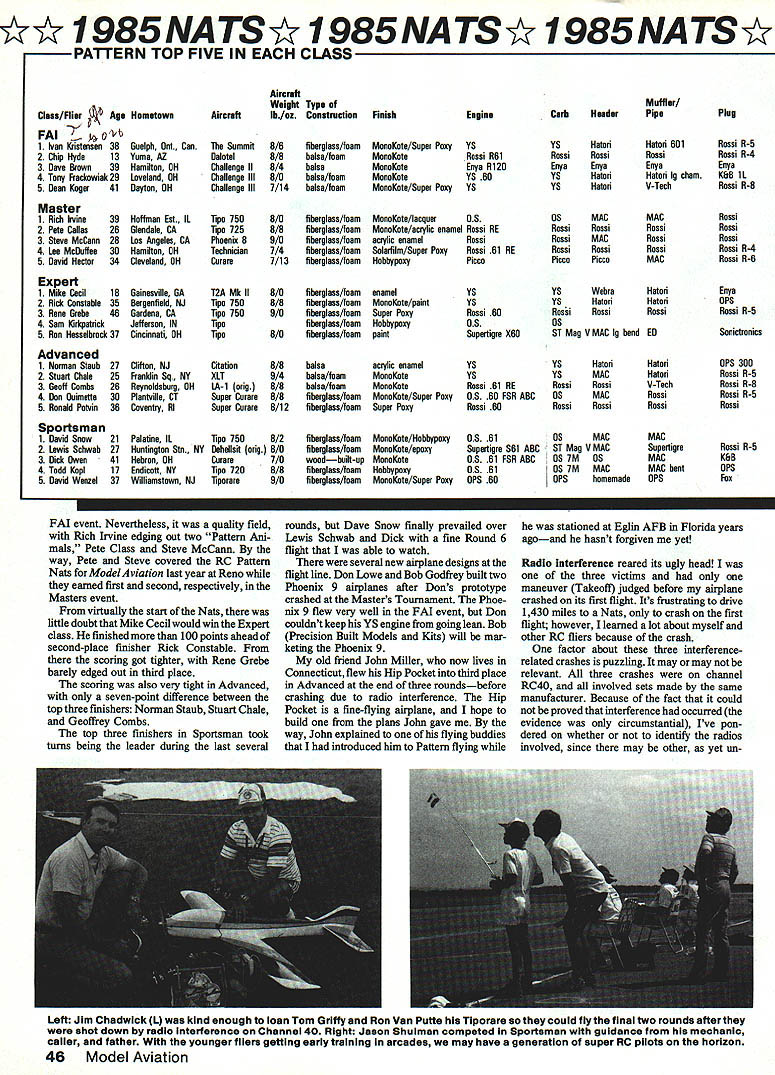
FAI (turnaround):
- Ivan Kristensen — clear winner
- Chip Hyde — last year's winner, came from Yuma, AZ, with a flowing style and distinct lines between maneuvers
- Dave Brown — finished a scant half-point behind Hyde out of more than 5,500 total points
- Tony Frankowiak
- Dean Koger
Master class:
- Small field (15), influenced by strong FAI turnout. Rich Irvine edged out Pete Callas and Steve McCann. (Pete and Steve had covered the RC Pattern Nats for Model Aviation at Reno and placed first and second respectively in Masters there.)
Expert class:
- Mike Cecil dominated, finishing more than 100 points ahead of Rick Constable. Rene Grebe finished a close third.
Advanced class:
- Very tight scoring; only seven points separated the top three: Norman Staub, Stuart Chale, and Geoffrey Combs.
Sportsman class:
- The lead swapped among the top three through the late rounds; Dave Snow prevailed over Lewis Schwab and Dick Owen with a strong Round 6.
New aircraft and designs
Several new designs appeared at the flight line. Don Lowe and Bob Godfrey built two Phoenix 9 airplanes after Don's prototype crashed at the Masters Tournament. The Phoenix 9 handled well in FAI, though Don experienced persistent engine leaning on his YS engine. Bob (Precision Built Models and Kits) planned to market the Phoenix 9.
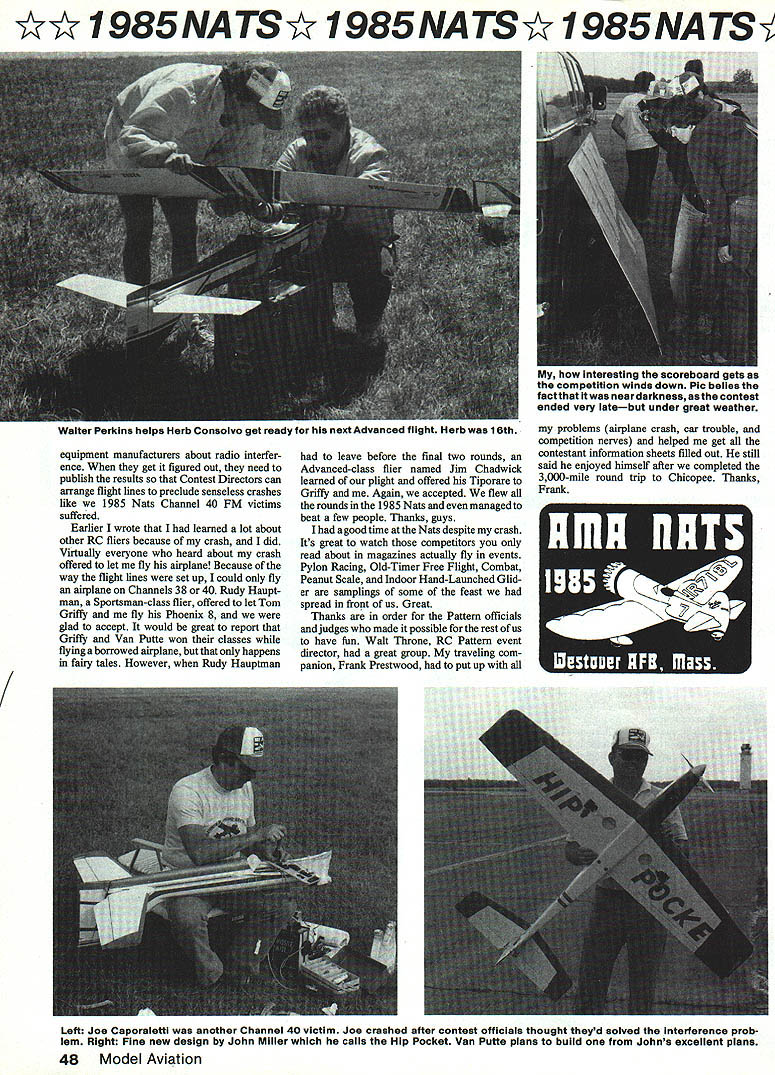
John Miller, flying a Hip Pocket, placed third in Advanced after three rounds before suffering a crash due to radio interference. The Hip Pocket proved a fine-flying design.
Radio interference and crashes
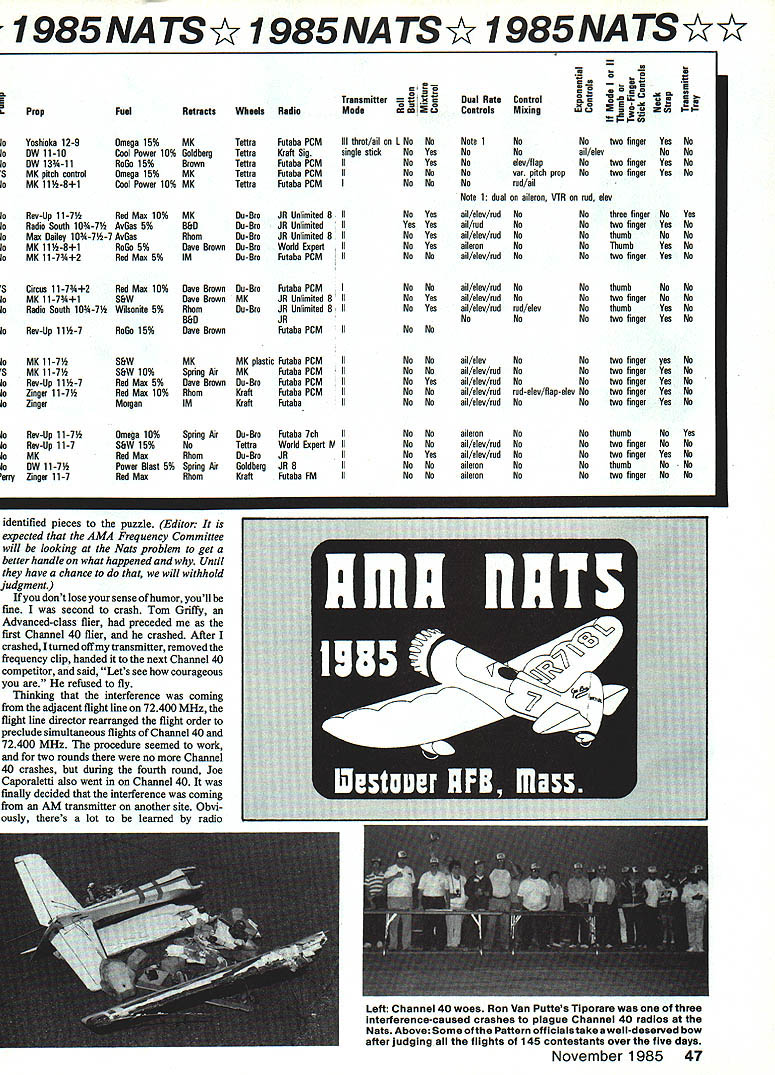
Radio interference became a notable problem at the event. There were three intermittent crashes that appeared related:
- All three crashes occurred on channel RC40.
- All involved transmitters/sets from the same manufacturer.
- Proving interference definitively was difficult; evidence was circumstantial. The suspected sets were reported to RC officials and logged.
Sequence of related incidents:
- Tom Griffy (Advanced) crashed first on Channel 40.
- The author (Van Putte) was second: only one maneuver (Takeoff) was judged before his airplane crashed on its first flight.
- Joe Caporaletti later crashed on Channel 40.
Initially, it was thought interference might be coming from an adjacent flight line on 72.400 MHz, so the flight order was rearranged to avoid simultaneous Channel 40/72.400 flights. That seemed to help for two rounds, but a subsequent crash occurred again on Channel 40. It was eventually determined the interference was coming from an AM transmitter on another site. The AMA Frequency Committee was expected to investigate the Nats problem to clarify what happened and why; until then, specifics were withheld.
Despite the frustration of crashing (especially after a long trip—1,430 miles for the author), the event highlighted the camaraderie of the RC community: nearly everyone offered to let the author fly their airplane afterward.
Borrowed airplanes and sportsmanship
Because of frequency restrictions and the loss of his own airplane, the author and Tom Griffy flew borrowed airplanes on Channels 38 or 40:
- Rudy Hauptman (Sportsman) lent his Phoenix 8 to Griffy and the author.
- When Hauptman had to leave before the final rounds, Advanced-class flier Jim Chadwick lent his Tiporare for the remaining rounds.
They completed the rounds flying borrowed aircraft and even managed to beat a few competitors. The generosity shown by fellow fliers was much appreciated.
Closing thanks
Thanks to the Pattern officials and judges—Walt Throne (RC Pattern event director) and his group—for making the event possible. Special thanks to traveling companion Frank Prestwood for assistance with contestant paperwork and support through airplane crash, car trouble, and competition nerves. Despite those problems, the trip (a roughly 3,000-mile round trip for the author) was enjoyable.
Other events at the Nats provided a varied feast for attendees, including Pylon Racing, Old-Timer Free Flight, Combat, Peanut Scale, and Indoor Hand-Launched Glider.
(Editor's note: The AMA Frequency Committee was expected to look into the radio problems reported at the Nats to get a better handle on what happened.)
Transcribed from original scans by AI. Minor OCR errors may remain.

