
1985 NATS: RC Scale
Arrival and the Gee Bee
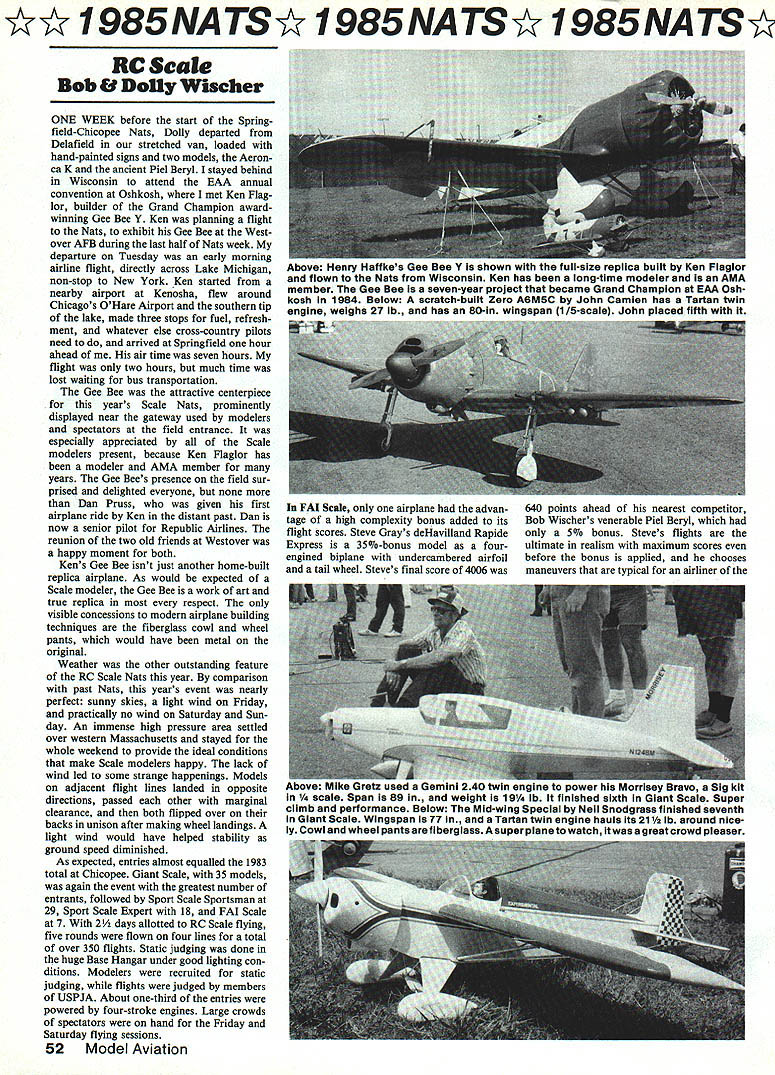
One week before the start of the Springfield–Chicopee Nats, Dolly Wischer departed Delafield in the stretched van loaded with hand‑painted signs and two models (an Aeronca K and an older Piel Beryl). I stayed in Wisconsin to attend the EAA annual convention at Oshkosh, where I met Ken Flaglor, builder of the Grand Champion Gee Bee Y. Ken planned to fly the Gee Bee to the Nats and exhibit it at Westover AFB during the latter half of the week.
Ken left from a nearby airport at Kenosha, routed around Chicago’s O’Hare and the southern tip of Lake Michigan, made three stops en route, and arrived in Springfield about an hour ahead of my airline flight. His air time was seven hours; my direct flight across Lake Michigan was only two hours, but much time was lost waiting for bus transportation.
Ken’s Gee Bee was an attractive centerpiece for the Scale Nats, prominently displayed near the field entrance and much appreciated by scale modelers. The Gee Bee is a true replica and a work of art; the only visible concessions to modern construction were a fiberglass cowl and wheel pants.
Weather and operations
Weather was another outstanding feature of the RC Scale Nats. Compared with past years, conditions were nearly perfect: sunny skies, a light wind on Friday, and practically no wind on Saturday and Sunday as a large high‑pressure area settled over western Massachusetts. The lack of wind, however, produced some odd situations—models on adjacent flight lines sometimes landed in opposite directions, passed each other with marginal clearance, and in a few cases both flipped onto their backs after wheel landings. A light wind would have helped stability during low‑speed ground rolls.
- Five rounds were flown on four flight lines over 2¼ days, totaling over 350 flights.
- Static judging was conducted in the huge base hangar under good lighting.
- Flight judging was handled by members of the USPJA; modelers were recruited to assist with static judging.
- About one‑third of entries were powered by four‑stroke engines.
- Large spectator crowds attended Friday and Saturday sessions.
Entries and categories
Entries nearly equaled the 1983 totals. Category counts included:
- Giant Scale: 35 entries (the largest group)
- Sport Scale — Sportsman: 29 entries
- Sport Scale — Expert: 18 entries
- FAI Scale: 7 entries
Notable winners and models
#### FAI Scale and notable FAI entries
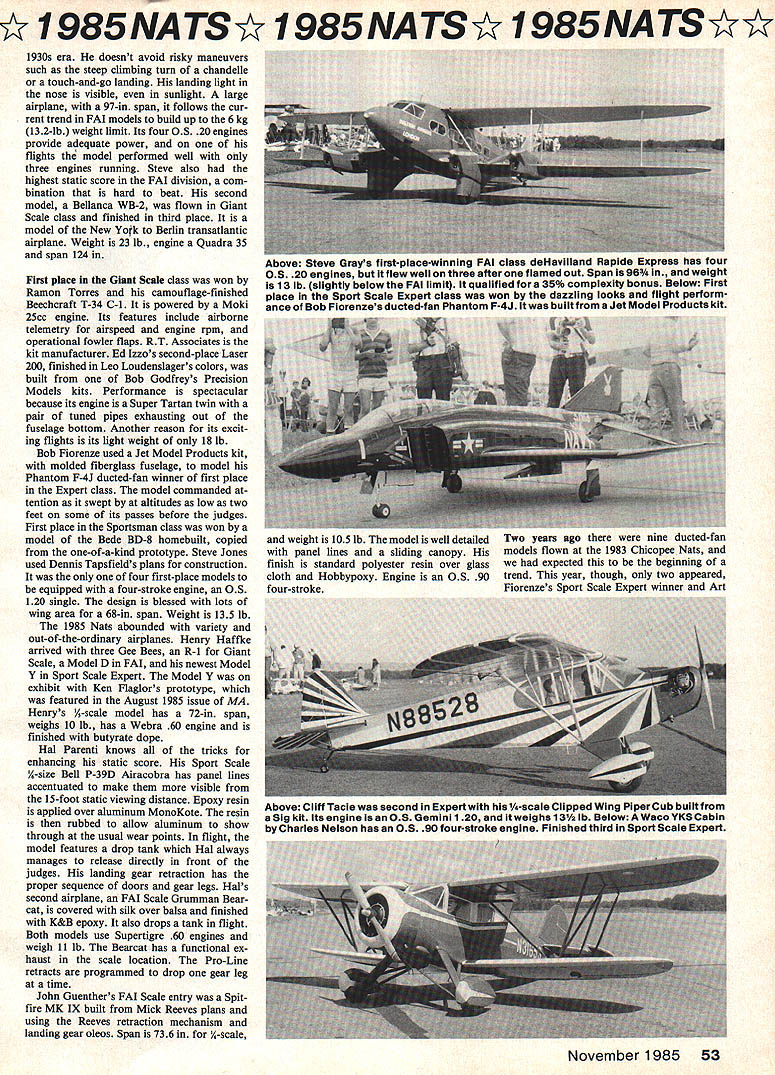
- A large 1930s‑era model (97 in. span) following the trend toward the 6 kg (13.2 lb) FAI limit used four O.S. .20 engines and performed well even with one engine out. The builder, identified as Steve in the reports, had the highest static score in the FAI division.
- John Guenther — Spitfire Mk IX (FAI 1/4‑scale): built from Mick Reeves plans, 73.6 in. span, 10.5 lb, O.S. .90 four‑stroke, glass cloth/polyester finish, Reeves retraction and oleos.
#### Giant Scale
- 1st place and George Meyer Craftsmanship Trophy: Ramon Torres — Beechcraft T‑34C‑1. Features: epoxy‑glass fuselage, Moki 25cc engine, airborne telemetry for airspeed and engine rpm, operational Fowler flaps. Specs: 80 in. span, ~22 lb. Static score: 97.
- 2nd place: Ed Izzo — Laser 200, finished in Leo Loudenslager colors; built from a Bob Godfrey/Precision Models kit; powered by a Super Tartan twin with tuned exhaust; light weight (~18 lb) contributed to spectacular performance.
- 3rd place: Bellanca WB‑2 (builder referenced as Steve for this entry) — transatlantic New York–Berlin replica, 124 in. span, 23 lb, Quadra .35 engine.
- 4th place: Bob Wischer — Aeronca K (see August 1985 MA for details).
- 5th place: John Camin — A6M5C Mitsubishi Zero, scratch‑built, 80 in. span, 27 lb, Tartan twin; canopy linked to gear retraction so it closes when gear raises; included drop tank and bombs; static score 95.
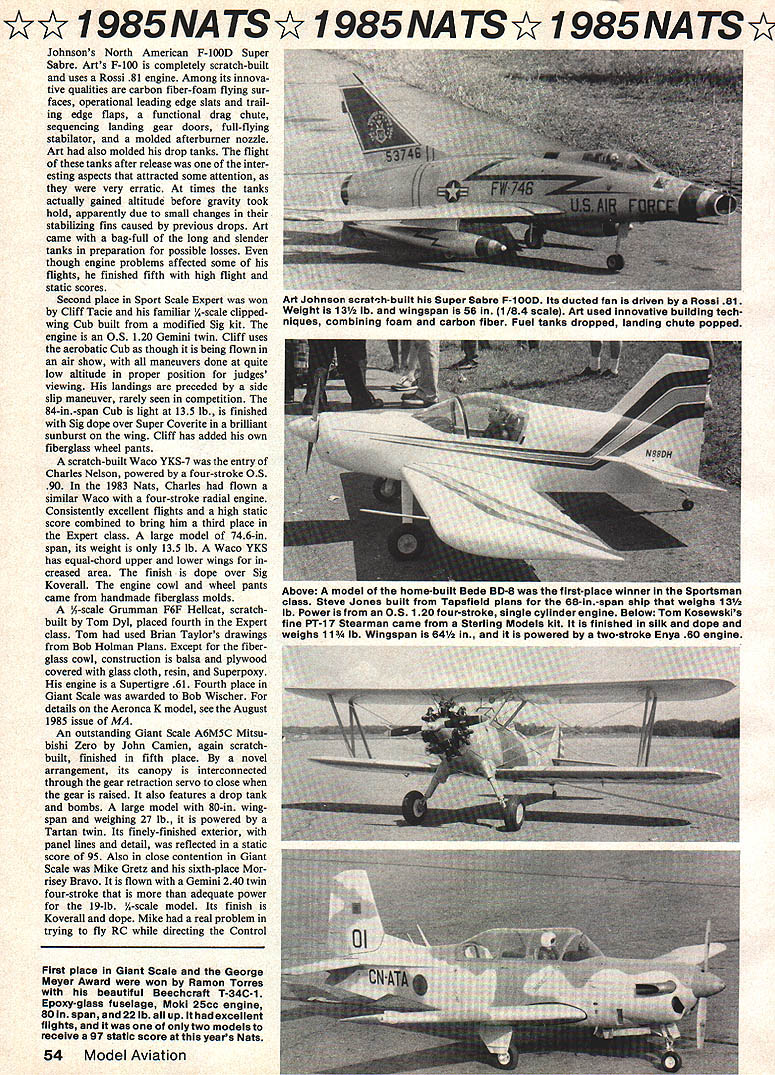
- 6th place: Mike Gretz — Morrisey Bravo, Y‑scale model, ~19 lb, Gemini 2.40 twin four‑stroke; finish K‑overall and dope.
#### Sport Scale — Expert and notable Expert entries
- 1st place (Expert class, ducted fan): Bob Fiorenze — Phantom F‑4J ducted‑fan, built from a Jet Model Products kit (molded fiberglass fuselage). The model flew low and fast, sometimes as low as 2 ft on passes.
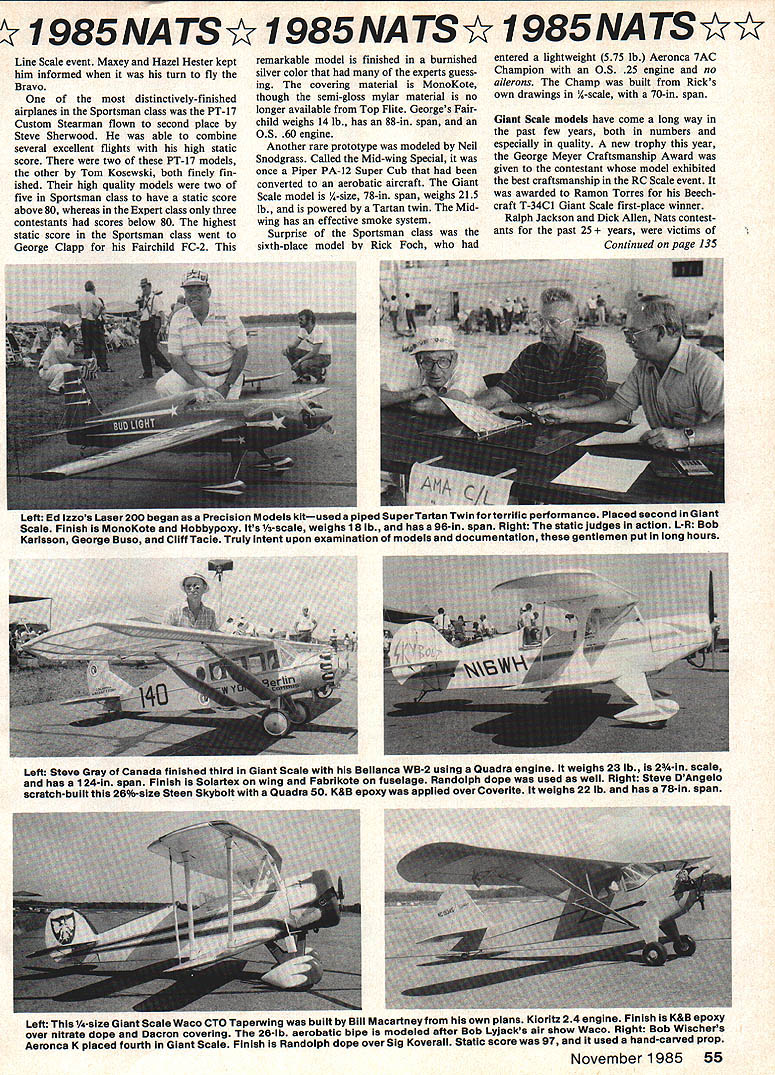
- 2nd place (Sport Scale Expert): Cliff Tate — 1/4‑scale clipped‑wing Cub modified from a Sig kit, 84 in. span, 13.5 lb, O.S. 1.20 Gemini twin. Cliff flew aerobatically at low altitude with well‑positioned maneuvers and distinctive side‑slip landings.
- 3rd place (Expert): Charles Nelson — scratch‑built Waco YKS‑7, 74.6 in. span, 13.5 lb, O.S. .90 four‑stroke; high static score and consistently excellent flights. Cowl and wheel pants produced from handmade fiberglass molds.
- 4th place (Expert): Tom Dyl — 7½‑scale Grumman F6F Hellcat, scratch‑built from Brian Taylor drawings and Bob Holman plans; balsa and plywood structure, glass cloth/resin/Superpoxy covering; Super Tigre .61 engine.
- 5th place (Expert): Art Gretz — Gemini 240 twin (1/4‑scale), span 89 in., weight 19.25 lb; finished sixth on scale performance in some counts. (Note: multiple ducted‑fan and twin entries were reported; Art’s models drew attention for their design details.)
#### Sportsman
- 1st place (Sportsman): Steve Jones — Bede BD‑8 homebuilt replica, built from Dennis Tapsfield plans; only one of the four first‑place models to use a four‑stroke (O.S. .120 single), 68 in. span, 13.5 lb.
- 2nd place (Sportsman): Steve Sherwood — PT‑17 Custom Stearman; finely finished and combined high static with strong flights. Tom Kosewski flew the other finely finished PT‑17.
- Highest static (Sportsman): George Clapp — Fairchild FC‑2, burnished silver finish using MonoKote, 88 in. span, 14 lb, O.S. .60.
- Surprise finish: Rick Foch — lightweight Aeronca 7AC Champion (1/6‑scale, 70 in. span), 5.75 lb, O.S. .25 engine, no ailerons; finished sixth in Sportsman.
Other notable builders and entries
- Henry Hafke — brought three Gee Bees: an R‑1 for Giant Scale, a Model D in FAI, and a 1/2‑scale Model Y in Sport Scale Expert (72 in. span, 10 lb, Webra .60 engine, butyrate dope finish). His Model Y was displayed alongside Ken Flaglor’s prototype featured in the August 1985 MA.
- Hal Parenti — Sport Scale 1/2‑size Bell P‑39D Airacobra and an FAI Grumman Bearcat. Hal used techniques to enhance static judging (accentuated panel lines, epoxy resin over aluminum MonoKote rubbed to show wear points), functioning retracts and drop tanks, and Super Tigre .60 engines. Both models weighed ~11 lb and featured scale exhaust and retraction sequencing.
- Neil Snodgrass — Giant Scale Mid‑wing Special (originally a converted Piper PA‑12 aerobatic prototype), 1/2‑scale, 78 in. span, 21.5 lb, Tartan twin, with an effective smoke system.
- A reduced number of ducted‑fan models appeared compared with 1983; only two were reported this year (Bob Fiorenze’s Phantom F‑4J and Art Gretz’s Gemini 240).
Awards and craftsmanship
- George Meyer Craftsmanship Trophy (new this year): Ramon Torres, for best craftsmanship in RC Scale (awarded to his first‑place Giant Scale T‑34C‑1).
- The event highlighted the steady improvement in Giant Scale quality and craftsmanship.
Thanks and organizers
Thanks are due to members of the Pioneer Valley RC Club and to Roman Polaski, the manpower coordinator. Their hard work helped make the Nats a resounding success.
Transcribed from original scans by AI. Minor OCR errors may remain.

