
1985 NATS: RC Soaring
Dan Pruss
DEAR BOSS: This was more like it. The 1985 Nats, I mean. Remember Reno and all the negative comments, bad attitudes and, in general, the bad time had by all? Well, I'm pleased to say this year's event was the antithesis of the bash held in 1984.
It's not that this contest was perfect — there's no record of one yet with that rating — but the feeling in the air by all of the contestants and officials was that we're going to make this one work. That attitude prevailed for five days.
Contest Director Jeff Troy and about 15 of his club members from the Valley Forge Signal Seekers, along with other volunteer help, kept the biggest-ever Thermal Soaring event humming for almost a week. That was no simple task, especially when you look at some of the numbers.
The above numbers aren't meant as a put-down towards any of the other RC events. No way. But just so you know, in case you're keeping score:
- Pattern: 159 entries
- Scale: 107 entries
- Pylon: 99 entries
- Helicopter: 81 entries
About the flying field, I don't know who was responsible for selecting this as a Soaring site, but tell everyone that the Soaring folks gave the site three and a half stars. That's pretty good when you consider four is the most one can get, and Reno received only half of one.
The site was the employees' recreation area of the Smith & Wesson plant, and if no one has had a chance to thank those people yet, would you see to it that many thanks get passed on to them from the guys and gals who flew there? They really appreciated the facilities.
The way things were scheduled was something like this: after processing on Monday, the regular Soaring events were to be flown from Tuesday through Friday at a rate of two rounds per day. That's a sensible pace. Saturday was reserved for Scale. It didn't quite work out that way.
Two rounds were flown on Tuesday — and Tuesday evening. Let's see, 331 entries times two ... you got the idea? Boss, this is where cooperation by all came in. Rather than bellyaching and protesting, a couple of hundred folks pitched in and got the contest up on step. (I'll get a little ahead of myself at this point and tell you that no protests were filed.)
This is not only a mark of how well the organizers did, but it also gives you an idea of the overall attitude of the contestants. Sean Walbank, a contestant and a reporter from England, summed it up best when he said, "I don't fly perfect flights, so why should I expect anyone to run the perfect contest? When I fly perfect flights, then I'll consider protesting." Maybe that's too laid-back an attitude for some folks, but it sure worked out nicely here.
On Wednesday the rains came, but what's a Nats without a little rain? A little of the wet stuff would have been tolerated, but this sprinkle was drowning frogs and lasted into the night! That day's two rounds were canceled, and the eight planned rounds suddenly became six. The best line of the meet came from Larry Jolly, though. He said it rained so hard his Eppler 205 wing turned into a Wortmann section. Now, that's rain!
The skies cleared on Thursday, but the wind continued just like on Tuesday. This increased the attrition rate somewhat, but it still was into the evening before the last flight was down. On Friday the winds diminished by afternoon, and the last flier landed by late afternoon, well in time for the awards banquet.
Statistics
First of all, a contestant could enter all three Soaring categories: Two-Meter, Standard, and Unlimited. Many did. They could also enter Scale, which a few did. Boss, I'm happy to report that RC Soaring was the biggest event at the Nationals. Look at these numbers:
- Two-Meter: 95 entered
- Standard class: 107 flew
- Unlimited: 120 signed up
- Scale (soaring entries): 9
Totals: 331. Boss, I'm not sure how some ecologists feel about this, but did you ever see about 40 acres of lush green grass suddenly covered with MonoKote?
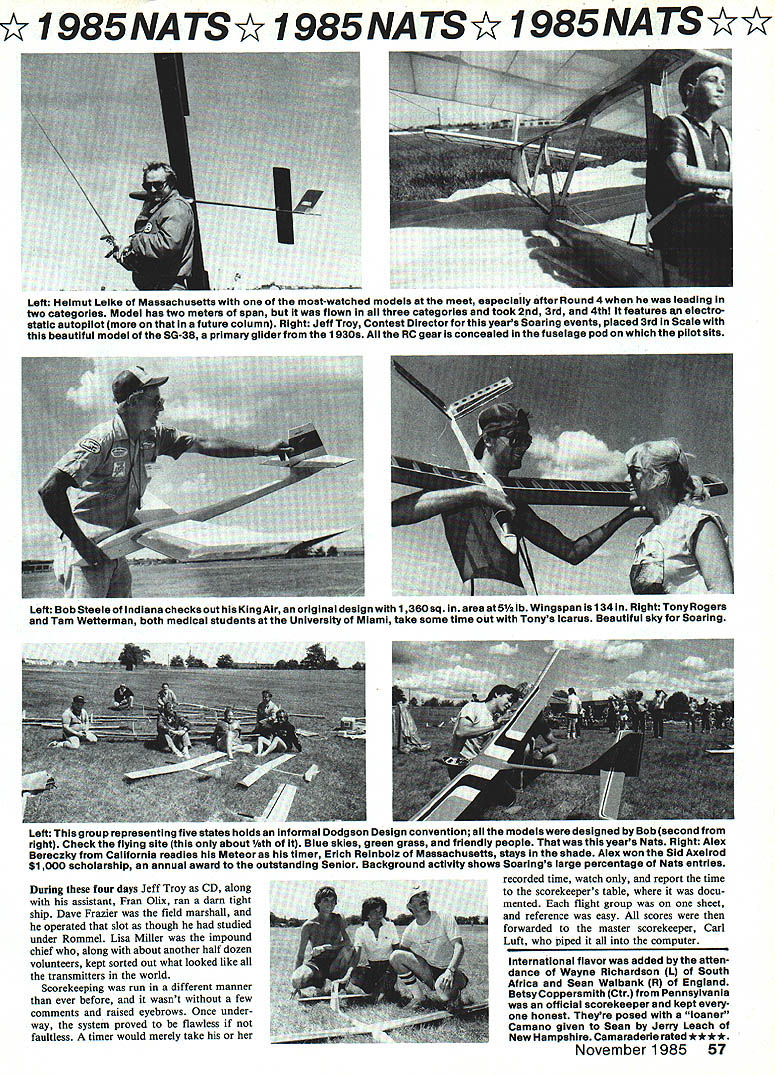
During these four days Jeff Troy as CD, along with his assistant Fran Olix, ran a darn tight ship. Dave Frazer was the field marshal, and he operated the slot as though he had studied under Rommel. Lisa Miller was the impound chief who, along with about another half dozen volunteers, kept sorted out what looked like all the transmitters in the world.
Scorekeeping was run in a different manner than ever before, and it wasn't without a few comments and raised eyebrows. Once underway, the system proved to be flawless if not faultless. A timer would merely take his or her recorded time, write it on the sheet, and report the time to the scorekeeper's table, where it was documented. Each flight group was on one sheet, and reference was easy. All scores were then forwarded to the master scorekeeper, Carl Luff, who piped it all into the computer.
This system reduced paperwork to a minimum. Instead of some 300 individual scorecards, there were only 18, one for each flight group.
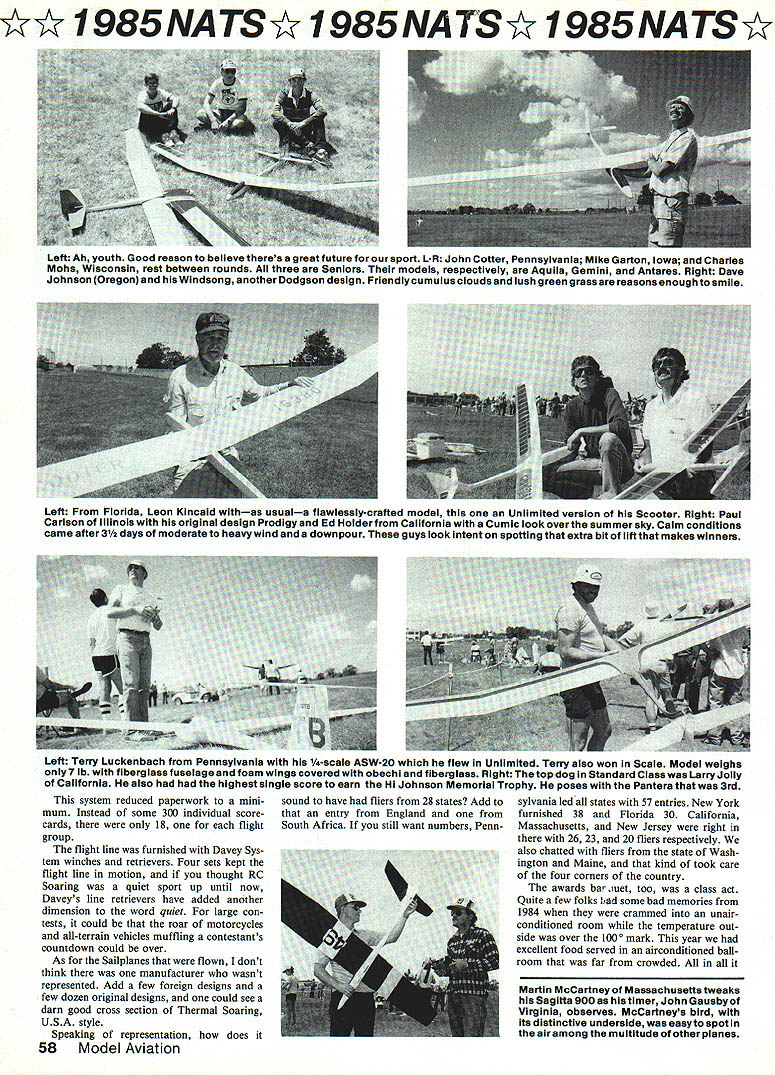
The flight line was furnished with Davey System winches and retrievers. Four sets kept the flight line in motion, and if you thought RC Soaring was a quiet sport up until now, Davey's line retrievers have added another dimension to the word quiet. For large contests, it could be that the roar of motorcycles and all-terrain vehicles muffling a contestant's countdown could be over.
As for the sailplanes that were flown, I don't think there was one manufacturer who wasn't represented. Add a few foreign designers and a few dozen original designs, and one could see a darn good cross section of Thermal Soaring, U.S.A.-style.
Speaking of representation, how does it sound to have had fliers from 28 states? Add to that an entry from England and one from South Africa. If you still want numbers, Pennsylvania led all states with 57 entries. New York furnished 38 and Florida 30. California, Massachusetts, and New Jersey were right in there with 26, 23, and 20 fliers respectively. We also chatted with fliers from the state of Washington and Maine, and that kind of took care of the four corners of the country.
The awards banquet, too, was a class act. Quite a few folks had some bad memories from 1984 when they were crammed into an unair-conditioned gymnasium while the temperature outside was over the 100° mark. This year we had excellent food served in an air-conditioned ballroom that was far from crowded. All in all it was a great Nats.
It typified the kind of service we received all week from the folks at the Quality Inn, which served as Nats Headquarters early in the week.
Highlights
Most of the classes had the lead change almost round by round. However, in Standard Class/Open, Larry Jolly of California not only led from the first round through the sixth, but he was only four points away from a perfect score. It earned him the very coveted Hi Johnson Memorial Award for the highest single score. It also got a few comments from his "friends," saying he ought to spend more time on helicopters.
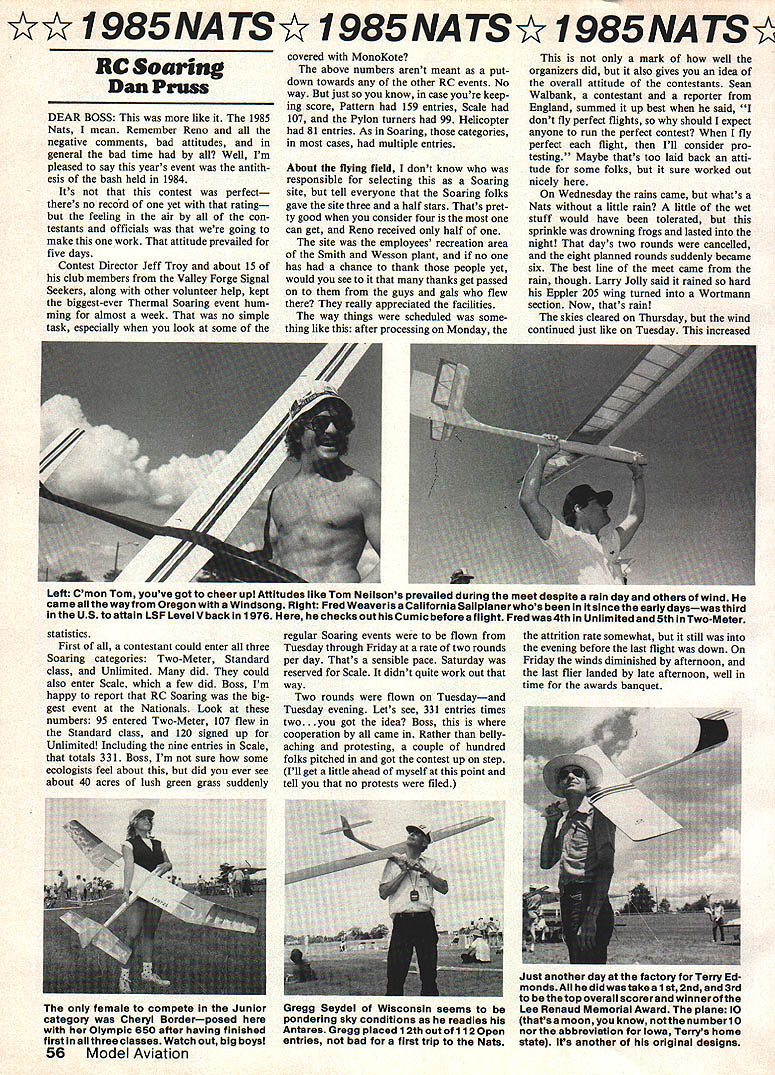
Heimut Leike of Massachusetts flew a Two-Meter bird in all three classes, and he was on top in two of the classes at the end of Round Four. The sailplane featured an autopilot that Maynard Hill came up with about a dozen years ago. Leike took a 3rd, 4th, and 2nd in Two-Meter, Standard, and Unlimited classes—plus about 80 gazillion LSF points.
The only guy to outpoint Leike in all three classes — and it took a 2nd, 3rd and 1st to do it — was Terry Edmonds of Iowa. That earned Terry the Lee Renaud Memorial Trophy. This is the first year for that award, and it will be given at subsequent Nats for the highest overall score.
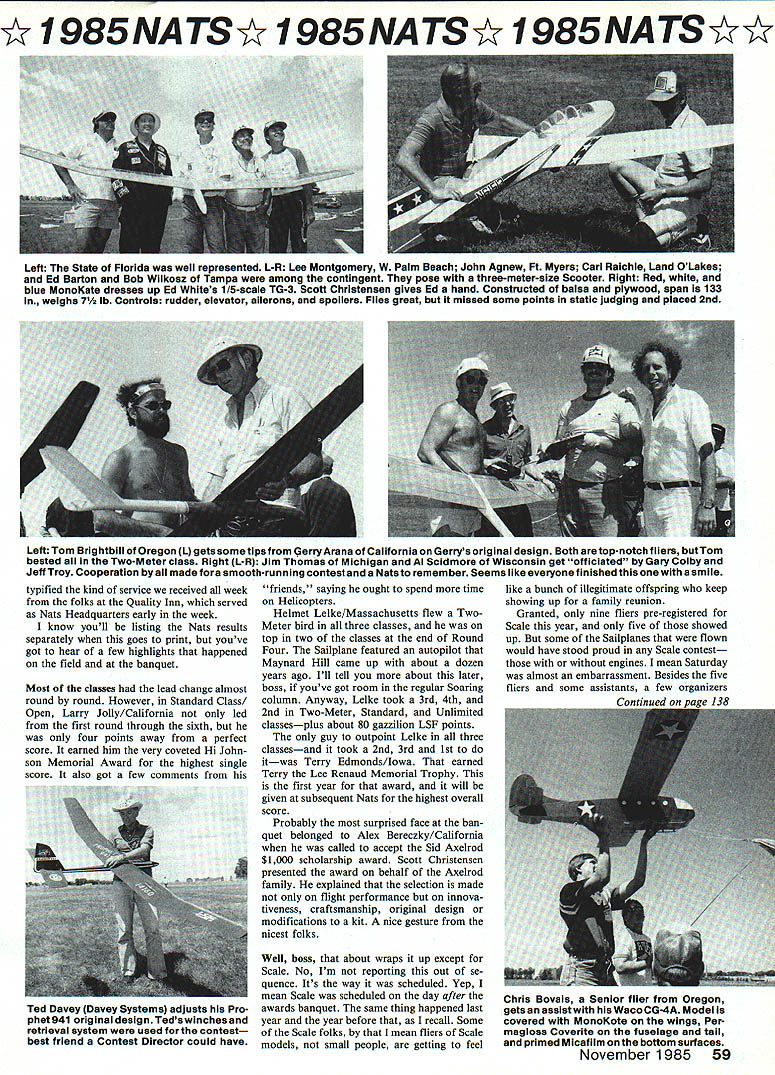
Probably the most surprised face at the banquet belonged to Alex Berezcky of California when he was called to accept the Sid Axelrod $1,000 scholarship award. Scott Christensen presented the award on behalf of the Axelrod family. He explained that the selection is made not only on flight performance but on innovativeness, craftsmanship, original design or modifications to a kit. A nice gesture from the nicest folks.
Scale
Well, boss, that about wraps it up except for Scale. No, I'm not reporting this out of sequence. It's the way it was scheduled. Yep, I mean Scale was scheduled on the day after the awards banquet. The same thing happened last year and the year before that, as I recall. Some of the Scale folks, by that I mean fliers of Scale models, not small people, are getting to feel like a bunch of illegitimate offspring who keep showing up for a family reunion.
Granted, only nine fliers pre-registered for Scale this year, and only five of those showed up. But some of the sailplanes that were flown would have stood proud in any Scale contest — those with or without engines. In one sense Saturday was almost an embarrassment.
Transcribed from original scans by AI. Minor OCR errors may remain.

