
ICARUS
Joel Rieman
A serious contender to win the long-standing $87,000 prize for the first man-powered craft to achieve the specified task, is this unique California-built craft.
role in the creation of the aircraft, putting nearly 600 hours and some good ideas into the construction. These two ingenious aviators hope to become the first to accomplish an unassisted man-powered flight in the United States; and if all goes well, make an attempt at the Kremer prize for man-powered flight being offered in England through the Royal Aeronautical Society.
Henry Kremer, a British industrialist, first offered the £5,000 prize in 1959, but at that time it could only be won by citizens of the British Commonwealth. This explains why the British have had the greatest success with MPAs. Today the Kremer prize stands at £50,000, approximately $87,000 in U.S. money (this depends on (this depends on the current value of the English pound.) Rules stipulate an unassisted man-powered takeoff and flight in a figure-eight course around pylons one-half mile apart at an altitude of ten feet, start to finish.
With its superb dimensions — including a huge stabilizer — Icarus should make a fine flying scale model. A drawback would seem to be the lack of dihedral; scale modelers, gluttons for punishment, would probably overlook this minor detail. The fuselage of the full-size aircraft, as well as a model, acts as a forward vertical fin and tends to keep the aircraft from overbanking; some dihedral would help, but Icarus nevertheless has a striking resemblance to man-powered aircraft yet built and is, in many respects, uniquely different.
The most obvious difference is its low-lying wing, designed to fly in ground effect. Theoretically, after the aircraft crosses the prescribed start height of ten feet, the low wing should exploit ground-effect benefits.
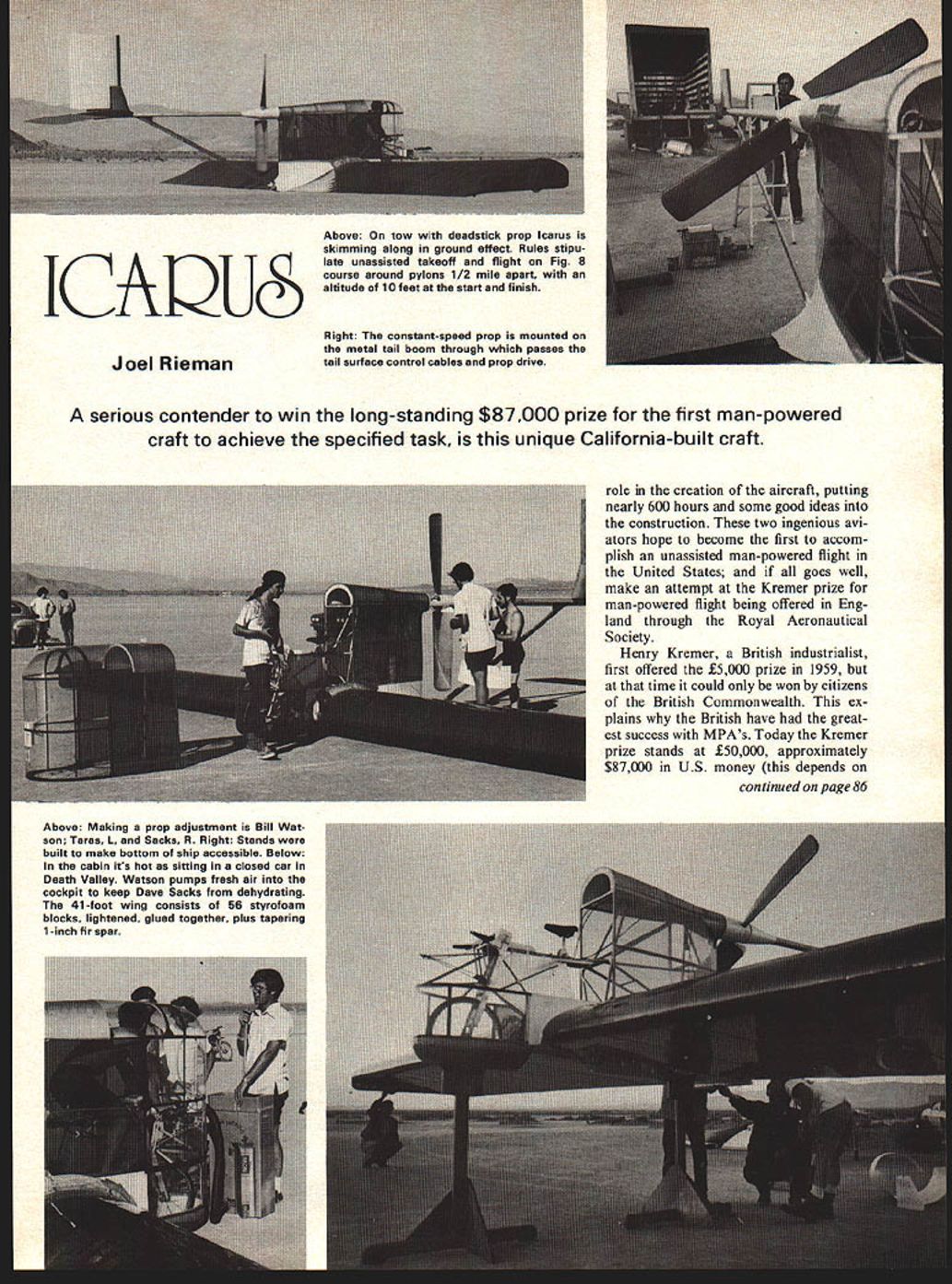
Joel Rieman and Taras Kiceniuk, with Bill Watson handling much of the flying, have put nearly 600 hours and some good ideas into the construction. On tow tests at El Mirage dry lake the Icarus was towed on a deadstick prop at about 20 mph; the ship will cruise at roughly a 3-foot altitude and is designed to skid around turns rather than bank — hence no ailerons.
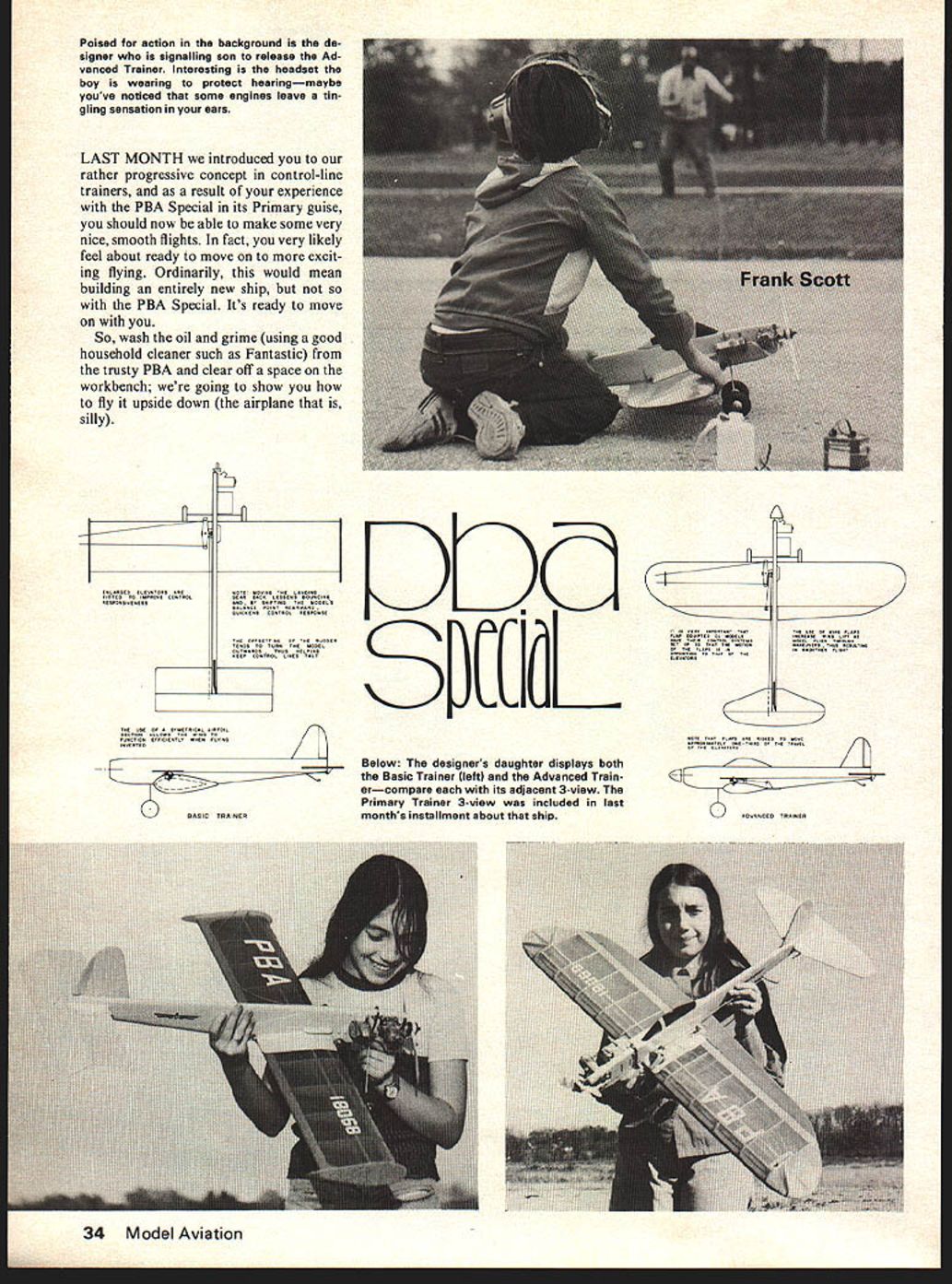
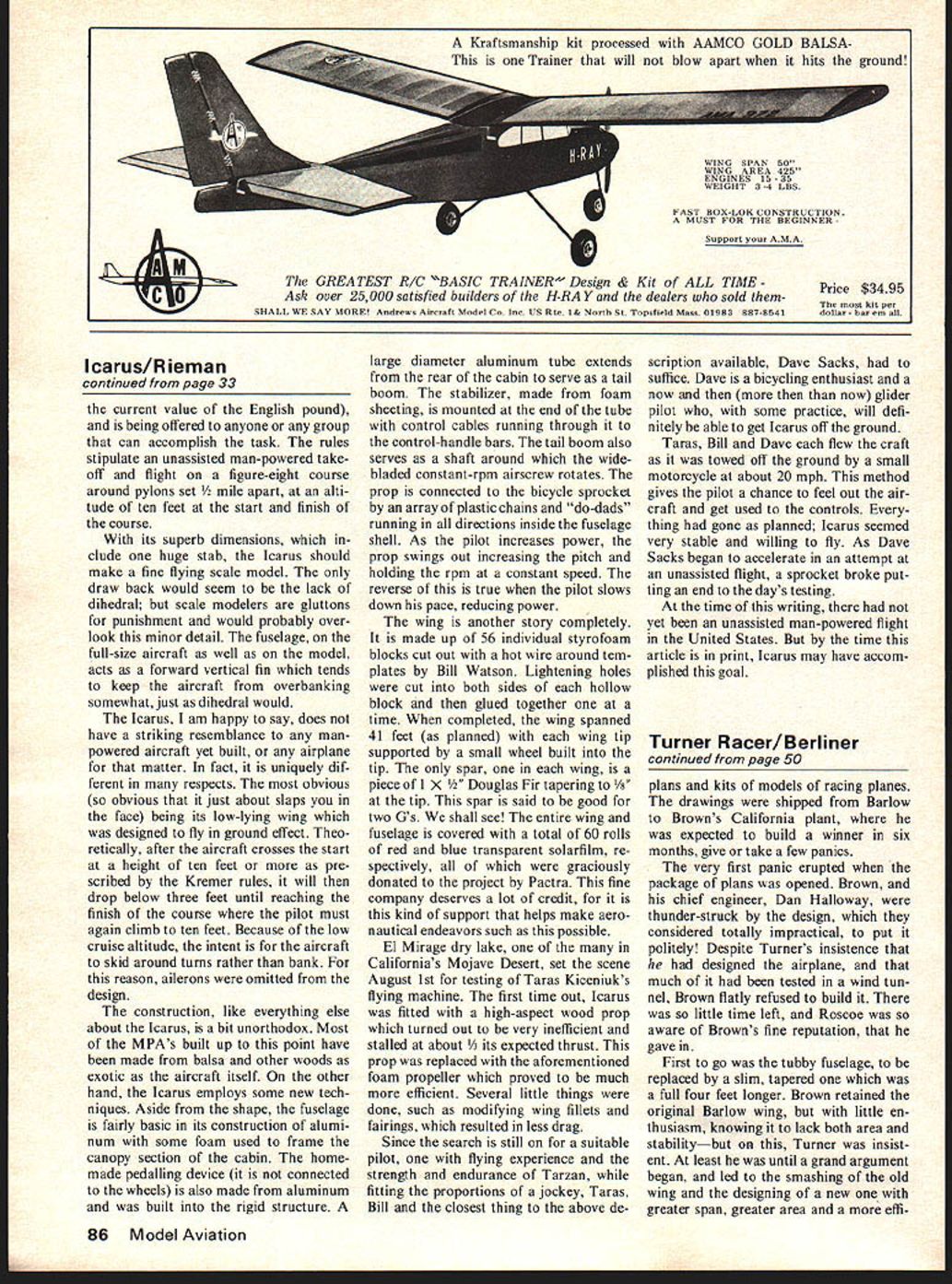
The 41-foot wing consists of 56 styrofoam blocks, lightened and glued together, with a tapering 1-inch fir spar. A constant-speed prop is mounted on a metal tailboom which also carries tail-surface control cables and the prop drive. Cockpit ventilation can be a problem in the closed cabin; during tests Watson has used auxiliary pumping to keep the pilot from dehydrating.
If the Icarus can meet the Kremer rules in an unassisted flight, it will be a serious contender for the prize. the current value of the English pound), and is being offered to anyone or any group that can accomplish the task. The rules stipulate an unassisted man-powered take-off and flight on a figure-eight course around pylons set 1/2 mile apart, at an altitude of ten feet at the start and finish of the course.
With its superb dimensions, which include one huge stab, the Icarus should make a fine flying scale model. The only drawback would seem to be the lack of dihedral; but scale modelers are gluttons for punishment and would probably overlook this minor detail. The fuselage, on the full-size aircraft as well as on the model, acts as a forward vertical fin which tends to keep the aircraft from overbanking somewhat, just as dihedral would.
The Icarus, I am happy to say, does not have a striking resemblance to any man-powered aircraft yet built, or any airplane for that matter. In fact, it is uniquely different in many respects. The most obvious (so obvious that it just about slaps you in the face) being its low-lying wing which was designed to fly in ground effect. Theoretically, after the aircraft crosses the start at a height of ten feet or more as prescribed by the Kremer rules, it will then drop below three feet until reaching the finish of the course where the pilot must again climb to ten feet. Because of the low cruise altitude, the intent is for the aircraft to skid around turns rather than bank. For this reason, ailerons were omitted from the design.
The construction, like everything else about the Icarus, is a bit unorthodox. Most of the MPA's built up to this point have been made from balsa and other woods as exotic as the aircraft itself. On the other hand, the Icarus employs some new techniques. Aside from the shape, the fuselage is fairly basic in its construction of aluminum with some foam used to frame the canopy section of the cabin. The homemade pedalling device (it is not connected to the wheels) is also made from aluminum and was built into the rigid structure. A large diameter aluminum tube extends from the rear of the cabin to serve as a tail boom. The stabilizer, made from foam sheeting, is mounted at the end of the tube with control cables running through it to the control-handle bars. The tail boom also serves as a shaft around which the wide-bladed constant-rpm airscrew rotates. The prop is connected to the bicycle sprocket by an array of plastic chains and "do-dads" running in all directions inside the fuselage shell. As the pilot increases power, the prop swings out increasing the pitch and holding the rpm at a constant speed. The reverse of this is true when the pilot slows down his pace, reducing power.
The wing is another story completely. It is made up of 56 individual styrofoam blocks cut out with a hot wire and templates by Bill Watson. Lightening holes were cut into both sides of each hollow block and then glued together one at a time. When completed, the wing spanned 41 feet (as planned) with each wing tip supported by a small wheel built into the tip. The only spar, one in each wing, is a piece of 1 x 1/2" Douglas Fir tapering to 1/8" at the tip. This spar is said to be good for two G's. We shall see! The entire wing and fuselage is covered with a total of 60 rolls of red and blue transparent Solarfilm, respectively, all of which were graciously donated to the project by Pactra. This fine company deserves a lot of credit, for it is this kind of support that helps make aeronautical endeavors such as this possible.
El Mirage dry lake, one of the many in California's Mojave Desert, set the scene August 1st for testing of Taras Kiceniuk's flying machine. The first time out, Icarus was fitted with a high-aspect wood prop which turned out to be very inefficient and stalled at about 1/3 its expected thrust. This prop was replaced with the aforementioned foam propeller which proved to be much more efficient. Several little things were done, such as modifying wing fillets and fairings, which resulted in less drag.
Since the search is still on for a suitable pilot, one with flying experience and the strength and endurance of Tarzan, while fitting the proportions of a jockey, Taras, Bill and the closest thing to the above description available, Dave Sacks, had to suffice. Dave is a bicycling enthusiast and a now and then (more then than now) glider pilot who, with some practice, will definitely be able to get Icarus off the ground.
Taras, Bill and Dave each flew the craft as it was towed off the ground by a small motorcycle at about 20 mph. This method gives the pilot a chance to feel out the aircraft and get used to the controls. Everything had gone as planned; Icarus seemed very stable and willing to fly. As Dave Sacks began to accelerate in an attempt at an unassisted flight, a sprocket broke putting an end to the day's testing.
At the time of this writing, there had not yet been an unassisted man-powered flight in the United States. But by the time this article is in print, Icarus may have accomplished this goal.
Transcribed from original scans by AI. Minor OCR errors may remain.

