
IE-30 DEVELOPMENT
Charles Lindley
Chronology of a Southern California group's experiments with a new Indoor class
Sept. 22, 1996
I just got back from one of the biggest kicks of my not-so-young life: putting an Indoor Electric Free Flight model into the top girders of the Santa Ana (California) blimp hangar and watching it fly for almost ten minutes! I hoped I could nail down the first ten-minute flight, but came up twelve seconds short on my best effort.
I hadn't been in that hangar since the 1963 Nationals. It must have grown in the last 30 years; it couldn't have been this big the last time I saw it! It's 158 feet high at the center rafters, and more than a quarter mile long. I knew that the Indoor Electric (IE-30) I'd been flying under a 26-foot ceiling needed a lot more height.
When Ken Johnson offered to get me into Santa Ana so we could find out what Indoor Electrics could do, I grabbed the opportunity. Looking up, I began to doubt that I really needed all that room—I probably would look a little silly even trying. At least I'd find out what an all-out Electric Indoor Duration model could do!
Tony Naccarato and I have had many bull sessions about what times could be made under his experimental IE-30 rules:
- Two 50 mAh Ni-Cd batteries
- 30-inch span
- Six-inch chord limit
- 50% stabilizer (stab)
(Who knows what you could get with lithium batteries? They are not rechargeable, and an $8 battery for each flight doesn't seem like sport flying.)
Early in the game, Tony was guessing we could do at least 12 minutes, and I thought maybe more like eight. As he, Bill Young and I built and tested over a couple of years, we've been homing in on ten minutes.
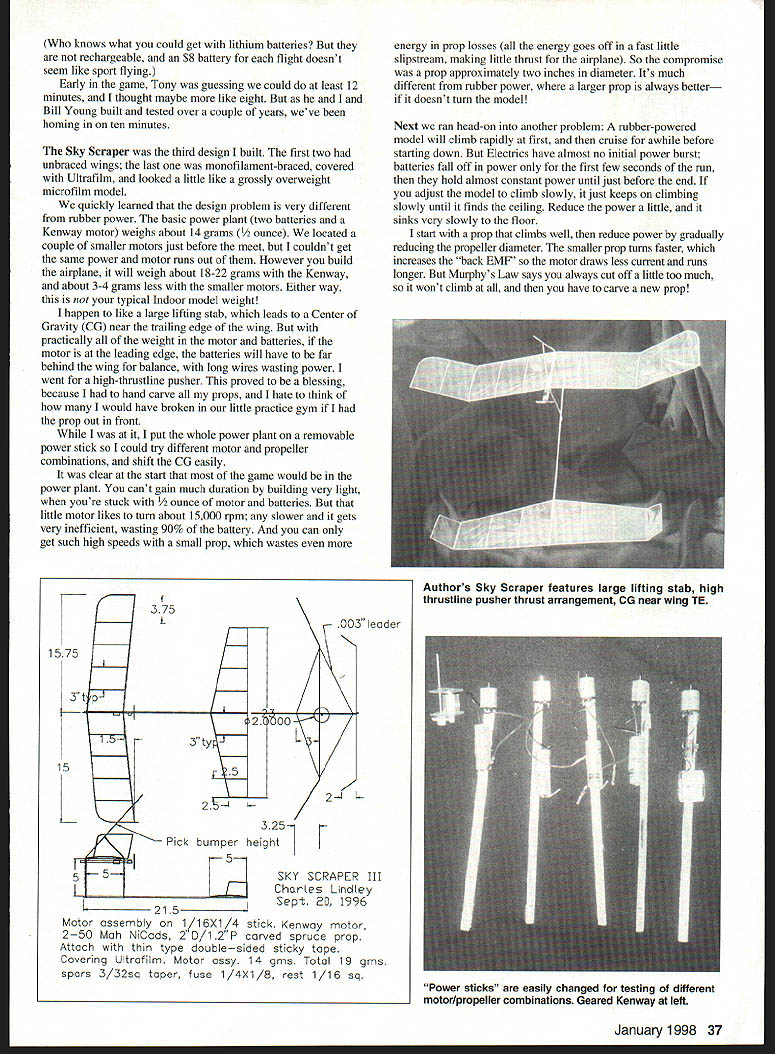
The Sky Scraper was the third design I built. The first two had unbraced wings; the last one was monofilament-braced, covered with Ultrafilm, and looked a little like a grossly overweight micro model.
We quickly learned that the design problem is very different from rubber power. The basic power plant (two batteries and a Kenway motor) weighs about 14 grams (half ounce). We located a couple of smaller motors just before the meet, but I couldn't get the same power and motor runs from them. However you build the airplane, it will weigh about 18–22 grams with the Kenway, and about 3–4 grams less with the smaller motors. Either way, this is not your typical indoor-model weight!
I happen to like a large lifting stabilizer, which leads to a center of gravity (CG) near the trailing edge of the wing. But with practically all of the weight in the motor and batteries, if the motor is at the leading edge the batteries will have to be far behind the wing for balance, with long wires wasting power. I went for a high-thrustline pusher. This proved to be a blessing because I had to hand-carve all my props, and I hate to think how many I would have broken in our little practice gym if I had the prop out in front.
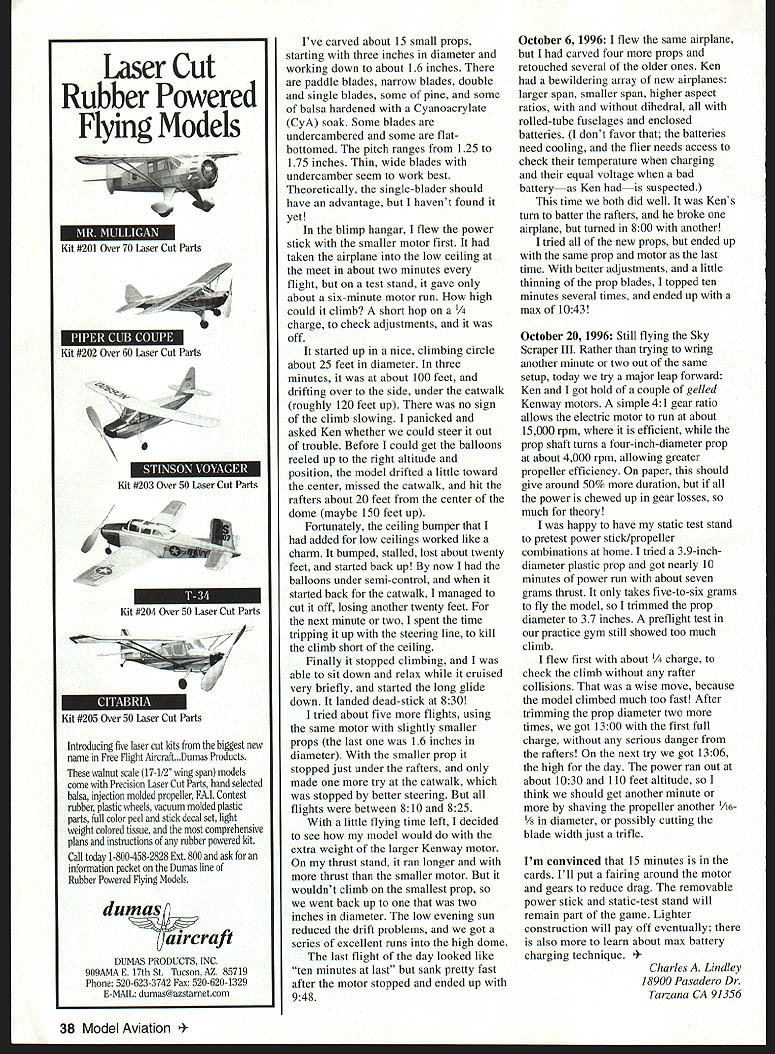
While I was at it, I put the whole power plant on a removable power stick so I could try different motor and propeller combinations and shift the CG easily.
It was clear at the start that most of the game would be in the power plant. You can't gain much duration by building very light when you're stuck with a half-ounce of motor and batteries. That little motor likes to turn about 15,000 rpm; any slower and it gets very inefficient, wasting 90% of the battery. And you can only get such high speeds with a small prop, which wastes even more energy in prop losses (all the energy goes off in a fast little slipstream, making little thrust for the airplane). So the compromise was a prop approximately two inches in diameter. It's much different from rubber power, where a larger prop is always better—if it doesn't stall the model!
Next we ran head-on into another problem: a rubber-powered model will climb rapidly at first and then cruise for a while before starting down. Electrics have almost no initial power burst; batteries fall off in power only for the first few seconds of the run, then they hold almost constant power until just before the end. If you adjust the model to climb slowly, it just keeps on climbing slowly until it finds the ceiling. Reduce the power a little, and it sinks very slowly to the floor.
I start with a prop that climbs well, then reduce power by gradually reducing the propeller diameter. The smaller prop turns faster, which increases the back EMF so the motor draws less current and runs longer. But Murphy's Law says you always cut off a little too much, so it won't climb at all, and then you have to carve a new prop!
I've carved about 15 small props, starting with three inches in diameter and working down to about 1.6 inches. There are paddle blades, narrow blades, double and single blades, some of pine and some of balsa hardened with a cyanoacrylate (CyA) soak. Some blades are undercambered and some are flat-bottomed. The pitch ranges from 1.25 to 1.75 inches. Thin, wide blades with undercamber seem to work best. Theoretically, the single-blader should have an advantage, but I haven't found it yet.
In the blimp hangar I flew the power stick with the smaller motor first. It had taken the airplane into the low ceiling at the meet in about two minutes every flight, but on a test stand it gave only about a six-minute motor run. How high could it climb? A short hop on a quarter charge to check adjustments, and it was off.
It started up in a nice, climbing circle about 25 feet in diameter. In three minutes it was at about 100 feet, and drifting over to the side under the catwalk (roughly 120 feet up). There was no sign of the climb slowing. I panicked and asked Ken whether we could steer it out of trouble. Before I could get the balloons reeled up to the right altitude and position, the model drifted a little toward the center, missed the catwalk, and hit the rafters about 20 feet from the center of the dome (maybe 150 feet up).
Fortunately, the ceiling bumper that I had added for low ceilings worked like a charm. It bumped, stalled, lost about twenty feet, and started back up! By now I had the balloons under semi-control, and when it started back for the catwalk I managed to cut it off, losing another twenty feet. For the next minute or two, I spent the time tripping it up with the steering line to kill the climb short of the ceiling.
Finally it stopped climbing, and I was able to sit down and relax while it cruised very briefly and started the long glide down. It landed dead-stick at 8:30!
I tried about five more flights, using the same motor with slightly smaller props (the last one was 1.6 inches in diameter). With the smaller prop it stopped just under the rafters and only made one more try at the catwalk, which was stopped by better steering. All flights were between 8:10 and 8:25.
With a little flying time left, I decided to see how my model would do with the extra weight of the larger Kenway motor. On my thrust stand it ran longer and had more thrust than the smaller motor, but it wouldn't climb on the smallest prop, so we went back up to one that was two inches in diameter. The low evening sun reduced the drift problems, and we got a series of excellent runs into the high dome. The last flight of the day looked like "ten minutes at last" but sank pretty fast after the motor stopped and ended up with 9:48.
Oct. 6, 1996
I flew the same airplane, but I had carved four more props and retouched several of the older ones. Ken had a bewildering array of new airplanes: larger span, smaller spars, higher aspect ratios, with and without dihedral, all with rolled-tube fuselages and enclosed batteries. I don't favor enclosed batteries; they need cooling, and the flier needs access to check their temperature when charging and their equal voltage when a bad battery—as Ken had—is suspected.
This time we both did well. It was Ken's turn to batter the rafters; he broke one airplane but turned in 8:00 with another! I tried all of the new props but ended up with the same prop and motor as the last time. With better adjustments and a little thinning of the prop blades, I topped ten minutes several times and ended up with a max of 10:43!
Oct. 20, 1996
Still flying the Sky Scraper III. Rather than try to wring another minute or two out of the same setup, today we tried a major leap forward: Ken and I got hold of a couple of gelled Kenway motors. A simple 4:1 gear ratio allows the electric motor to run at about 15,000 rpm, where it is efficient, while the prop shaft turns at about 3,750 rpm, allowing greater propeller efficiency. On paper, this should give around 50% more duration, but if all the power is chewed up in gear losses, so much for theory!
I was happy to have my static test stand to pretest power stick/propeller combinations at home. I tried a 3.9-inch-diameter plastic prop and got nearly 10 minutes of motor run with about seven grams thrust. It only takes five-to-six grams to fly the model, so I trimmed the prop until the diameter was reduced to 3.7 inches. A preflight test in our practice gym still showed too much climb.
I flew first with about a quarter charge to check the climb without any after collisions. That was a wise move, because the model climbed much too fast! After trimming the prop diameter two more times, we got 13:00 with the first full charge, with no serious danger from the rafters. On the next try we got 13:06, the high for the day. The power ran out at about 10:30–11:00 feet altitude, so I think we should get another minute or more by shaving the propeller another 1/16–1/8 inch in diameter, or possibly cutting the blade width just a trifle.
I'm convinced that 15 minutes is in the cards. I'll put a fairing around the motor and gears to reduce drag. The removable power stick and static-test stand will remain part of the game. Lighter construction will pay off eventually; there is also more to learn about maximum battery charging technique.
Charles A. Lindley 18900 Pasedero Dr. Tarzana, CA 91356
Transcribed from original scans by AI. Minor OCR errors may remain.

