
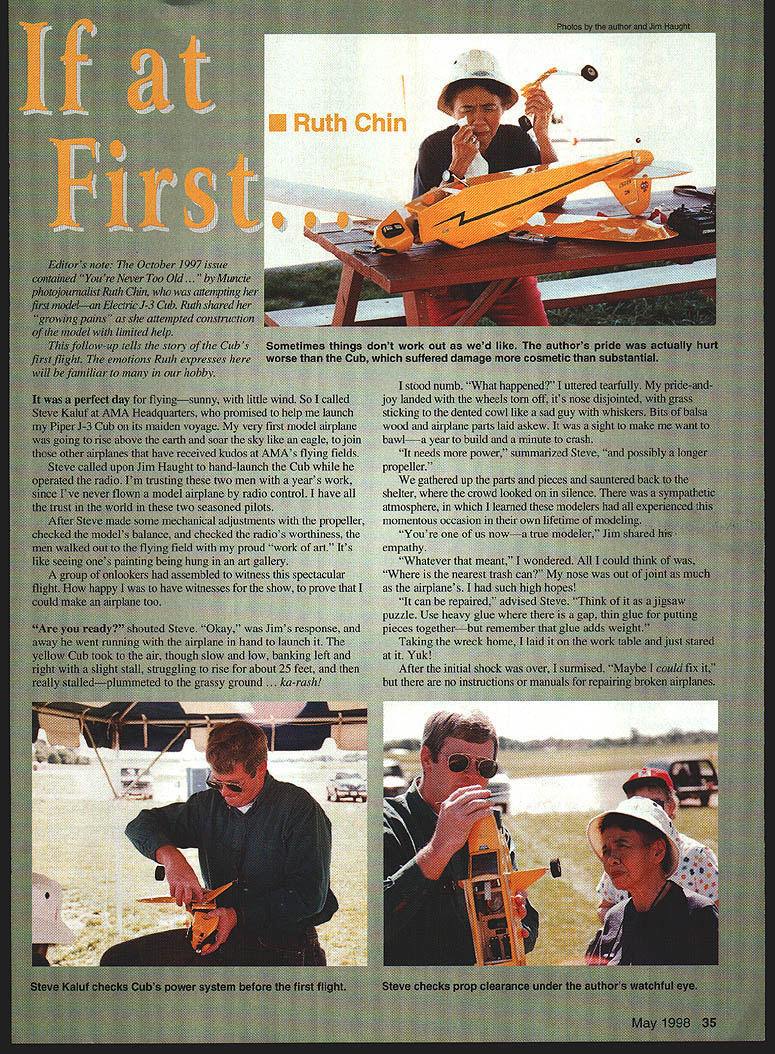
If at First...
Ruth Chin
Editor's note
The October 1987 issue contained "You're Never Too Old..." by Muncie photojournalist Ruth Chin, who was attempting her first model—an Electric J-3 Cub. Ruth shared her "growing pains" as she attempted construction of the model with limited help. This follow-up tells the story of the Cub's first flight. The emotions Ruth expresses here will be familiar to many in our hobby.
The maiden flight
It was a perfect day for flying—sunny, with little wind. I called Steve Kaluf at AMA Headquarters, who promised to help me launch my Piper J-3 Cub on its maiden voyage. My very first model airplane was going to rise above the earth and soar like an eagle, to join those other airplanes that have received kudos at AMA's flying fields.
Steve called upon Jim Haught to hand-launch the Cub while he operated the radio. I was trusting these two men with a year's work, since I'd never flown a model airplane by radio control. I had all the trust in the world in these two seasoned pilots.
After Steve made some mechanical adjustments with the propeller, checked the model's balance, and checked the radio, the men walked out to the flying field with my proud "work of art." It felt like seeing one's painting hung in an art gallery. A group of onlookers had assembled to witness this spectacular flight. How happy I was to have witnesses for the show, to prove that I could make an airplane too.
"Are you ready?" shouted Steve. "Okay," was Jim's response, and away they went running with the airplane in hand to launch it. The yellow Cub took to the air—slow and low—banking left and right with a slight stall, struggling to rise about 25 feet, and then really stalled—plummeted to the grassy ground... ka-rash!
I stood numb. "What happened?" I uttered tearfully. My pride and joy landed with the wheels off, its nose dented with grass sticking to the dented cowl like a sad man with whiskers. Bits of balsa wood and airplane parts lay askew. It was a sight to make me want to bawl—a year to build and a minute to crash.
"It needs more power," summarized Steve, "and possibly a longer propeller."
We gathered up the parts and sauntered back to the shelter, where the crowd looked on in silence. There was a sympathetic atmosphere; I learned these modelers had all experienced this moment in their own modeling lives.
"You're one of us now—a true modeler," Jim shared. Whatever that meant, all I could think of was, "Where is the nearest trash can?" My nose was as out of joint as the airplane's. I had such high hopes!
Repairing the Cub
"It can be repaired," advised Steve. "Think of it as a jigsaw puzzle. Use heavy glue where there is a gap, thin glue for putting pieces together—but remember that glue adds weight."
Taking the wreck home, I laid it on the workbench and just stared at it. Yuck! After the initial shock, I thought, "Maybe I could fix it," but there are no instructions or manuals for repairing broken airplanes.
I dug out the original plans and instruction manual and studied them again. Looking at the plans brought another tear. The airplane was so new to me when I first started to put it together—mysterious and much fun. Repairing a wreck wasn't as much fun.
First I removed the hardware so I wouldn't damage anything while gluing bits and pieces together. No sense asking for more trouble. I started gluing what I could after checking to see if I had acetone or fingernail polish remover, just in case the cyanoacrylate (CA) glue got on my fingers as it had the first time. Of course, somehow glue got under my large ring, gluing it to my finger and the two fingers next to it. I dunked the fingers in a can of acetone and finally got unstuck—along with the black design on the ring. Oh, well!
Some pieces didn't meet neatly after gluing; some had lost splinters of balsa. Steve had suggested using thick glue to fill cracks, but that would add weight—so I duplicated pieces since I had saved scrap material, as the instructions recommended. Weeks went by and the airplane looked pretty good after piecing it back together. It wasn't nearly as bad a job as I'd first thought—because now I was experienced.
However, the covering was in a sad state—torn. Could it be patched? Would it look neat? I fought with the decision to tear off the covering down to the bare wood. If I removed it I could sand rough places and do a better job. It would be the third time this airplane had been covered. (The first time I forgot to remove the backing from the Monokote and bubbles appeared—after rereading the instructions I found my mistake.)
Making the decision to remove the covering was monumental. If I took it off, maybe I could do a better job. What about the logo lettering? Would I be able to duplicate it? Maybe—just maybe—it would peel off. Yep, it did. So now what? Waiting? Oh heck—why wait? Rrrriippp! Back at the hobby store I explained what had happened and bought some Piper Cub yellow covering and a bit of glue.
Recovering the airplane wasn't nearly as much hassle the second time, partly because I was experienced and partly because of the materials. I used the tacking iron more than the heat blower; the iron seemed to tighten the covering more smoothly.
Putting the hardware back, checking batteries and motor, inspecting the radio wiring, and reconnecting pushrods to rudder and elevators took patience. Replacing the antenna was as much a challenge as the first time. I learned that if you don't succeed at a job, leave it alone and go back to it later.
Even replacing the lettering peeled from the old covering was a snap compared to the first time.
After the airplane was together again, I recharged the battery and tested the radio—the pushrods responded. Now—Contact! Switch on! Clear! Oops—the motor didn't turn. Time to go through the instructions again. Lo and behold: the fuse had blown in the crash and I hadn't replaced it. I put in a new one, turned the motor switch, and—knock on wood—luck held; I held my breath, blinked—and it worked!
Now, does it fly? We'll soon see.
Tips learned
- Use thick glue to fill gaps and thin glue for joins, but remember glue adds weight.
- Save scrap material to duplicate damaged parts rather than overbuilding with heavy glue.
- Keep acetone or nail-polish remover handy when using CA glue, but be careful—it can damage finishes and jewelry.
- If covering bubbles appear, review the covering instructions before reapplying.
- Patience helps—if you get stuck, step away and return later.
Whoever said "If at first you don't succeed, try, try again" must have had me in mind.
Ruth Chin 1007 N. Tillotson Ave. Muncie, IN 47304
Transcribed from original scans by AI. Minor OCR errors may remain.

