
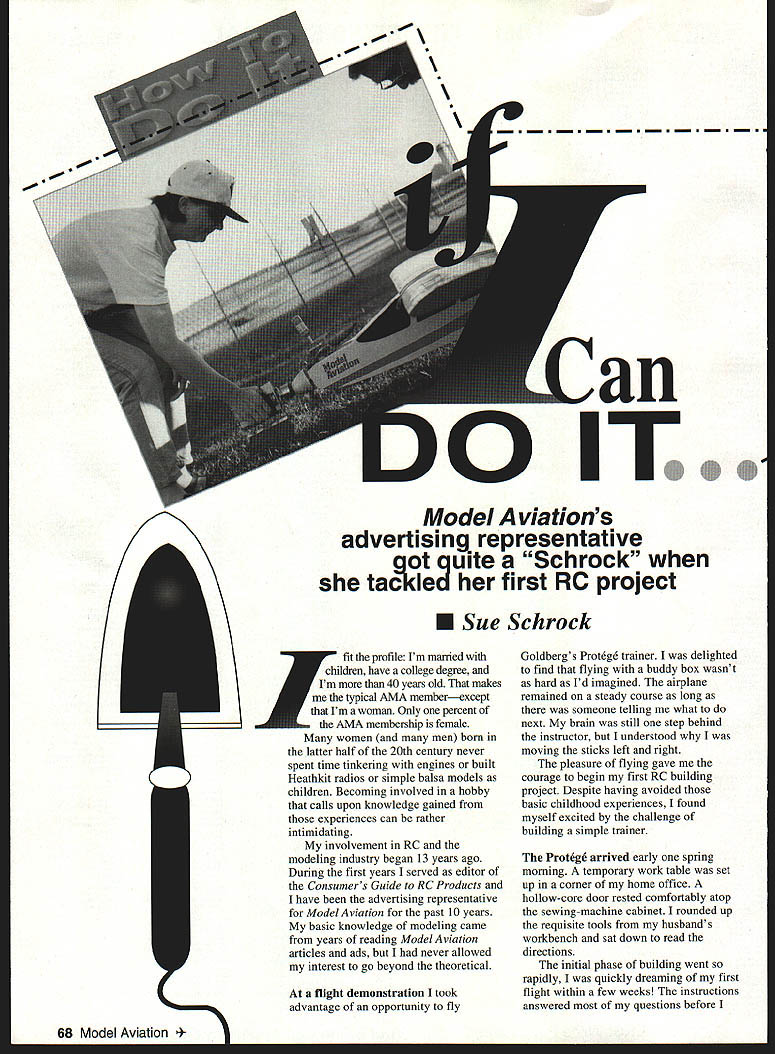
If I Can Do It
By Sue Schrock
I fit the profile: I'm married with children, have a college degree, and I'm more than 40 years old. That makes me the typical AMA member—except that I'm a woman. Only one percent of the AMA membership is female.
Many women (and many men) born in the latter half of the 20th century never spent time tinkering with engines, building Heathkit radios, or constructing simple balsa models as children. Becoming involved in a hobby that calls upon knowledge gained from those experiences can be rather intimidating.
Background
My involvement in RC and the modeling industry began 13 years ago. During the first years I served as editor of the Consumer's Guide to RC Products, and I have been the advertising representative for Model Aviation for the past 10 years. My basic knowledge of modeling came from years of reading Model Aviation articles and ads, but I had never allowed my interest to go beyond the theoretical.
At a flight demonstration I took advantage of an opportunity to fly Goldberg's Protégé trainer. I was delighted to find that flying with a buddy box wasn't as hard as I'd imagined. The airplane remained on a steady course as long as there was someone telling me what to do next. My brain was still one step behind the instructor, but I understood why I was moving the sticks left and right.
The pleasure of flying gave me the courage to begin my first RC building project. Despite having avoided those basic childhood experiences, I found myself excited by the challenge of building a simple trainer.
Building the Protégé
The Protégé arrived early one spring morning. I set up a temporary work table in a corner of my home office—a hollow-core door resting on the sewing-machine cabinet. I rounded up the requisite tools from my husband's workbench and sat down to read the directions.
The initial phase of building went so rapidly that I was quickly dreaming of my first flight within a few weeks. The instructions answered most of my questions before I could pick up the phone and ask modeling friends. Explanations of doublers and dihedral were a wonderful resource; experts existed just a phone call away.
I sanded the first trailing edge and, not content to stand aside completely dependent on Goldberg's manual, I was pleasantly surprised at how thoroughly the simplest tasks were explained for the novice builder. The local hobby shop became my resource; I quickly found myself making several trips in a 24-hour period to buy a hinge-slotting kit, glue, cyanoacrylate kicker, and other items.
I discovered I needed to order radio and servos before I could finish the wing and that I needed to decide on an engine before beginning the fuselage. The hobby shop did not stock the Futaba Sky Sport radio I had my eye on, and they had no .60 engines. Like a child anticipating Christmas, I waited while these necessities were mail-ordered.
Problems and Lessons
When the engine and radio arrived, I had my first lesson in how intimidating the whole RC experience can be. I thought I understood the basics of radio control, but the sophistication and options available—even in a basic radio such as the Sky Sport—brought the project to a screeching halt for a week. After carefully reading and rereading the instruction booklet, I called friends and asked questions about "modes" and "aileron extensions." I then carefully set up the mounts for the servos on my wing.
Drilling the holes for the engine mounts proved difficult; it had been ten years since I had held a power tool. The drill slipped while drilling one hole, but my husband helped adjust the holes for proper thrust line.
Work and a short vacation brought everything to a standstill after I finished filling and sanding the aircraft, and the prospect of covering the airplane caused another week-long delay. Covering wasn't as difficult as I had imagined; it simply required that I follow the UltraCote instructions. I complicated the project by refusing to follow the instructions when I covered the bottom of the wing—using one piece instead of the suggested two resulted in a few wrinkles around the wingtip. But I soon caught on to how easily the UltraCote goes on if you simply follow the directions.
A seemingly simple task—attaching the connector body to the throttle arm—turned out to be more complicated in practice. The connector body did not fit the throttle arm. Phone calls garnered all sorts of advice, and my husband and I agreed it didn't fit. I called Thunder Tiger and found out I needed to bore out the hole in the throttle arm.
The connector-body dilemma was my first indication that sometimes directions don't tell you every single step in a process. In a modeler's world you are expected to look ahead through the task at hand; if a part doesn't fit or doesn't work the way the manufacturer says, you will have to cut, bore, or sand it to make it fit.
Building the kit was easier than figuring out the hookup. I discovered that mounting the servos so they wouldn't bind, completing the final assembly so the tail and elevator would move freely, and installing the fuel tank, receiver, electric starter, and battery pack all required knowledge I hadn't acquired over the years.
I asked my dad, who is also a novice modeler, to take a look at my project. We joked that when I was young he never spent any time showing me how to drill holes and crimp wires. He initiated a crash course as he stood by me while I completed the final stages of finishing the model. More than once, I had to ask him to step aside and let me do the job myself.
I then realized that so much of the final phase of building required a basic knowledge of "the way things work." For example, the position of the hole in the firewall for the throttle pushrod needed to be aligned so that a simple bend in the end would allow direct, straight-line action between the servo arm and the throttle arm. Mechanical cause-and-effect relationships were never important to me before.
I spent a day nursing my slightly wounded ego while my dad's assistance helped me speed the project to completion. He was busy pointing out things I needed to think through before I drilled or glued something. Without his guidance, I would have spent weeks undoing mistakes. This was the time to concentrate on learning a few of those laws of physics I had finessed my way through in high school. Having come to that realization, my sense of accomplishment was diminished only slightly.
Joining the Club and First Flights
The next step was the hardest one to face: I was ready to take the airplane to the flying field, but I was uncertain whether I would be welcomed by the local club. I had never met any modelers from the area; now I had to ask a group of total strangers to assist me in learning to fly.
The Valley RC Flying Club was a very friendly group of people. One month after applying to join, and four days after being accepted as a member of the AMA-chartered club, I arrived at the field with more than a little anxiety.
The first comments I heard as I took my wing out of the van were, "You did that yourself?" and "Gee, will you cover my next plane?"
The airplane passed its preflight check with flying colors. Several screws on the engine and a servo connection or two were tightened. The rudder was reversed (and corrected), and someone questioned the amount of throw on the ailerons. The idle on the engine needed some fine tuning, but within an hour they pronounced the airplane ready for its test flight.
It took off smoothly and, with some minor adjustments to trim, settled into level, hands-off flight within a few minutes. I was delighted to see it was indeed airworthy.
After the pilot attempted a loop, the engine died. He landed the model smoothly, and upon retrieving the plane from the field discovered that the glow plug had dropped out—apparently the one thing we had not tightened.
After starting the engine and checking the idle one more time, I was ready to fly with a buddy box. Two tanks of fuel later, I was beginning to get the feel for turns and level flight, but still experienced orientation difficulty as the airplane came toward me. My instructor assured me this was typical of the first-time flier and that in no time at all I'd be taking that final turn with ease.
The elation and sense of accomplishment as I drove away from the field is something I will never forget. For some of us, that initial step into this hobby is very big!
Afterward
Now I'm beginning to forget how intimidating the prospect of building and flying an RC model was. I have plans to build that Bücker Jungmann, and I dream of executing lomcevaks and rolls—as soon as the weather improves!
Transcribed from original scans by AI. Minor OCR errors may remain.

