
If you're thinking about buying a "narrowband" RC radio, here's a few words of advice from AMA
Consider this if and when you need the kind of equipment required to operate in a crowded radio-control environment. Here's what to look for and why narrowband RC is what it will take to do the job.
Here's the basics of what's involved . . .
Even if you haven't kept up with the issues surrounding the changes in the radio-control environment, you're probably aware that there's lots of confusion and conflicting information about the new channels that have recently been added (the "even" channels, 14 through 34), plus the "odd" numbered channels that will be activated in the near future.
Most of all, you're probably concerned about the kinds of radios you may need for trouble-free flying in this new radio "climate."
Well, the best way to clear up the issue on what kind of radios may be needed is to tell you why you may need them. Let's start by filling you in on the 50-channel "spectrum."
Who needs 50 channels anyway?
Ever asked that question? Well, so have thousands of your fellow RCers.
Problem is, there's no simple answer to the question. Just to clear the record, however, we didn't accept all 50 channels just because we thought we'd need them to operate simultaneously—even at large contests or the busiest of our flying sites.
But hold on.
If that leads you to believe that fewer channels spaced further apart would cure your interference problems, you'd better think again.
The real reason for the 50-channel RC model aviation spectrum
Back when we applied for new channels that would be better separated from surface channels, we were offered all fifty of them on a kind of take-it-or-leave-it basis.
These exclusive channels were a definite improvement over what we had, because they weren't shared with any other users. On the other hand, they were still located in a pretty tough "neighborhood."
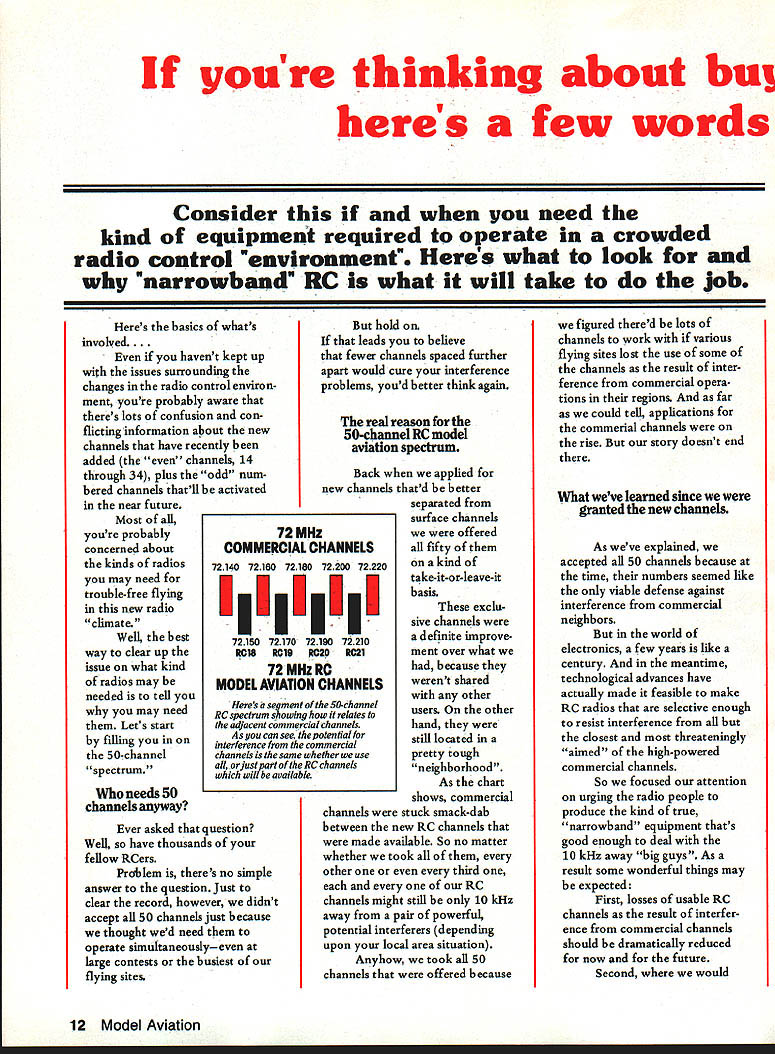
72 MHz COMMERCIAL CHANNELS 72.140 72.160 72.180 72.200 72.220
72 MHz RC MODEL AVIATION CHANNELS 72.150 RC18 72.170 RC19 72.190 RC20 72.210 RC21
Here's a segment of the 50-channel RC spectrum showing how it relates to the adjacent commercial channels. As you can see, the potential for interference from the commercial channels is the same for whichever RC channels are used, or just part of the RC channels which will be available.
As the chart shows, commercial channels were stuck smack-dab between the new RC channels that were made available. So no matter whether we took all of them, every other one, or even every third one, each and every one of our RC channels might still be only 10 kHz away from a pair of powerful potential interferers (depending upon your local area situation).
Anyhow, we took all 50 channels that were offered because we figured there'd be lots of channels to work with if various flying sites lost the use of some channels as the result of interference from commercial operations in their regions. And as far as we could tell, applications for the commercial channels were on the rise. But our story doesn't end there.
What we've learned since we were granted the new channels
As we've explained, we accepted all 50 channels because at the time, their numbers seemed like the only viable defense against interference from commercial neighbors.
But in the world of electronics, a few years is like a century. In the meantime, technological advances have actually made it feasible to make RC radios that are selective enough to resist interference from all but the closest and most threateningly aimed high-powered commercial channels.
So we focused our attention on urging the radio people to produce the kind of true narrowband equipment that's good enough to deal with the 10 kHz-away "big guys." As a result, some wonderful things may be expected:
- First, losses of usable RC channels as the result of interference from commercial channels should be dramatically reduced for now and for the future.
- Second, where we would be using only this kind of highly selective narrowband equipment, our concerns about flyer-to-flyer interference would virtually be eliminated.
- Plus, we'll have a smoother transition to the enhanced convenience that more channels can give us.
Four rules to follow when you shop for a narrowband radio
- Steer clear of radios advertised with vague "narrowband" or "1991" claims. Instead, look for specific claims that advertised receivers and transmitters meet or exceed all of the AMA Radio Guideline parameters for narrowband (20 kHz channel-separation) operation.
- Scan the modeling magazines for radio test reports that use actual lab measurements backed up by demanding field trials as the basis for their conclusions. Good reports should also include impressions of overall product quality.
- When purchasing a radio, make it clear to your dealer that you're only interested in considering equipment which meets or exceeds all AMA Radio Guideline values.
- When evaluating a radio, try to look beyond the bells and whistles. Satisfy yourself that the manufacturer's first priority was the same as yours: reliable performance derived from the use of high-quality components and exacting assembly.
The AMA Radio Guidelines for Transmitters and Receivers appear on page 34 of the AMA Radio Guideline pamphlet. Copies are available from AMA Headquarters upon request. The guidelines specify transmitter and receiver limits and should be consulted when evaluating equipment for use in club and contest flying environments. The AMA cannot accept responsibility for the performance of equipment that does not meet these guidelines.
Is it really practical to produce the kind of radios we need?
The answer is yes.
There are already some excellent units on the market, and with some encouragement, we're confident that the radio industry will soon provide a lot more to choose from.
Most experts agree that radios like we're talking about aren't that tough to design and produce. For openers, narrowband transmitters are a snap. While adequately interference-resistant receivers are a bit more difficult, they can be built without coming within a country mile of the leading edge of technology.
Best of all, these "radios for the future" don't have to cost an arm and a leg. We can buy excellent narrowband sport radios for little more than we're accustomed to spending for ordinary wideband equipment.
What you buy is up to you and your local situation
If you need narrowband, here's how to spot the real thing.
Minimal regulation of our hobby has permitted lots of misleading advertising to appear. Organizations like the AMA have been reluctant to publish test reports or product recommendations out of concern that we'd find ourselves up to our necks in lawsuits filed by offended users and product manufacturers.
So while it isn't fair to expect you to become an electronics expert, it's in your own best interest to at least become a better-educated consumer.
You can start raising your "radio I.Q." by studying the "Four rules" section that talks about how to shop for a narrowband radio. If you follow its suggestions, you'll definitely reduce any doubt about what to look for.
A few tips for interference-free flying in the meantime
- Don't operate RC transmitters on currently used channels unless they've been checked on a spectrum analyzer for compliance with AMA guideline minimums (-35 dB @ 20 kHz out), for use at 40 kHz channel spacing. These minimums will qualify a transmitter for an AMA "silver" sticker, which indicates AMA approval for its use on current channels 38–56. If — as the majority of recently manufactured units do — your transmitter meets AMA minimums for narrowband operation (-55 dB @ 20 kHz out), it'll qualify for an AMA "gold" sticker indicating AMA approval for its use on all "even" channels now and after the future activation of the "odd" channels.
To have your transmitter checked free of charge, take it to one of the major trade shows where this service is available. Otherwise, make inquiries via your radio's manufacturer or have it checked on a spectrum analyzer by an independent, authorized service station.
- If your club is fortunate enough to govern its flying site, make rules that prevent the use of unchecked transmitters, and make the rules as stringent as your club feels appropriate.
- If you aren't a member of an AMA-chartered club, join one. Chances are they'll have field-operation rules that are designed to minimize interference. Plus, you'll be tuned in to more information and activities.
- If you're in a club that hasn't regulated its site with flight-station spacing and/or other interference-prevention techniques, find out what other clubs are doing and adopt a system that suits your club's needs.
Transcribed from original scans by AI. Minor OCR errors may remain.

