
IMAA Fun-Fly Festival
WE'VE ALL HEARD the old saw, "Everyone talks about the weather, but no one ever does anything about it." We all talked about the weather at Ida Grove last year (who would believe it was cold in Iowa in August?), and apparently someone did something about it. Unfortunately, that someone overshot on the adjustment. This year it was hot, hot, HOT!
Weather and conditions
Except for the heat and a Saturday squall (mentioned later), the weather was great for flying. That heat — over 100° in the afternoons — affected engine and aircraft performance. Modelers, especially those from lower altitudes, got a practical lesson in the effects of heat and air density. The heat also thinned out the spectators at the flight area and the display booths.
The heat had a big effect on my photographs. With my sometimes erratic heart, I couldn't be out long in that kind of heat, so my wife Evelyn and I would get to the field early and leave just before noon, when the two-hour-plus full-scale flying activities started. That schedule let us see most of the model activity (which is what we came for), and then we holed up in the air-conditioned motel during the worst of the heat. Since the flight line was laid out north–south, with the pits and spectator area to the west, most of the time I was trying to take pictures into the sun — not the best of conditions — but I got a few shots I think are worth including here.
Crashes and incidents
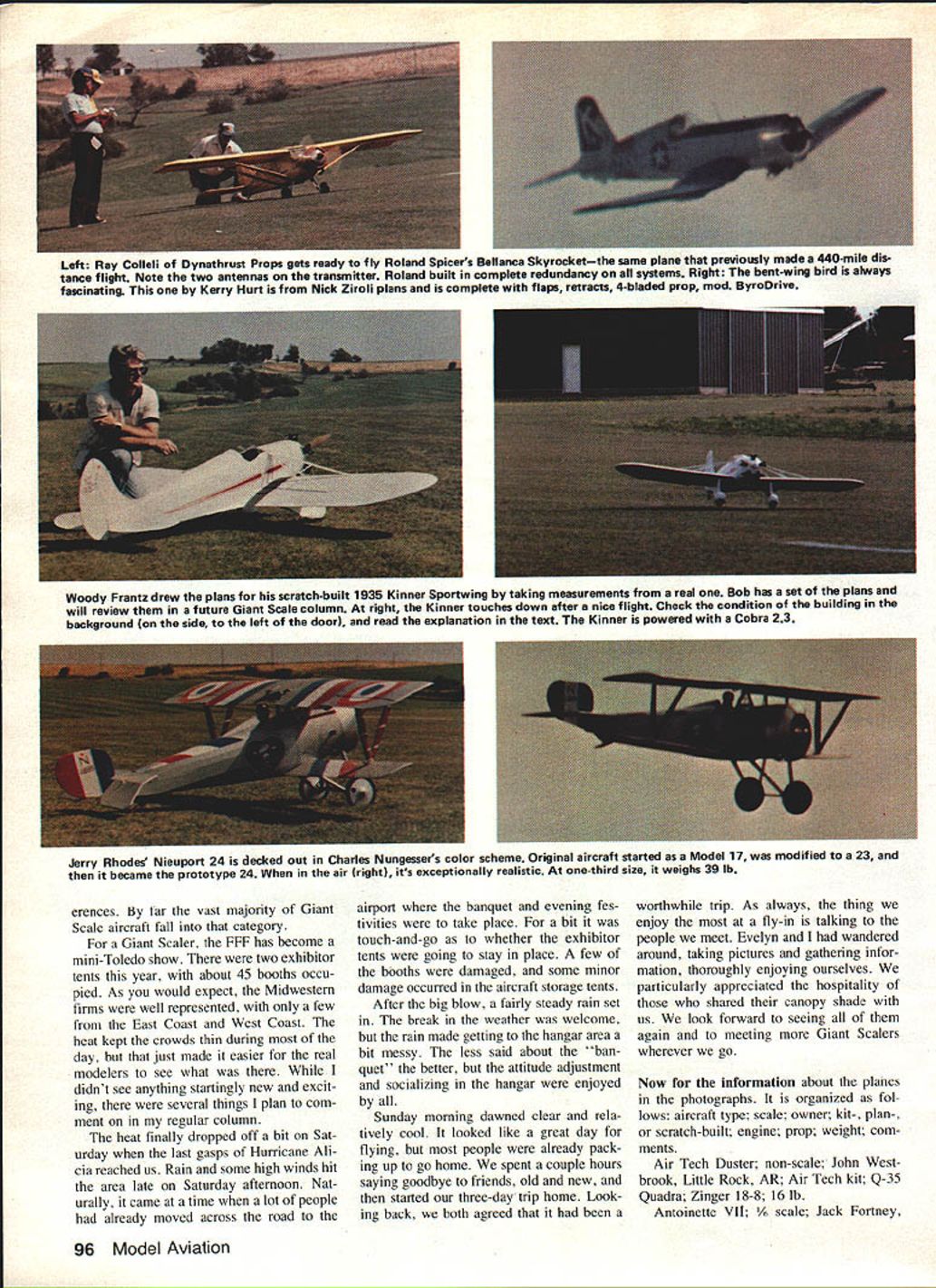
As a consequence of our schedule, we missed some of the more spectacular crashes (though I heard about them later). On second thought, that was probably just as well; I've never been particularly fond of crashes. I can't resist passing on the description of one of them, however. A Byron Mustang, during a demonstration flight, made a low pass and actually disappeared briefly where the ground drops away along the southeast edge of the runway. As the plane came into view again, it started a slow roll just a few feet off the ground. It seems the pilot was concentrating so hard on staying above the ground that he forgot to look ahead, and the plane flew full bore into a metal-sided equipment shed east of the field. My informant's description of the impact was: "All that foam turned into a cloud of little white pieces. It was just like hitting a chicken at about 60." A couple of pictures show the shed before and after. It's not surprising the plane disintegrated; under the circumstances, any construction type would have. It is noteworthy that the drive engine came through in good shape.
I don't want to give the impression there were a lot of crashes. For the number of planes and amount of flying, they were few and far between. The fact that most crashes happened when I wasn't there might be significant — remember, I wasn't there because it was the hottest time of day.
Attendance and facilities
Attendance this year was down a bit. The most reliable figure I could get was 331 registrants. I would estimate the total aircraft at 400 to 450. The facilities were great, and some aspects had been improved over last year. There were two overnight storage tents instead of one, so things weren't nearly as crowded. The layout of the pits and flight line was the same as last year; in my opinion the flight lines were unnecessarily close together, but things were managed well.
Most of the time there were several planes in the air, and the waiting in line to fly was no worse than you would expect for the number of participants. Members of the Omahawks and other local modelers who served as flight-line officials contributed greatly to the smooth operation. I heard a few comments about "over-regulation," but with that many fliers and models you have to have either regulation or chaos.
Exhibitors and vendors
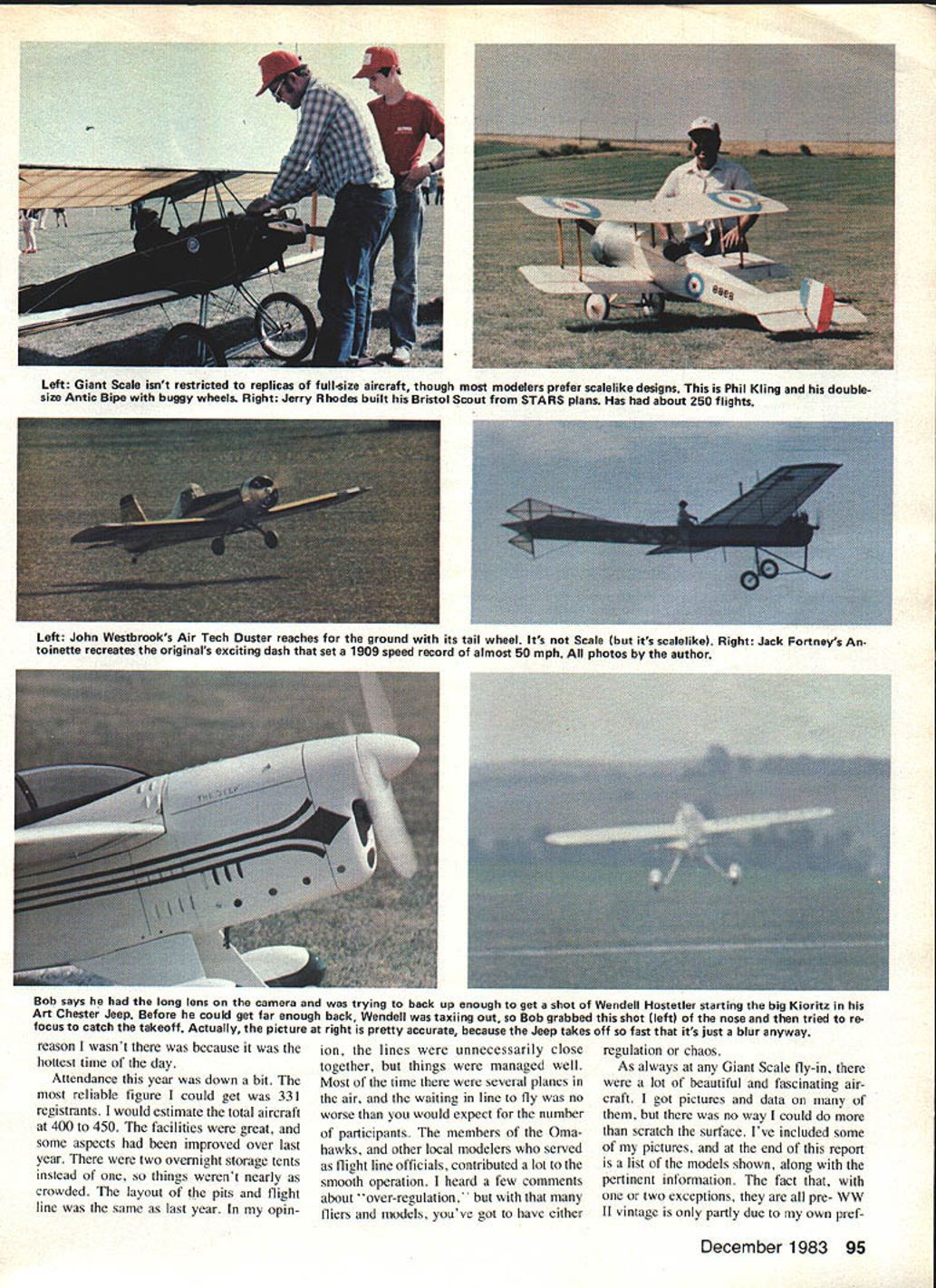
As always at any Giant Scale fly-in, there were a lot of beautiful and fascinating aircraft. I photographed many of them and collected data, but there was no way to do more than scratch the surface. I've included some pictures, and at the end of this report is a list of the models shown, along with pertinent information. The fact that, with one or two exceptions, they are all pre–World War I vintage is only partly due to my own preference — the vast majority of Giant Scale aircraft fall into that category.
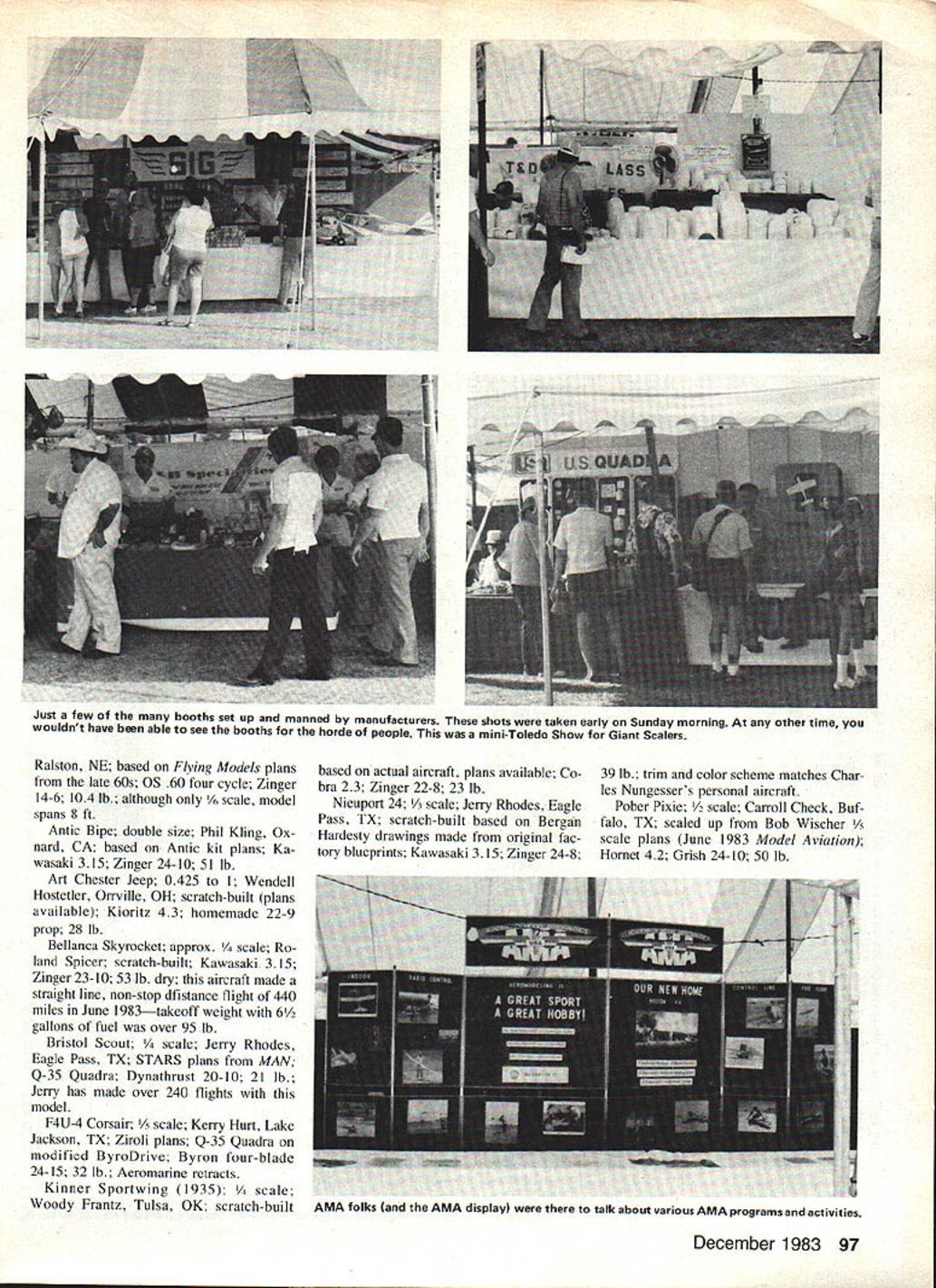
For a Giant Scaler, the FFF has become a mini-Toledo show. There were two exhibitor tents this year, with about 45 booths occupied. As expected, Midwestern firms were well represented, with only a few from the East and West Coasts. The heat kept crowds thin during most of the day, which made it easier for modelers to see what was there. While I didn't see anything startlingly new and exciting, there were several things I plan to comment on in my regular column.
Saturday squall and banquet
The heat finally dropped a bit on Saturday when the last gasps of Hurricane Alicia reached us. Rain and some high winds hit late Saturday afternoon. Naturally, it came when a lot of people had already moved across the road to the airport where the banquet and evening festivities were to take place. For a bit it was touch-and-go as to whether the exhibitor tents would stay in place. A few booths were damaged, and some minor damage occurred in the aircraft storage tents.
After the big blow, a fairly steady rain set in. The break in the weather was welcome, but the rain made getting to the hangar area messy. The less said about the "banquet" the better, but the attitude adjustment and socializing in the hangar were enjoyed by all.
Sunday and return
Sunday morning dawned clear and relatively cool. It looked like a great day for flying, but most people were already packing up to go home. We spent a couple hours saying goodbye to friends, old and new, and then started our three-day trip home. Looking back, we both agreed it had been a worthwhile trip. As always, the thing we enjoy most at a fly-in is talking to the people we meet. Evelyn and I wandered around, took pictures, and gathered information, thoroughly enjoying ourselves. We particularly appreciated the hospitality of those who shared their canopy shade with us. We look forward to seeing all of them again and to meeting more Giant Scalers wherever we go.
Aircraft photographed
The information below is organized as: aircraft type; scale; owner; kit/plan/scratch-built; engine; prop; weight; comments.
- Air Tech Duster
- Scale: non-scale
- Owner: John Westbrook, Little Rock, AR
- Built: Air Tech kit
- Engine: Q-35 Quadra
- Prop: Zinger 18-8
- Weight: 16 lb.
- Antoinette VII
- Scale: 1/6 scale
- Owner: Jack Fortney, Ralston, NE
- Built: Based on Flying Models plans from the late '60s
- Engine: OS .60 four-cycle
- Prop: Zinger 14-6
- Weight: 10.4 lb.
- Comments: Although listed as 1/6 scale in the notes, a later comment indicates the model spans 8 ft (reported as 1/2 scale in one note).
- Antic Bipe
- Scale: double size
- Owner: Phil Kling, Oxnard, CA
- Built: Based on Antic kit plans
- Engine: Kawasaki 3.15
- Prop: Zinger 24-10
- Weight: 51 lb.
- Art Chester Jeep
- Scale: 0.425 to 1
- Owner: Wendell Hostetler, Orrville, OH
- Built: Scratch-built (plans available)
- Engine: Kioritz 4.3
- Prop: Homemade 22-9
- Weight: 28 lb.
- Bellanca Skyrocket
- Scale: approx. 1/4 scale
- Owner: Roland Spicer
- Built: Scratch-built
- Engine: Kawasaki 3.15
- Prop: Zinger 23-10
- Weight: 53 lb. dry
- Comments: This aircraft made a straight-line, non-stop distance flight of 440 miles in June 1983 — takeoff weight with 6-1/2 gallons of fuel was over 95 lb.
- Bristol Scout
- Scale: 1/4 scale
- Owner: Jerry Rhodes, Eagle Pass, TX
- Built: STARS plans from MAN
- Engine: Q-35 Quadra
- Prop: Dynathrust 20-10
- Weight: 21 lb.
- Comments: Jerry has made over 240 flights with this model.
- F4U-4 Corsair
- Scale: 1/3 scale
- Owner: Kerry Hurt, Lake Jackson, TX
- Built: Ziroli plans
- Engine: Q-35 Quadra on modified ByroDrive
- Prop: Byron four-blade 24-15
- Weight: 32 lb.
- Comments: Aeromarine retracts.
- Kinner Sportwing (1935)
- Scale: 1/4 scale
- Owner: Woody Frantz, Tulsa, OK
- Built: Scratch-built based on actual aircraft (plans available)
- Engine: Cobra 2.3
- Prop: Zinger 22-8
- Weight: 23 lb.
- Nieuport 24
- Scale: 3/4 scale
- Owner: Jerry Rhodes, Eagle Pass, TX
- Built: Scratch-built based on Bergan Hardesty drawings made from original factory blueprints
- Engine: Kawasaki 3.15
- Prop: Zinger 24-8
- Weight: 39 lb.
- Comments: Trim and color scheme matches Charles Nungesser's personal aircraft.
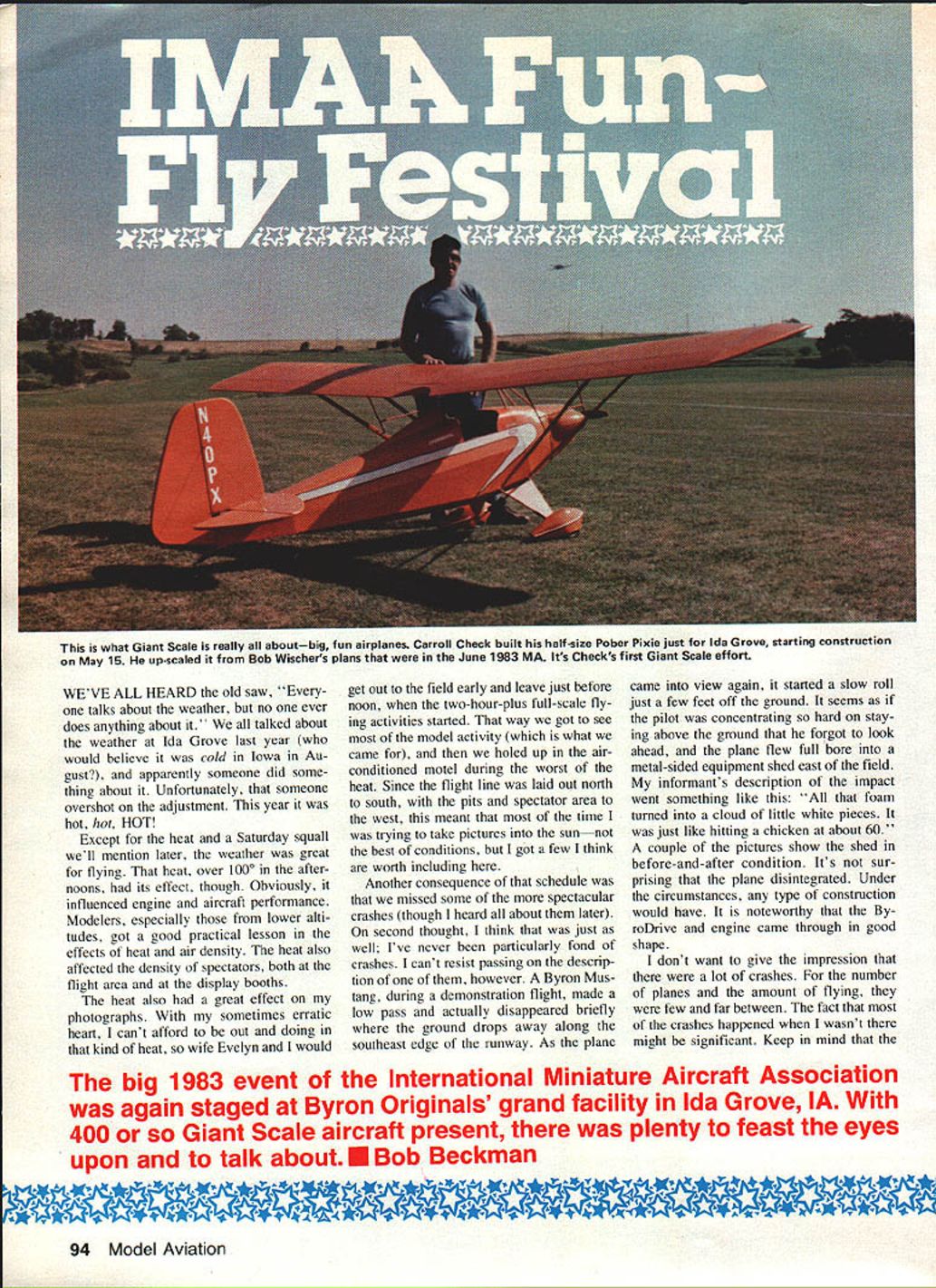
- Pober Pixie
- Scale: 1/2 scale
- Owner: Carroll Check, Buffalo, TX
- Built: Scaled up from Bob Wischer 1/4 scale plans (June 1983 Model Aviation)
- Engine: Hornet 4.2
- Prop: Grish 24-10
- Weight: 50 lb.
Transcribed from original scans by AI. Minor OCR errors may remain.

