
INDIAN CREEK SCHOOL PROGRAM
BOB BABURA
Background
The Indian Creek After School Program in Crownsville, Maryland was conceived in the fall of 1996 to teach interested students how to build and fly radio-control (RC) model airplanes. The program was initiated by school officials Tracy Coleman and Bruce Crossman, with Bob McDaniel serving as program director.
Organization and Volunteers
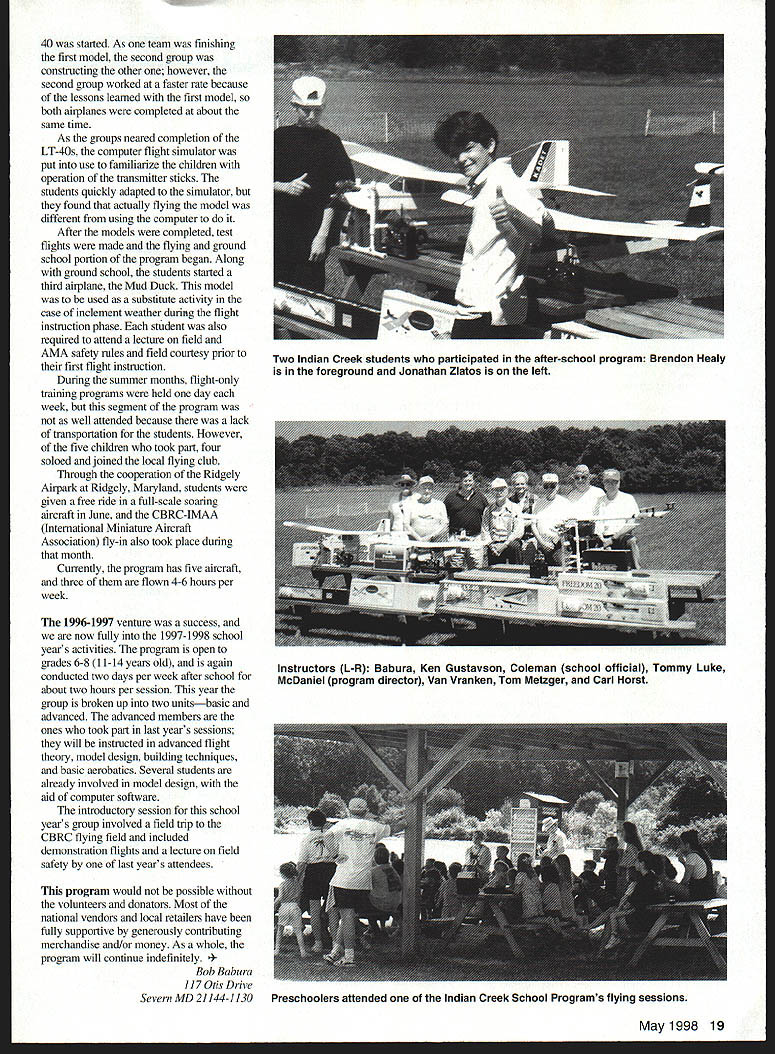
After the program was approved, the first step was to recruit instructors. Bob approached the Chesapeake Bay Radio Control Club (CBRCC) and nine members volunteered to conduct building and flying sessions. All instructors were accomplished RC modelers, and several had backgrounds in full-scale aviation.
Bob also solicited donations from national and local RC suppliers and manufacturers, securing contributions after many telephone calls and numerous letters at his own expense.
Sessions were scheduled on Tuesdays and Thursdays, the days the volunteers normally flew at the CBRCC field, which proved convenient. Instructors met one hour before each session to plan activities and address problems; this system worked extremely well.
Classroom and Materials
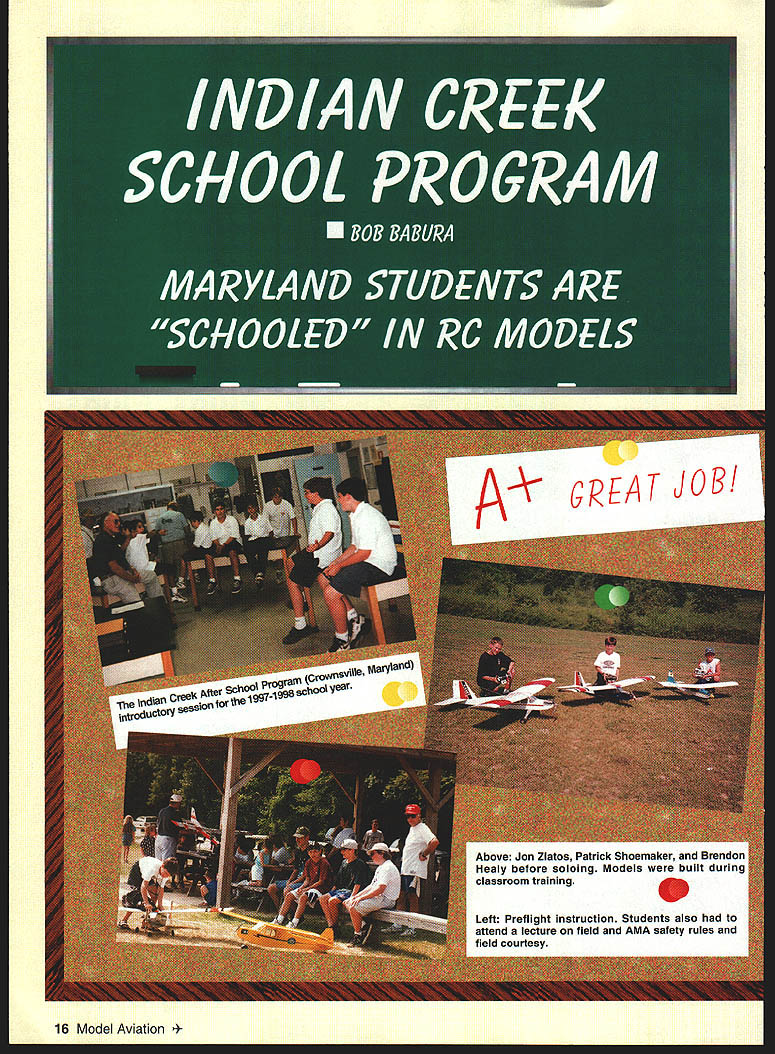
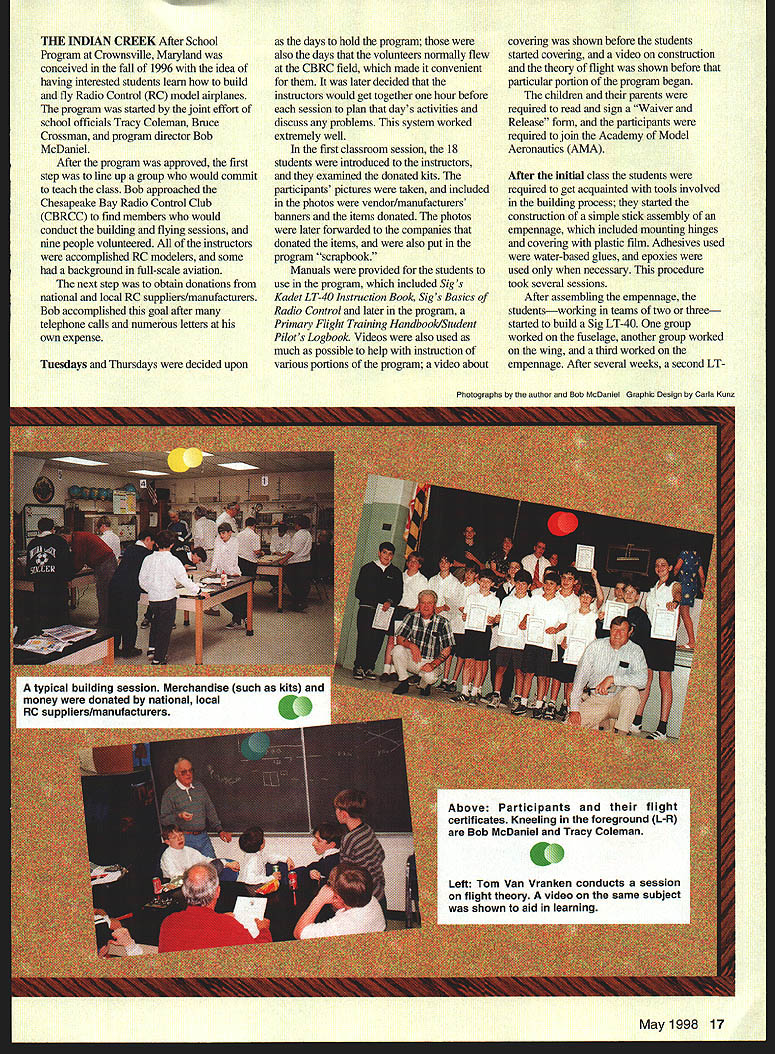
In the first classroom session, 18 students were introduced to the instructors and shown the donated kits. Photographs of the participants, along with vendor/manufacturer banners and donated items, were taken for the program scrapbook and sent to the contributing companies.
Students were provided with manuals including Sig's Kadet LT-40 Instruction Book, Sig's Basics of Radio Control, and later a Primary Flight Training Handbook/Student Pilot’s Logbook. Instructional videos were used when appropriate—for example, a covering video before students began covering and a construction/theory of flight video before related lessons.
All children and their parents read and signed a Waiver and Release form, and participants were required to join the Academy of Model Aeronautics (AMA).
Building Phase
Students first learned to use the tools involved in the building process. They constructed a simple stick assembly empennage, including mounting hinges and covering with plastic film. Water-based glues were used primarily; epoxies were used only when necessary. This process took several sessions.
After assembling the empennage, students worked in teams of two or three to build a Sig LT-40:
- One group worked on the fuselage.
- Another group worked on the wing.
- A third group worked on the empennage.
After several weeks, a second LT-40 was started. Lessons learned from the first build allowed the second group to work faster, so both airplanes were completed at about the same time.
Flight Training and Simulator Use
As the groups neared completion of the LT-40s, an LT-40 computer flight simulator was used to familiarize students with transmitter stick operation. Students adapted quickly to the simulator but noted a difference between simulator and actual model flying.
After the models were completed, test flights were performed and the flying/ground school portion of the program began. Along with ground school, students started a third airplane (the Mud Duck) to use as a substitute activity in case of inclement weather. Prior to their first flight instruction, students attended a lecture on field and AMA safety rules and field courtesy.
Summer and Additional Activities
During the summer months, flight-only training programs were held one day per week. Attendance was good, especially for students lacking transportation during the school year. Five children took part in summer training; four soloed and joined the local flying club.
Through cooperation with Ridgely Airpark in Ridgely, Maryland, students were given free rides in a full-scale soaring aircraft in June. The CBRCC-IMAA (International Miniature Aircraft Association) fly-in also took place during the month.
Current Status and Curriculum Expansion
The program currently has five aircraft, three of which are flown 4–6 hours per week. The 1996–1997 venture was successful and has been expanded for the 1997–1998 school year.
- The program is open to grades 6–8 (ages 11–14).
- Sessions are conducted two days per week after school, about two hours per session.
- The group is now divided into two units: Basic and Advanced.
- Advanced members are those who participated in last year’s sessions; they receive instruction in advanced flight theory, model design, building techniques, and basic aerobatics.
- Several students are already involved in model design with the aid of computer software.
The introductory session for the current school year included a field trip to the CBRCC flying field, demonstration flights, and a field-safety lecture given by one of last year’s attendees.
Acknowledgments
This program would not be possible without volunteers and donors. Most national vendors and local retailers have been very supportive, generously contributing merchandise and/or money. As a whole, the program is expected to continue indefinitely.
Bob Babura 117 Otis Drive Severn, MD 21144-1130
Transcribed from original scans by AI. Minor OCR errors may remain.

