
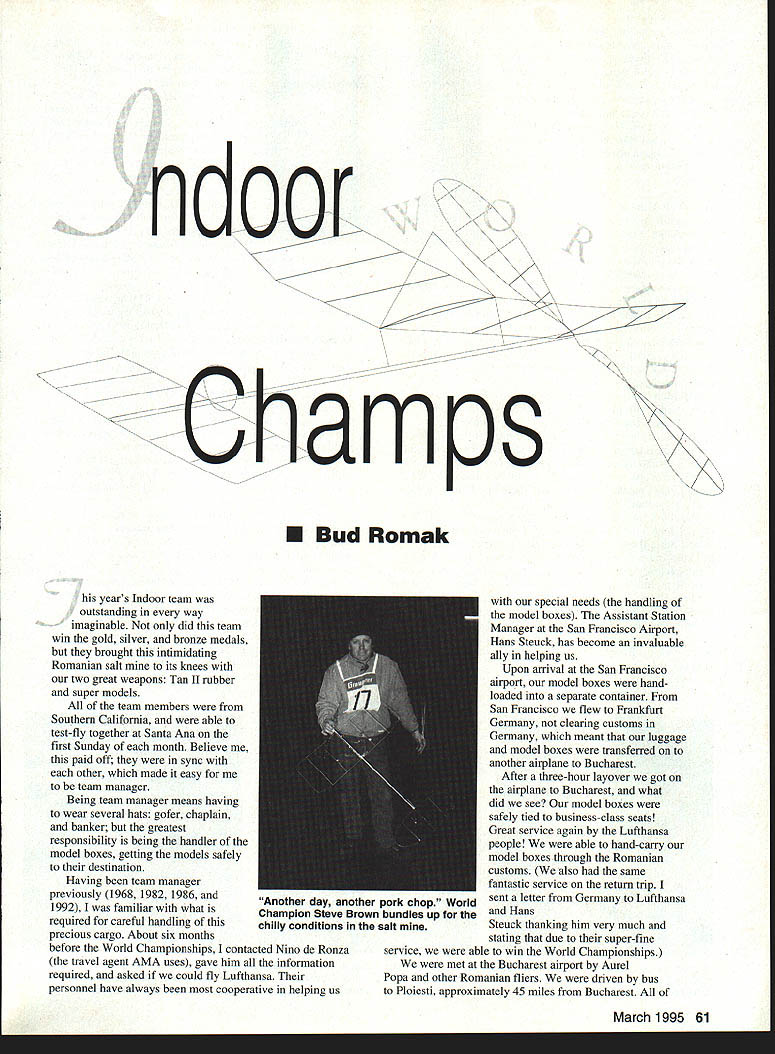
Indoor Champs
Bud Romak
This year's Indoor team was outstanding in every way imaginable. Not only did this team win the gold, silver, and bronze medals, but they brought this intimidating Romanian salt mine to its knees with our two great weapons: Tan II rubber and super models.
All of the team members were from Southern California and were able to test-fly together at Santa Ana on the first Sunday of each month. Believe me, this paid off; they were in sync with each other, which made it easy for me to be team manager.
Being team manager means wearing several hats — gofer, chaplain, and banker — but the greatest responsibility is being the handler of the model boxes and getting the models safely to their destination.
Having been team manager previously (1968, 1982, 1986, and 1992), I was familiar with what is required for careful handling of this precious cargo. About six months before the World Championships I contacted Nino de Ronza (the travel agent AMA uses), gave him all the required information, and asked if we could fly Lufthansa. Their personnel have always been most cooperative in helping us with our special needs (the handling of the model boxes). The Assistant Station Manager at the San Francisco Airport, Hans Steuck, has become an invaluable ally in helping us.
Upon arrival at the San Francisco airport, our model boxes were hand-loaded into a separate container. From San Francisco we flew to Frankfurt, Germany, without clearing customs there, which meant our luggage and model boxes were transferred to another airplane bound for Bucharest.
After a three-hour layover we boarded the airplane to Bucharest, and what did we see? Our model boxes were safely tied to business-class seats — great service again by the Lufthansa people. We were able to hand-carry our model boxes through Romanian customs. (We also had the same fantastic service on the return trip. I sent a letter from Germany to Lufthansa and to Hans Steuck thanking him very much and stating that due to their super-fine service, we were able to win the World Championships.)
We were met at the Bucharest airport by Aurel Popa and other Romanian fliers. We were driven by bus to Ploiesti, approximately 45 miles from Bucharest. All of the Indoor teams, supporters, and managers stayed at the Central Hotel there. Each morning at 7:45 we traveled approximately 25 miles to Slanic, which took about an hour. We left the salt mine at 4:30 each afternoon.
I had tried my best to convince our team that the salt mine in Slanic would really make them feel humble. Temperature is a constant 50°F, 700 feet below the ground; it's cold, dark, and a tough place to fly. If they could fly there with success, they could fly anywhere in the world.
At the Salt Mine
We waited in line with our boxes in tow, boarded a small elevator, and made our 700-foot descent to the mine.
The team was amazed at this truly incredible site. We wore boots, thermal socks, long johns, sweatshirts, sweaters, jackets, and ski caps — we were ready.
Our team had a new 12-volt car battery, a halogen searchlight, and many flashlights. Unfortunately, the car battery died after the second day, so we had a Romanian flier (Aurel Morar) install it in his car, which he drove to Ploiesti and back to the mine to charge it. It worked again for just another day. (We gave the battery to him at the end of the World Championships.)
The team used only 1/4 to 1/2 motors on the first day because there was no hydrogen to fill our balloons. With hydrogen available the second day, we were able to do more testing.
Contest day arrived and I selected the rotation for flying. I chose Cezar Banks to fly first, Bob Randolph second, and Steve Brown third. I did this because Cezar had flown here in 1982. Well, he sure did: 44:23, the highest time ever made in the salt mine, and the longest flight of the World Championships — what a great start!
Randolph broke a couple of motors getting ready for his first flight, but he finally got his flight off. Time was running out for us, and Steve Brown was waiting patiently for his first flight. He had little time remaining in the first round, and I was getting Randolph ready to intentionally balloon his model if it was not a good flight. Ballooning was not needed, and we were relieved that Brown could get his first attempt off. We made it by a minute and 35 seconds — too close for comfort!
From then on, flying went smoothly. We had a so-so first round, but in the second round we showed our true colors: gold, silver, bronze — Brown, Banks, Randolph. This trend continued until the final (sixth) round.
I talked to the team and told them that any one of them could be the World Champion, and they could go for broke because no other team had a chance to win. What a great feeling, being manager of a team that had it all, and any member could be World Champion. This team was outstanding!
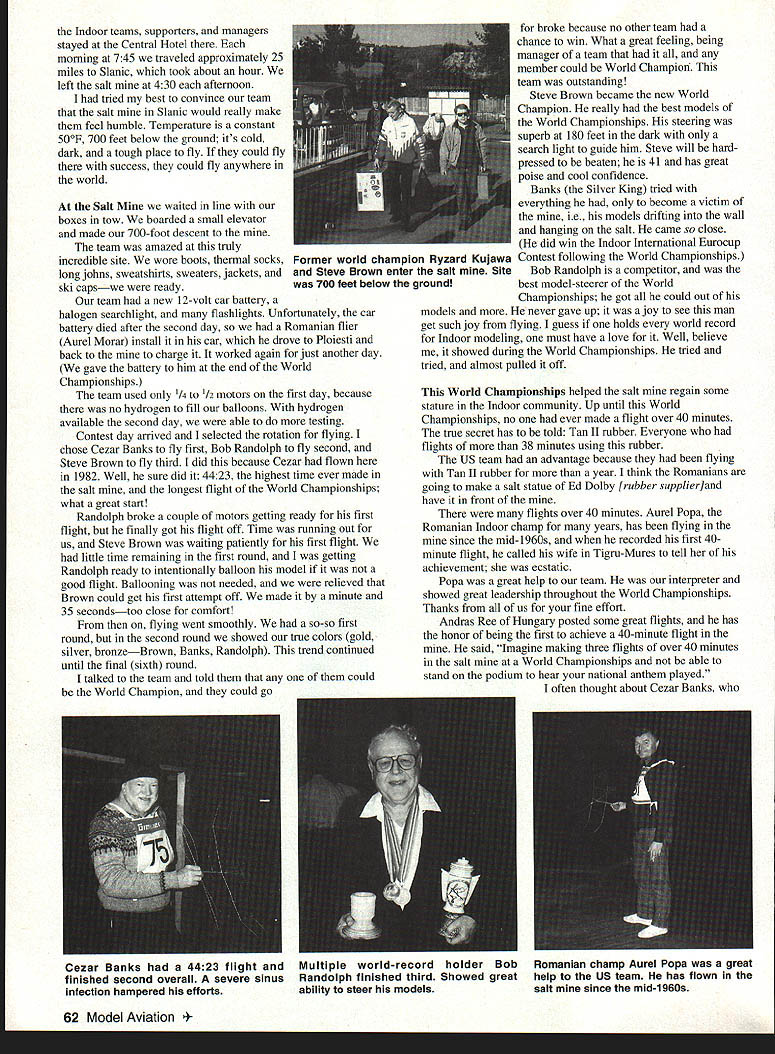
Steve Brown became the new World Champion. He really had the best models of the World Championships. His steering was superb at 180 feet in the dark with only a searchlight to guide him. Steve will be hard-pressed to be beaten; he is 41 and has great poise and cool confidence.
Banks (the Silver King) tried with everything he had, only to become a victim of the mine — his models drifting into the wall and hanging on the salt. He came so close. (He did win the Indoor International Eurocup Contest following the World Championships.) Bob Randolph is a competitor and was the best model-steerer of the World Championships; he got all he could out of his models and more. He never gave up; it was a joy to see this man derive such pleasure from flying. If one holds every world record for Indoor modeling, one must have a love for it — and it showed during the World Championships. He tried and tried and almost pulled it off.
This World Championships helped the salt mine regain some stature in the Indoor community. Up until these World Championships, no one had ever made a flight over 40 minutes. The true secret has to be told: Tan II rubber. Everyone who had flights of more than 38 minutes used this rubber.
The U.S. team had an advantage because they had been flying with Tan II rubber for more than a year. I think the Romanians are going to make a salt statue of Ed Dolby (rubber supplier) and have it in front of the mine.
There were many flights over 40 minutes. Aurel Popa, the Romanian Indoor champ for many years, has been flying in the mine since the mid-1960s, and when he recorded his first 40-minute flight he called his wife in Targu-Mures to tell her of his achievement; she was ecstatic.
Popa was a great help to our team. He was our interpreter and showed great leadership throughout the World Championships. Thanks from all of us for your fine effort.
Andras Ree of Hungary posted some great flights, and he has the honor of being the first to achieve a 40-minute flight in the mine. He said, "Imagine making three flights of over 40 minutes in the salt mine at a World Championships and not be able to stand on the podium to hear your national anthem played." He was the second person to make a flight of more than 40 minutes. He also has the longest flight ever made in the mine.
Cezar had a severe sinus infection in his nose and right eye; no telling how he would have done if he had been able to see his model to steer it properly. He had a devastating time trying to balloon his model with only one good eye while the other one was tearing. He tried so hard, but it was almost impossible for him to see his model throughout its flight.
Our fine supporters traveled a great distance at considerable cost to attend this World Championships: Larry Parsons from Davis, California; Herb Robbins from Los Gatos, California; and Vern Hacker from Cleveland, Ohio. They were very helpful manning the searchlight, providing food and soft drinks for the team, and performing many other duties that helped make a smooth-running team. Thanks again to all of you from me and the team.
Random thoughts
- Seeing the expressions on the faces of the team members and supporters as we rode the bus from Ploiesti to the salt mine in Slanic: the horse carts, cattle, chickens, bicycle riders, primitive homes — being reminded of Old World charm.
- Steve Brown with his favorite expression: "Another day, another pork chop."
- Larry Parsons' and Doc Hacker's expressions as they were about to embark into the elevator that sent them flying down 700 feet on four bell rings.
- Herb Robbins and his pidgin English trying to talk with the Romanians and all of the contestants. He really had a great time.
The U.S. team and I want to thank everyone involved in putting this World Championships together; it ran very smoothly. Thank you again for this great World Championships. It was truly a great experience for all.
Transcribed from original scans by AI. Minor OCR errors may remain.

