
Indoor Flying at the International Modeler Show
Eloy Marez
The Show
The season-opening International Modeler Show (IMS), this year's being No. 8, took place in the City of Roses, Pasadena, CA, over the weekend of January 12–13, 1985. Being the youngest of the major model trade shows, the IMS has been watched with great interest by both the model industry and by modelers themselves.
The fact that it is now an established success was best described by one of my East Coast friends. Upon seeing the multitude of people swarming in when the doors opened on Saturday morning, he remarked, "Wow, it looks just like Toledo, only with warm weather—and flying!"
While not exactly a roaring success the first couple of years, IMS management persevered. With the support of many industry and modeling friends, the show is now an established major event, a "must" for thousands of us. This includes the news media in the Los Angeles area, who helped spread the word via radio and television prior to the show—and who came to the show and took seemingly miles of tape of the flying events for later showing on the air. We'll never know the numbers, but there is no doubt that the modeler population increased over that weekend from the exposure of new people to the activity.
The Flying Demonstrations
The flying demonstrations indoors have been part of the IMS since its inception. Show organizer Bill Northrop himself, a longtime model builder, designer and flier, has attempted to attract experienced, involved modelers as well as the uninvolved young and old alike—especially youngsters, since they will become tomorrow's Carl Goldbergs and Dave Browns. Exposing younger generations to the type of model airplanes seen flying at the IMS is very important; they can identify the type and see what its capabilities are. They also appreciate the highly complex (and expensive) models seen in the display areas, even if those are outside their present experience and budget range.
Much of the flying exposure is due to the effort of the Black Sheep Squadron of Burbank, CA, the group that organized and put on two fast-paced programs a day. Sparkplugged by the popular Addie and Tony Naccarato, the group includes everyone from pre-teenagers to a couple of adult aviation engineers. The Black Sheep organized the flying, but it was by no means a closed event; anyone who attended and wished to fly a model that was considered safe to operate within the convention hall was allowed to do so.
- Free Flight models
- Control Line models
- Radio Control (RC) models, including Indoor RC
- Power sources including electric, CO2, glow, and rubberband
We saw blimps, hot-air balloons, tractors and pushers, conventional and canard designs, big and little. Not even helicopters missed their turn, in various types powered by rubber and electric motors. Glow-engine-powered models were flown for TV camera crews and before the event was opened to the general public.
The Flight Program
While the site for flying is not exactly Nats proportions, it is adequate for small models of many types. During the opening part of the flight demonstration the air was full of rubber-powered craft—from Peanut Scale bipes to AMA Delta Darts. The Black Sheep then opened up the throttle with exciting Control Line exhibitions (electric-powered), which included carrier takeoffs and landings from a realistic aircraft carrier complete with arresting cables temporarily installed.
They demonstrated slow, fast, and formation flying, followed by an electric-powered stunter that could do just about everything, including inside and outside loops—and crowd-pleasing inverted low-level flight.
Then something that looked surprisingly like a B-25 took to the air; the Black Sheep, being good Navy folks, call theirs a PBJ. The realism in form and flight was enjoyed by all. The pièce de résistance was Tony Naccarato's flight of his RC Farman, an extremely lightweight but perfectly controllable 80-inch-span model, a veteran of four years of IMS flying that has performed at many other fly-ins, both indoors and out.
Communication and Outreach
An important part of any public demonstration is communication—the public must be made aware of what is going on. Throughout the entire program, one of the Black Sheep members was on the public-address system, expertly informing the audience about the models in the air. If a scale ship was flying, the announcer also told the audience about the full-sized counterpart and its history.
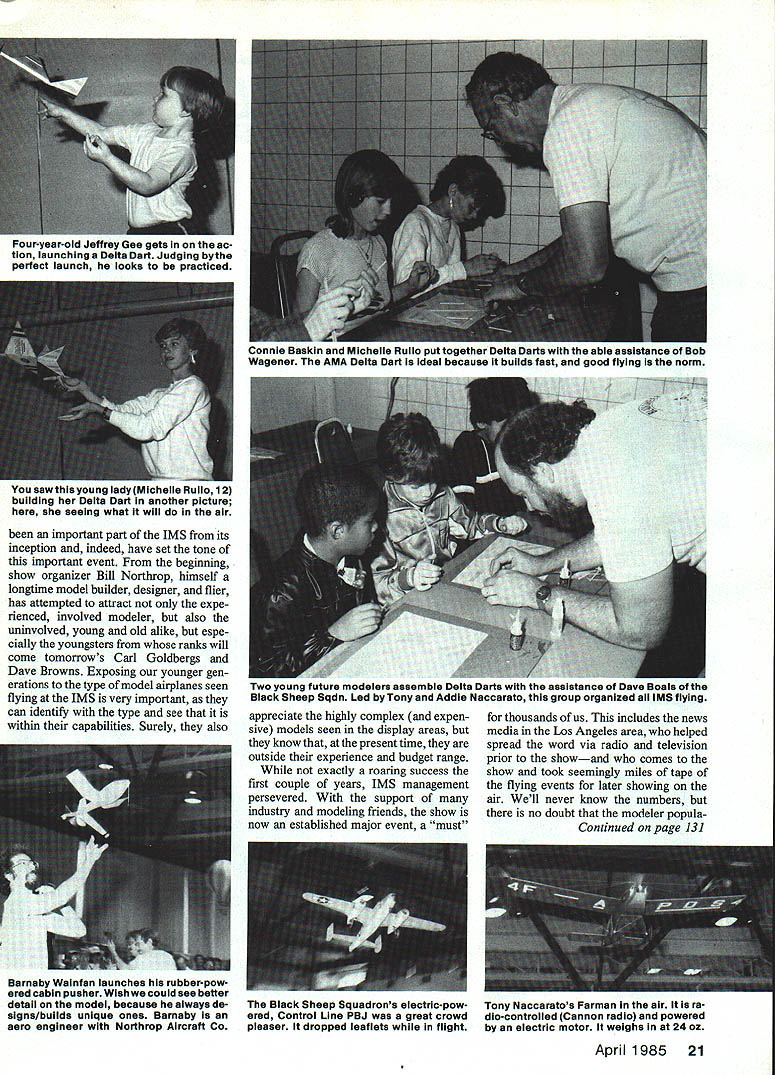
The audience was not sent home empty-handed. Anyone who wished was invited to an area where facilities and help were provided for building, trimming, and flying an AMA Delta Dart. Members of the Black Sheep Squadron instructed instead of taking a well-deserved break. Though an occasional adult could be seen dutifully sticking "Part A to Part B," the program was mostly—and thoroughly—enjoyed by the children. The pleasure they derived from a single model was evident: there was no age restriction on the satisfaction obtained from creating something that works as it is supposed to.
Conclusion
The Black Sheep members' only reward for all their time and effort was applause and smiles, and they got plenty of both—not only from the general public, but from those of us whose current modeling activity centers more around seven-channel radios and percentages of nitro.
May they always be favored with CAVU weather and happy landings!
Transcribed from original scans by AI. Minor OCR errors may remain.

