
Indoor Nats
Bud Tenny
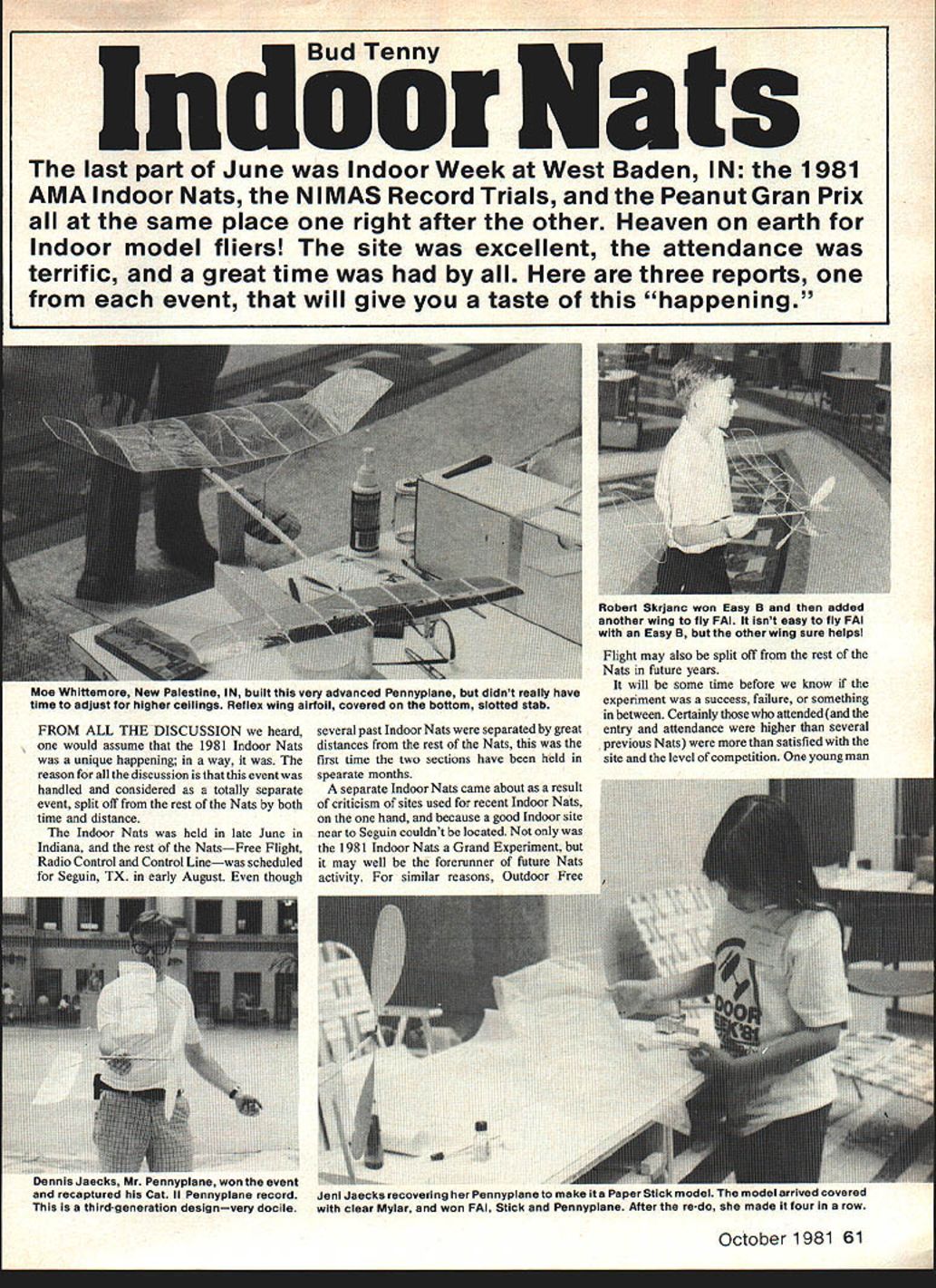
The last part of June was Indoor Week at West Baden, IN: the 1981 AMA Indoor Nats, the NIMAS Record Trials, and the Peanut Gran Prix — all at the same site, one right after the other. The site was excellent, attendance was terrific, and everyone had a great time. The following report summarizes the week: site and organization, competition highlights, junior activity, and related events.
Site and organization
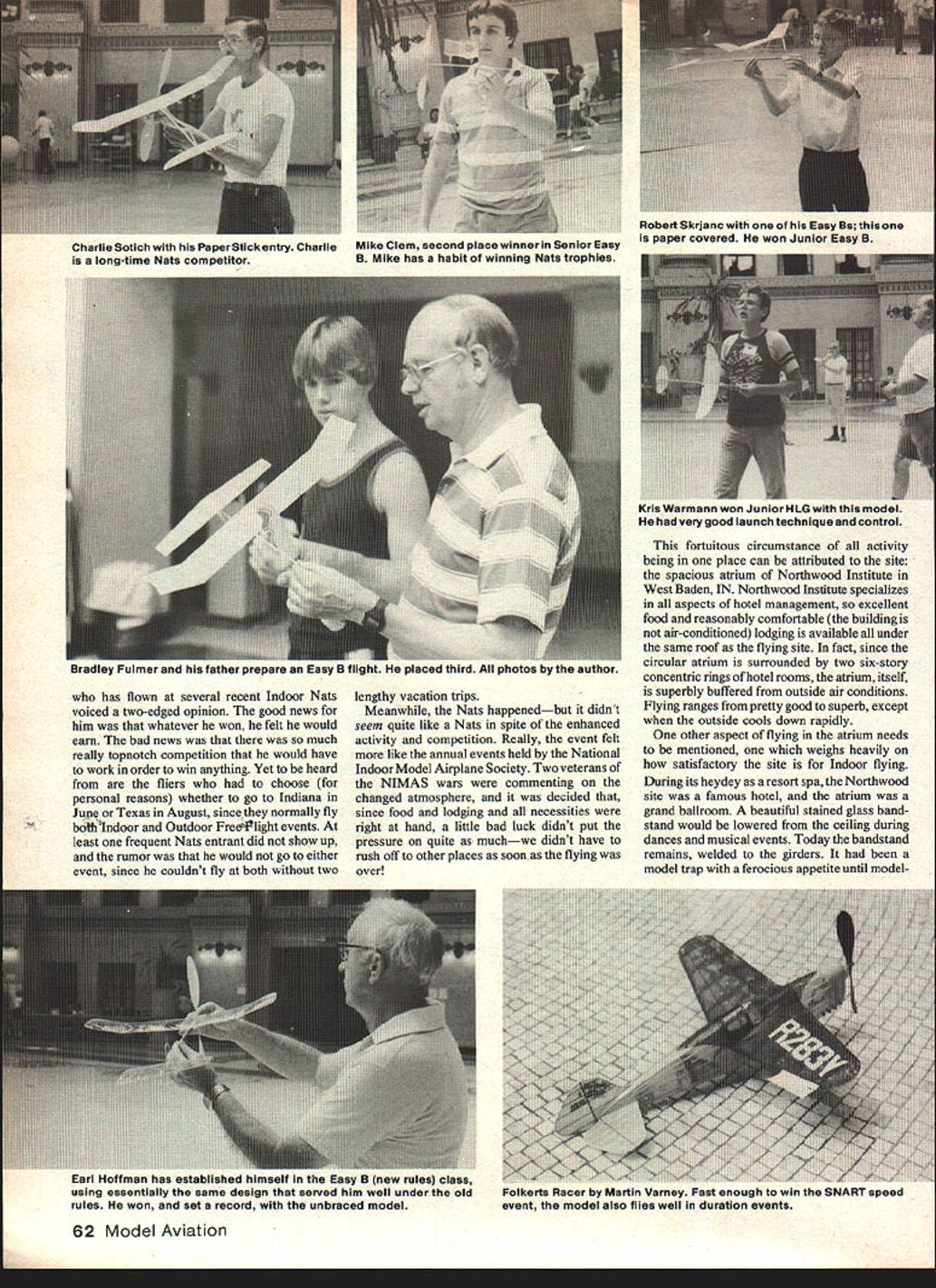
- The meet was held in the spacious circular atrium of Northwood Institute, West Baden, IN. The atrium is surrounded by two six-story concentric rings of hotel rooms, so it is superbly buffered from outside air conditions.
- Northwood specializes in hotel management, so food and lodging were available under the same roof as the flying site. The building is not air-conditioned, but overall accommodations were reasonably comfortable.
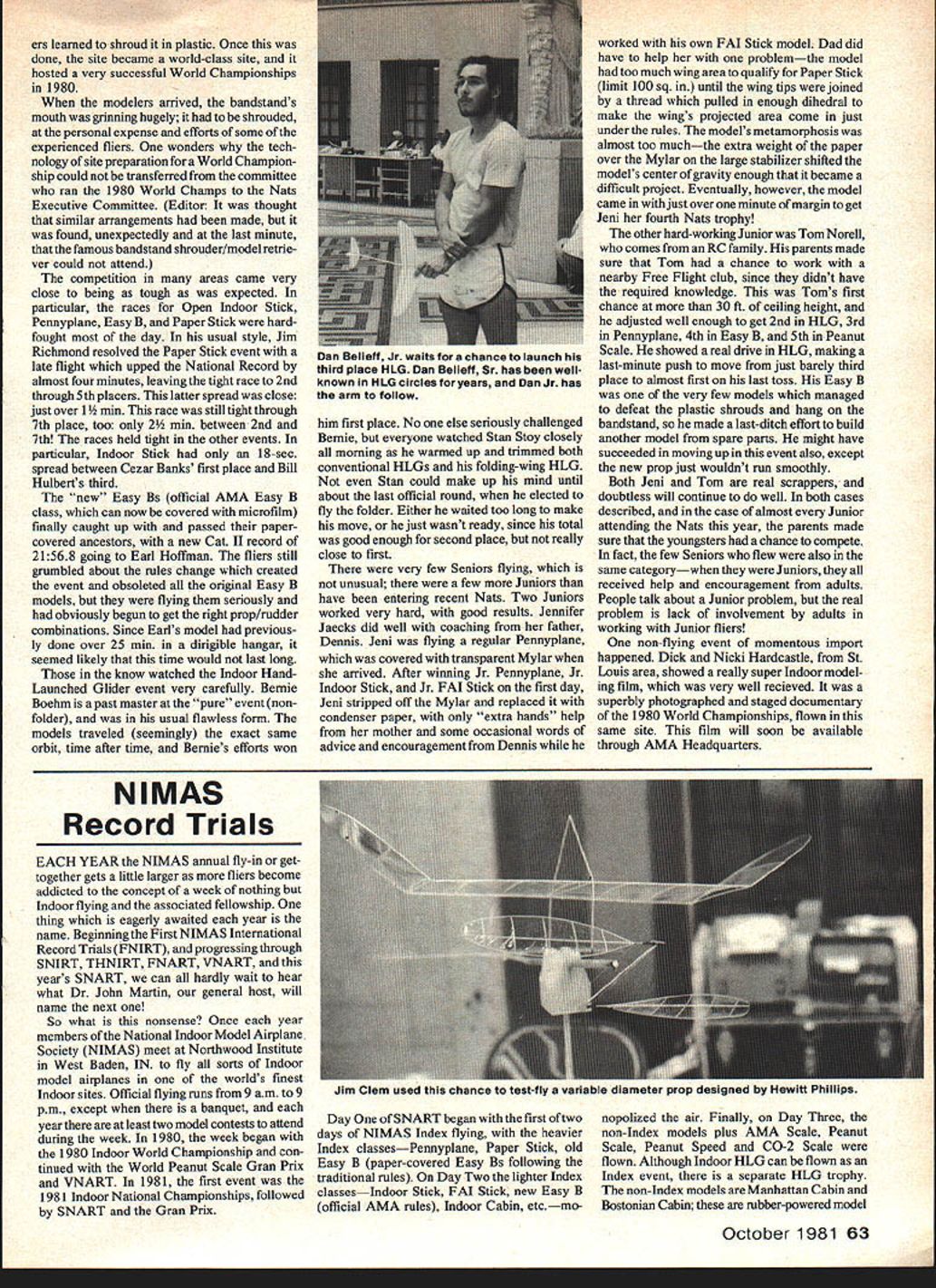
- One important site feature was a welded bandstand suspended in the atrium. It had been a notorious model trap until experienced fliers shrouded it in plastic. That shrouding made the site world-class; the same site had hosted a very successful World Championships in 1980.
- The bandstand had to be shrouded at personal expense and effort by some experienced fliers when the Nats arrived. (An expected helper from the 1980 Worlds was unexpectedly unable to attend.)
Competition atmosphere
- Because lodging, food, and flying were all under one roof, the meet felt more like a NIMAS annual event than a typical multisite Nats. The relaxed logistics reduced the usual travel pressure and changed the atmosphere for many competitors.
- The 1981 Indoor Nats was handled as a separate event (held late June in Indiana) from the remainder of the Nats (Free Flight, Radio Control, Control Line at Seguin, TX, in early August). This separation by time and distance was a “Grand Experiment” brought on by site criticism for recent Indoor Nats and the lack of a suitable indoor site near Seguin. It may be a forerunner of future Nats scheduling changes.
Competition highlights
- Races were tight in many events:
- Paper Stick: Jim Richmond won with a late flight that raised the national record by almost four minutes. The spread from 2nd through 5th was just over 1½ minutes; 2nd through 7th were within 2½ minutes.
- Open Indoor Stick: very close — only an 18-second spread between Cezar Banks (1st) and Bill Hulbert (3rd).
- Easy B (new official AMA Easy B class, coverable with microfilm): Earl Hoffman set a Cat. II record of 21:56.8. Models using the new rules were quickly being optimized for prop/rudder combinations; times were likely to improve further.
- Hand-Launched Glider (HLG): Bernie Boehm dominated the conventional (non-folder) event with highly consistent flights and won first place. Stan Stoy warmed up both conventional and folding-wing HLGs; he chose the folder late and finished second.
- Other notable results:
- Robert Skrjanc and Jim Richmond established new ROG Stick records.
- Lew Gitlow boosted the Ornithopter record slightly; his bird clearly exhibited a climb then cruise phase and idled to the floor like a tired bird.
Pennyplane and Paper Stick battle
- Open Pennyplane featured an intense record battle. Dennis Jaecks recaptured the record during the Nats and then kept pushing:
- He posted flights including 14:07.7, 14:12.6 and ultimately 15:01.6.
- Cezar Banks countered with a 14:55.5.
- Dick Hardcastle also contributed strong times (14:08.6).
- Dennis’ 15:01.6 held through the meet.
Juniors
- A modest number of Seniors attended; there were a few more Juniors than in recent Nats.
- Jennifer (Jeni) Jaecks:
- Won Jr. Pennyplane, Jr. Indoor Stick, and Jr. FAI Stick on the first day flying a model covered in transparent Mylar.
- Later re-covered the model with condenser paper to compete in Paper Stick (100 sq. in. limit). A thread pulling in dihedral reduced projected area to qualify. The heavier paper shifted the CG and made trimming difficult, but she finished with just over one minute to spare and earned a fourth Nats trophy.
- Tom Norell:
- From an RC family, he worked with a nearby Free Flight club to get experience for the high ceilings.
- Results: 2nd in HLG, 3rd in Pennyplane, 4th in Easy B, and 5th in Peanut Scale.
- He made a last-minute push in HLG and nearly moved to first on his final toss.
- The report emphasizes that Juniors succeed when adults (parents and clubs) invest time and encouragement; the “Junior problem” is often lack of adult involvement, not lack of interest from youngsters.
Film
- Dick and Nicki Hardcastle from the St. Louis area showed an excellent indoor modeling film documenting the 1980 World Championships at the same site. The film was superbly photographed and well received; it was slated to be made available through AMA Headquarters.
NIMAS Index Competition
What the Index is
- The NIMAS Index Competition allows many different AMA model classes to be flown in the same contest. Each flight is divided by the National Record time for that model class and age group, producing an Index number (flight time ÷ record time). The highest Index wins.
- Effects:
- Juniors and Seniors often place high because their record baselines are lower than Open records.
- Many national records tend to be broken and re-broken during Index meets.
- Choosing which class to fly can be strategic: a flier’s best personal class might not yield the best Index if its record is high; a weaker personal class with a low record might produce a higher Index.
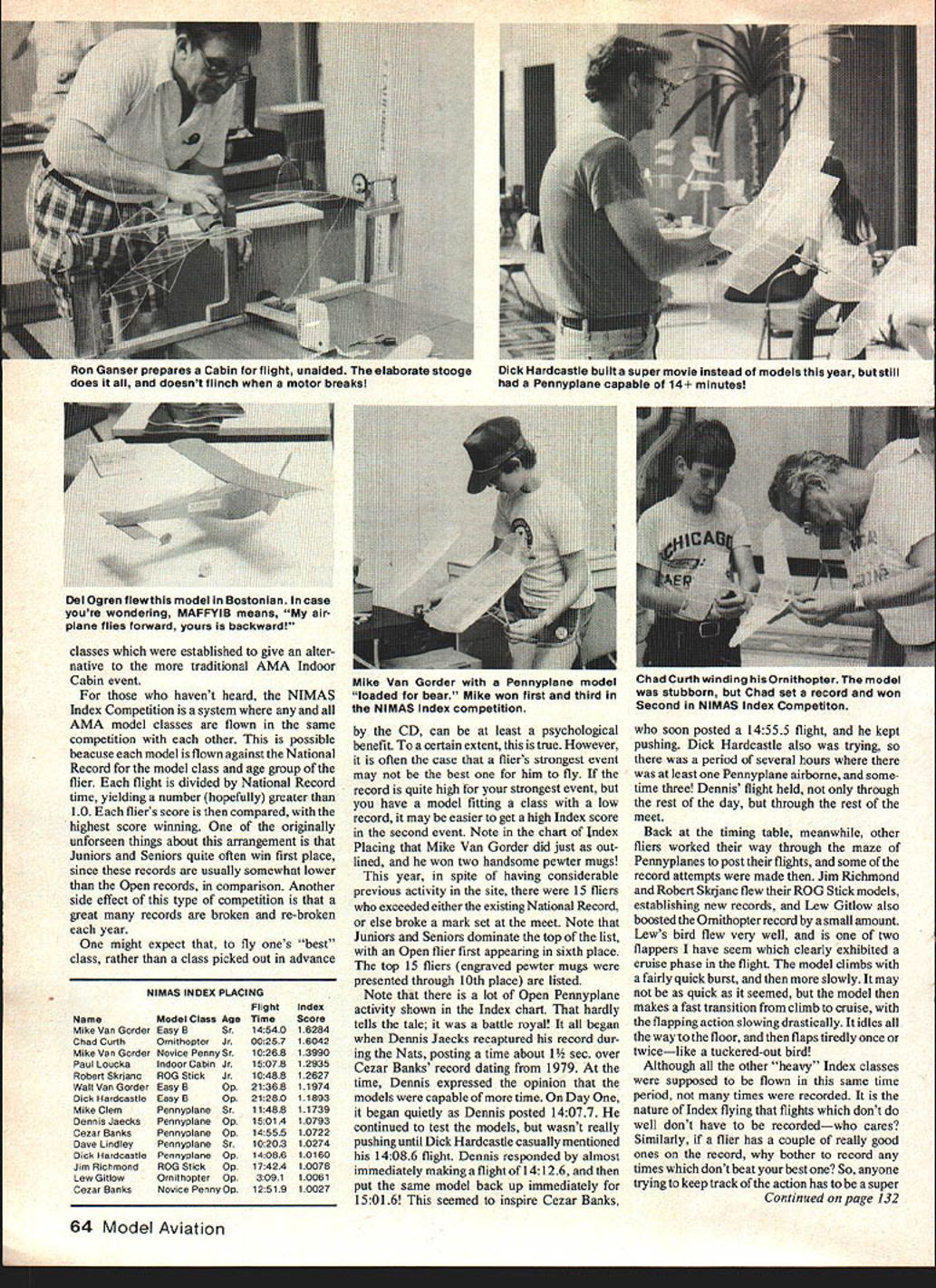
- This year, despite considerable previous activity at the site, 15 fliers exceeded existing National Records or set marks at the meet. Juniors and Seniors dominated the top of the Index list; an Open flier first appeared at sixth place. Engraved pewter mugs were presented through 10th place.
Index highlights
- Pennyplane activity dominated the Index chart; many top Index scores came from Pennyplane flights because of the record battle described above.
- Other notable Index moves:
- Jim Richmond and Robert Skrjanc established new ROG Stick records.
- Lew Gitlow improved the Ornithopter record.
- Because Index flying encourages recording only your best flights, many lower-quality flights went unrecorded, so observers had to be vigilant and ask questions to follow all the action.
Microfilm (mike) classes and Easy B
- Day Two focused on the microfilm classes. Many microfilm records were already strong, so fewer surprises occurred. Easy B saw activity:
- Earl Hoffman’s Nats-winning Easy B had previously flown over 25 minutes in a dirigible hangar, so his Cat. II time was not expected to last long as a record.
- Stan Chilton pushed the paper-covered Easy B past 20 minutes and later rebuilt microfilm-covered models, posting about 22:14 as a record attempt (not an Index mug winner).
Banquets
- The week included multiple banquets:
- A NIMAS annual meeting and victory banquet where Index prizes were awarded.
- A separate banquet after the Peanut Gran Prix where non-Index event winners received prizes.
- If you attended all week, that added up to three banquets.
Peanut Gran Prix and Scale events
Manhattan and Bostonian Cabin events
- Manhattan and Bostonian are special cabin events requiring a minimum cross-section volume to steer models toward a more scale-like form.
- Manhattan: cross-section volume requirement (2 × 2½ × 4 in.) and a minimum simulated window area. Models are delicate and typically fly up to 10 minutes.
- Bostonian: smaller, heavier models with limits similar to Manhattan, but judged for scale appeal; judge’s Charisma Factor (1.0–1.2) multiplies flight time as the score.
- Results:
- Walt Van Gorder won Manhattan with 9:09 and was still chasing a 10-minute flight in the atrium.
- Bob Clemens won Bostonian with a three-flight total of 289 seconds and a Charisma Factor of 1.2 (score 346.8); he flew the same model as the previous year.
Peanut Scale and Peanut Speed
- Peanut Scale: Tony Sutter won with a Heinold 100 V-8; other top placings included Jim Miller (Vagabond), Mike Arak (Lacey), and Bob Wiley (Fike). Lacey M-10 models were well represented and placed highly in multiple events.
- Peanut Scale Speed was redesigned this year because last year’s straight-line speed event had become a destruction derby. Event director Charlie Sotich set out balloons 20 ft. apart as pylons for a two-lap course. Some models performed well, but logged times were erratic.
CO-2 and Rubber Scale
- CO-2 Scale tends to show a smaller power difference between takeoff and cruise than rubber-powered scale models. Butch Hadland won again using the same Lacey model as last year, switching between CO-2 and rubber power to contest two events with one airframe. His flight total was 226 seconds; Bob Clemens posted 154.2 seconds in his Farman Jabiru; Phil Cox took third with 152 seconds. Static scores for these top models were in the mid-80s.
Lacey M-10s and notable entries
- The Lacey M-10 family did well in Rubber Scale: Hadland and three Sanfords (Curt and his daughters) plus others placed near the top. The competition was close: Hadland 154.4, Jeff Sanford 145.5, John Martin 145.0, Melanie Sanford 140.6, Liz Sanford 139.6.
- A Lacey was flown in memory of builder Ted Gozon, who died before he could attend; the model was proxy-flown in his honor.
- A small but realistic Solar Challenger model, built by Millard Wells, was noteworthy. The real aircraft’s wing and tail cell angles informed the model’s rigging; it did not fly until the wing/tail incidence relationship was correct.
Final notes
- The separate Indoor Nats experiment produced higher entry and attendance numbers than several recent Nats; many competitors were very satisfied with the site and the level of competition.
- The week produced strong competition, several records, spirited Index battles, and memorable junior performances. The Northwood Institute atrium proved a superb indoor venue once the bandstand trap was properly shrouded.
Transcribed from original scans by AI. Minor OCR errors may remain.

