
Indoor RC Electrics
By Mitch Poling
Introduction
Electric power is opening, or has the potential to open, whole new worlds for model flying. Electric power is a natural for indoor RC—clean, quiet, and convenient. The Astro .020 and the Astro .035 motors are just the right size, and with the belt drive supplied by Astro Flight they can swing quite a large prop.
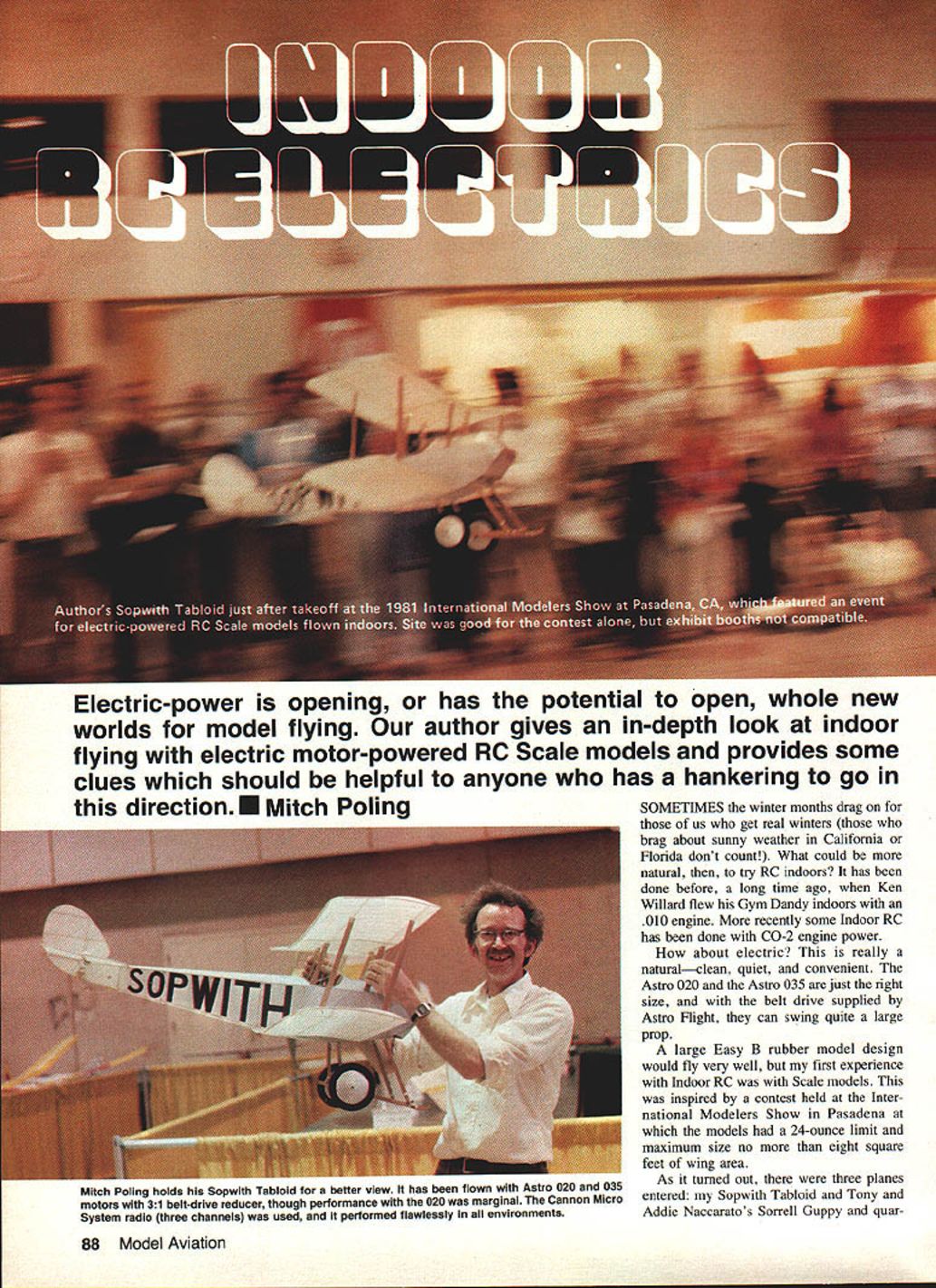
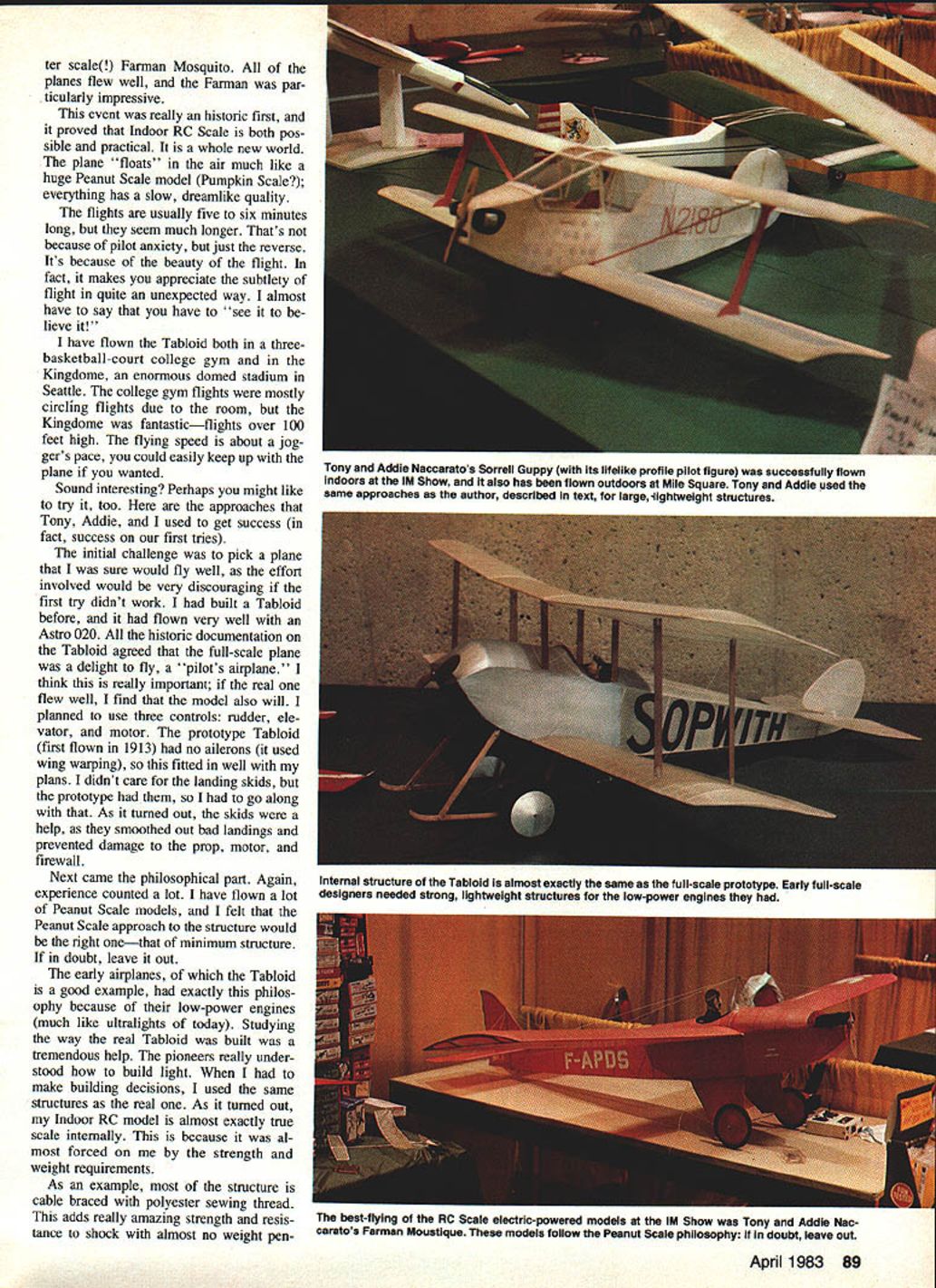
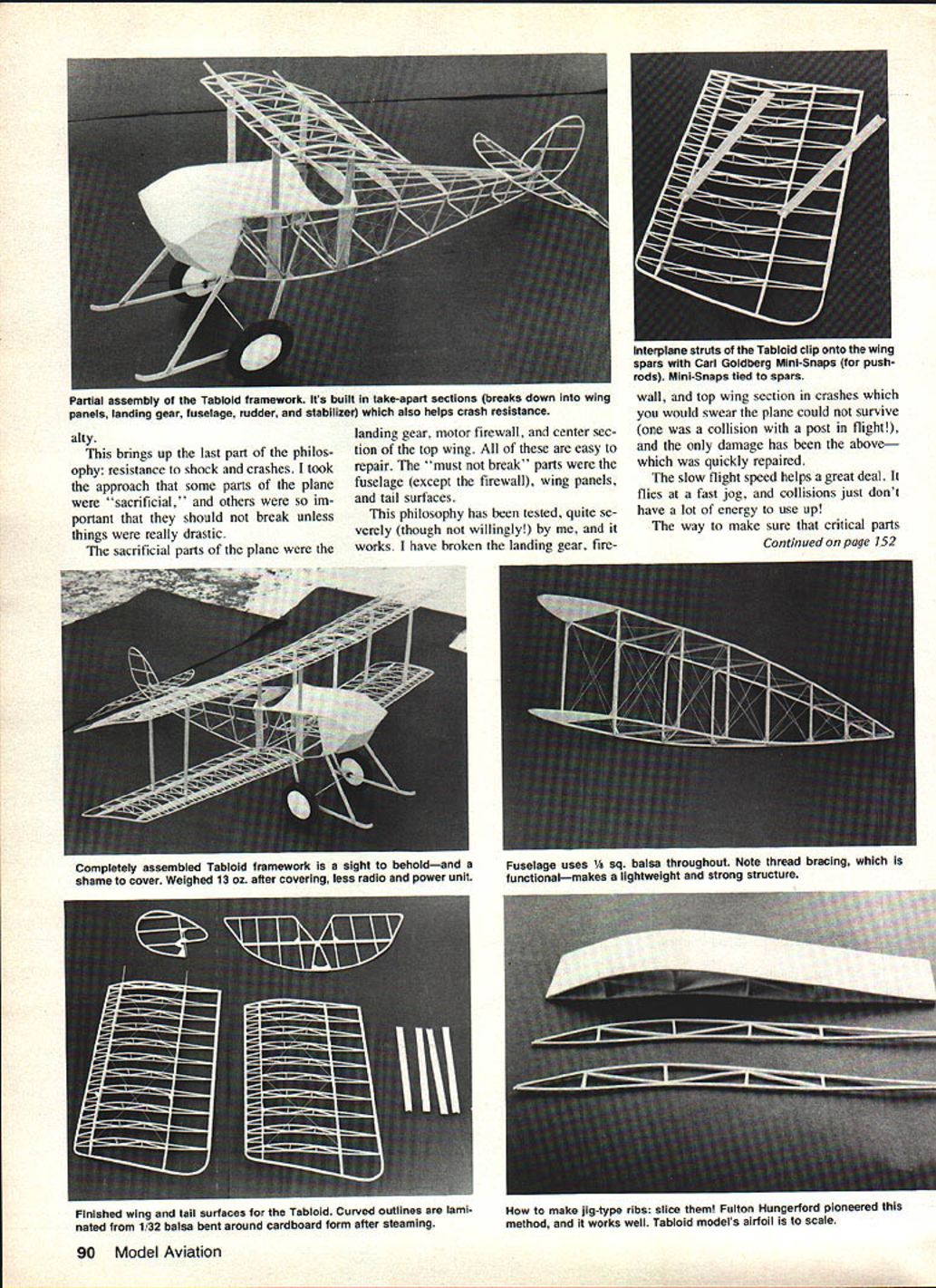
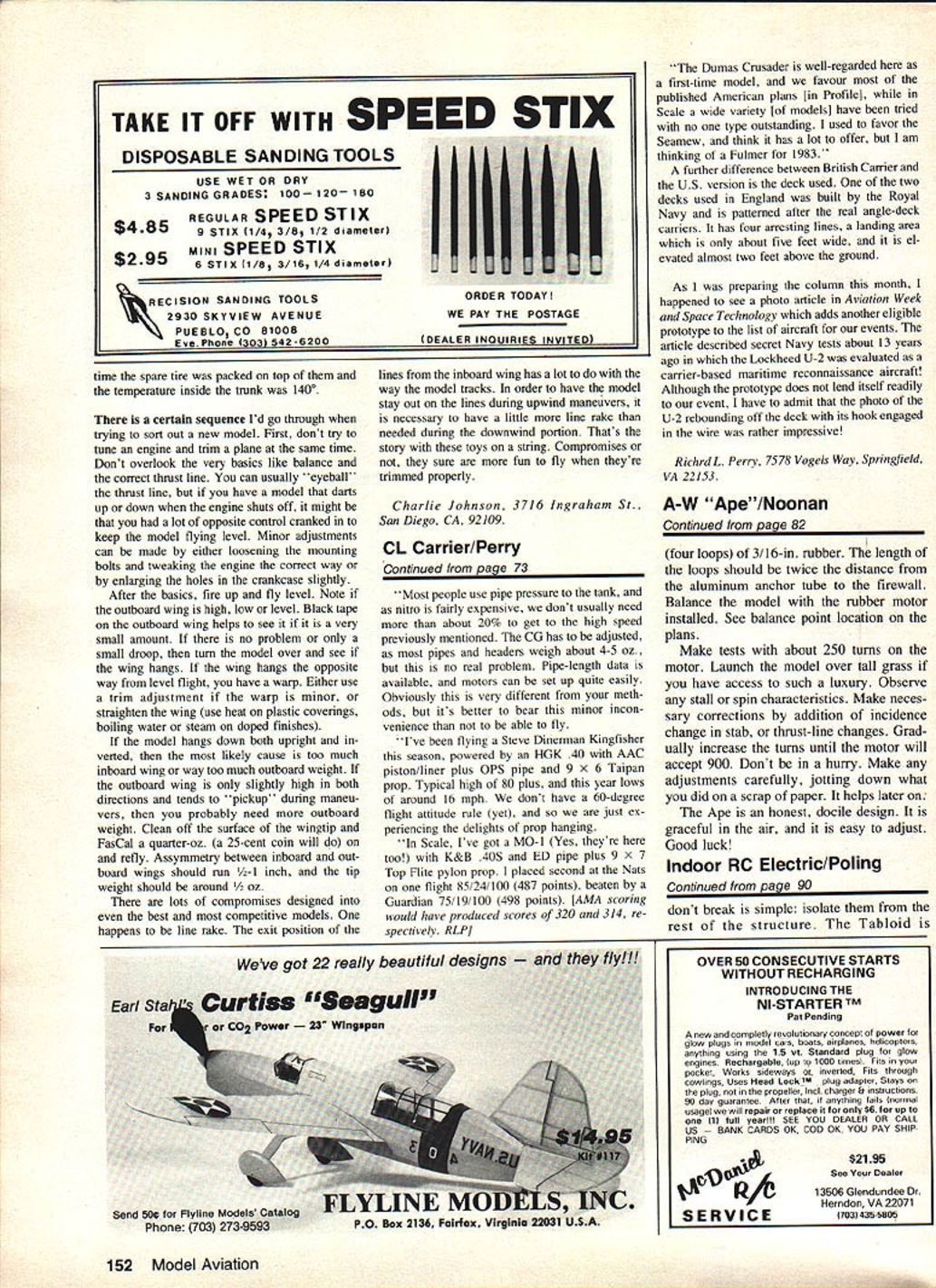
I first became interested in Indoor RC Scale after a contest at the International Modelers Show in Pasadena, where models had a 24-ounce limit and a maximum size of eight square feet of wing area. Three planes were entered: my Sopwith Tabloid and Tony and Addie Naccarato's Sorrell Guppy and quarter-scale Farman Mosquito. All flew well; the Farman was particularly impressive. The event proved that Indoor RC Scale is both possible and practical.
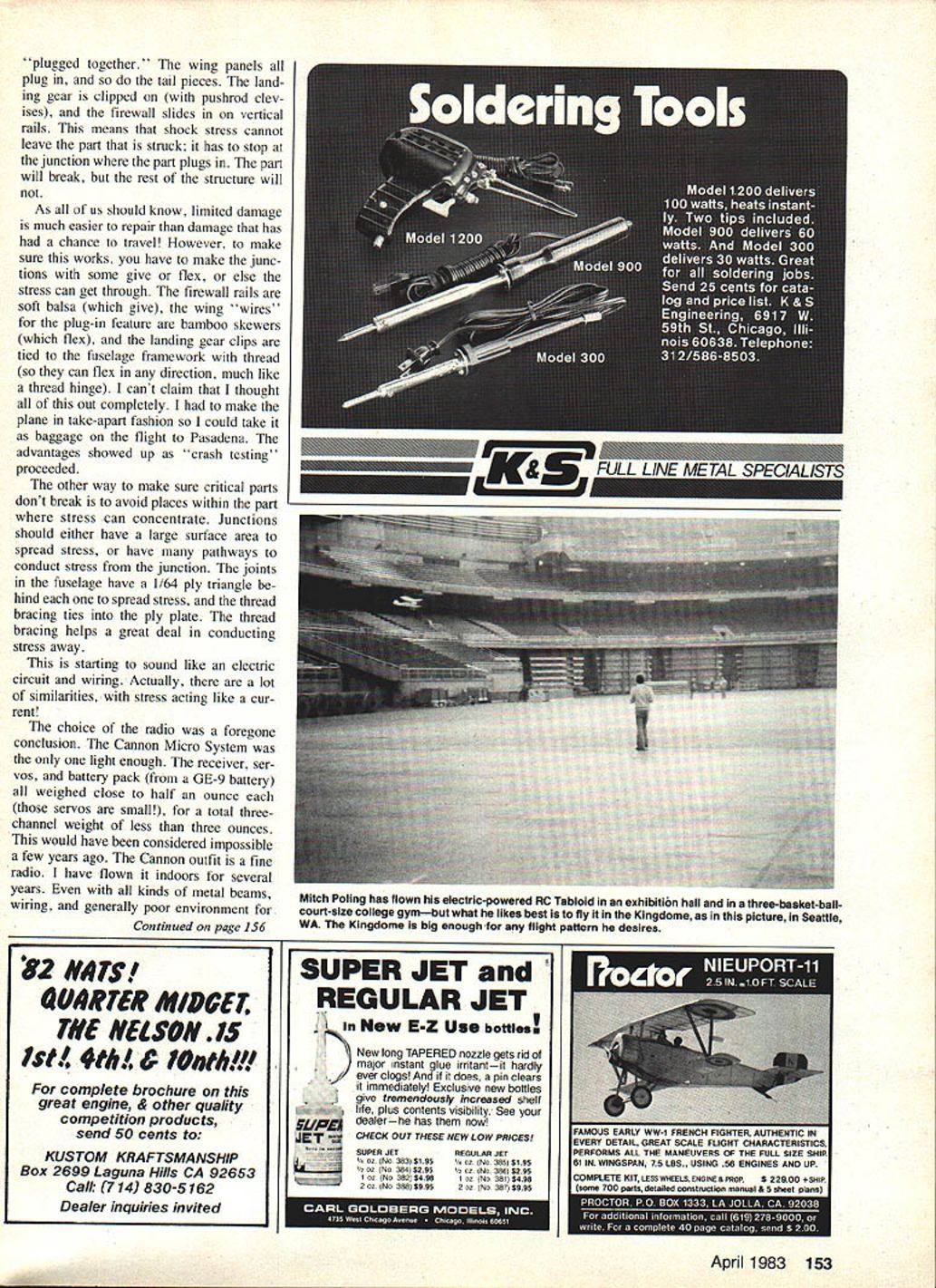
The plane "floats" in the air much like a huge Peanut Scale model—everything has a slow, dreamlike quality. Flights are usually five to six minutes long but seem much longer because of the beauty of the flight. I have flown the Tabloid in a three-basketball-court college gym and in the Kingdome in Seattle. The college gym flights were mostly circling due to space limits, but the Kingdome allowed flights over 100 feet high. Flying speed is about a jogger's pace—you could easily keep up with the plane if you wanted.
If this sounds interesting, here are the approaches Tony, Addie, and I used to succeed—success on our first tries.
Choosing the prototype and control setup
I chose a plane I was confident would fly well. I had built the Tabloid before and it flew well with an Astro .020. Historical documentation showed the full-scale Tabloid was a delight to fly—a "pilot's airplane." I believe this is important: if the real one flew well, the model likely will too.
I planned to use three controls: rudder, elevator, and motor. The prototype Tabloid (first flown in 1913) had no ailerons (it used wing warping), which fit my plans. I didn't care for the landing skids, but the prototype had them, so I followed suit. As it turned out, the skids were a help: they smoothed out bad landings and prevented damage to the prop, motor, and firewall.
Philosophy and structure
My philosophy came from Peanut Scale experience: minimum structure—if in doubt, leave it out. The early Tabloid construction reflected this philosophy because of low-power engines, and studying the real Tabloid helped a lot. I used the same structures as the real plane whenever possible. As a result, my indoor RC model is almost exactly true scale internally—forced by strength and weight requirements.
Most of the structure is cable-braced with polyester sewing thread. This adds surprising strength and resistance to shock with almost no weight penalty.
I also designed the plane with the idea of sacrificial parts and critical parts that must not break. Sacrificial parts are easy to repair; critical parts should survive everything but the most drastic incidents.
- Sacrificial parts:
- Landing gear
- Motor firewall
- Center section of the top wing
- "Must not break" parts:
- Fuselage (except the firewall)
- Wing panels
- Tail surfaces
This philosophy was tested—I've broken the landing gear, firewall, and top wing section in crashes (including a collision with a post) and only those parts were damaged; repairs were quick.
The slow flight speed helps a great deal. The plane flies at about a fast jog, and collisions just don't have a lot of energy.
Designing for limited damage
The way to make sure that critical parts are "plugged together" is to design joints so shock stress cannot travel into the rest of the structure. The wing panels plug in, and so do the tail pieces. The landing gear clips on (with pushrod clevises), and the firewall slides in on vertical rails. When a part takes the hit, the stress stops at the junction and only the part breaks.
To make this work, junctions need some give or flex, or else stress can transfer through. Examples from my Tabloid:
- Firewall rails are soft balsa (they give).
- Wing "wires" for the plug-in feature are bamboo skewers (they flex).
- Landing gear clips are tied to the fuselage framework with thread (acting like a hinge).
The fuselage joints have a 1/64" ply triangle behind each one to spread stress; the thread bracing ties into the ply plate. The thread bracing helps conduct stress away. There are many similarities here to an electric circuit, with stress acting like a current.
Radio choice
The Cannon Micro System was the only radio light enough at the time. The receiver, servos, and battery pack (from a GE-9 battery) all weighed close to half an ounce each—the total three-channel weight was less than three ounces. Even in difficult indoor environments (metal beams, wiring), the Cannon system performed without glitches.
Motor and power
Motor selection was harder. I tried both the Astro .020 (with a 3:1 belt drive reducer) and the Astro .035 with the reducer. The Astro .020 uses four cells; the Astro .035 uses six. I estimated the Tabloid would be about 24 oz. with the .035 and about 22 oz. with the .020.
- The .020 could ROG (rotate on ground) the plane, but lacked power for anything but the most careful turns.
- The .035 had plenty of power. Once up and cruising, I could go to half power and loaf in great style.
Motor control used two switches mounted on the motor servo: one for full power and one for half power (a .33 ohm resistor, 0.5 watt). The right prop was an 11x4 wood Top Flite; finding that required experimentation.
Controls and cockpit layout
The receiver, rudder and elevator servos, and receiver battery pack were mounted on a balsa slide-in plate that went into the cockpit. Rudder and elevator were worked by thread cable, adjusted at the tail surfaces by slip knots. Hinges for surfaces were thread—light and flexible.
The motor battery pack was hung just behind and below the firewall. Since the battery is the heaviest item, it must not be able to pull or push on structure in a crash. I made a light balsa box with the front end open so the battery fits loosely; in a crash the battery can slide out of the box, pass below the firewall, and out of the plane. The box is suspended by fiber tape from a former above it so it can "swing" a little. This system has prevented battery-related damage.
Construction details and materials
- Fuselage: 1/8" square balsa framework with 1/32" balsa sheeting in the nose and cockpit area.
- Tail surfaces: laminated 1/32" x 1/8" balsa strips and 1/8" sq. balsa.
- Wings: 1/8" sq. spruce spars top and bottom, with 1/32" balsa vertical webbing in a box structure. Wing tips are laminated 1/32" x 1/8" balsa strips.
- Wing "wires": bamboo shish-kebab skewers fitted inside the box spars—tough, very light, and with the right amount of give. I bent them with steam for the dihedral.
- Bottom panels plug into aluminum tubing through the fuselage.
- Interplane and cabane struts: laminated from one layer of 1/64" balsa and 1/16" balsa, clipping into Carl Goldberg mini-snaps tied to wing spars with thread.
- Landing gear: laminated 1/16" basswood and 1/16" balsa, clipping into mini-snaps tied on fuselage longerons. The axle is a bamboo skewer bound to the skids with rubber bands.
Wheels: 1-inch-thick Styrofoam (1 lb./cu. ft. density) spun on a hand drill used as a lathe. I used a #11 X-Acto as a lathe tool and an emery board for finishing. Axle hubs are plastic tubing epoxied to a 1/64" ply 1-inch disk on each end to prevent the foam from tearing. Wheels are painted with black watercolor and wheel cones are bond paper—very light, realistic, and strong.
Covering: Peck-Polymers white Japanese tissue applied with thinned white glue and tightened with isopropyl alcohol sprayed with an inexpensive Badger sprayer. Avoid water—too much shrinkage. The trick is to barely tighten the paper; dope will further shrink it later.
Doping and finishes: regular clear dope with castor-oil plasticizer caused too much shrinkage on some parts, so I used Sig Lite clear dope (50:50 with Sig thinner). Sig Lite shrinks very little; one coat applied with an inexpensive Badger sprayer was sufficient. The aluminum cowl was painted with Floquil railroad paint thinned 50:50 with Floquil thinner—excellent coverage in one coat.
Lettering: Sopwith lettering was cut from black bamboo paper (darker than regular tissue) and stuck on with thinned clear dope (Sig Lite).
Bracing wires: landing gear and wings use silver silk thread from a sewing store for realistic-looking wire braces; cable tension is adjusted with slip knots. The plane balances at about one third of the chord back from the leading edge on the top wing, which proved right for good flying.
Trim and control settings
- Motor thrust: about 5° down and 4° right; both are needed. Without these settings, right turns are much too slow and trim changes when the motor is on or off.
- Control throws: rudder 1½ in. each side; elevator 1 in. each side.
- Final dimensions: 51 in. span, 11 in. chord, 41 in. length.
- All-up weight: 24 to 26 oz., depending on motor batteries. This worked out to roughly 1/6 scale (that was unintentional); I had aimed at eight square feet.
Flight characteristics
Takeoff is a delight—slow and dreamlike. It lifts off in about 8–12 feet of ground roll. Climb is gentle but fast enough that after a minute I switch to half throttle to keep below the ceiling. Left turns are easy and smooth; right turns require more work—the full-scale airplane apparently behaved similarly due to its rotary engine.
Response to controls is positive but not jumpy—the large size relative to weight makes the plane take a little time to respond, like pushing a balloon. I have not tried aerobatics; the model is not stressed for them (though I have room in the Kingdome). Landings are slow, floating, and graceful. Overall it was a rewarding but challenging project—and a lot of fun.
Recommendations
If you'd like to try Indoor RC Scale:
- Try a 5–6 sq. ft. model under 20 oz. with an Astro .020 for smaller indoor spaces.
- For large indoor spaces, try the 24-oz., 8 sq. ft. size with an Astro .035.
Stay dry and warm—fly indoors!
Transcribed from original scans by AI. Minor OCR errors may remain.

