
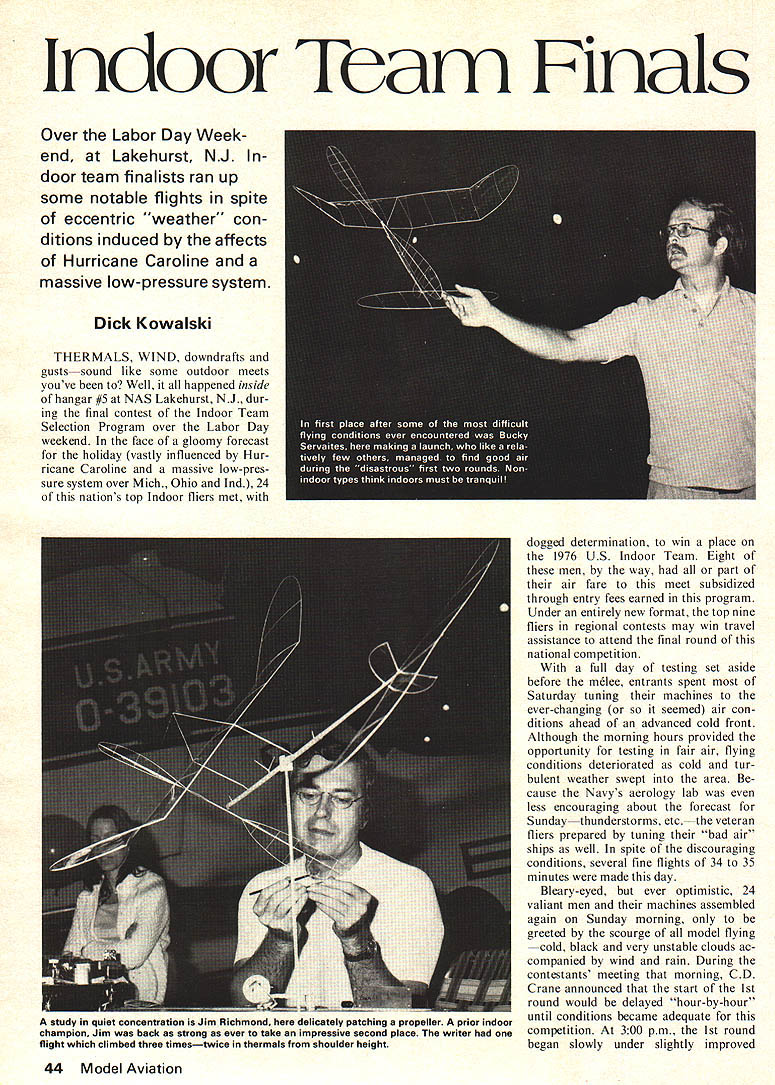
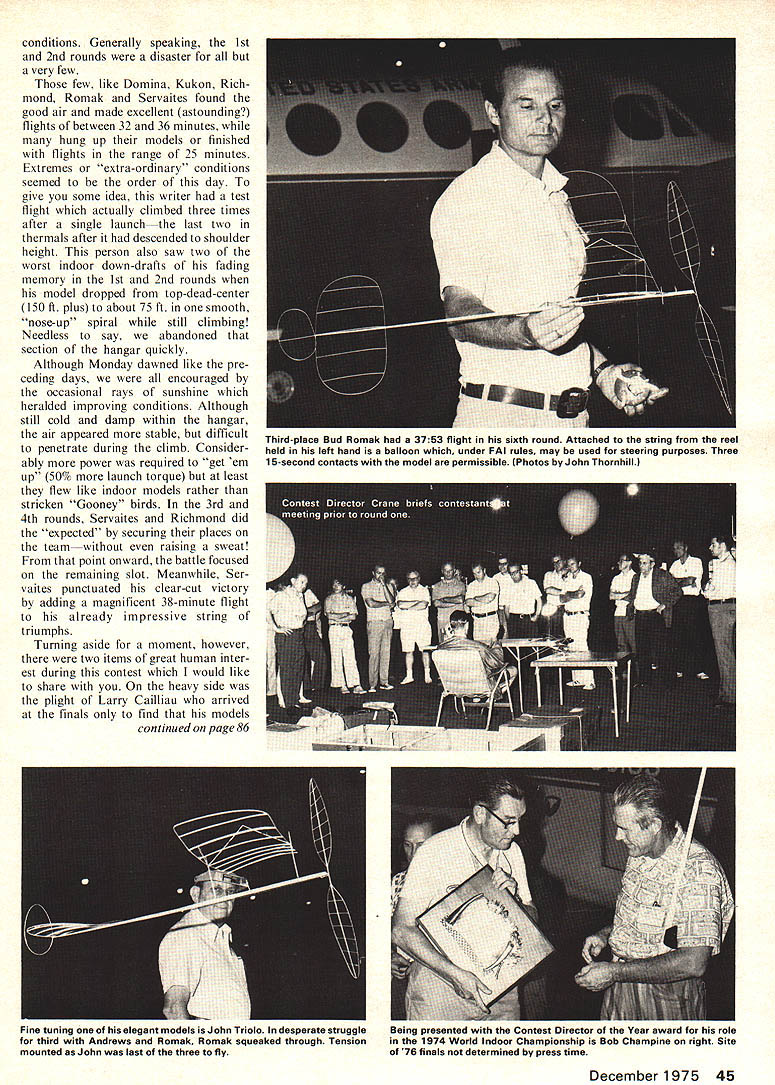
Indoor Team Finals
Over the Labor Day Weekend, at Lakehurst, N.J., indoor team finalists ran up some notable flights in spite of eccentric "weather" conditions induced by the effects of Hurricane Caroline and a massive low-pressure system.
Dick Kowalski
THERMALS, WIND, downdrafts and gusts—sound like some outdoor meets you've been to? Well, it all happened inside of hangar #5 at NAS Lakehurst, N.J., during the final contest of the Indoor Team Selection Program over the Labor Day weekend. In the face of a gloomy forecast for the holiday (vastly influenced by Hurricane Caroline and a massive low-pressure system over Mich., Ohio and Ind.), 24 of this nation's top indoor fliers met, with dogged determination to win a place on the 1976 U.S. Indoor Team. Eight of these men, by the way, had all or part of their air fare to this meet subsidized through entry fees earned in this program. Under an entirely new format, the top nine fliers in regional contests may win travel assistance to attend the final round of this national competition.
With a full day of testing set aside before the melee, entrants spent most of Saturday tuning their machines to the ever-changing (or so it seemed) air conditions ahead of an advanced cold front. Although the morning hours provided the opportunity for testing in fair air, flying conditions deteriorated as cold and turbulent weather swept into the area. Because the Navy's aerology lab was even less encouraging about the forecast for Sunday—thunderstorms, etc.—the veteran fliers prepared by tuning their "bad air" ships as well. In spite of the discouraging conditions, several fine flights of 34 to 35 minutes were made this day.
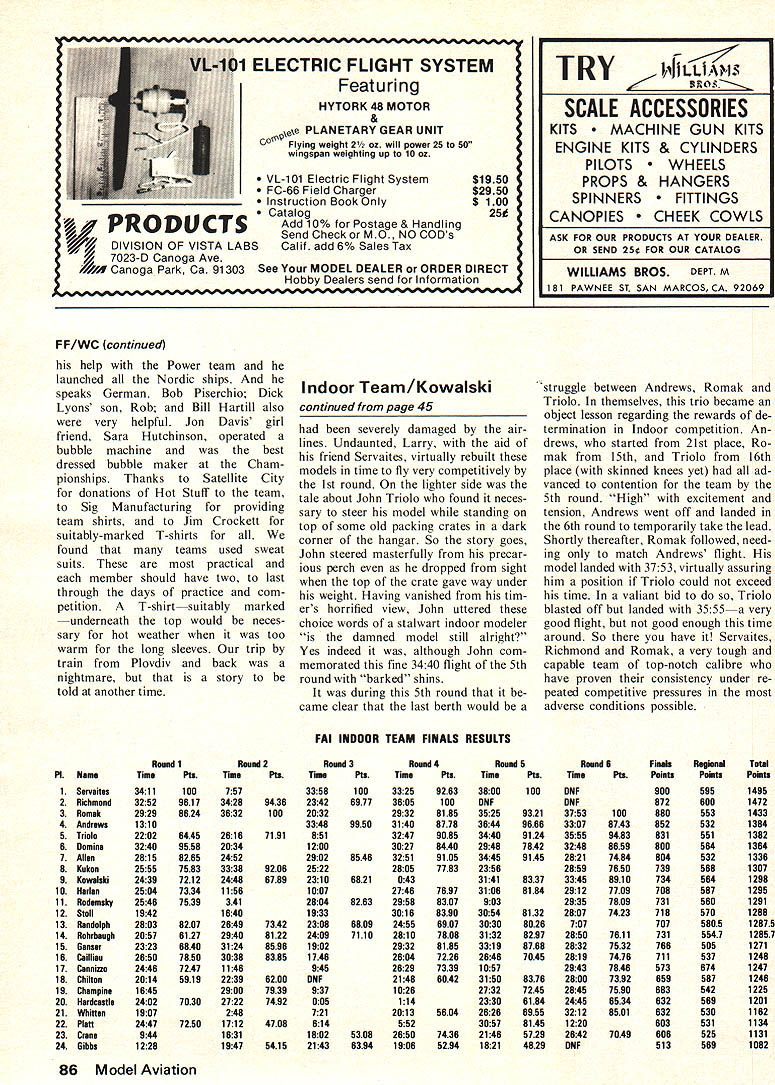
Bleary-eyed, but ever optimistic, 24 valiant men and their machines assembled again on Sunday morning, only to be greeted by the scourge of all model flying—cold, black and very unstable clouds accompanied by wind and rain. During the contestants' meeting that morning, C.D. Crane announced that the start of the 1st round would be delayed "hour-by-hour" until conditions became adequate for this competition. At 3:00 p.m., the 1st round began slowly under slightly improved conditions. Generally speaking, the 1st and 2nd rounds were a disaster for all but a very few.
Those few, like Domina, Kukon, Richmond, Romak and Servaites found the good air and made excellent (astounding) flights of between 32 and 36 minutes, while many hung up their models or finished with flights in the range of 25 minutes. Extremes or "extra-ordinary" conditions seemed to be the order of this day. To give you some idea, this writer had a test flight which actually climbed three times after a single launch—the last two in thermals after it had descended to shoulder height. This person also saw two of the worst indoor down-drafts of his fading memory in the 1st and 2nd rounds when his model dropped from top-dead-center (150 ft.) to about 75 ft. in one smooth, "nose-up" spiral while still climbing! Needless to say, we abandoned that section of the hangar quickly.
Although Monday dawned like the preceding days, we were all encouraged by the occasional rays of sunshine which heralded improving conditions. Although still cold and damp within the hangar, the air appeared more stable, but difficult to penetrate during the climb. Considerably more power was required to "get 'em up" (50% more launch torque) but at least they flew like indoor models rather than stricken "Gooney" birds. In the 3rd and 4th rounds, Servaites and Richmond did the "expected" by securing their places on the team—without even raising a sweat! From that point onward, the battle focused on the remaining slot. Meanwhile, Servaites punctuated his clear-cut victory by adding a magnificent 38-minute flight to his already impressive string of triumphs.
Turning aside for a moment, however, there were two items of great human interest during this contest which I would like to share with you. On the heavy side was the plight of Larry Cailliau who arrived at the finals only to find that his models
Indoor Team/Kowalski
had been severely damaged by the airlines. Undaunted, Larry, with the aid of his friend Servaites, virtually rebuilt these models in time to fly very competitively by the 1st round. On the lighter side was the tale about John Triolo who found it necessary to steer his model while standing on top of some old packing crates in a dark corner of the hangar. So the story goes, John steered masterfully from his precarious perch even as he dropped from sight when the top of the crate gave way under his weight. Having vanished from his timer's horrified view, John uttered these choice words of a stalwart indoor modeler: "Is the damned model still all right?" Yes indeed it was, although John commemorated this fine 34:40 flight of the 5th round with "barked" shins.
It was during this 5th round that it became clear that the last berth would be a struggle between Andrews, Romak and Triolo. In themselves, this trio became the object lesson regarding the rewards of determination in Indoor competition. Andrews, who started from 21st place, Romak from 15th and Triolo from 16th place (with skinned knees yet) had all advanced to contention for the team by the 5th round. High with excitement and tension, Andrews went off and landed in the 6th round to temporarily take the lead. Shortly thereafter, Romak followed, needing only to match Andrews' flight. His model landed with 37:53, virtually assuring him a position if Triolo could not exceed this time. In a valiant try Triolo landed with 35:55 — a very good flight, but not enough to deny Romak this last spot. So there you have it: Servaites, Richmond and Romak — a very tough and capable team of top-notch calibre who have proven their consistency under repeated competitive pressures in the most adverse conditions possible.
Transcribed from original scans by AI. Minor OCR errors may remain.

