
Indoor Week: U.S. Indoor Championships
Three events came together consecutively to produce a nearly week-long extravaganza for indoor model flying. First was the U.S. Indoor Championships, followed by the NIMAS Record Trials, and then the round‑the‑clock Peanut Grand Prix. Flying conditions at West Baden, IN were great. — Bob Clemens
U.S. Indoor Championships
Nobody said it would be easy, and it wasn't. Competition among the almost 80 contestants at the U.S. Indoor Championships held at West Baden, IN on June 14–16 was keen in all ten AMA events as well as five additional unofficial events held during this Class AAAA meet. Fliers coming away from the contest with trophies knew they had earned them by flying against some of the country's best indoor competitors at one of the best indoor arenas anywhere.
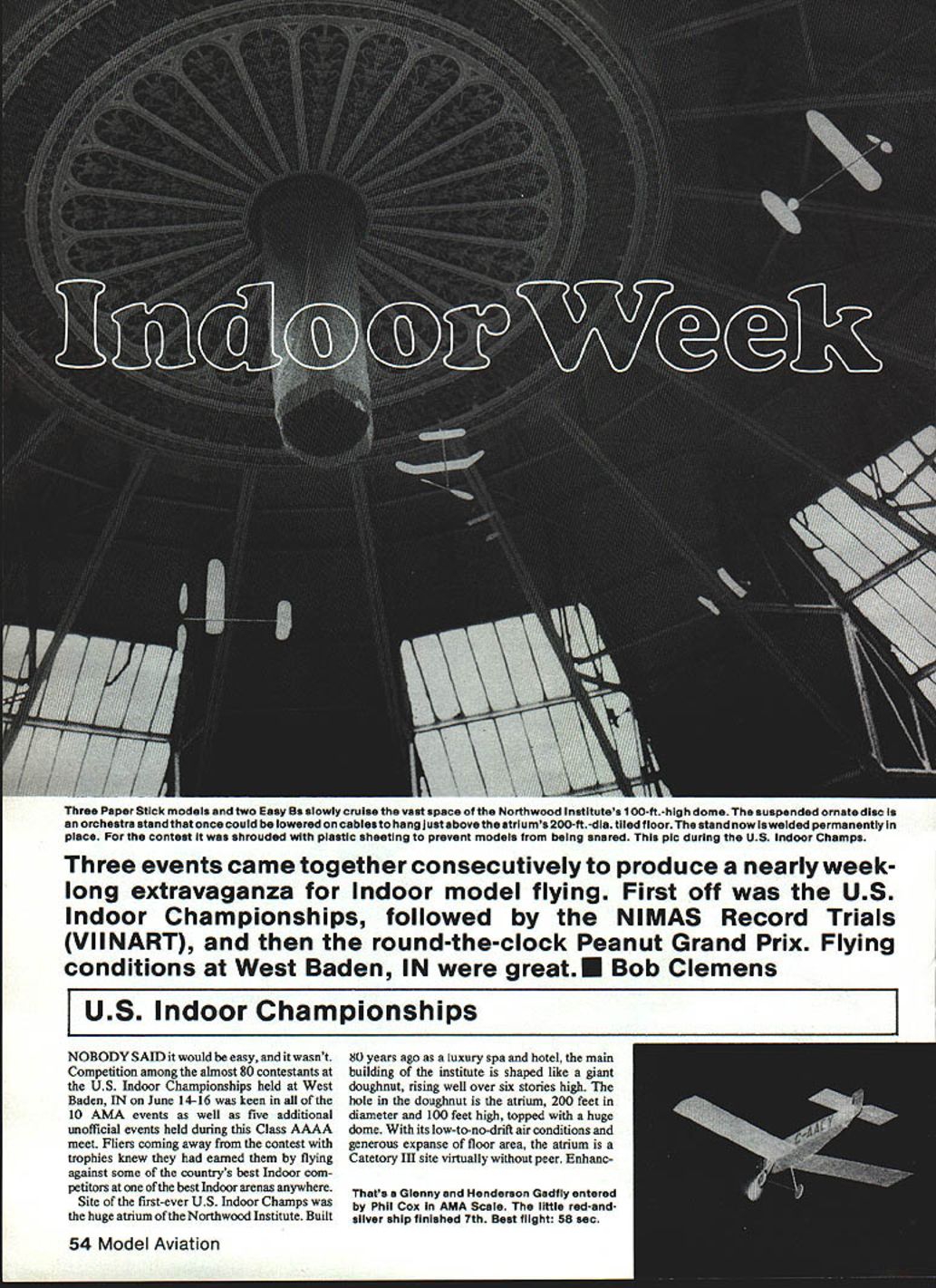
The site of the first-ever U.S. Indoor Championships was the huge atrium of the Northwood Institute. Built 80 years ago as a luxury spa and hotel, the main building of the institute is shaped like a giant doughnut, rising well over six stories high. The hole in the doughnut is the atrium, 200 feet in diameter and 100 feet high, topped with a huge dome. With its low-to-no-drift air conditions and generous expanse of floor area, the atrium is a Category III site virtually without peer. Enhancing its desirability and uniqueness is the fact that the same building also provides dormitory rooms for contestants as well as complete dining facilities.
Sponsors and officials
- Sponsors: National Free Flight Society, National Indoor Model Airplane Society, Illinois Model Airplane Club, Chicago Aeronuts.
- Contest Directors: Tony Italiano, Hardy Brodersen, Charlie Sotich, Gordon Wisniewski.
Official flying got underway at 8 a.m. on Monday, June 14, as Manhattan and Bostonian cabin events were run simultaneously. Both events place emphasis on model realism and have specific dimensional requirements involving prop diameter, overall length, span, and fuselage cross section. Minimum weight for Manhattan models is 4 grams; Bostonians must weigh at least 7 grams and are also awarded a "charisma" score ranging from 1.0 to 1.2 points. Charisma points are given for overall appearance and originality and are added to the flight score.
Jack McGillivray of Toronto walked away with the Bostonian event with his Yeti, loosely modeled after a Pilatus Porter used in the Himalayan mountains. Jack's neat orange-and-white ship received a full 1.2 charisma score and posted ROG flights of 2:52, 3:01, and 3:07 for a total of 6:48—far ahead of Martin Varney's second-place effort of 3:27.8. The Yeti featured double-covered wings and stab, both using undercambered airfoils. Power was a 28‑in. loop of 1/16 Pirelli wound to as many as 2,560 turns.
A nine-man field battled for the lighter Manhattan class title. Chuck Markos of the Chicago Aeronuts posted a high time of 9:57 to beat out Larry Loucka's 9:50; Walt Van Gorder was third with 8:40.
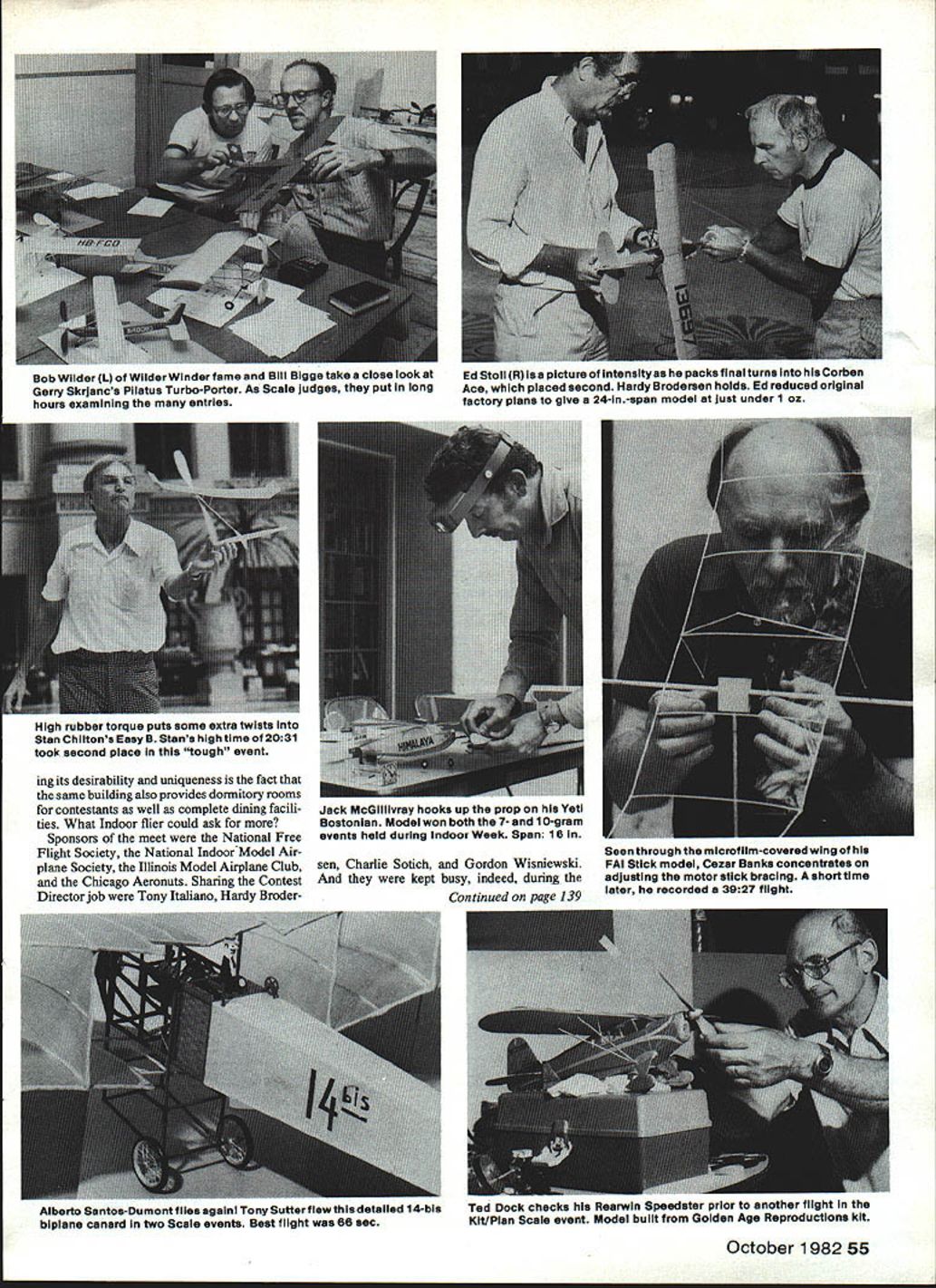
High noon saw Easy B and Paper Stick take over the arena. Carrying what must be the greatest misnomer in the history of aeromodelling, Easy B this year returned to paper-covered-only status (microfilm was allowed in 1980–81). Gerry Skrjanc, Stan Chilton, and Walt Van Gorder, three of the small number of real masters of this demanding event, met head-to-head to determine the Open winner. When official flying ended at 6 p.m., just 24 seconds separated first from third:
- 1) Gerry Skrjanc — 20:43
- 2) Stan Chilton — 20:31
- 3) Walt Van Gorder — 20:19
In Jr./Sr. Easy B, Bob Skrjanc was first with 11:08, followed by David Brown at 7:52.
Tuesday featured Pennylane and Novice Pennylane competition from 8 a.m. until noon. Both events were closely contested. Walt Van Gorder topped a 14-man field in Open Pennylane with an 11:34 flight, closely pressed by Gerry Skrjanc at 11:30. Bob Warmann finished third at 10:45. In the Senior field, Dave Lindley of Naperville, Ill., with 11:30 beat out Kriss Warmann's 10:42.
San Diego's Cezar Banks won Novice Pennylane by 11 seconds; his best flight of 11:43 edged Walt Van Gorder's 11:32. Glider ace Bernie Boehm took third with 10:22. Mike Clem won Senior with a 9:28 flight.
High noon marked the entrance of the elite lightweights of indoor duration flying: Paper Stick, AMA Cabin, AMA Stick, and FAI Stick. The FAI event was flown in six half‑hour rounds, ending at 9 p.m., with the top two flights of each flier added together to determine the order of finish.
FAI competition saw four flights over 30 minutes. Two of these belonged to Stan Chilton: 32:20 and 30:56, for a 63:16 total that earned first place. Jim Richmond finished second with 63:05, and Ed Stoll was third with 59:06. Crowded airspace resulted in numerous mid‑air collisions during the afternoon.
Dave Lindley topped Senior AMA Stick with 17:43, while Jim Richmond took first in Open AMA Stick with 32:54 over Rich Doig's 31:24. Rich Doig topped the four-man field in AMA Cabin with a 22:54 flight.
Bernie Boehm again demonstrated his mastery of the atrium in Hand‑Launched Glider as he took the Open title on Wednesday morning with flights of 64.8 and 63.8 seconds. Bob Larsh was second with 58.8 and 60.2 seconds, while Senior Bryan Fullmer's two‑flight total of 104.6 seconds topped his class.
The grand finale of the U.S. Indoor Championships was Scale. Flying began at noon after the dozens of AMA and Peanut models had been closely scrutinized by static judges Bill Bigge and Bob Wilder. Jack McGillivray led a 10‑man field in Open AMA Scale with his superb SE‑5A. Although a biplane, it turned two max flights of 90 seconds and earned 87 scale points for a 177‑point total. Jack's model is actually a Peanut and features an authentic opaque finish. Ed Stoll finished second, just 5½ points back, with a beautiful 24‑in. Corben Ace. Ed's two‑flight high time average was 78.5 seconds combined with 93 scale points. Third place went to Ken Grove's Bucker Jungmeister with 166 points. Ken Warmann won Jr./Sr. Scale.
Peanut Scale saw 15 Open contestants battling for the 13‑in. class title. Jack McGillivray notched his third victory of the meet as his Volksplane totaled 199 points. Fellow Canadian Ken Grove took second with a Fike. Despite having a higher flight time of 1:56, Ken's single‑winged Fike lost out on scale and handicap points to the SE‑5A, which recorded 1:50. Jim Miller's veteran Piper Vagabond was third with 183 points—best flight of 1:46.
Peanut Jr./Sr. went to Brad Fullmer and his Lacey M‑10 at 142 points; second was his brother Bryan at 131 points, also with a Lacey. Third was Brian Varney with a Nesmith Cougar and 107 points.
Charlie Sotich ran the unique Peanut Speed and Unlimited Speed events off the side of the floor. Models are required to be ROG and complete two full airborne laps around two balloons tethered 20 feet apart. Martin Varney repeated his Peanut Speed victory of 1981, again flying a Folkerts racer. Marty's ship polished the course in 5.94 seconds to win, while Millard Wells got his Andreasson MF‑1 around the two laps in 8.77 seconds for second place. Marty's Folkerts also took the Unlimited Speed event with a 5.49 clocking; his son Brian finished second with a Gullow ROG in 8.6 seconds.
An interesting additional Scale event was held by the Calumet Aircraft Modelers of Griffith, IN: Kit/Plan Scale. Models are scored for flight duration and for fidelity of construction to the kit or published plan from which they are built. No conventional scale judging is used, so older Comet, Megow, and Peerless plans are excellent subjects. There were eight entries—a good turnout for a new and somewhat unfamiliar event. Miami's Dr. John Martin took first place flying a Curtiss Robin from a 1931 model airplane plans book. Second went to Terry Mrakava of the Chicago Aeronuts with a Peck Lacey M‑10, while Ted Dock was third with a Golden Age Rearwin Speedster. Dr. Martin's Robin turned in times of 1:21 and 1:23—not bad for a 31‑year‑old design.
Capping the three days of flying was a banquet on Wednesday evening featuring guest speaker Dr. Paul MacCready of man‑powered‑flight fame. A former indoor modeler himself, Dr. MacCready presented many fascinating insights on his Gossamer and Solar series of aircraft and their history‑making flights.
A straw poll taken at the banquet indicated those in attendance would like to see the U.S. Indoor Championships become an annual part of Indoor Week at West Baden. No matter what the exact schedule, most contestants were already looking forward to another session of fine flying and fellowship in 1983.
Transcribed from original scans by AI. Minor OCR errors may remain.

