
Indoor World Championship
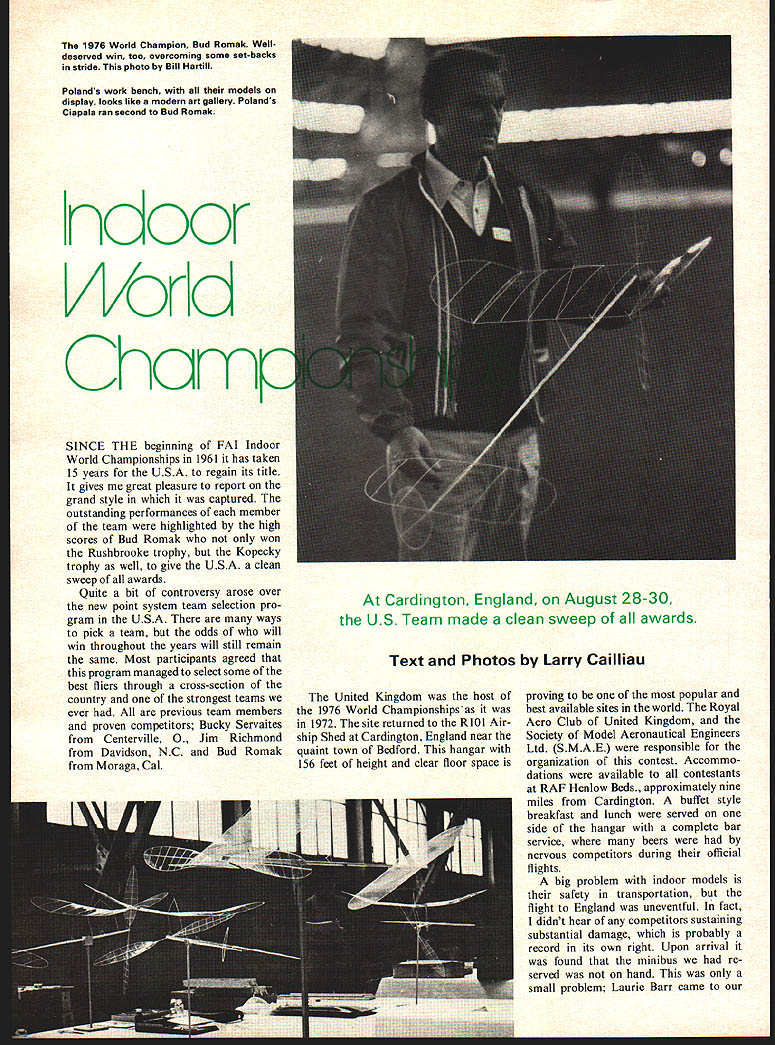
SINCE THE beginning of FAI Indoor World Championships in 1961 it has taken 15 years for the U.S.A. to regain its title. It gives me great pleasure to report on the grand style in which it was captured. The outstanding performances of each member of the team were highlighted by the high scores of Bud Romak who not only won the Rushbrooke trophy, but the Kopecky trophy as well, to give the U.S.A. a clean sweep of all awards.
Quite a bit of controversy arose over the new point system team selection program in the U.S.A. There are many ways to pick a team, but the odds of who will win throughout the years will still remain the same. Most participants agreed that this program managed to select some of the best fliers through a cross-section of the country and one of the strongest teams we ever had. All are previous team members and proven competitors: Bucky Servaites from Centerville, O.; Jim Richmond from Davidson, N.C.; and Bud Romak from Moraga, Cal.
At Cardington, England, on August 28-30, the U.S. Team made a clean sweep of all awards.
Text and Photos by Larry Cailliau
The United Kingdom was the host of the 1976 World Championships as it was in 1972. The site returned to the R101 Airship Shed at Cardington, England near the quaint town of Bedford. This hangar with 156 feet of height and clear floor space is proving to be one of the most popular and best available sites in the world. The Royal Aero Club of United Kingdom, and the Society of Model Aeronautical Engineers, Ltd. (S.M.A.E.) were responsible for the organization of this contest. Accommodations were available to all contestants at RAF Henlow, Beds., approximately nine miles from Cardington. A buffet-style breakfast and lunch were served on one side of the hangar with a complete bar service, where many beers were had by nervous competitors during their official flights.
A big problem with indoor models is their safety in transportation, but the flight to England was uneventful. In fact, I didn't hear of any competitors sustaining substantial damage, which is probably a record in its own right. Upon arrival it was found that the minibus we had reserved was not on hand. This was only a small problem; Laurie Barr came to our aid.
Official testing was available Saturday, August 28, the day anticipated. Fifteen nations producing 42 entrants had a hand in giving the best shot. Now, wouldn't you know after a long drought, England decided to start raining Saturday. I knew at least 41 people in the country praying it would stop and set the trend for the next three days. Although it rained lightly off and on and it was quite chilly, it wasn't a bad day for testing.
Ron Green, United Kingdom, promptly put up the full test—37 minutes—which turned out to be the best flight of the day and showed everyone two things: little drift and a high ceiling. England's new team member was going to be tough to beat. Immediately following, others started shooting up. Jim Richmond hit and stuck the ceiling five minutes into his first opportunity. Meet "the rigger," indoor modelers' hero—no name; they just called him "the rigger." Undaunted, with nerves of steel, he would climb anywhere in the hangar to dislodge a model. Best knew how to handle indoor models. After Jim's model was freed, having lost some altitude, it managed to climb back up with the drift. Jim decided to walk down the catwalk to take the motor off; in time the model came down.
Ryszard Czechowski of Poland put up a nice test about 10 feet below the ceiling—34 minutes—showing the ex-champ still had the stuff together. Bud Romak had a nice flight going, got tired of watching it fly, and snagged a balloon about 100 ft. altitude. At 27 minutes he put the model back in the box for safekeeping. Bud took out another model trying to get the feel of the proper rubber size, managed to hang on the catwalk. Disappointed, Bud went back to the box for another model; before he could get set up, Ryszard Czechowski, up the catwalks retrieving his own models, found Bud's returned unharmed.
I didn't notice many new inventions. Torque meters are standard now; everybody was using bent-wing posts to provide wing offset. Another new thing was a large clear plastic collapsible box used by the Netherlands team to carry models safely and swiftly over long distances. In the hangar you would set the whole model inside the box, close the lid and off you would go, having no worry about collapsing a wing when walking too fast or moving in an unexpected gust. Seemed like a good idea.
The Swedish team's models looked quite different from others—very long tail booms flying 105% C.G. I heard of a test flight over 36 minutes Sunday morning. Pete Andrews, team manager, checking weather and making sure team members aided with another car to help transport the models to Cardington.
Official testing was available Saturday, August 28, the day we all were anticipating. Fifteen nations, producing 42 entrants, were on hand to give it their best shot. Now wouldn't you know that, after a long drought in England, it would decide to start raining Saturday. I knew of at least 41 people in the country who were praying for it to stop. This set the trend of weather conditions for the next three days.
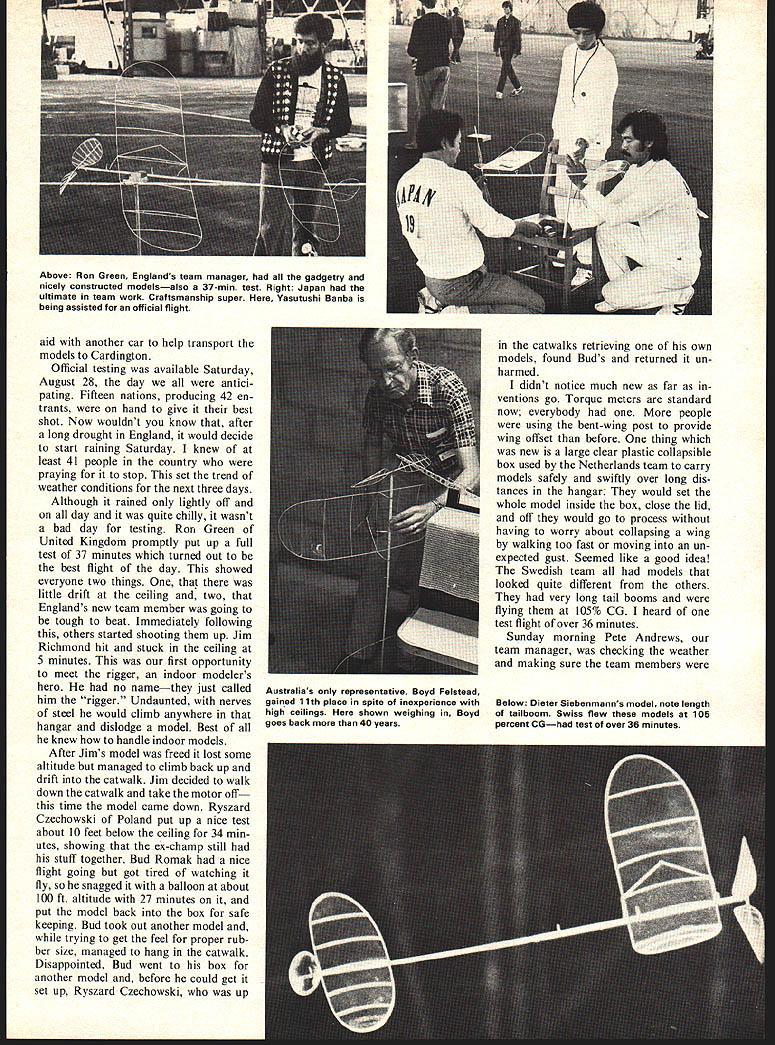
Although it rained only lightly off and on all day and it was quite chilly, it wasn't a bad day for testing. Ron Green of United Kingdom promptly put up a full test of 37 minutes which turned out to be the best flight of the day. This showed everyone two things. One, that there was little drift at the ceiling and, two, that England's new team member was going to be tough to beat. Immediately following this, others started shooting them up. Jim Richmond hit and stuck in the ceiling at 5 minutes. This was our first opportunity to meet the rigger, an indoor modeler's hero. He had no name—they just called him the "rigger." Undaunted, with nerves of steel he would climb anywhere in that hangar and dislodge a model. Best of all he knew how to handle indoor models.
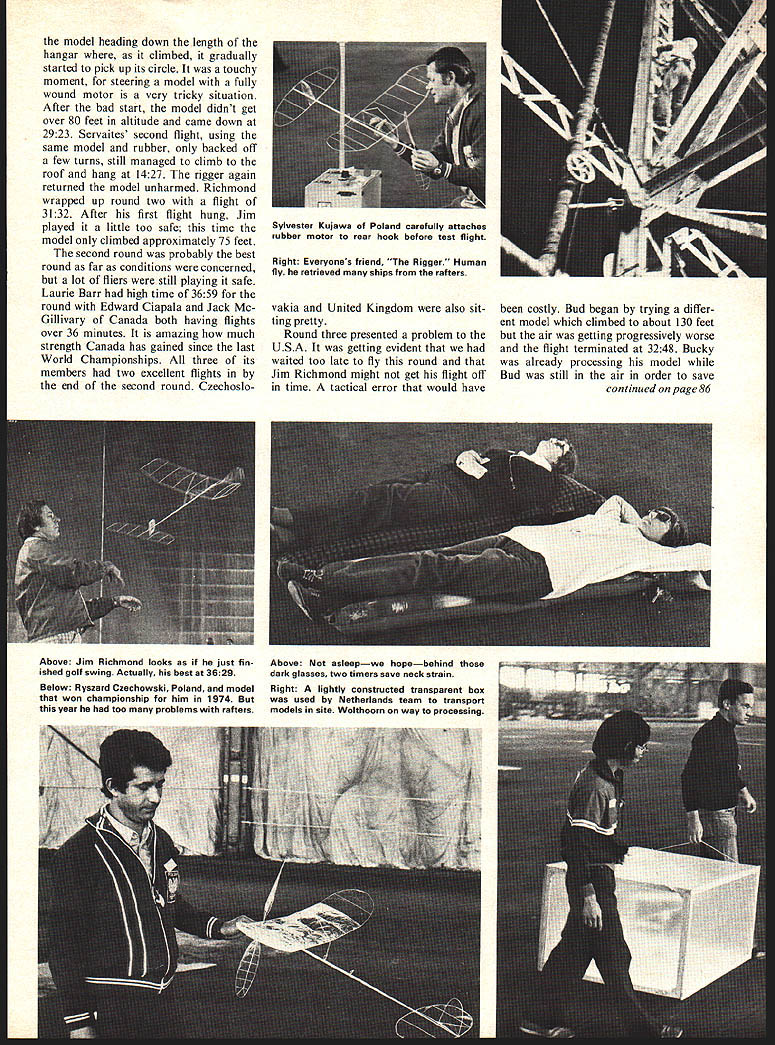
After Jim's model was freed it lost some altitude but managed to climb back up and drift into the catwalk. Jim decided to walk down the catwalk and take the motor off—this time the model came down. Ryszard Czechowski of Poland put up a nice test about 10 feet below the ceiling for 34 minutes, showing that the ex-champ still had his stuff together. Bud Romak had a nice flight going but got tired of watching it fly, so he snagged it with a balloon at about 100 ft. altitude with 27 minutes on it, and put the model back into the box for safekeeping. Bud took out another model and, while trying to get the feel for proper rubber size, managed to hang in the catwalk. Disappointed, Bud went to his box for another model and, before he could get it set up, Ryszard Czechowski, who was up in the catwalks retrieving one of his own models, found Bud's and returned it unharmed.
I didn't notice much new as far as inventions go. Torque meters are standard now; everybody had one. More people were using the bent-wing post to provide wing offset than before. One thing which was new is a large clear plastic collapsible box used by the Netherlands team to carry models safely and swiftly over long distances in the hangar. They would set the whole model inside the box, close the lid, and off they would go to process without having to worry about collapsing a wing by walking too fast or moving into an unexpected gust. Seemed like a good idea! The Swedish team all had models that looked quite different from the others. They had very long tail booms and were flying them at 105% C.G. I heard of one test flight of over 36 minutes.
Indoor World Champs
up bright and early, or should I say, dull and early. The look-out-the-window weather check seemed much like Saturday, only the clouds were darker and there was a slight breeze. Traveling to the hangar seemed endless on an empty stomach with anticipations growing, for this was no drill. Entering the hangar for one of these contests always gives me a feeling of stepping into the twilight zone or a different world. You leave the brightness, noise, hustle and bustle behind you for the dark, serene, whisper-slow-motion world inside. Some days I can hardly wait to get there, especially today as breakfast was waiting inside. Across from the dining area were hung the colorful flags of all the nations, and it was fun to sit and leisurely eat while you watched the models floating about.
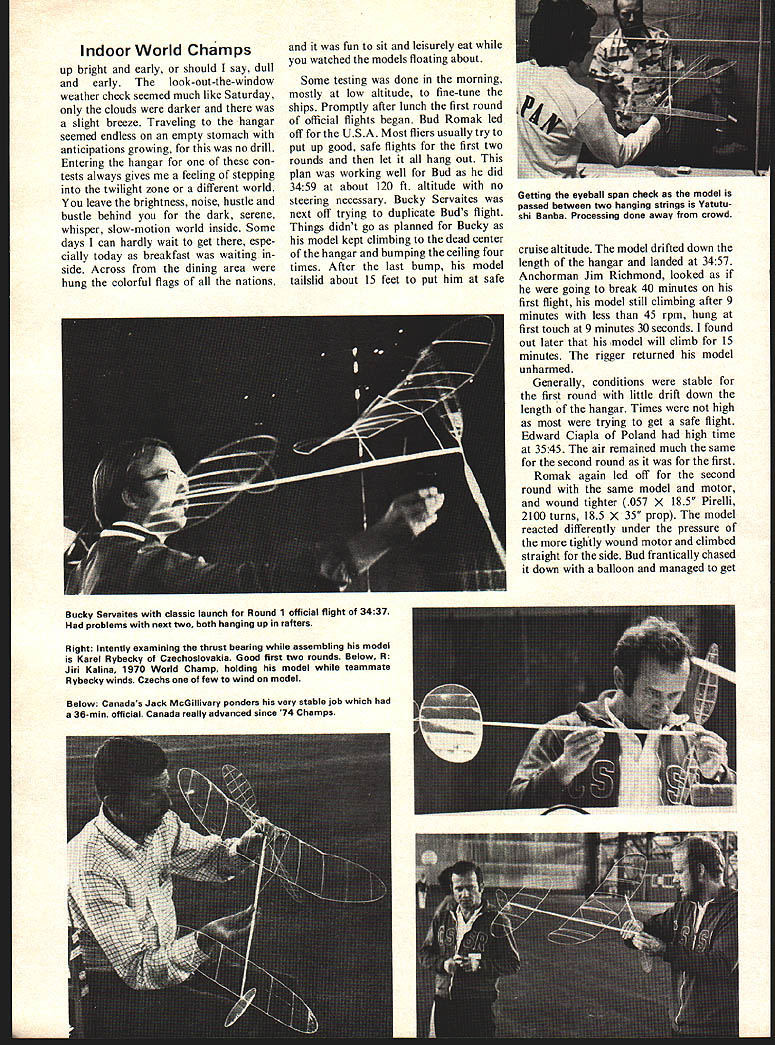
Some testing was done in the morning, mostly at low altitude, to fine-tune the ships. Promptly after lunch the first round of official flights began. Bud Romak led off for the U.S.A. Most fliers usually try to put up good, safe flights for the first two rounds and then let it all hang out. This plan was working well for Bud as he did 34:59 at about 120 ft. altitude with no steering necessary. Bucky Servaites was next off trying to duplicate Bud's flight. Things didn't go as planned for Bucky as his model kept climbing to the dead center of the hangar and bumping the ceiling four times. After the last bump, his model tailslid about 15 feet to put him at a safe 34:37. The rigger returned his model unharmed.
Generally, conditions were stable for the first round with little drift down the length of the hangar. Times were not high as most were trying to get a safe flight. Edward Ciapela of Poland had high time of 35:45. The air remained much the same for the second round as it was for the first.
Romak again led off for the second round with the same model and motor, wound tighter (.057 x 18.5" Pirelli, 2100 turns, 18.5 x 35" prop). The model reacted differently under the pressure of the more tightly wound motor and climbed straight for the side. Bud frantically chased it down with a balloon and managed to get cruise altitude. The model drifted down the length of the hangar and landed at 34:57. Anchorman Jim Richmond looked as if he were going to break 40 minutes on his first flight; his model was still climbing after 9 minutes with less than 45 rpm and hung at first touch at 9 minutes 30 seconds. I found out later that his model will climb for 15 minutes. The rigger returned his model unharmed. The model heading down the length of the hangar where, as it climbed, it gradually started to pick up its circle. It was a touchy moment, for steering a model with a fully wound motor is a very tricky situation. After the rigger had started, the model didn't get over 80 feet in altitude and came down at 29:23. Servaites' second flight, using the same model and rubber, only backed off a few turns, still managed to climb to the roof and hang at 14:27. The rigger again returned the model unharmed. Richmond wrapped up round two with a flight of 31:32. After his first flight hung, Jim played it a little too safe; this time the model only climbed approximately 75 feet. The second round was probably the best round as far as conditions were concerned, but a lot of fliers were still playing it safe. Laurie Barr had high time of 36:59 for the round with Edward Ciapela and Jack McGillivray of Canada both having flights over 36 minutes. It is amazing how much strength Canada has gained since the last World Championships. All three members had two excellent flights in by the end of the second round. Czechoslovakia and United Kingdom were also sitting pretty.
Round three presented a problem to the U.S.A. It was getting evident that we had waited too late to fly this round and that Jim Richmond might not get his flight off in time. A tactical error that would have been costly. Bud began by trying a different model which climbed to about 130 feet but the air was getting progressively worse and the flight terminated at 32:48. Bucky was already processing his model while Bud was still in the air in order to save.
Indoor World Championship
time. He still could not shake his bad luck as his model hit some bad air and drifted to the side. After a perfect steer he had it centered again, only to have the model drift back and hang at 10:15. Called the rigger one more time. If Bucky hadn't hung, Richmond would not have had time to fly his third round. But what was about to happen to Jim was astonishing. Jim packed in 2,150 turns using .067 x 19" Pirelli and a 21 x 36" prop and let her go. It was now raining heavily outside and water was dripping at different spots in the hangar. The model climbed well to about 10 feet, then hit some terrible air. The ship stalled, buffeted, and fell to about 60 feet and found some relatively smooth air. The flight looked doomed but we kept watching it cruise for about another 30 minutes at 60 feet. It finally landed with a time of 36:29 for the best flight of the round. Unreal!
The end of a hard-fought first day revealed United Kingdom in first place, Canada in second, and Czechoslovakia in third place. Bud Romak had the misfortune of getting two different times on his first flight. One timer had 33:59 and the other had 35:59, obviously a watch error. The watches were checked again and found to read alike, so the officials decided to throw the difference out and gave him 34:59. In an act of good sportsmanship and to relieve any ill feeling, Bud and Pete Andrews asked for the lower time, but the officials stood fast to their decision. Ron Green was putting up progressively better official flights when a motor broke on his third launch which caused him to change models. All in all the contest was running smoothly and very few mishaps occurred the first day.
The second day of competition began with a bang — in fact a lot of bangs from all the motors snapping. All you would hear from different parts of the hangar was snap and then some four-letter words in various languages. Everyone was winding them up as tight as they could get them. In fact, Bud was to start round two, but while hooking up the rubber it broke with the timers on hand, leaving him with some very soft toothpicks. This was probably the worst thing that ever happened to him because he mumbled something about needing to get out one of his better models anyway.
Meanwhile, Jim was prepared, so he led off round two with an underpowered flight of 20:53. Jim, I felt, had the most potential of all but just couldn't find the right rubber combination. Bud was now ready again with his "better" model which had a spectacular flight from beginning to end. The model stalled and recovered for about two minutes, holding an altitude of about 6 feet, then started a normal climb to an altitude of about 130 feet, drifted very little, and then struck the catwalk and came down. Once again Bucky was involved and brought it down with the rigger; the flight was given a good time.
It was interesting to note the various equipment and techniques in evidence. Torque meters were standard now and everybody seemed to be using bent-wing posts to provide wing offset before launch. A new large clear plastic collapsible box used by the Netherlands team carried models safely and swiftly over long distances. You would set the whole model inside the box, close the lid and off you would go without worrying about collapsing a wing while walking too fast or encountering an unexpected gust. Seemed like a good idea.
The Swedish team's models looked quite different from the others — very long tail booms flying at about 105% CG. Test flights Sunday morning showed some very long times, with Ron Green of England putting up a 37-minute test and other teams showing excellent craftsmanship and teamwork. Japan's team demonstrated ultimate teamwork and superb craftsmanship throughout the contest.
In the end, Bud Romak captured outstanding performances and a well-deserved title for the U.S.A. His win, overcoming some setbacks, gave great pleasure to the team and was highlighted by several very high scores. Bud Romak won the Rushbrooke Trophy and the Kopecky Trophy, giving the U.S.A. a clean sweep of major awards. Next, Bucky finally got his second safe flight up without hanging. The model climbed to only 100 feet of altitude, but returned in a respectable time of 32:34. Now we were back in the race.
Round five began with Jim; his model climbed to good altitude but seemed to be diving very slightly in descent. The rpm was higher than normal and the flight landed at 31:41, still upping his second best time. Bucky was ready to launch as soon as Jim's model touched down, but the motor stuck collapsed and he had to try a new model. This model, relatively untested, climbed poorly and came down for a time at 23:48. Nobody saw much of Bucky after this because he went to the far end of the hangar determined to get this model tested out. Now everyone's eyes were on Bud to see if now he could do it again. Bud was very cautious, wound to the same amount and held the model for about 90 seconds, letting the prop turn freely to get rid of the powerburst which caused his last flight to stall. He said he could tell by watching the flare in the prop when it was time to let it go. It is hard for me to believe this but he judged it perfectly anyway. The model climbed steadily, hanging on the edge of a stall with the prop not flaring as wildly as the flight before. The flight continued to be a replica of the former and came down at 39:36, making the question over the timing of his first flight immaterial. Bud was overwhelmed by the number of contestants who immediately came to offer congratulations, for it was evident that he was to become the new champ.
The final round was now under way and the fight for team championship was still within the reach of United Kingdom, Canada, and Czechoslovakia. It was now raining heavily again, as it was for the last round yesterday. With conditions deteriorating in the hangar, Jim made a valiant effort for his last flight. The model wound to the hilt, made tight circles and was poor over-diving. Jim caught the model and gave it a touch more incidence and re-launched satisfactorily but the rain storm had set up a very fast drift down the length of the hangar. Jim had to steer the model to keep it from drifting into the doors after only 17 minutes. Steering is almost impossible in a fast drift and the prop became entangled in the balloon string.
Bucky now appeared out of the shadows of the hangar satisfied that his new model was flying properly. He launched further down wind than Jim did, only to find the air much different. As the model climbed, half of the circle would hit an up-draft and climb like a rocket and the other half would hit a down-draft and fall about 5 feet with its nose pointing up. The model continued this crazy climb to about 130 feet, then ran into a total down-draft which pushed it down to about 100 feet and started to cruise, taking the same flight path as Jim's. By now the drift down the hangar was not as bad and Bucky's model landed about 10 feet from the doors at 33:41. This was a great flight for the conditions, in a round where only one other flight was over 30 minutes. This upped Bucky's total to over a minute, which put the team championship out of reach for any other country. Bud did not need to fly the last round!
I kind of hated to see it end, but this is the way I like to see it end. First, U.S.A. (215:26); second, United Kingdom (210:26); and third, Canada (202:51). Now it was off to the closing banquet and the Bud Romak award presentations, and to bid farewell to some fine friends. After a bit of toasting to the Queen, the Society, the Competitors, and the Guests, it was said in jest during the presentations that the U.S.A. should keep the spirit of the Bicentennial and stop at 200 minutes.
Editor's Note: There is talk now of someday breaking the 60-minute barrier. How come? — Dick Kowalski's sensational 50:41 "300" flight on August 14. Bob Meuser describes it on page 42 — and presents an excellent three-view. Bud Kenny also discusses it on page 45. Dick's flight set both FAI and AMA min records.
Transcribed from original scans by AI. Minor OCR errors may remain.

