
Indoor World Championships
Bud Tenny
Overview
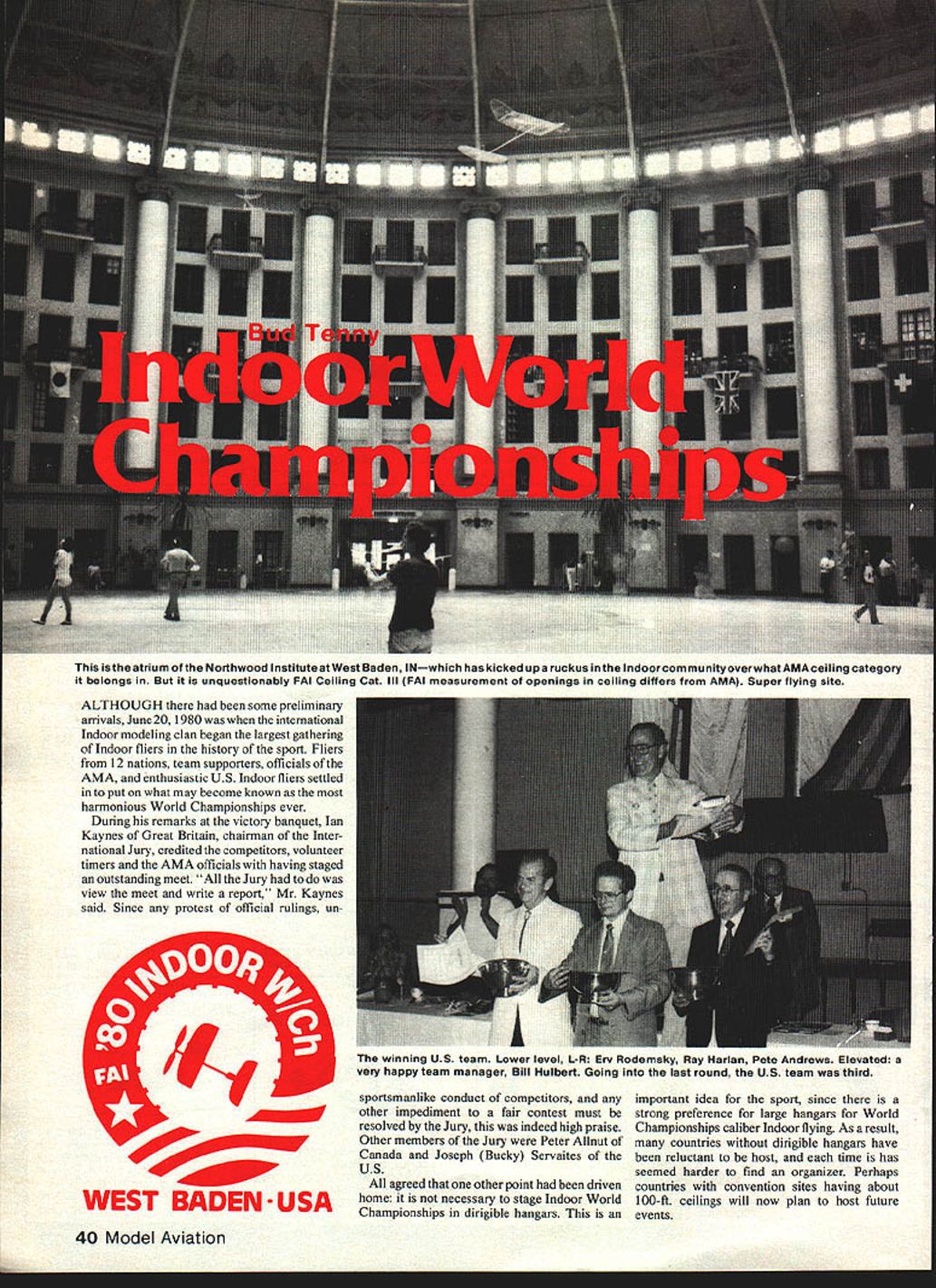
Although there had been some preliminary arrivals, June 20, 1980 was when the international indoor modeling clan began the largest gathering of indoor fliers in the history of the sport. Fliers from 12 nations, team supporters, officials of the AMA, and enthusiastic U.S. indoor fliers settled in to put on what may become known as the most harmonious World Championships ever.
During his remarks at the victory banquet, Ian Kaynes of Great Britain, chairman of the International Jury, credited the competitors, volunteer timers and the AMA officials with having staged an outstanding meet. "All the Jury had to do was view the meet and write a report," Mr. Kaynes said. Since any protest of official rulings, unsportsmanlike conduct of competitors, and any other impediment to a fair contest must be resolved by the Jury, this was high praise.
Other members of the Jury were Peter Allnut of Canada and Joseph (Bucky) Servaites of the U.S.
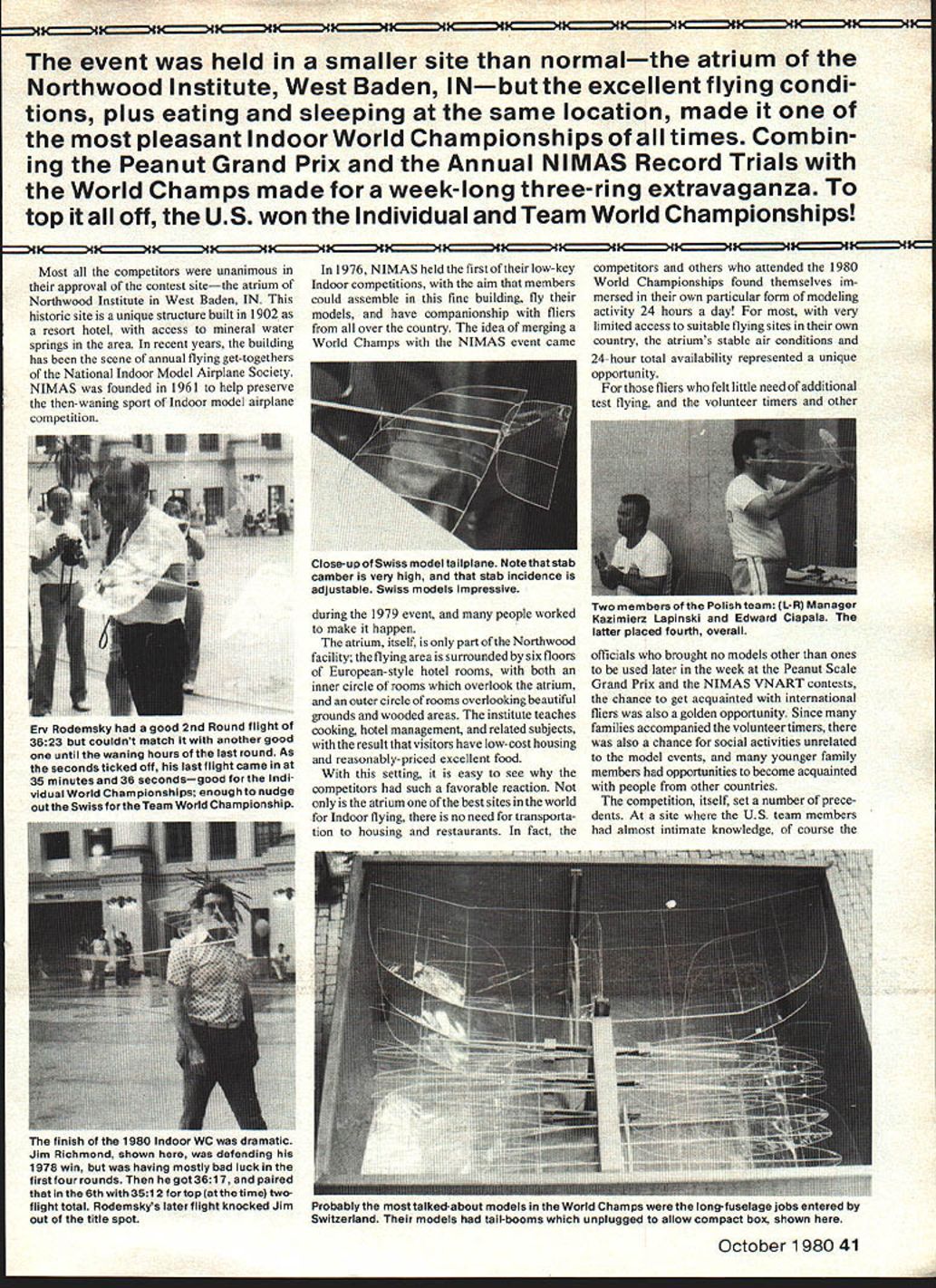
Coinciding Peanut, Scale, Grand Prix, Annual NIMAS Record Trials and World Champs made for a week-long, three-ring extravaganza. To top it off, the U.S. won the Individual and Team World Championships. Most competitors gave unanimous approval to the contest site — the atrium of Northwood Institute, West Baden, IN.
Venue
The historic site is a unique structure, built in 1902 as a resort hotel with access to mineral water springs. In recent years the building has been the scene of annual flying get-togethers. The National Indoor Model Airplane Society (NIMAS), founded in 1961 to help preserve the then-waning sport of indoor model airplane competition, in 1976 held its first low-key indoor competitions with the aim that members could assemble in a fine building, fly models and enjoy the companionship of fliers from across the country. The idea of merging a World Champs with a NIMAS event came during the 1979 event, and people worked to make it happen.
The atrium itself is part of the Northwood facility. The flying area is surrounded by six floors of European-style hotel rooms; inner circle rooms overlook the atrium and outer circle rooms overlook the beautiful grounds and wooded areas. The institute teaches cooking, hotel management and related subjects. As a result, visitors had low-cost housing, reasonably priced excellent food, and a pleasant setting.
It is easy to see why competitors reacted so favorably: the atrium is one of the best sites in the world for indoor flying — there is no need for transportation to housing or restaurants. Competitors and others attending the 1980 World Championships found themselves immersed in their particular form of modeling activity 24 hours a day. For those with very limited access to suitable flying sites in their own country, atriums' stable air conditions and 24-hour availability represented a unique opportunity.
Volunteer timers and other officials often brought no models, using ones later in the week for Peanut, Scale, Grand Prix and NIMAS/VNART contests — chances to get acquainted with international fliers. Since families accompanied many of the volunteer timers, there were also opportunities for social activities unrelated to model events; younger family members had chances to become acquainted with people from other countries.
All agreed that one other point had been driven home: it is not necessary to stage Indoor World Championships in dirigible hangars. This is an important idea for the sport, since a preference for large hangars has made many countries without them reluctant to host. Perhaps countries with convention sites having about 100-foot ceilings will now plan to host future events.
Competition and Technology
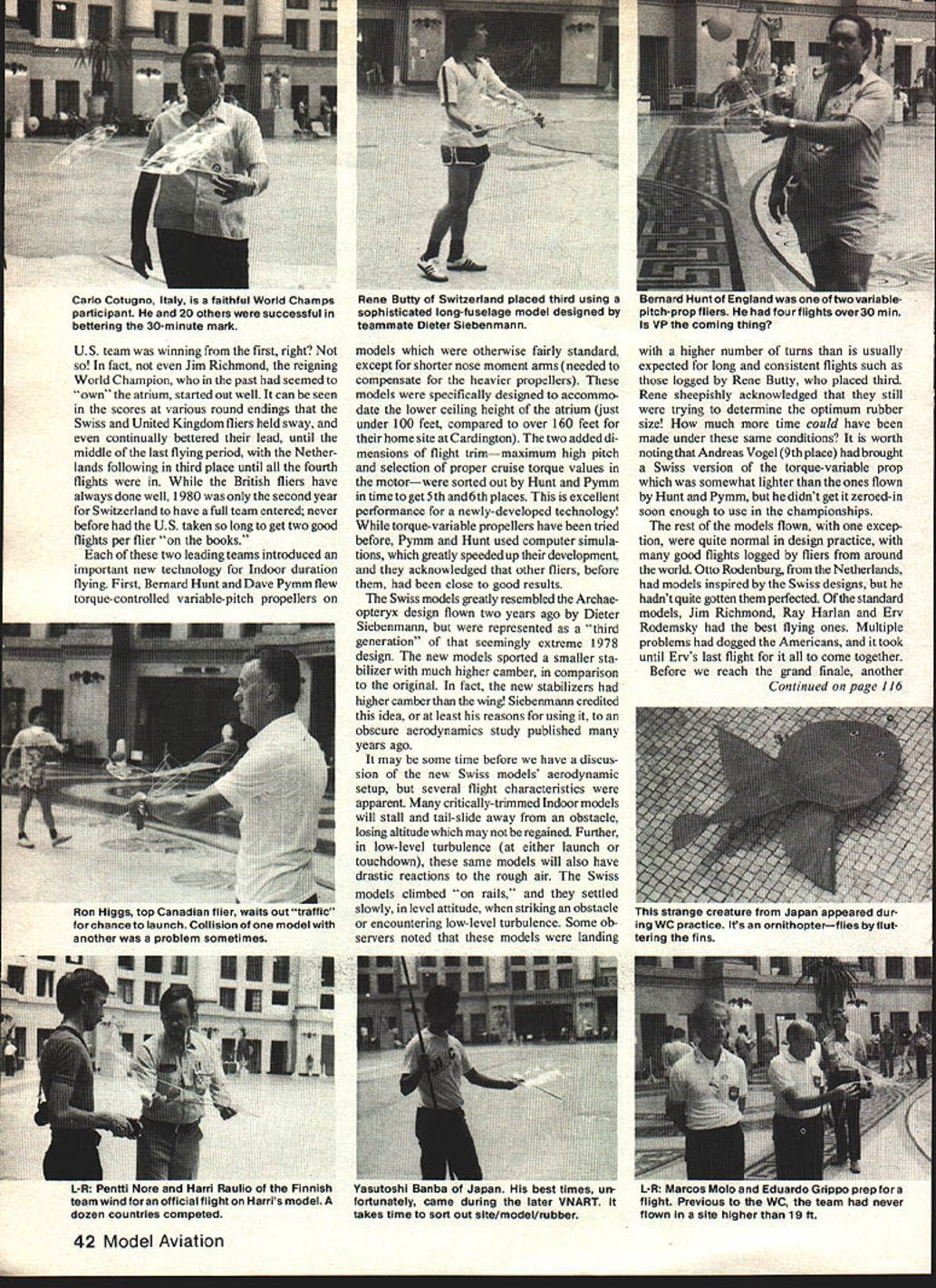
The competition itself set a number of precedents. Although U.S. team members had intimate knowledge of the course, the lead changed hands several times. Jim Richmond, the reigning World Champion who in the past had seemed to "own" the atrium, did not start out well. Early on the Swiss and United Kingdom fliers held sway and continued to better their leads until the middle of the last flying period; the Netherlands followed in third place until all fourth flights were in. This was only the second year Switzerland had a full team entered, and never before had the U.S. taken so long to get two good flights per flier on the books.
Each of the two leading teams introduced important new technologies for indoor-duration flying. First, Bernard Hunt and Dave Pymm flew torque-controlled variable-pitch propellers on models which were otherwise fairly standard, except for shorter nose moment arms to compensate for the heavier propellers. These models were specifically designed to accommodate the atrium's lower ceiling height (just under 100 feet, compared to over 160 feet at their home site). The two added dimensions of flight trim — maximum high pitch and selection of proper cruise torque values in the motor — were sorted out by Hunt and Pymm in time to get 5th and 6th places. While torque-variable propellers had been tried before, Pymm and Hunt used computer simulations, which greatly sped their development.
The Swiss models resembled the Archaeopteryx design flown two years earlier by Dieter Siebenmann, but were represented as a "third generation" of that 1978 design. The new models featured a smaller stabilizer with much higher camber — in fact, the new stabilizers had higher camber than the wing. Siebenmann credited this idea, or at least his reasons for using it, to an obscure aerodynamics study published many years ago.
Several flight characteristics of the Swiss models were apparent. Many critically trimmed indoor models will stall and tail-slide away from an obstacle, losing altitude that may not be regained. In low-level turbulence these models also react drastically to rough air. The Swiss models climbed "on rails" and settled slowly, in level attitude, when striking an obstacle or encountering low-level turbulence. Observers noted these models were landing with a higher number of turns than usually expected for long, consistent flights such as those logged by Rene Butty, who placed third. Butty acknowledged they were still trying to determine the optimum rubber size. Andreas Vogel (9th place) had brought a Swiss version of the torque-variable prop which was somewhat larger than those used by Hunt and Pymm, but he did not get it zeroed-in soon enough to use it in the championships.
Most other models flown were quite normal in design practice, with many good flights logged by fliers from around the world. Otto Rodenburg, from the Netherlands, had models inspired by the Swiss designs, but he had not quite perfected them. Of the standard models, Jim Richmond, Ray Harlan and Erv Rodemsky had the best flying ones. Multiple problems dogged the Americans, and it took until Erv's last flight for things to come together.
The Finale
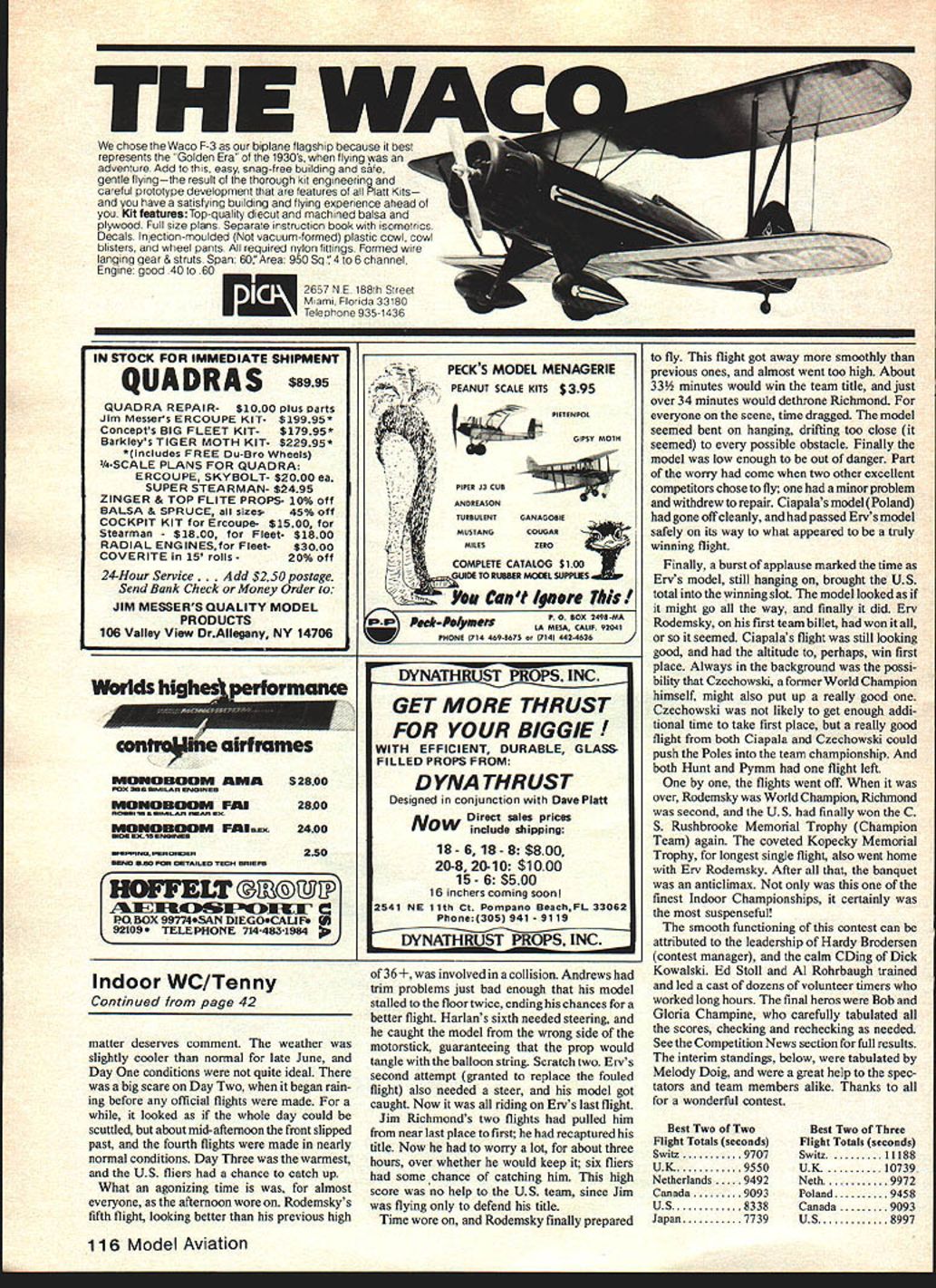
Before the grand finale, weather played a part: Day One conditions were not ideal; Day Two began with rain before any official flights were made, threatening to scuttle the day. About mid-afternoon the front passed, and the fourth flights were made in nearly normal conditions. Day Three was the warmest, and the U.S. fliers had a chance to catch up.
The final day was agonizing for almost everyone. Rodemsky's fifth flight, which looked better than his previous high, was involved in a collision. Andrews had trim problems that caused his model to stall to the floor twice, ending his chances. Harlan's sixth needed steering and was caught on the wrong side of the motorstick, entangling the prop with the balloon string. Erv's granted replacement attempt also needed a steer and was fouled. Now all hope rested on Erv's last flight.
Jim Richmond's two flights had pulled him from near last place to first and had him defending his title. Six fliers still had a chance to catch him. Time dragged as Rodemsky prepared to fly; his model almost went too high. About 33½ minutes would win the team title, and just over 34 minutes would dethrone Richmond. The model floated close to obstacles and seemed bent on hanging. Ciapala's model (Poland) went off cleanly and looked like a potentially winning flight.
Finally, amid a burst of applause, Erv's model, still hanging on, brought the U.S. total into the winning slot. The model completed the flight — Erv Rodemsky, on his first team billet, had won the championship, and Jim Richmond finished second. The U.S. won the C. S. Rushbrooke Memorial Trophy (Champion Team) again. The Kopecky Memorial Trophy, for longest single flight, also went to Erv Rodemsky.
After all that suspense, the banquet was an anticlimax. Not only was this one of the finest Indoor Championships, it was certainly the most suspenseful.
Organizers and Volunteers
The smooth functioning of the contest can be attributed to the leadership of contest manager Hardy Brodersen and the calm C.D.-ing of Dick Kowalski. Ed Stoll and Al Rohrbaugh trained and led a cast of dozens of volunteer timers who worked long hours. Bob and Gloria Chalmers carefully tabulated all the scores, checking and rechecking as needed. The NIMAS membership and local people also deserve many thanks for their aid and help to competitors and team members alike.
Results
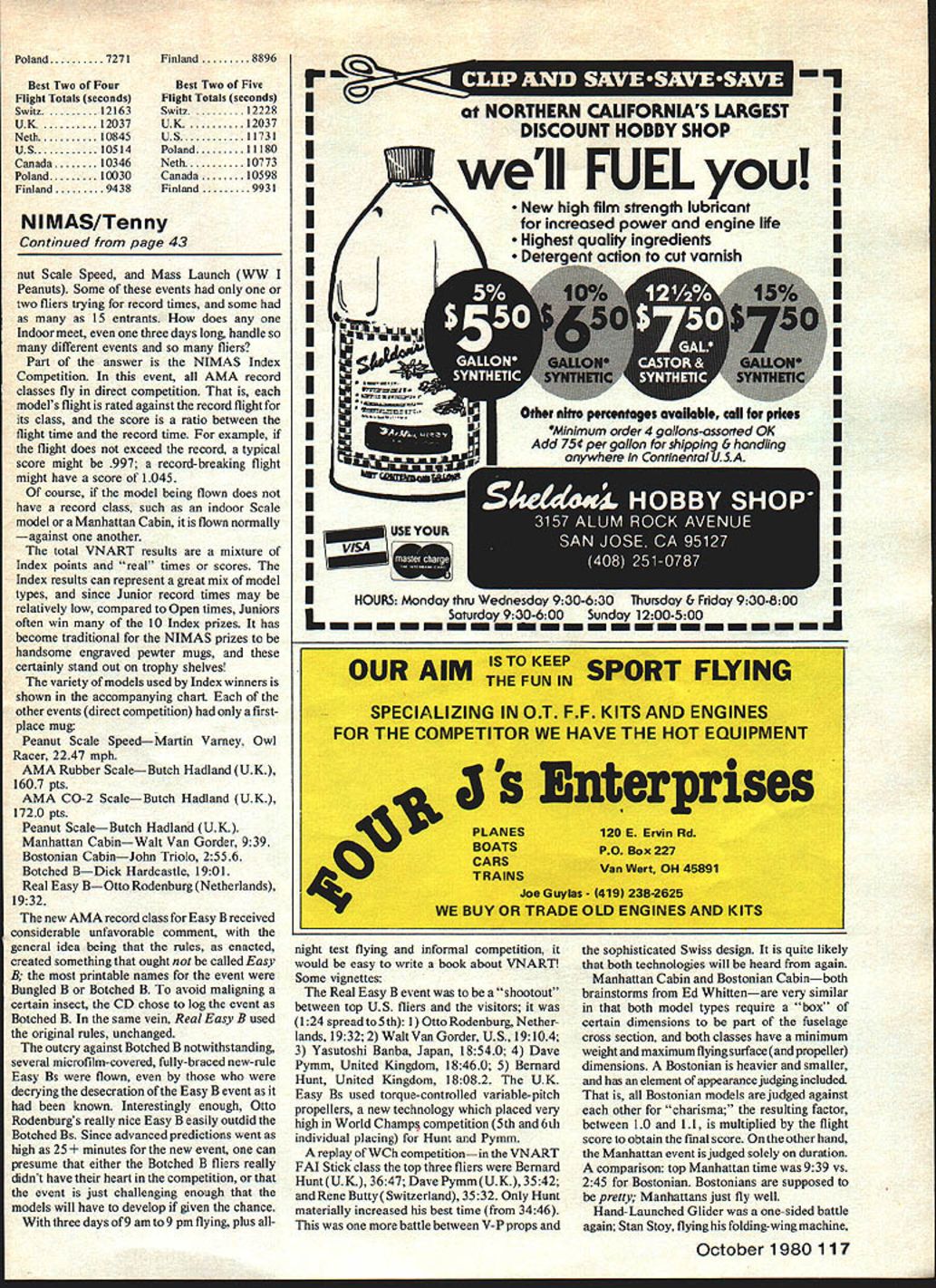
Best Two of Two Flight Totals (seconds)
- Switzerland: 9,707
- United Kingdom: 9,550
- Netherlands: 9,492
- Canada: 9,093
- U.S.: 8,338
- Japan: 7,739
Best Two of Three Flight Totals (seconds)
- Switzerland: 11,888
- United Kingdom: 10,739
- Netherlands: 9,972
- Poland: 9,458
- Canada: 9,093
- U.S.: 8,997
With three days of 9 a.m. to 9 p.m. flying, plus all-night test flying and informal competition, there was a great deal of activity in VNART.
Vignettes
- The Real Easy B event was a "shootout" between top U.S. fliers and the visitors (1:24 spread to 5th):
- Otto Rodenburg, Netherlands — 19:32
- Walt Van Gorder, U.S. — 19:10.4
- Yasutoshi Banba, Japan — 18:54.0
- Dave Pymm, United Kingdom — 18:46.0
- Bernard Hunt, United Kingdom — 18:08.2
The U.K. team used torque-controlled variable-pitch props, a new technology that placed highly in World Champs competition (5th and 6th individual placing for Hunt and Pymm).
- VNART FAI Stick class replayed World Champs competition:
- Bernard Hunt (U.K.) — 36:47
- Dave Pymm (U.K.) — 35:42
- Rene Butty (Switzerland) — 35:32
Only Hunt substantially increased his best time (from 34:46). This was another battle between variable-pitch props and the sophisticated Swiss design; both technologies are likely to reappear.
- Manhattan Cabin and Bostonian Cabin — both brainstorms from Ed Whitten — are similar in that both model types require a "box" of certain dimensions to be part of the fuselage cross section, and both classes have a minimum weight and maximum flying surface (and propeller) dimensions. A Bostonian is heavier, smaller, and includes an appearance judgment ("charisma") that affects the final score; a Manhattan is judged solely on duration. Top Manhattan time was 9:39 vs. 2:45 for a Bostonian. Bostonians are judged for appearance; Manhattans just fly well.
- Hand-Launched Glider was a one-sided battle again; Stan Stoy, flying his folding-wing machine, won easily.
Transcribed from original scans by AI. Minor OCR errors may remain.

