
Indoor World Championships
By Ray Harlan
Arrival and baggage disaster
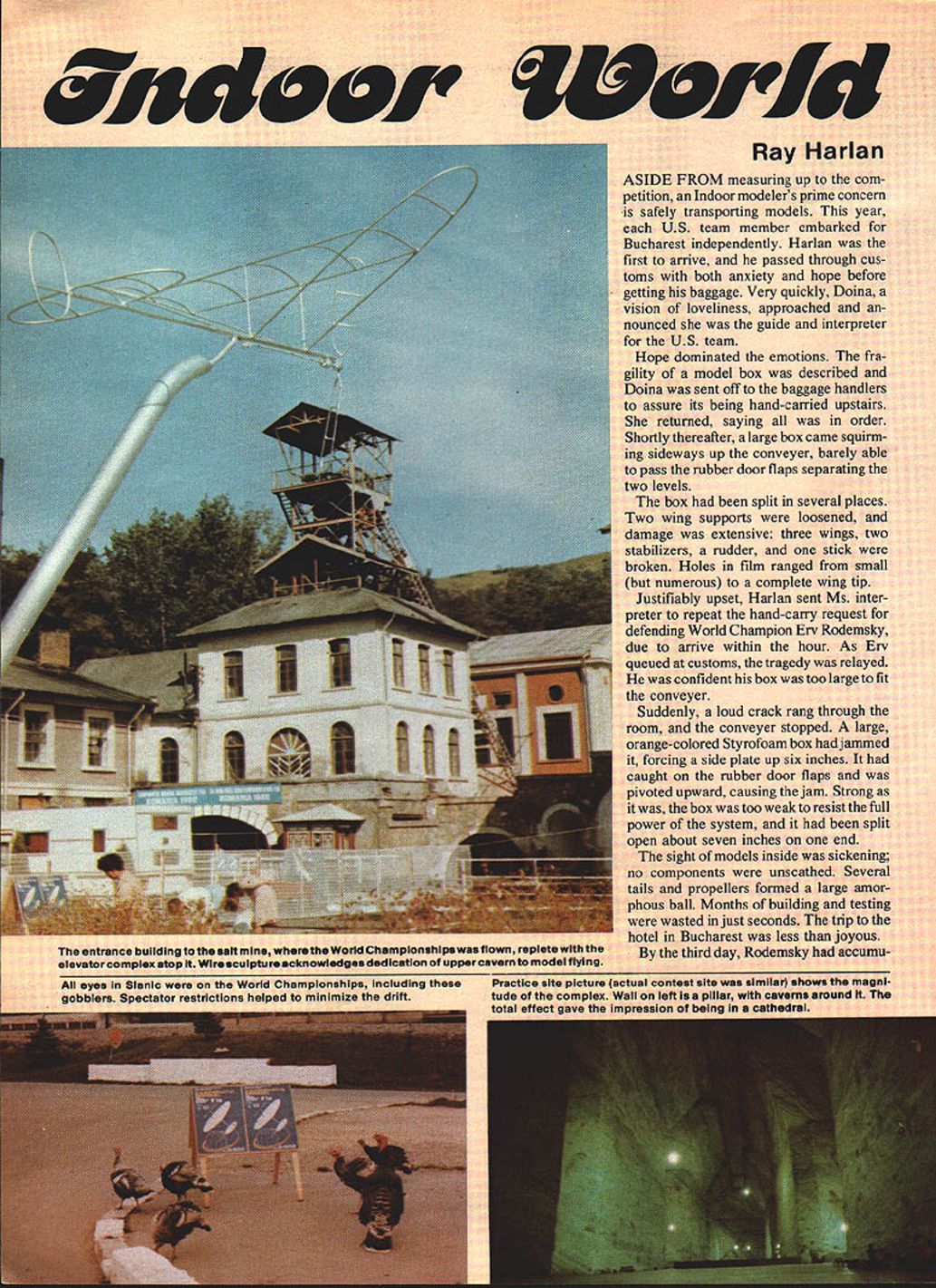
Aside from measuring up to the competition, an indoor modeler's prime concern is safely transporting models. This year each U.S. team member traveled to Bucharest independently. I was first to arrive and passed through customs with both anxiety and hope before getting my baggage. Very quickly Doina, a vision of loveliness, approached and announced she was the guide and interpreter for the U.S. team.
Hope dominated the emotions. The fragility of a model box was described and Doina was sent off to the baggage handlers to request that the box be hand-carried upstairs. She returned saying all was in order. Shortly thereafter a large box came squirming sideways up the conveyor, barely able to pass the rubber door flaps separating the two levels.
The box had been split in several places. Two wing supports were loosened and the damage was extensive: three wings, two stabilizers, a rudder, and one stick were broken. Holes in film ranged from small (but numerous) to a complete wing tip missing. Justifiably upset, I sent Doina to repeat the hand-carry request for defending World Champion Erv Rodemsky, due to arrive within the hour. As Erv queued at customs, the tragedy was relayed. He was confident his box was too large to fit the conveyor.
Suddenly a loud crack rang through the room and the conveyor stopped. A large orange Styrofoam box had jammed it, forcing a side plate up six inches. It had caught on the rubber door flaps and pivoted upward; the box had been split open about seven inches on one end. The sight of models inside was sickening; no components were unscathed. Several tails and propellers formed a large amorphous ball. Months of building and testing were wasted in seconds. The trip to the hotel in Bucharest was less than joyous.
Repairs and logistics
By the third day Rodemsky had accumulated 40 hours of repair time; I had 15. Patch film and papers littered floors; beds were unkempt; maid service was refused. Erv's bathroom wall was sticky with spray cement from microfilm hoops; the bathtub served as a repair tank. He restored four models to at least resemble the masterworks that had left California. My models just seemed to have more patches than before. Neither flier would know the real state of affairs until tested.
Doina returned to the airport to secure a tank of helium and a crate of salt-mine equipment that Team Manager Bud Romak had shipped a week earlier. The shipment included:
- a helium tank
- salt-mine lights and batteries
- balloons
- binoculars
- peanut butter and jelly
- other small items
There we discovered the true meaning of bureaucracy — the theme "Catch-22" came into focus. It took two documents from the Federation Aeromodeling and four hours to retrieve the cargo. Unfortunately Doina had left a note at customs stating the equipment was returned to the U.S., and I could have been liable for $120 duty. Later the Federation let us off the hook with a letter saying the equipment had been destroyed in the mine, which provided the first bright spot since our arrival.
The evening brought a reunion with the British team and the trip to Slănic. Their boxes had received perfect handling; apparently the chief baggage handler had been fined the equivalent of $150 for inattention to fragile labels on damaged boxes.
The salt mine — site description
Only three hours of testing were allowed the first Sunday because lift operators worked a short day. The first sight of the salt mine was awesome, preceded by a lightless descent in an iron cage about 5–7 ft long. The lift bumped wooden shaft framing often enough to threaten models.
Expecting very dim lighting, we were surprised to turn the corner and see fluorescent lights strung along the walls of the main flying area about six feet above the floor. A row of five mercury-vapor lights lit the cavern but also made models effectively invisible in the upper half of the flying space.
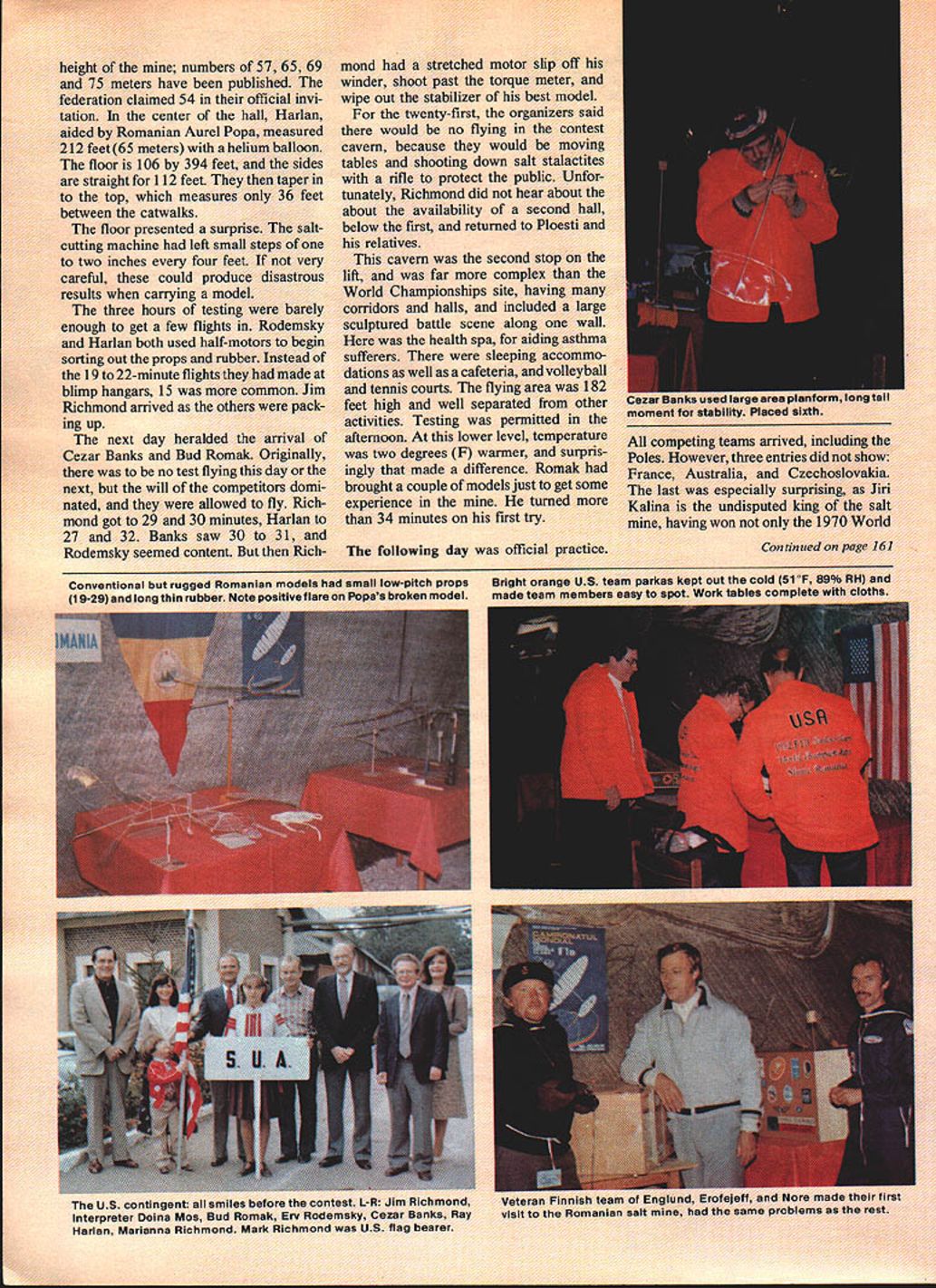
Published height numbers for the mine vary — 57, 65, 69, and 75 meters — while the Federation claimed 54 m in their official invitation. In the center of the hall, with the aid of Romanian Aurel Popa, we measured 212 feet (65 meters) using a helium balloon. The floor measures 106 by 394 feet; the sides are straight for 112 feet and then taper into a top that measures only 36 feet between the catwalks.
The floor presented another surprise: the salt-cutting machine had left small steps of one to two inches every four feet. If not careful, these could produce disastrous results when carrying a model.
Testing in the mine
The three hours of testing were barely enough to get a few flights in. Rodemsky and I both used half-motors to begin sorting props and rubber. Instead of the 19–22 minute flights we had made in blimp hangars, 15 minutes was more common. Jim Richmond arrived as others were packing up.
The next day Cezar Banks and Bud Romak arrived. Originally there was to be no test flying that day or the next, but competitors prevailed and were allowed to fly. Richmond recorded 29 and 30 minutes, I reached 27 and 32, Banks saw 30–31, and Rodemsky seemed content. But Richmond had a stretched motor slip off his winder, shoot past the torque meter, and wipe out the stabilizer of his best model.
On the 21st the organizers said there would be no flying in the contest cavern because they were moving tables and shooting down salt stalactites with a rifle to protect the public. Unfortunately Richmond did not hear that a second hall below the first was available and returned to Ploiești and his relatives.
This lower cavern (the second stop on the lift) was far more complex than the World Championship site. It included many corridors and halls and a large sculptured battle scene along one wall. Here was the health spa for aiding asthma sufferers, sleeping accommodations, a cafeteria, and volleyball and tennis courts. The flying area was 182 feet high and well separated from other activities. Testing was permitted in the afternoon there. At this lower level the temperature was about 2°F warmer — surprisingly enough to make a difference. Romak turned more than 34 minutes on his first try.
The following day was official practice. All competing teams arrived, including the Poles. However, three entries did not show: France, Australia, and Czechoslovakia. The latter was especially surprising, as Jiri Kalina is the undisputed king of the salt mine, having won the 1970 World Championships and numerous other contests at this site.
Testing was cautious because of the greater number of models in the air (there were no restrictions). Richmond came on form with a 36:45. Rodemsky was satisfied with 19:50 on a half-motor. I reached 29:28 with 400 turns left. Most teams used heavier motors than in hangars and realized they needed to avoid bunching rubber near the prop, which would rub the motor stick and dramatically reduce delivered power.
Equipment note
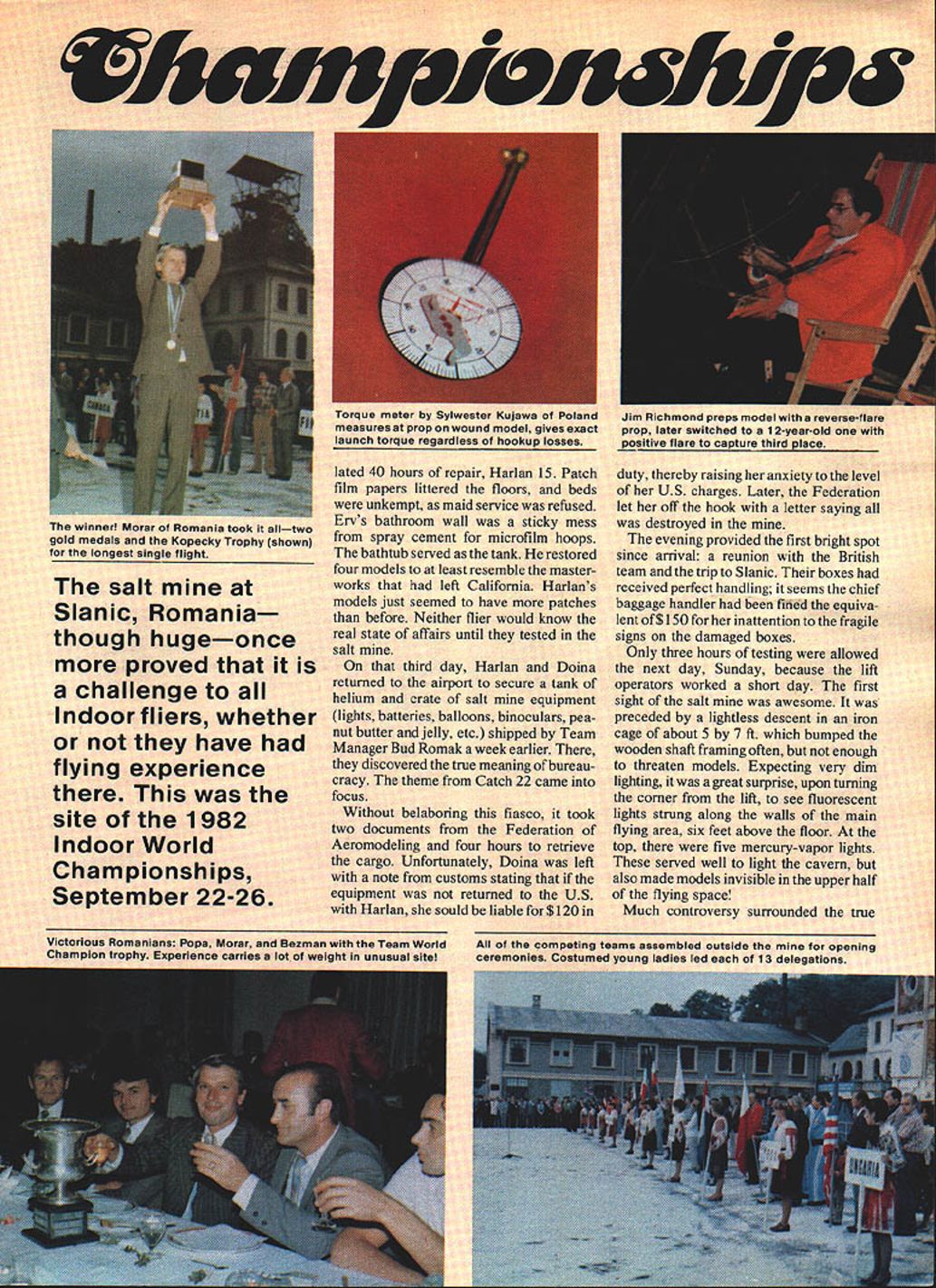
A torque meter (Sylwester Kujawa, Poland) measures prop-wound models and gives exact launch torque regardless of hookup losses. The Kopecky Trophy was shown for the longest single flight.
Competition
The organizers originally scheduled two days of three rounds each and a third day for prize ceremonies and tours. Competitors prevailed again, and the event ran three days of two rounds each, with the awards ceremony on the afternoon of the third day.
The FAI jury was to include Ian Kaynes (Britain), Gheorghe Stana (Romania), and Otakar Safek (Czechoslovakia). Safek had not arrived by the end of practice, and the organizers asked Nonaka of Japan to replace him; Nonaka declined to stay with his team. Bud Romak suggested Warren Williams, who had paid his own way to support the U.S. team; he accepted and performed admirably.
Round summaries and key flights
- Rodemsky opened the competition with a full-motor flight that climbed and centered 20 feet below the catwalk and landed at 34:10 — the longest flight of that round.
- Banks nearly reached 30 minutes in his first flight.
- Richmond, using the same combination that had given him a 34:30 the day before, managed 31:34.
- My entry could not repeat an earlier altitude; it never passed halfway in the cavern.
Only five flights over 30 minutes were recorded in the first round, four of them from the eventual winners. Popa hit the wall and slid down most of the angled section but still recorded 29:45. During lunch a thunderstorm outside created turbulence about halfway up the cavern and produced a persistent inversion layer that often kept models from reaching upper levels.
The turbulence took its toll in round two. Rodemsky stalled in it and the prop caught the wing, terminating the flight. Only András Réa (Hungary) exceeded 30 minutes in that round. Barr (Laurie Barr) put himself in the lead for the first day with just under half an hour. Richmond learned Popa was using a positive-flare prop and tried one he had built for a 1970 salt-mine visit; it improved his placing.
Following a night of grumbling and repairing, the third round opened. Rodemsky folded his number three ship. I was again unable to climb as before, and several promising entries suffered mishaps in the tricky conditions.
Richmond had a wing post pull loose, destroying the wing and breaking the tail boom. On his official he improved his total but just fell short of 30 minutes. Banks' model rose sharply but stalled at 40 feet; it continued stalling and losing altitude and Cezar could not grab it before the one-minute attempt limit.
My motor went flat and the model peaked at 80 feet. Barr strengthened his lead with 31:29, and Popa posted a clean 32:47. Rodemsky perfectly centered his official flight 20 feet below the catwalk but drifted near 16 minutes and in just three circles hit the side.
This round was limited to three half-hour marks. With many contestants, timers, and officials in the cavern, body heat created abnormal drift at the top, so those breaking through the inversion layer had to worry about hitting the side walls. The veteran Romanian team was divided on best launching position: Bezman chose the tee intersection closest to the entrance, while Popa preferred the blind end of the hall. Morar tried everything in between.
In the fourth round:
- Banks rose to about 180 feet but drifted into a downdraft and landed at 28:51. On another attempt he achieved his best flight of the meet, 32:59, landing just inside the flying area and moving into third place that day.
- Richmond put one within 10 feet of the roof and clocked 36:37 — the top time of the meet to that point, putting him in first place.
- My attempts continued to go over the top; added stiffness only prolonged failure before both wing and tail boom gave in.
- Rodemsky hit the top in eight minutes, scrubbed for four, and hung on the catwalk; Popa retrieved the model through the tunnel system.
After repairs and tense quiet before the final rounds, several contestants nursed sore throats and fevers acquired in the mine. For the U.S., Banks broke five motors (one blew a piece through his wing) and could not improve his total. Richmond broke multiple motors later in the meet when winding heavy motors; the problem turned out to be a failing plastic O-ring on the torque meter hook.
The dramatic finale:
- Pymm (Dave Pymm) produced a 35:39, his only decent flight since the first round.
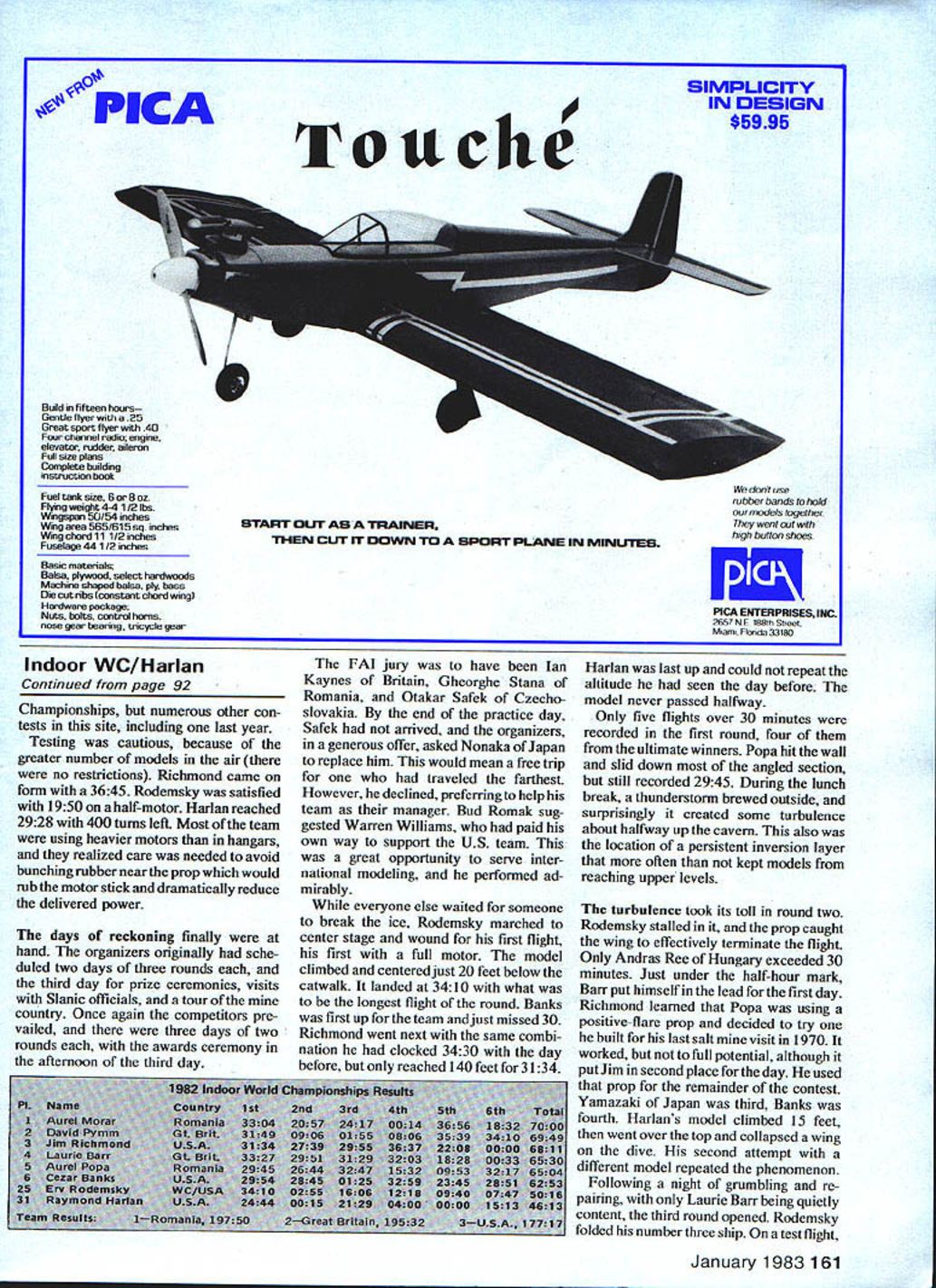
- Morar had a model that hit a wire stretched across the hall between the catwalks, hung for eight seconds, then flew free and recorded the contest's longest flight, 35:56, catapulting him from ninth to first ahead of Richmond.
- Pymm finished second, coming from nowhere in the last two rounds. Each of the top three helped carry teammates to team placements.
Richmond had lost his chance to be the first three-time World Champion because his motors broke during his final winding — not due to the typical causes, but because a 0.013-inch music wire plastic O-ring slipped off the torque meter hook under the stress of winding heavy motors.
(Results table appeared in the original page.)
Analysis and conclusions
If statistics are compared with the 1980 World Championships at West Baden (a site half the height of the salt mine), Slănic was far harsher. At Slănic only 10% of flights exceeded 30 minutes, while 44% were below 20 minutes. At West Baden the corresponding percentages were 23% over 30 minutes and 39% below 20 minutes. The salt mine is hostile to both the uninitiated and the veterans. Morar had only two good flights for his win. The Poles usually excel at this site yet could not reach the top 10 this time.
A week before the World Championship Bezman had posted 37 minutes and become national champion, yet he was unable to break 32 at this contest. Conditions had deteriorated primarily due to the great addition of people — each body a 100-watt heater, changing the normal equilibrium of the mine. This was the first World Championship at Slănic in 12 years. In 1970 conditions were worse, with electrical heaters used to warm contestants; this year cool fluorescent bulbs provided lots of light and little heat.
The organizers did everything possible to limit the number of people in the flying area to contestants on official flights, team managers, and timers, but drift could not be eliminated and the inversion layer remained strong. Despite these problems, it was a great surprise that not one collision occurred, even during practice.
The organizers worked diligently toward the success of the event. They listened to contestants and made schedule changes. Accommodations were excellent, right down to fresh flowers in each room and daily maid service. There was almost too much savory Romanian food to eat.
This meet will long be remembered, and more than one contestant will look forward to the challenge of the salt mine in the future.
Transcribed from original scans by AI. Minor OCR errors may remain.

