
Indoor World Championships
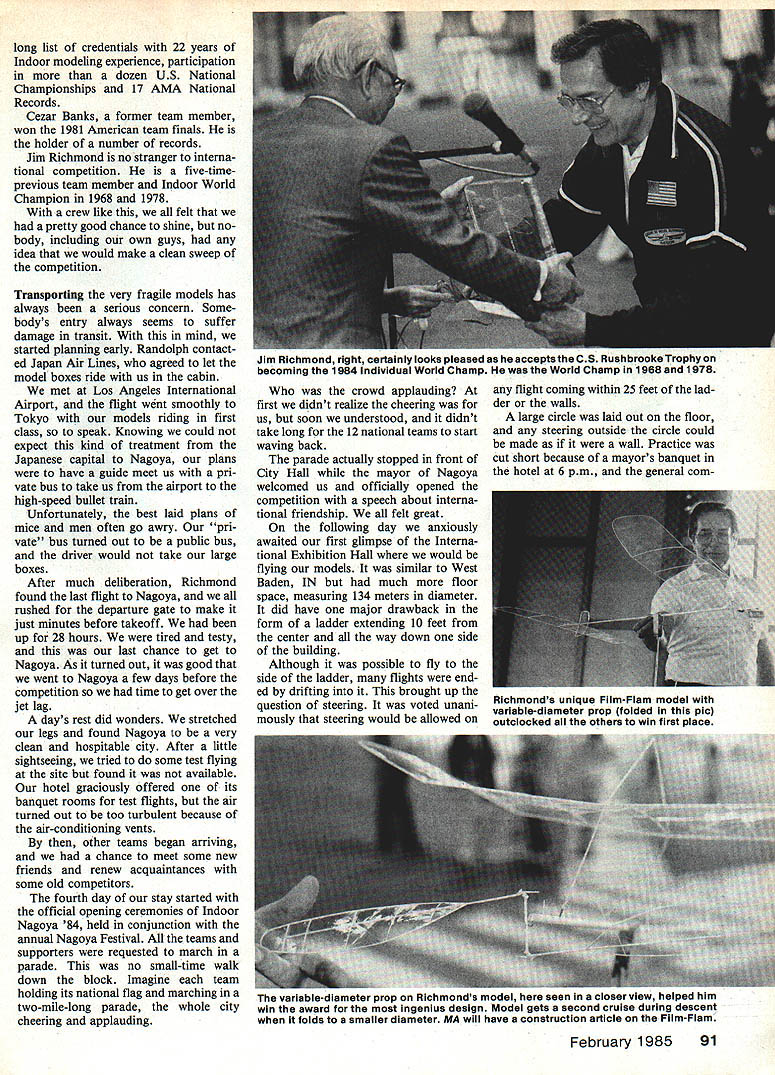
The United States captured first, second, and third place, plus the team award and the prize for the most ingenious model, at the 1984 Indoor World Championships in Nagoya, Japan. It was the first time in history that a country has made a clean sweep in the indoor event.
As manager of the three-member U.S. team, it is my pleasure to report on the events leading to the most prestigious showing ever by a competing team—a feat which will go in the record books.
The Team
- Bob Randolph — First time on the U.S. team, but with 22 years' indoor modeling experience, participation in a dozen U.S. National Championships, and 17 AMA national records.
- Cezar Banks — Former team member, winner of the 1981 American team finals and holder of numerous records.
- Jim Richmond — Five-time previous team member and Indoor World Champion in 1968 and 1978.
A crew like that felt confident about its chances, but nobody, including our own guys, expected we would make a clean sweep.
Travel and Arrival
Transporting very fragile models is always a concern. Randolph contacted Japan Air Lines and arranged for the model boxes to ride in the cabin on the Los Angeles flight; the models effectively rode "first class." We expected to be met in Nagoya and taken by private bus to our hotel and the high-speed bullet train, but plans went awry when the "private" bus turned out to be a public bus whose driver would not accept our large boxes.
After much deliberation, Richmond found the last flight to Nagoya and rushed to the departure gate, making it just minutes before takeoff. After 28 hours, tired and testy, that was our last chance to get to Nagoya.
We arrived a few days before competition time to recover from jet lag. Nagoya proved to be a very clean, hospitable city. After a little sightseeing, we tried some test flying. A nearby hotel graciously offered a banquet room for test flights, but the air proved too turbulent because of air-conditioning vents.
Opening Ceremonies
Other teams began arriving and we had a chance to meet new friends and renew acquaintances. On the fourth day the official opening ceremonies began. Indoor Nagoya '84 was held in conjunction with the annual Nagoya Festival. All teams and supporters were requested to march in a two-mile parade while the city cheered and applauded. The parade stopped in front of City Hall where the mayor of Nagoya welcomed us and officially opened the competition with a speech about international friendship.
Venue and Rules
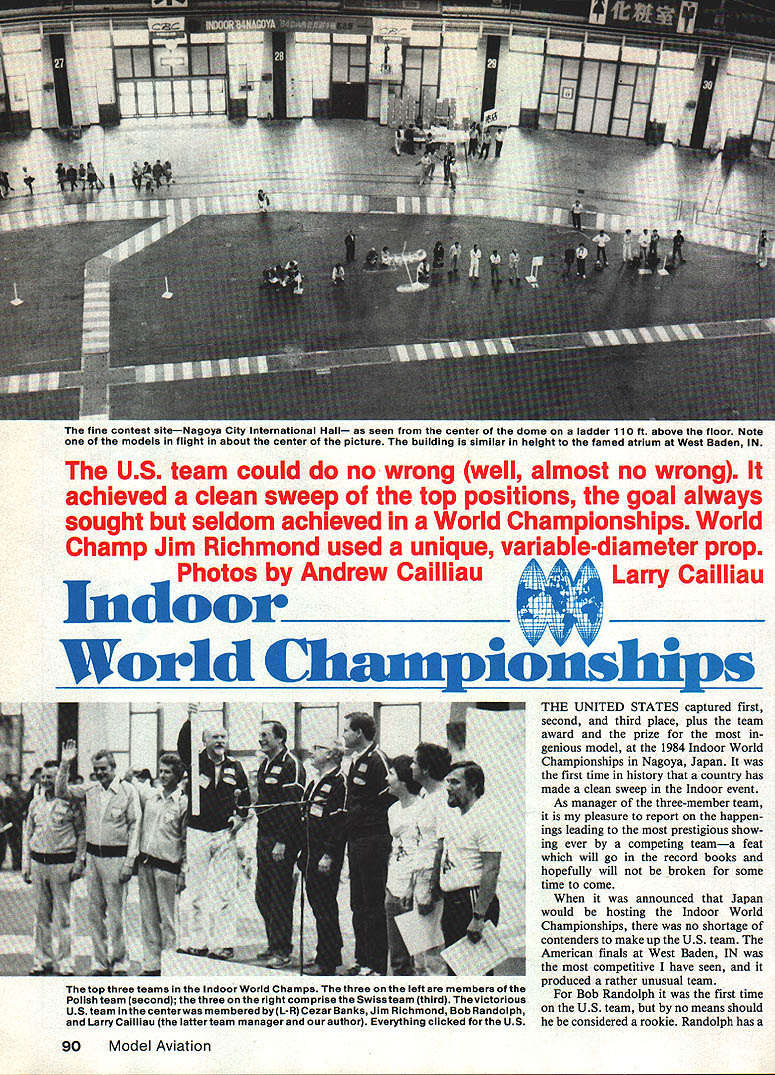
The competition was held in the International Exhibition Hall. The floor measured about 134 meters in diameter, similar to West Baden, IN, but the hall had a major drawback: a ladder suspended about 110 ft. above the center and extending part way down the side of the building. Flights that drifted toward the ladder raised the question of steering. It was voted unanimously that steering would be allowed for flights coming within 25 feet of the ladder or walls. A large circle was laid out on the floor; steering outside the circle could be made by the wall. Practice time at the site was cut short because of the mayor's banquet at the hotel.
Competition — Rounds and Highlights
General note: weather varied across the event—overcast and cool for the first two days, drizzly on the third, and warmer and sunny on the final day. These conditions affected high flights and prop performance.
Round One
- Bob Randolph led off. His rubber broke at the rear hook on the first attempt but the model was unharmed. On a later attempt the motor stick collapsed; a second model launched, power-stalled after a minute, then climbed to the ceiling. After drifting toward the wall, I was allowed to steer (Bob had broken his leg a couple of weeks earlier and was wearing a heavy cast) and got the ship back to center. The flight landed at 36 minutes 35 seconds.
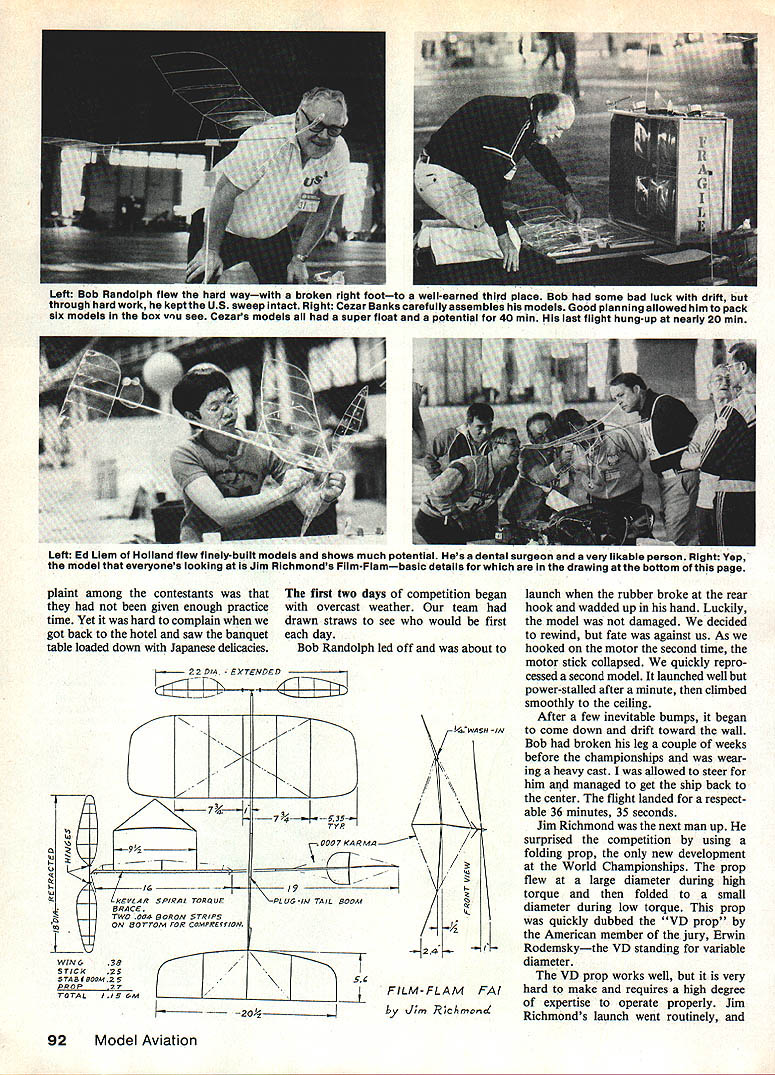
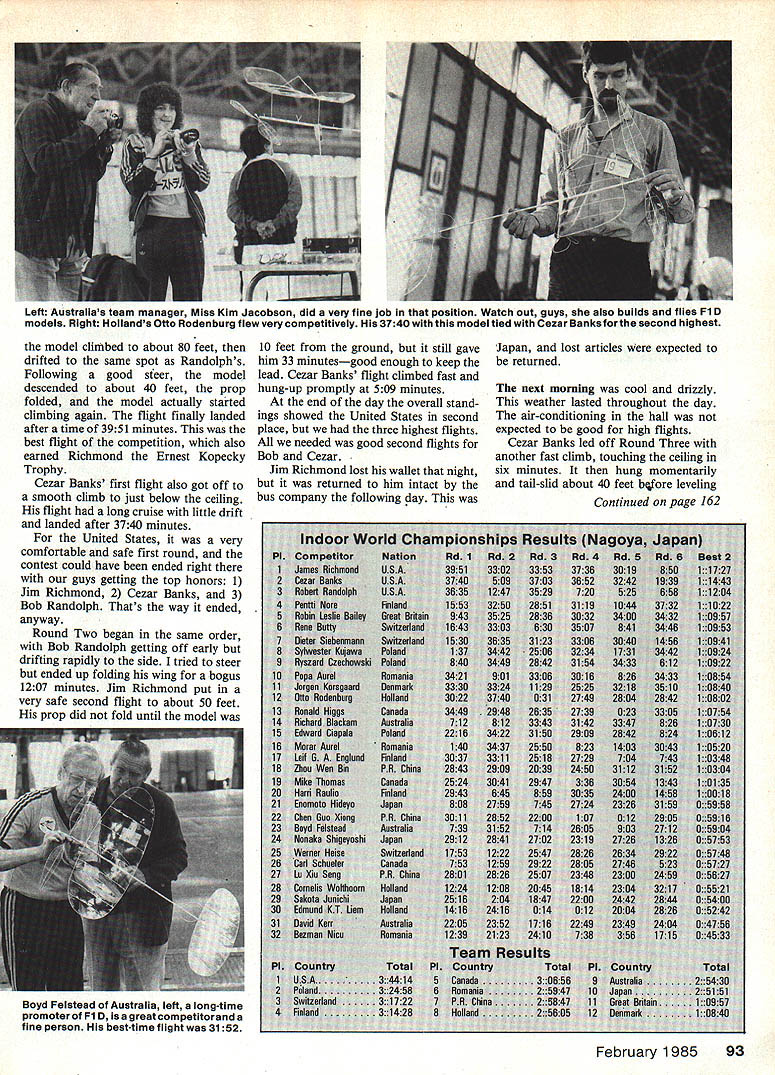
- Jim Richmond used a folding prop—the only notable new development at the championships. The prop flew at a large diameter during high torque and folded to a smaller diameter during low torque. It was quickly dubbed the "VD prop" (variable-diameter prop). Jim’s model climbed to a super float and had potential for 40 minutes; his flight landed at 39 minutes 51 seconds. This was the best flight of the competition and earned him the Ernest Kopecky Trophy.
- Cezar Banks climbed to just below the ceiling and cruised with little drift, landing after 37 minutes 40 seconds.
Round Two
- Bob Randolph drifted rapidly to the side; an attempted steer folded his wing and produced a bogus 12 minutes 7 seconds.
- Jim Richmond flew safely to about 50 feet; his prop did not fold until 10 feet from the ground and he recorded 33 minutes—enough to keep the lead.
- Cezar Banks' flight climbed fast and hung up briefly at 5 minutes 9 seconds. At the end of the day the United States had the three highest flights and was in second place overall; we needed strong second flights from Bob and Cezar to secure the team title.
Round Three (cool and drizzly)
- Cezar Banks led off, touched the ceiling in six minutes, then tail-slid about 40 feet before leveling. His model collided with one flown by Mike Thomas of Canada, but since his model was undamaged he rewound and restarted, climbing more slowly and leveling at the ceiling to hang for 37 minutes 3 seconds.
- Bob Randolph also had a collision and a restart. His second attempt, with a model fresh from the box, produced 35 minutes 29 seconds—the second-best of the round.
- Jim Richmond tried a conventional prop, hit bad air shortly into cruise, and had a time of 33 minutes 35 seconds.
Round Four
- Cezar Banks put up a good flight but hit the same bad air as Richmond and descended rapidly, still landing with 36 minutes 52 seconds.
- Bob Randolph hung quickly at 7 minutes 20 seconds on his attempt.
- Jim Richmond returned to the VD prop; the model was underpowered and climbed only to about 60 feet. After 25 minutes it descended to 10 feet where the prop finally folded and returned at that altitude for a time of 37 minutes 36 seconds. The VD prop showed promise but was difficult to perfect and operate reliably.
Round Five (warmer, sunnier)
- Jim Richmond led off with a late prop flip, giving him 30 minutes 19 seconds.
- Cezar Banks' model was wound tight and bounced the rafters several times before settling for 32 minutes 42 seconds.
- Bob Randolph's tightly wound model hung high in the very center, nicking the ladder.
Round Six (best air of the competition)
- Jim Richmond wound for and achieved a 50-minute flight, the first time he hit the ceiling. The model hung briefly, then tail-slid about 30 feet before folding and coming down.
- Cezar Banks had a beautiful, perfectly centered flight on the opposite side of the ladder. The model scraped the ceiling and circled gracefully, showing signs of a 40-minute flight; at one point the prop barely caught the edge of a beam and hung precariously but did not fall.
- Bob Randolph sought a high time but was impeded by the ladder.
With the team championship secure, the last rounds became a shoot-out for first place among the three Americans. Despite obstacles and varying air, the U.S. team finished first, second, and third.
Results and Awards
- Individual places: 1) Jim Richmond, 2) Cezar Banks, 3) Bob Randolph.
- Jim Richmond received the Ernest Kopecky Trophy for the best flight.
- The United States also won the team award and the prize for the most ingenious model.
The closing ceremonies and awards were spectacular. A marching band entered the hall with precision, national anthems were played, and flags displayed. Jim Richmond made a brief speech noting it was a little embarrassing that the United States had taken all three places. A superb banquet followed.
Observations and Notes
- The contest was well organized and ran smoothly with no protests.
- The competition was tougher than the final standings suggest; Poland and Switzerland were close contenders.
- A milestone: Australia had its first woman team manager (who also builds indoor models).
- Lost articles were returned intact—an instance of the exemplary conduct we experienced in Japan (Jim Richmond lost his wallet and it was returned by the bus company).
Acknowledgements
I would like to thank:
- AMA HQ, particularly Micheline Madison and Penny Hudson, for help extended to the team.
- TRW Corp. for a generous donation that enabled us to buy team uniforms.
- Wally Summers for assistance with the team fund.
- Jim and Mary Kagawa and all the supporters for their help.
Most of all, thank you, Japan.
Transcribed from original scans by AI. Minor OCR errors may remain.

