
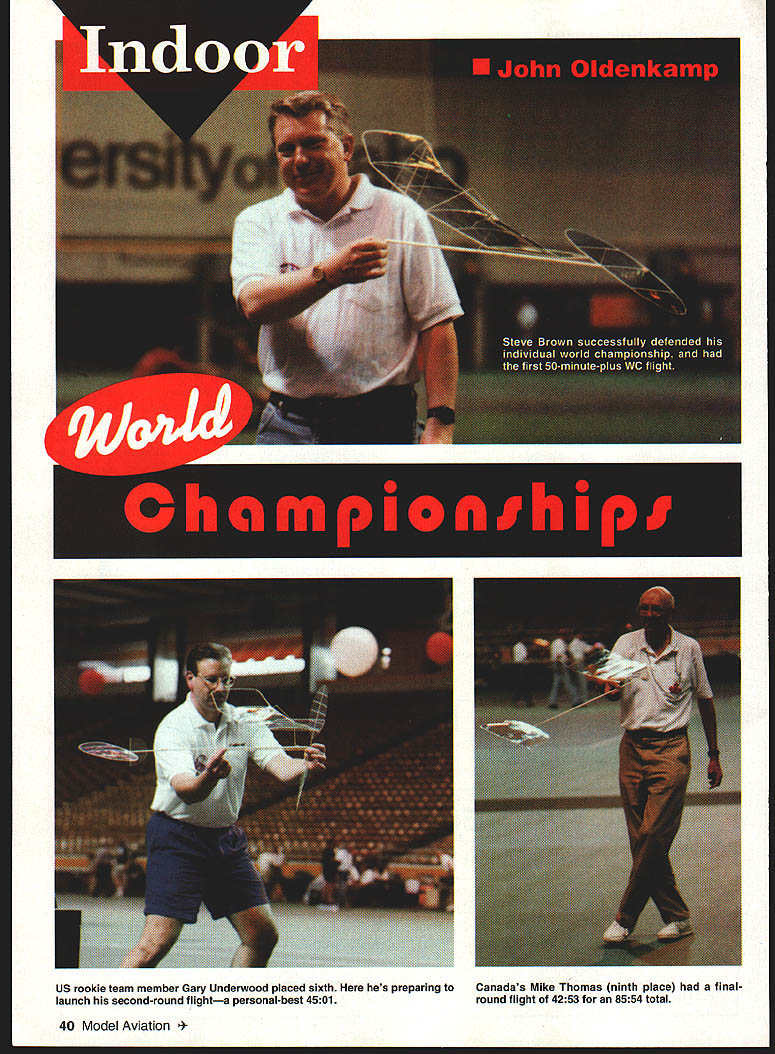
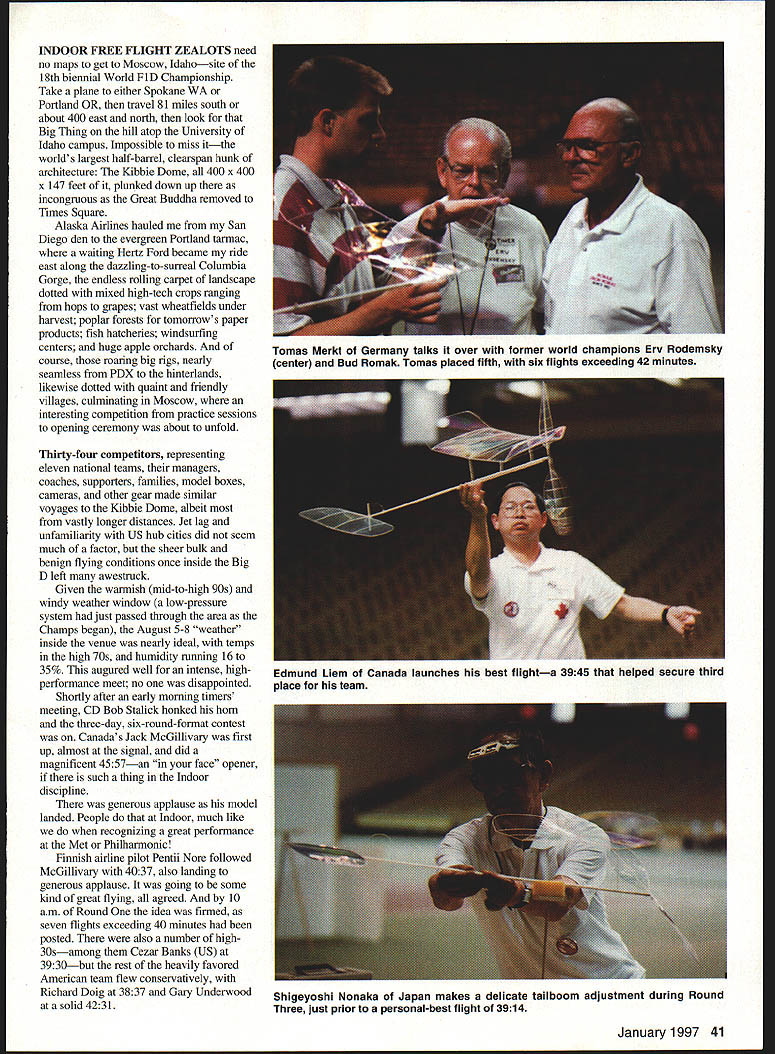
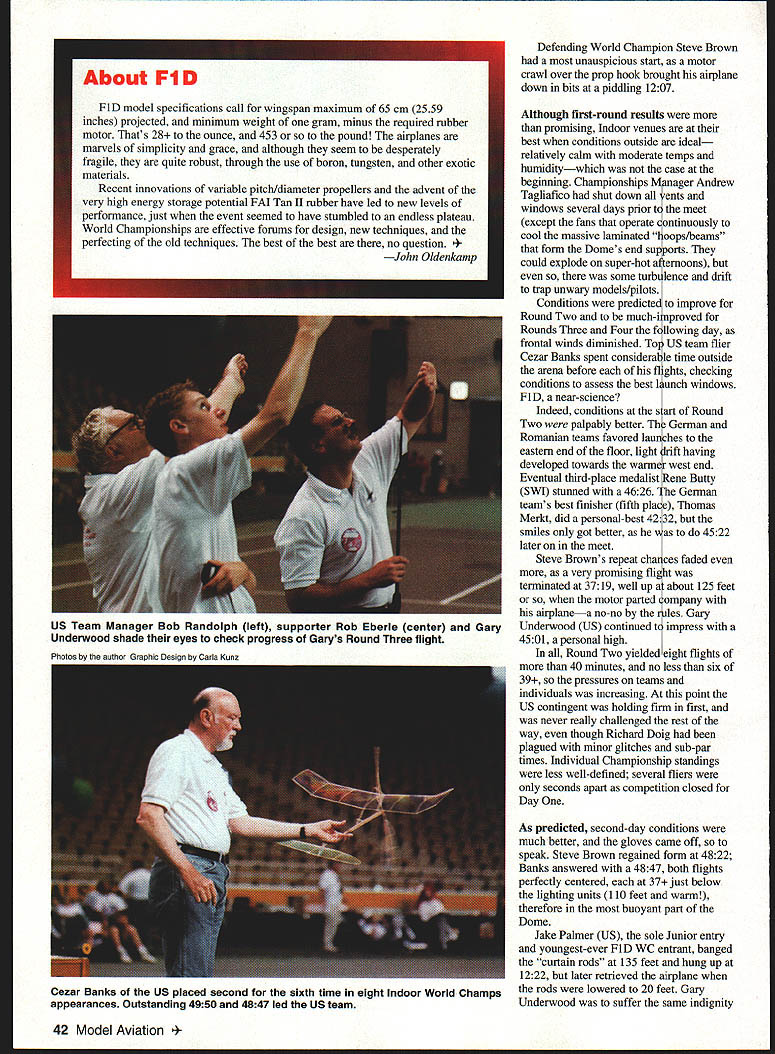
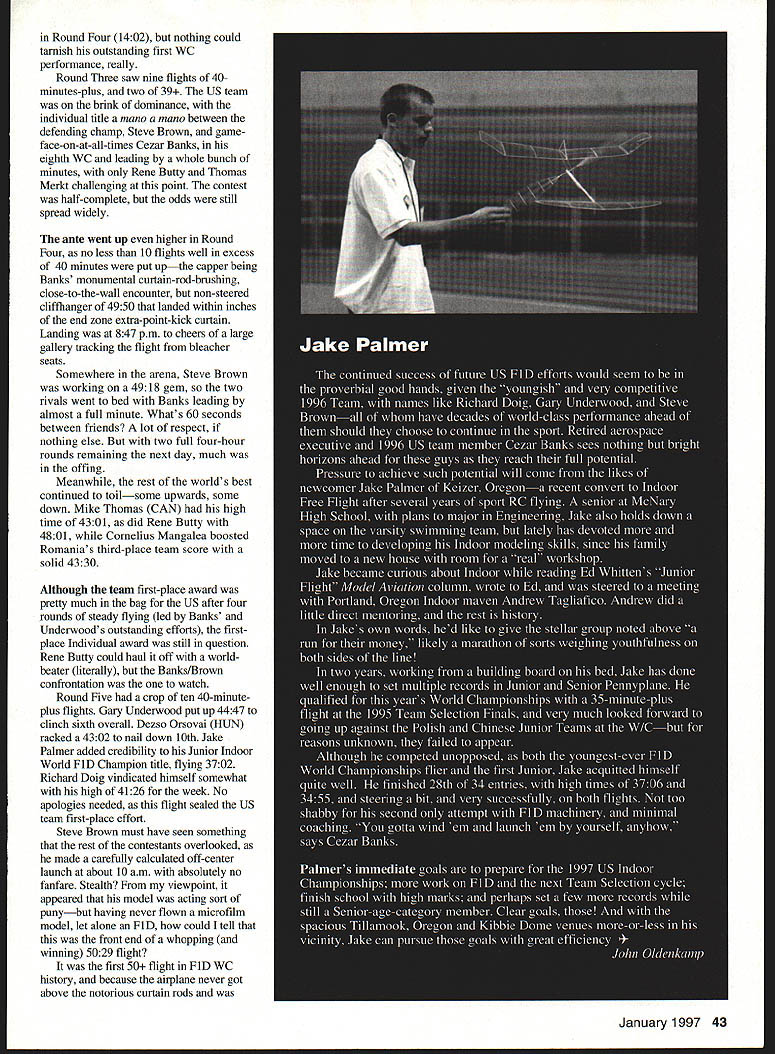
Indoor World Championships
FOR free-flight zealots, maps are unnecessary: Moscow, Idaho, hosted the 18th biennial World F1D Championship inside the Kibbie Dome on the University of Idaho campus. The dome—an unmistakable half-barrel clear-span structure—measures roughly 400 x 400 x 147 feet and provided the stage for four intense days of indoor free-flight competition, August 5–8.
Getting there
- Fly to Spokane, WA, or Portland, OR.
- From Spokane it's about an 81-mile drive to Moscow; from Portland the trip is much longer.
- The drive from Portland east along the Columbia Gorge is a dramatic transition from river landscapes to wheatfields, orchards and small towns en route to the Palouse and Moscow.
Venue
- Kibbie Dome: enormous clear-span half-barrel, offering typically benign indoor flying conditions.
- Championship conditions inside (despite hot, windy weather outside): temperatures in the high 70s and humidity 16–35%, ideal for high-performance F1D flying.
- To reduce turbulence from the dome’s laminated hoops/beams, vents and windows were shut in advance, with fans operating continuously to keep structural members cool.
Competitors and format
- 34 competitors representing 11 national teams, plus managers, coaches, supporters and families.
- Contest Director: Bob Stalick.
- Format: three days, six rounds.
Conditions and preparation
- Early rounds were affected by outside weather and residual dome turbulence; managers had shut vents and restricted airflow to stabilize conditions.
- Competitors closely monitored micro-conditions before launches; selecting the right launch window was crucial and near-scientific in practice.
- A light drift developed toward the west end of the floor at times; some teams favored eastern-end launches.
Round-by-round highlights
- Round One
- Opening flights set a high standard: Jack McGillivray (CAN) 45:57, Pentti Nore (FIN) 40:37.
- Seven flights exceeded 40 minutes early in the round; several others were in the high 30s (Cezar Banks, USA, 39:30).
- Defending champion Steve Brown suffered a mechanical start, a motor crawl over the prop hook, resulting in a 12:07 flight.
- Round Two
- Conditions improved markedly.
- René Bütty (SUI) posted a stunning 46:26.
- Thomas Merkt (GER) recorded a personal best 42:32; Gary Underwood (USA) posted 45:01.
- Rounds Three and Four
- Frontal winds diminished; flying conditions continued to improve.
- Round Three: nine flights over 40 minutes.
- Round Four: ten flights over 40 minutes. Cezar Banks produced a dramatic 49:50, brushing curtain rods and landing to cheers; Steve Brown posted a 49:18.
- Both Banks and Brown were contenders for the individual title as the contest reached its midpoint.
- Day-two notable moments
- Steve Brown regained form with a 48:22; Banks answered with 48:47—both flights centered in the most buoyant part of the dome.
- Junior entrant Jake Palmer (USA) struck the curtain rods at 135 feet and had a temporary hang-up but later retrieved his airplane; he flew well enough overall to add credibility to his junior title.
- Round Five
- Ten flights exceeded 40 minutes.
- Gary Underwood clinched sixth overall with 44:47.
- Steve Brown launched a carefully calculated flight that resulted in 50:29—the first 50+ minute flight in F1D World Championship history. The flight spent long durations near the lighting bars and was decisive for the individual title.
- Round Six
- Twelve flights over 40 minutes.
- Thomas Merkt (GER) 45:27 and Bernard Hunt (UK) 45:22 among the top efforts.
- Canadians Mike Thomas 42:53 and Edmund Liem 39:45 combined to vault Canada past Romania in the final team standings.
Results
- Individual
- Gold: Steve Brown (defending champion) — 50:29 pivotal flight; final individual total 99:47.
- Silver: Cezar Banks (USA) — final total 98:37; sixth-time silver-medalist.
- Bronze: René Bütty (SUI) — key 46:26 performance.
- Team
- Gold: United States (steady team performance led by Banks and Underwood).
- Silver: United Kingdom (British team had secured second early and held it).
- Bronze: Canada — overcame Romania in the final round, winning the team battle 252:04 to 249:12.
Aftermath and acknowledgments
- Generous applause closed the meet as competitors packed up for the trip home.
- The next biennial F1D World Championships were tentatively planned for 1998 in Nagoya, Japan (site of the 1984 Worlds).
- Special thanks to Andrew Tagliafico, Clarence Mather, and Cezar Banks for supplying information used in this report, and to the meet organizers for staging an exciting, friendly and accommodating 1996 F1D World Championships.
Transcribed from original scans by AI. Minor OCR errors may remain.

