
Indoor World Champs
Bud Tenny
Indoor modelers from around the world gathered in May to shoot it out in this world-class event. After a shaky start a determined U.S. team stayed tough and walked away with the honors.
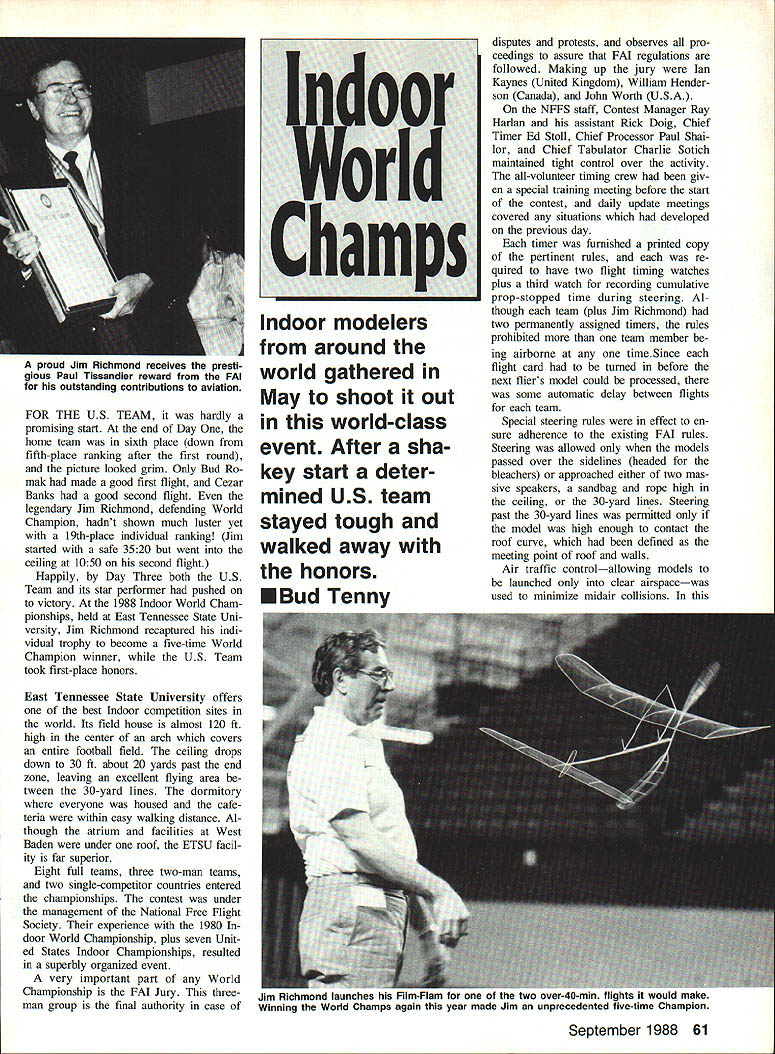
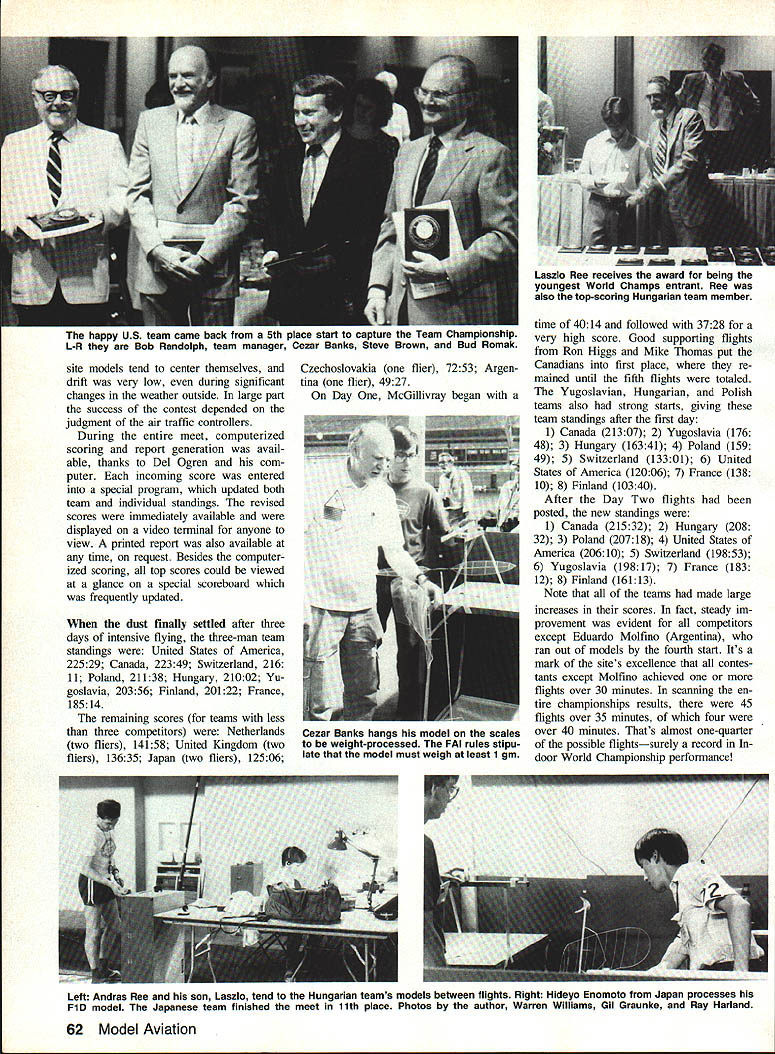
For the U.S. team, it was hardly a promising start. At the end of Day One the home team was in sixth place (down from a fifth-place ranking after the first round), and the picture looked grim. Only Bud Romak had made a good first flight, and Cezar Banks had a good second flight. Even the legendary Jim Richmond, defending World Champion, hadn't shown much luster yet—he was 19th in the individual rankings after starting safely with 35:20 and going to the ceiling at 10:50 on his second flight.
Happily, by Day Three both the U.S. team and its star performer had pushed on to victory. At the 1988 Indoor World Championships, held at East Tennessee State University, Jim Richmond recaptured the individual trophy to become a five-time World Champion, while the U.S. team took first-place honors.
Venue
East Tennessee State University offers one of the best indoor competition sites in the world. Its field house is almost 120 ft high in the center arch which covers an entire football field. The ceiling drops down to about 30 ft roughly 20 yards past the end zone, leaving an excellent flying area between the 30-yard lines. Dormitories and the cafeteria were within easy walking distance. Although the atrium facilities at West Baden are under one roof, the ETSU facility proved far superior.
Participants and organization
- Eight full teams, three two-man teams, and two single-competitor countries entered the championships.
- The contest was managed by the National Free Flight Society (NFFS). Drawing on experience from the 1980 Indoor World Championship and seven U.S. Indoor Championships, the NFFS produced a superbly organized event.
- The FAI Jury, a three-man group and the final authority on disputes and protests, consisted of Ian Kaynes (United Kingdom), William Henderson (Canada), and John Worth (U.S.A.).
NFFS staff included Contest Manager Ray Harlan, assistant Rick Doig, Chief Timer Ed Stoll, Chief Processor Paul Shailor, and Chief Tabulator Charlie Sotich. The all-volunteer timing crew received a special training meeting before the contest and daily update meetings to review situations arising the previous day.
Each timer was provided a printed copy of the pertinent rules and was required to carry two flight-timing watches plus a third watch for recording cumulative prop-stopped time during steering. Although each team (and Jim Richmond) had two permanently assigned timers, rules prohibited more than one team member being airborne at any one time. Because each flight card had to be turned in before the next flier's model could be processed, there was some automatic delay between flights for each team.
Rules, steering, and air traffic control
Special steering rules were in effect to ensure adherence to existing FAI regulations. Steering was allowed only when models passed over the sidelines (headed for the bleachers) or approached either of two massive speakers, a sandbag and rope high in the ceiling, or the 30-yard lines. Steering past the 30-yard lines was permitted only if the model was high enough to contact the roof curve (defined as the meeting point of roof and walls).
Air traffic control—allowing models to be launched only into clear airspace—was used to minimize midair collisions. At this site, models tend to center themselves low during significant changes in the weather outside, so a large part of the contest's success depended on the judgment of the air traffic controllers.
Scoring and reports
Computerized scoring and report generation were available throughout the meet thanks to Del Ogren. Incoming scores were entered into a special program that updated both team and individual standings; revised scores were immediately available and displayed on a video terminal for anyone to view. Printed reports were also available on request.
Team standings (three-man teams) — final after three days
- United States of America 225:29
- Canada 223:49
- Switzerland 216:11
- Poland 211:38
- Hungary 210:02
- Yugoslavia 203:56
- Finland 201:28
- France 185:14
Remaining scores (teams with fewer than three competitors):
- Netherlands (two fliers) 141:58
- United Kingdom (two fliers) 136:35
- Japan (two fliers) 125:06
- Czechoslovakia (one flier) 72:53
- Argentina (one flier) 49:27
Day-by-day notes
On Day One, Jack McGillivray began with a 40:14 and followed with 37:28 for a very high score. Good supporting flights from Ron Higgs and Mike Thomas put the Canadians into first place, where they remained until the fifth flights were totaled.
Yugoslavia, Hungary, and Poland also had strong starts. Team standings after the first day were: 1) Canada 213:07 2) Yugoslavia 176:48 3) Hungary 163:41 4) Poland 159:49 5) Switzerland 133:01 6) United States of America 120:06 7) France 138:10 8) Finland 103:40
After Day Two flights were posted, the standings tightened: 1) Canada 215:32 2) Hungary 208:32 3) Poland 207:18 4) United States of America 206:10 5) Switzerland 198:53 6) Yugoslavia 198:17 7) France 183:12 8) Finland 161:13
All teams made large increases in their scores; steady improvement was evident for all competitors except Eduardo Molfino (Argentina), who ran out of models by the fourth start. It's a mark of the site's excellence that all contestants except Molfino achieved one or more flights over 30 minutes. Across the three championships there were 45 flights over 35 minutes, four of which exceeded 40 minutes—almost one-quarter of possible flights, a likely record for Indoor World Championships.
U.S. team highlights
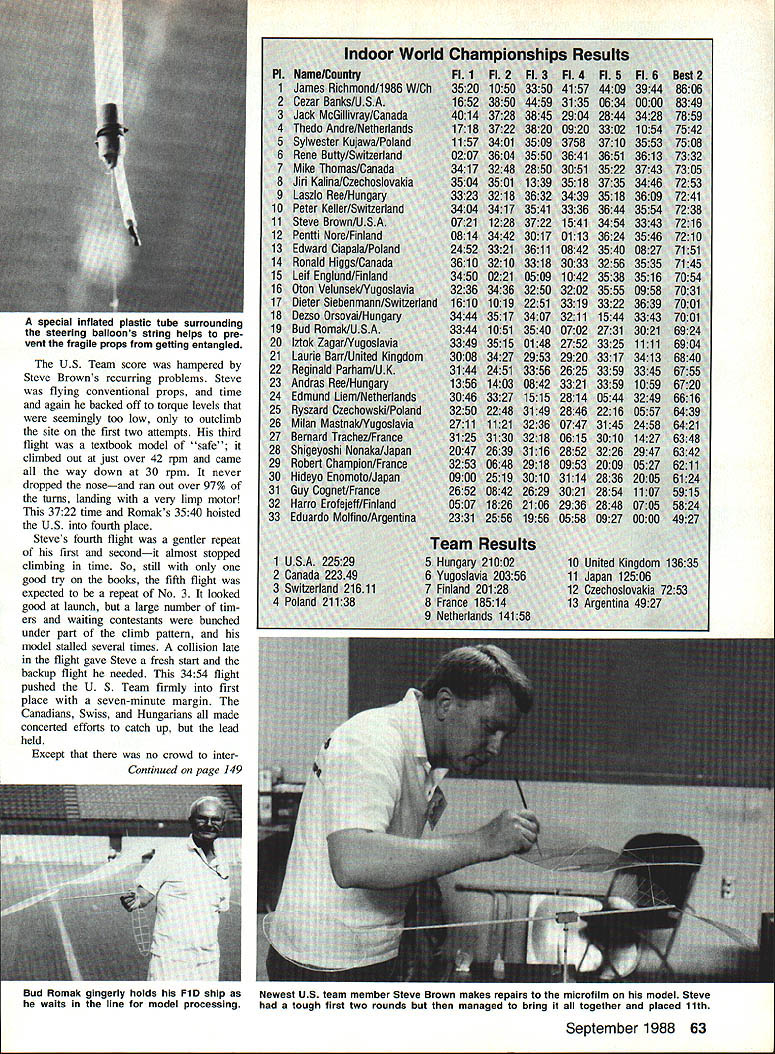
The U.S. team score was hampered early by Steve Brown's recurring problems. Flying conventional props, Steve repeatedly backed off to torque levels that appeared too low and outclimbed the site on his first two attempts. His third flight was a textbook "safe": it climbed out at just over 42 rpm, came down at 30 rpm without dropping the nose, and ran out over about 97% of the turns, landing with a limp motor for a 37:22 time. That flight and Bud Romak's 35:40 helped hoist the U.S. into fourth place.
Steve's fourth flight nearly stalled on climb, and with only one reliably good time on the books, his fifth flight was critical. After a troubled launch with many timers and waiting contestants bunched under part of the climb pattern—resulting in stalls and a late-flight collision that produced a fresh start—Steve recorded a 34:54 backup flight. That effort pushed the U.S. team firmly into first place with a roughly seven-minute margin. The Canadians, Swiss, and Hungarians made strong attempts to close the gap, but the lead held.
Indoor World Championships Results
Pl. Name/Country — Fl.1 Fl.2 Fl.3 Fl.4 Fl.5 Fl.6 Best 2
- James Richmond (1986 W/Ch) — 35:20 10:50 33:50 41:57 44:09 39:44 Best 2: 86:06
- Cezar Banks / U.S.A. — 16:52 38:50 44:59 31:35 06:34 00:00 Best 2: 83:49
- Jack McGillivray / Canada — 40:14 37:28 38:45 29:04 28:44 34:28 Best 2: 78:59
- Theo Andre / Netherlands — 17:18 37:22 38:20 09:20 03:32 10:54 Best 2: 75:42
- Sylwester Kujawa / Poland — 11:57 34:01 35:09 37:58 37:10 35:53 Best 2: 75:08
- Rene Butty / Switzerland — 02:07 36:04 35:50 36:41 36:51 32:36 Best 2: 73:32
- Mike Thomas / Canada — 34:17 32:48 28:50 30:51 35:22 37:43 Best 2: 73:05
- Jiri Kalina / Czechoslovakia — 35:04 35:12 43:36 36:37 37:35 34:46 Best 2: 72:53
- Laszlo Rees / Hungary — 33:23 32:18 36:32 34:39 35:18 36:09 Best 2: 72:41
- Peter Keller / Switzerland — 34:04 34:17 35:41 33:36 36:44 35:54 Best 2: 72:38
- Steve Brown / U.S.A. — 07:21 12:28 37:22 15:14 34:54 33:43 Best 2: 72:16
- Pentti Nore / Finland — 08:14 34:42 30:17 01:13 36:24 35:46 Best 2: 72:10
- Edward Ciapala / Poland — 24:52 32:31 31:08 08:42 30:48 08:27 Best 2: 71:51
- Ronald Higgs / Canada — 36:10 32:10 33:18 30:33 25:35 35:35 Best 2: 71:45
- Leif Englund / Finland — 34:50 32:02 31:05 00:42 33:49 36:02 Best 2: 71:45
- Oton Velunsek / Yugoslavia — 32:36 34:36 32:50 32:02 35:55 39:58 Best 2: 70:31
- Dieter Siebenmann / Switzerland — 16:10 10:19 22:51 33:19 35:22 36:39 Best 2: 70:01
- Dezso Orsovai / Hungary — 27:56 35:11 31:24 35:12 32:06 30:50 Best 2: 69:57
- Bud Romak / U.S.A. — 34:19 31:55 35:40 07:02 27:31 31:21 Best 2: 69:24
- Iztok Zagar / Yugoslavia — 32:49 35:15 01:48 27:52 33:25 11:11 Best 2: 69:04
- Laurie Barr / United Kingdom — 30:08 34:27 29:25 29:20 33:17 34:13 Best 2: 68:40
- Reginald Parham / United Kingdom — 31:44 24:51 39:25 26:25 33:59 33:45 Best 2: 67:55
- Andras Ree / Hungary — 13:56 14:08 08:42 23:01 33:59 10:39 Best 2: 67:20
- Edmund Liem / Netherlands — 30:46 33:37 15:15 28:14 34:05 32:49 Best 2: 66:16
- Ryszard Czechowski / Poland — 32:50 22:48 31:49 28:46 35:16 36:57 Best 2: 64:39
- Milan Mastnak / Yugoslavia — 27:11 11:21 32:36 07:47 31:45 24:58 Best 2: 64:21
- Bernard Trachrez / France — 31:25 31:30 32:18 30:15 30:41 27:04 Best 2: 63:48
- Shigeyoshi Nonaka / Japan — 20:47 26:39 31:18 26:32 32:26 29:47 Best 2: 63:42
- Robert Champion / France — 32:53 06:48 29:18 09:35 30:09 25:07 Best 2: 62:11
- Hideyo Enomoto / Japan — 24:09 25:31 20:14 31:14 28:36 20:05 Best 2: 56:24
- Guy Cognet / France — 26:52 08:42 26:29 30:21 28:54 11:07 Best 2: 51:45
- Harro Erofejeff / Finland — 05:07 18:26 21:06 10:34 22:08 40:27 Best 2: 50:35
- Eduardo Molfino / Argentina — 23:31 25:56 19:56 05:58 09:27 00:00 Best 2: 49:27
Team Results (summary)
- 1 U.S.A. 225:29
- 2 Canada 223:49
- 3 Switzerland 216:11
- 4 Poland 211:38
- 5 Hungary 210:02
- 6 Yugoslavia 203:56
- 7 Finland 201:28
- 8 France 185:14
- 9 Netherlands 141:58
- 10 United Kingdom 136:35
- 11 Japan 125:06
- 12 Czechoslovakia 72:53
- 13 Argentina 49:27
Transcribed from original scans by AI. Minor OCR errors may remain.

