
Indoor World Champs
Bob Clemens
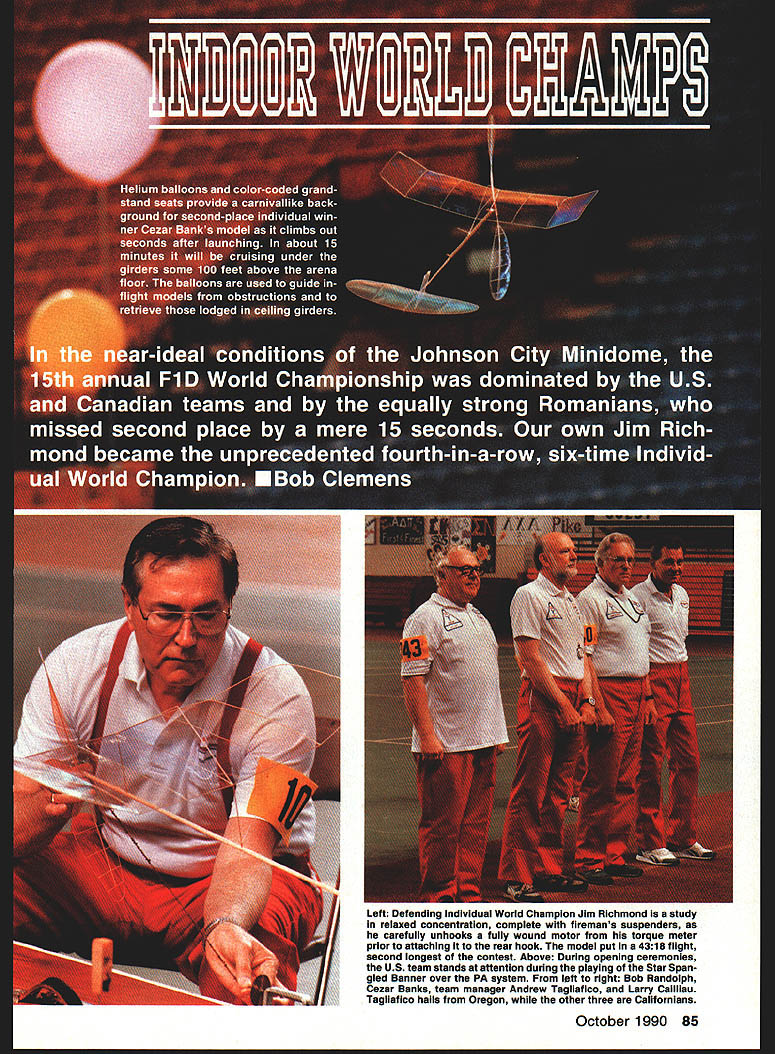
In the near-ideal conditions of the Johnson City Minidome, the 15th annual F1D World Championship was dominated by the U.S. and Canadian teams and by the equally strong Romanians, who missed second place by a mere 13 seconds. Our own Jim Richmond became the unprecedented fourth-in-a-row, six-time Individual World Champion.
Event overview
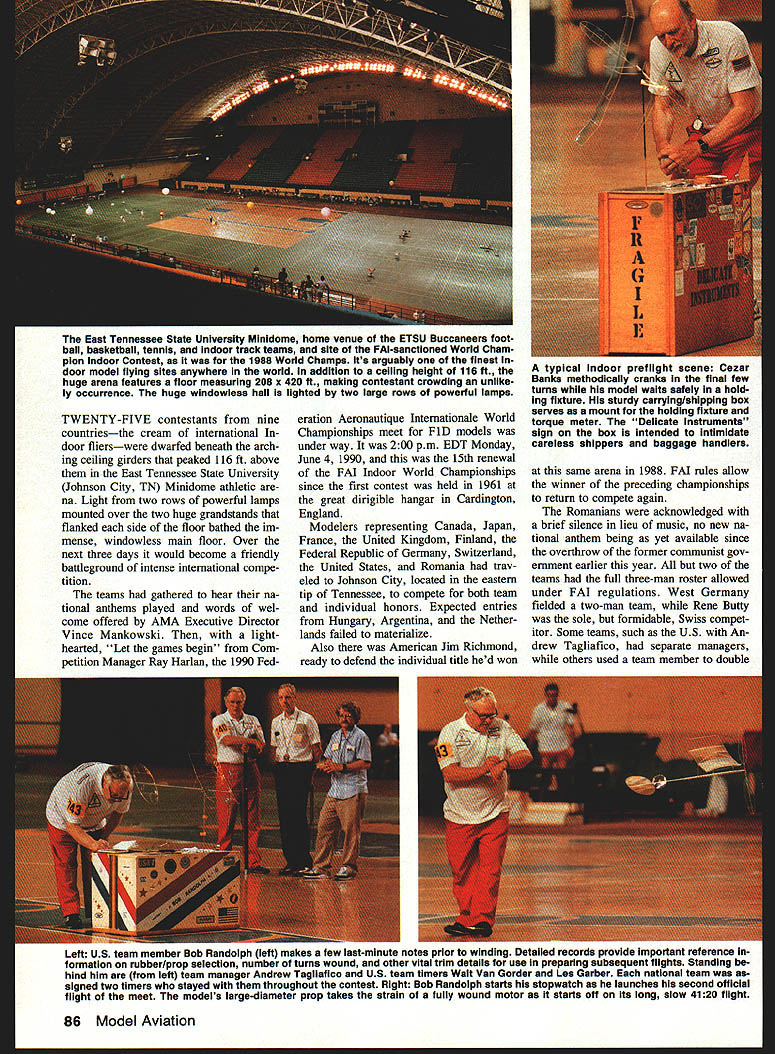
Twenty-five contestants from nine countries—the cream of international indoor fliers—gathered beneath the arching ceiling girders that peaked 116 ft. above them in the East Tennessee State University (Johnson City, TN) Minidome athletic arena. Light from two rows of powerful lamps mounted over the two huge grandstands bathed the immense, windowless main floor. Over three days it became a friendly battleground of intense international competition.
The meet opened with national anthems and welcome remarks by AMA Executive Director Vince Mankowski. Competition Manager Ray Harlan light-heartedly declared, "Let the games begin," and the 1990 Federation Aeronautique Internationale World Championships for F1D models was under way at 2:00 p.m. EDT on Monday, June 4, 1990. This was the 15th renewal of the FAI Indoor World Championships since the first contest in 1961 at Cardington, England.
Participating countries
- Canada
- Japan
- France
- United Kingdom
- Finland
- Federal Republic of Germany
- Switzerland
- United States
- Romania
Expected entries from Hungary, Argentina, and the Netherlands did not materialize.
Teams and entrants
Modelers representing each country competed for team and individual honors. All but two teams fielded the full three-man roster allowed under FAI regulations. West Germany had a two-man team; Rene Butty was the sole Swiss competitor. Some teams, such as the U.S. with Andrew Tagliafico, had separate managers, while others used a team member to double as manager in this important role.
Also present was American Jim Richmond, returning to defend the individual title he'd won at the same arena in 1988. FAI rules allow the winner of the preceding championships to return.
Competition format
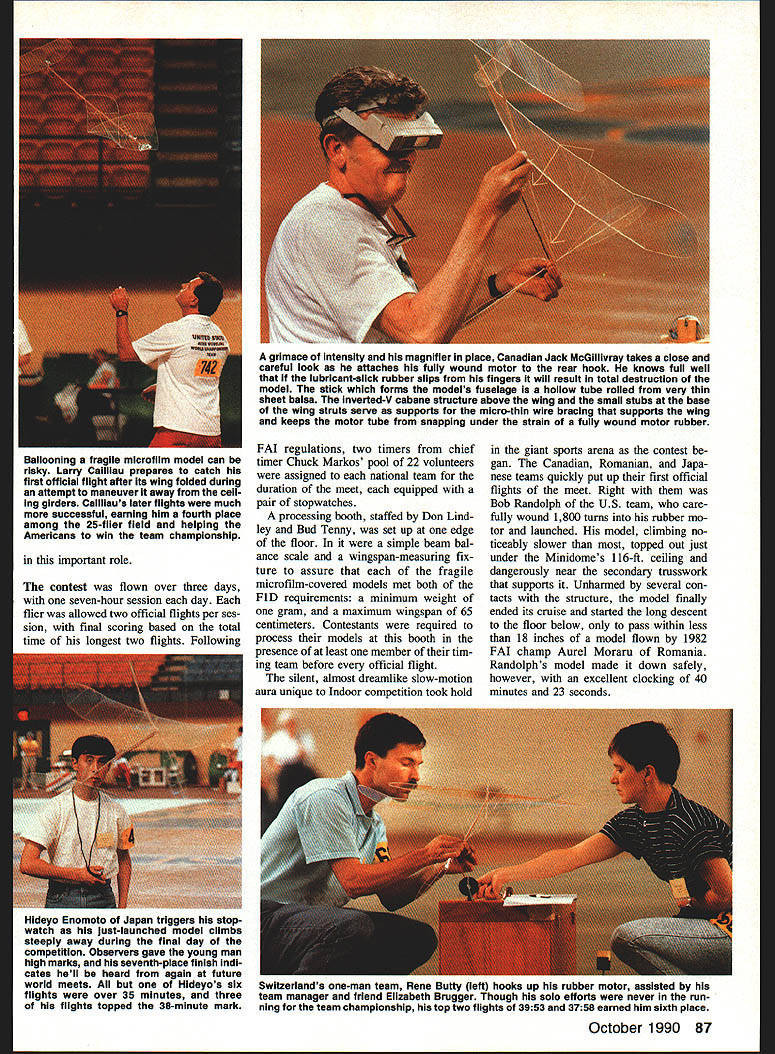
The contest was flown over three days, with one seven-hour session each day. Each flier was allowed two official flights per session; final scoring was based on the total time of his longest two flights. Following FAI regulations, two timers from chief timer Chuck Markos' pool of 22 volunteers were assigned to each national team for the duration of the meet, each equipped with a pair of stopwatches.
A processing booth, staffed by Don Lindley and Bud Tenny, was set up at one edge of the floor. It featured a beam-balance scale and a wingspan-measuring fixture to ensure each fragile, microfilm-covered model met F1D requirements: a minimum weight of one gram and a maximum wingspan of 65 centimeters. Contestants were required to process their models at this booth in the presence of at least one member of their timing team before every official flight.
Day One
The silent, almost dreamlike slow-motion aura unique to indoor competition took hold as the meet began. The Canadian, Romanian, and Japanese teams quickly put up their first official flights. Right with them was Bob Randolph of the U.S. team, who carefully wound 1,800 turns into his rubber motor and launched. His model, climbing noticeably slower than most, topped out just under the Minidome's 116-ft. ceiling and dangerously near the secondary trusswork. Unharmed by several contacts with the structure, the model finally ended its cruise and started the long descent to the floor below, passing within less than 18 inches of a model flown by 1982 FAI champ Aurel Moraru of Romania. Randolph's model made it down safely with an excellent clocking of 40:23.
Jack McGillivray, veteran of the strong Canadian team, hung up on a beam only five minutes 36 seconds into his opening flight after a too-rapid ascent. The lofty steelwork and midair collisions would claim many other models as the meet progressed; for some contestants this attrition proved their most implacable opponent.
Cezar Banks followed Randolph for the U.S. team and barely got the watches started. Banks' model, badly distorted by the torque of a fully wound motor, wouldn't climb and hit the floor after a mere 54 seconds.
Teammate Larry Cailliau, using a helium balloon to reposition his model during its first official attempt (allowed and often effectively used under FAI rules), inadvertently crumpled a wing and sent his ship spiraling slowly to the floor. His time was 12:41. Despite a very respectable 39:21 on Cailliau's second effort and a fine 41:20 number two from Bob Randolph, the end of the first round found the American team in fourth place behind Romania, Japan, and Finland. In the individual standings Randolph was second, Cailliau third, and Cezar Banks 25th.
Jim Richmond defended his title without delay. He calmly put up two splendid flights: 43:18 and 42:15, both using the same .040 x .060 x 20-in. Pirelli motor he'd flown to victory in the 1988 meet. They were the seventh and eighth official flights on that Pirelli motor. Richmond cranked in 2,250 and 2,290 turns respectively for the two flights. On the second, his ship miraculously squeezed through the girders during one circle.
Day Two
Official flying began at 1 p.m. on Tuesday. Bob Randolph suffered two midairs, including one that saw a dead-sticking descent by Romania's Aurel Popa snag his ascending model, prematurely ending good flights for both contestants. (Flights are allowed after such collisions, so no official flights are lost, but a reflight doesn't bring back a high time lost by collision.)
Despite his mishaps, Randolph raised his remarkable string of 40-minute-plus flights to four with timings of 41:14 and 40:46, holding second place in the individual standings by 2:40 over a resurgent Cezar Banks. With Banks' 41:05 and Larry Cailliau's 39:21, the American team's total increased to 241:10 and leapfrogged them into first place in the team standings—a position they would hold for the remainder of the contest.
As Tuesday night closed, the Romanian team had moved into second place with a total of 211:15, Japan was third at 198:22, and Canada moved up to a close fourth with 191:23. It became clear the real team battles would be for second and third places.
In the individual competition, Jim Richmond proved he was human with a disastrous out-of-trim third flight of only 2:30, followed by a fourth that was just average at 38:33. His good Pirelli motor finally broke during winding. But with his two-flight total of 85:33 from day one, Richmond still held a slim 3:59 lead over the consistent Randolph. Also in the running were Cezar Banks, Rene Butty of Switzerland (77:51), Pentti Nore of Finland (77:22), and Hideyo Enomoto of Japan (77:01).
Day Three — Finale
Wednesday began with a precontest practice session from 7:00 through 10:30 a.m., then the final seven-hour official session. Drift within the Minidome remained minimal. Championship Manager Tony Italiano and Facilities Manager Gilbert Graunke had kept exterior doors closed and locked to ensure calm air. Diane Gallalee and Bob Vojtisek of AMA Headquarters offered administrative support. Chief tabulator Charlie Stoick and computer operator Del Ogren provided continuous updates of standings projected to a wall screen. A blue-ribbon FAI jury (William Henderson of Canada, John Worth of the United States, and Ian Kaynes of the United Kingdom) stood by; no rules disputes arose.
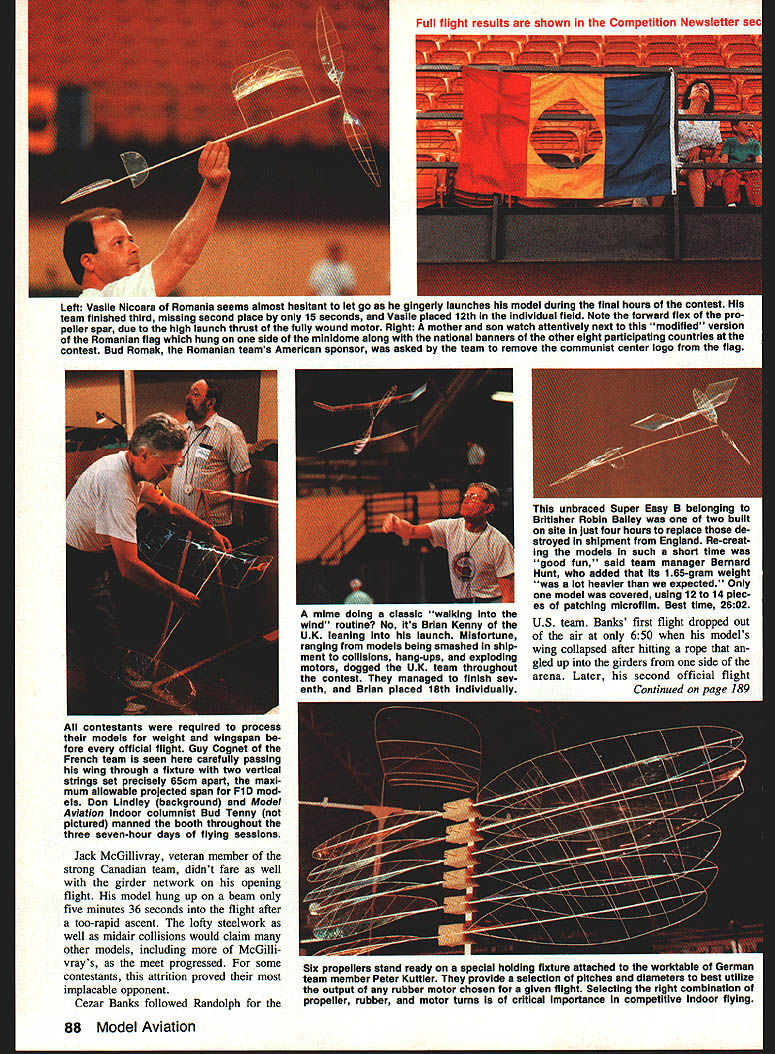
As the finale approached, propeller and rubber selection, tiny adjustments to variable-pitch-and-diameter prop mechanisms, tweaking of incidence angles, motor torque interpretation, and other arcane facets of indoor flying took on heightened importance.
Under the watchful eye of launch controller Richard Doig, the stream of final official flights began. Cezar Banks set the pace with a 42:42 flight that stood as the third-longest of the contest. Banks later said of his variable-pitch mechanism, "If low pitch had kicked in five minutes earlier, I believe my time would have been around 45–46 minutes. My mistake was in adjusting the low pitch angle of the blade instead of adjusting the tension on the torsion spring that kicks in the lower pitch." Like many top indoor fliers, he uses a propeller with a spring-actuated hub mechanism that sets the blades to a lower pitch about 30 minutes into the flight; under optimum conditions this increases rpm and regains altitude, adding several minutes.
Banks, like Richmond, used Pirelli rubber. He had used the same motor for his earlier best flight of 41:05. At the 42:42 flight he put in 1,880 turns, backing off 70 turns to limit unwanted launch torque.
Bob Randolph, displaying superb skill at ballooning his fragile craft away from the girders during long flights, recorded a 100-ft. overhead during the final minutes of his last flight, clocked 42:07, and raised his two-flight total to 83:27. Despite an astounding run of six consecutive 40-minute-plus flights, this left Randolph in third place, a heartbreaking 20 seconds behind Banks' 83:47.
And Jim Richmond? Flying the same model he'd used in his previous four finals, he had wound to 2,200 turns, backed off 20, and launched. The model climbed to a safe cruise altitude just under the mainspar truss. When this superbly orchestrated "no-touch" flight finally landed, the watches showed a duration of 44:18—the longest single flight of the contest.
"My variable-diameter prop folded (to a smaller diameter) right where I wanted it to," Richmond explained, "at 25 minutes into the flight." Like variable-pitch set-ups, Richmond's variable-diameter prop boosted rpm enough to halt the descent and return the model to a few minutes of climb. The added altitude increased overall flight time.
Richmond's win gave him an unprecedented record of six FAI individual championships, the last four comprising an unbroken string dating from his 1984 victory in Nagoya, Japan. In the 15 World Championship Indoor contests now in the books, no other flier has ever won more than a single individual title. Richmond has set a standard of competitive excellence in aeromodeling that may well never be surpassed.
Beating the final flight deadline of 5:30 p.m. by only seconds, Robin Bailey of the United Kingdom got off the final launch of the contest. But it was a Romanian model—former champ Aurel Moraru's—that was the last to land and bring the contest to a close. The Romanians fell a scant 13 seconds short of the Canadian team in the battle for second-place team honors: Canada totaled 2:11:24 to edge Romania's 2:11:11.
Final results
- Teams
- United States (team champions)
- Canada (second)
- Romania (third)
- Japan (fourth)
- Finland (fifth)
- France (sixth)
- United Kingdom (seventh)
- Federal Republic of Germany (eighth)
- Switzerland (ninth)
- Individuals (top three)
- Jim Richmond (gold)
- Cezar Banks (silver)
- Bob Randolph (bronze)
Eleven flights of over 40 minutes were recorded, all flown by Americans. Bob Randolph had six of these, Jim Richmond three, and Cezar Banks two. Rene Butty of Switzerland, who finished sixth, missed the 40-minute mark by seven seconds when his second flight on day one touched down at 39:53.
Awards banquet
Following a two-hour break for rest and refurbishment by contestants, officials, and interested spectators, an awards banquet was held at the Sheraton Hotel. Medals and trophies were presented to the top three individuals (Richmond, Banks, and Randolph) and to the top three teams (United States, Canada, and Romania).
The Romanian team and Bud Romak
Special mention must be made of the Romanian team of Aurel Moraru, Vasile Nicoara, and Aurel Popa. Without the concern and generosity of Oakland Cloud Duster Bud Romak, this scrappy East European trio would not have been at the meet. "The price of an airline ticket alone is two-thirds of one of their annual salaries," Romak explained. "They were prevented by the former government from coming to the '88 championships here, and I got a telegram from them only a month ago saying they could come but didn't have the financial backing for the trip. So I became their sponsor."
Romak has been a friend, mentor, and patron of Eastern European indoor fliers since meeting many of them at the 1966 World Championships in Hungary. "They were using straw for motor sticks and hair for bracing. They had virtually no access to modeling supplies as we know them. I left them all my models (I had won the individual championship), and Lew Gitlow (Indoor Model Supply) donated wood and other supplies at the '68 championships. Ever since those days, they treat me like a brother, and I try to treat them the same way."
Romak, who lives in California, met the Romanians in New York and drove them to Johnson City. He predicted they would win a sure third and possibly a second place. They indeed finished third, less than a quarter of a minute behind the second-place Canadian team. "They're really special," he concluded.
Transcribed from original scans by AI. Minor OCR errors may remain.

