

Inside the Electronic Speed Control
by Lee Estingoy
MYSTERIOUS EVENTS are often attributed to mystical causes, and brushless power systems are about as mysterious as things get in RC. Some systems work and others don't. Why?
The usual explanation is something along the lines of, "It's a mystery!" The reason for a component failure is a mystery to most involved, but understanding a bit more about brushless systems can go a long way toward helping a hobbyist enjoy outstanding reliability in an electric-powered airplane or helicopter.
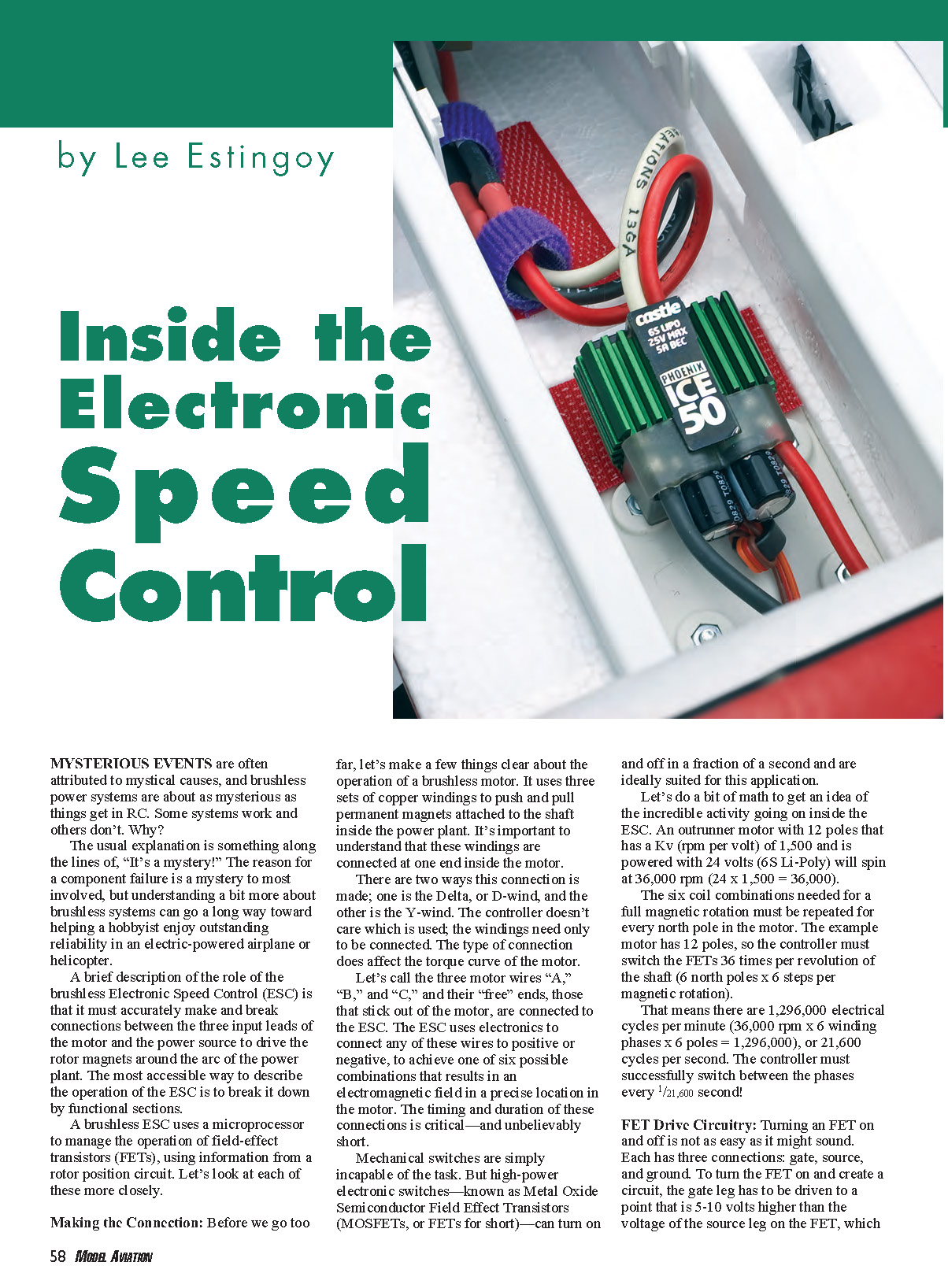
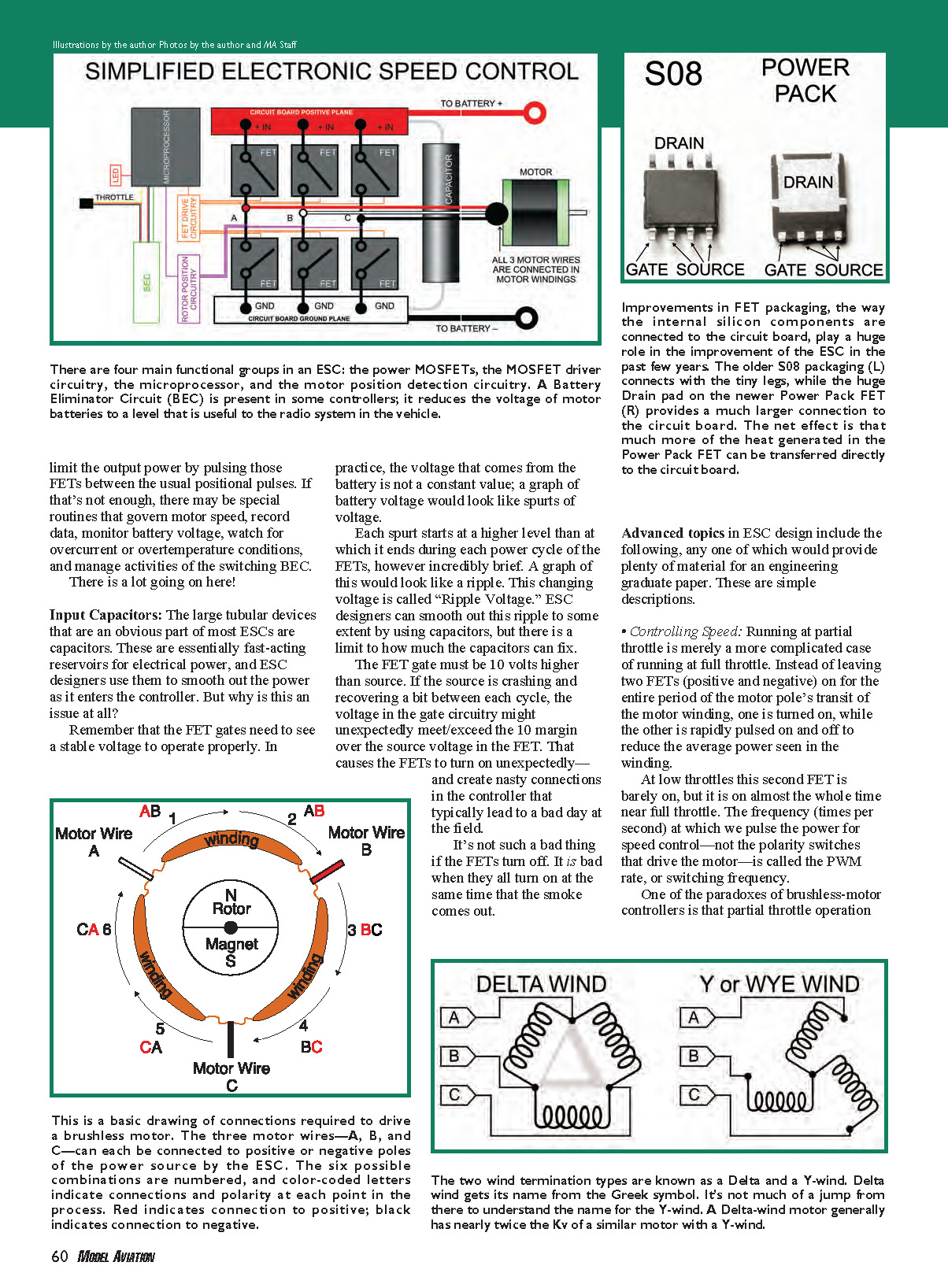
A brief description of the role of the brushless Electronic Speed Control (ESC) is that it must accurately make and break connections between the three input leads of the motor and the power source to drive the rotor magnets around the arc of the power plant. The most accessible way to describe the operation of the ESC is to break it down by functional sections.
A brushless ESC uses a microprocessor to manage the operation of field-effect transistors (FETs), using information from a rotor position circuit. Let's look at each of these more closely.
Making the Connection
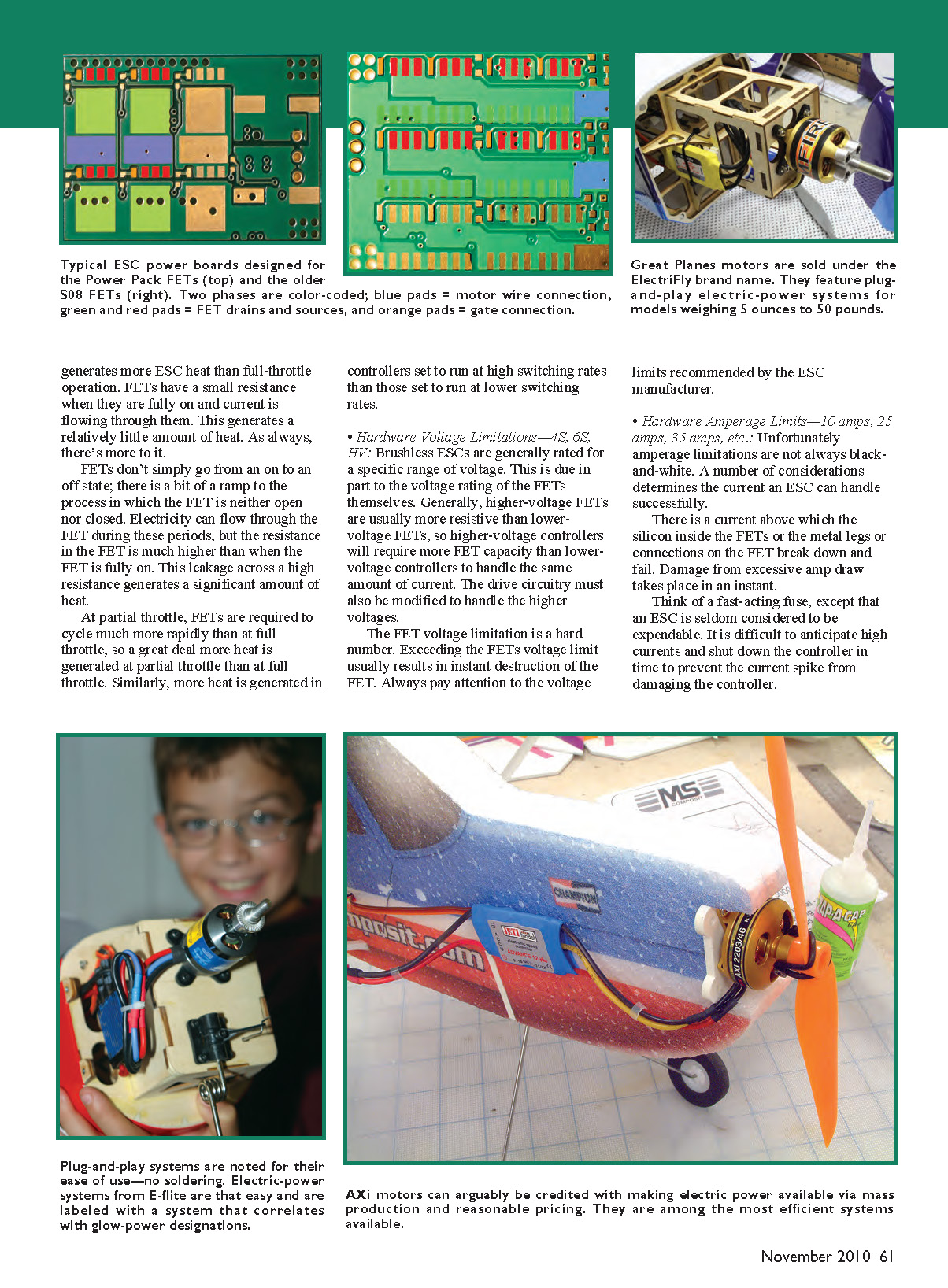
Before we go too far, let's make a few things clear about the operation of a brushless motor. It uses three sets of copper windings to push and pull permanent magnets attached to the shaft inside the power plant. It's important to understand that these windings are connected at one end inside the motor. There are two ways this connection is made: the Delta, or D-wind, and the Y-wind. The controller doesn't care which is used; the windings need only to be connected. The type of connection does affect the torque curve of the motor.
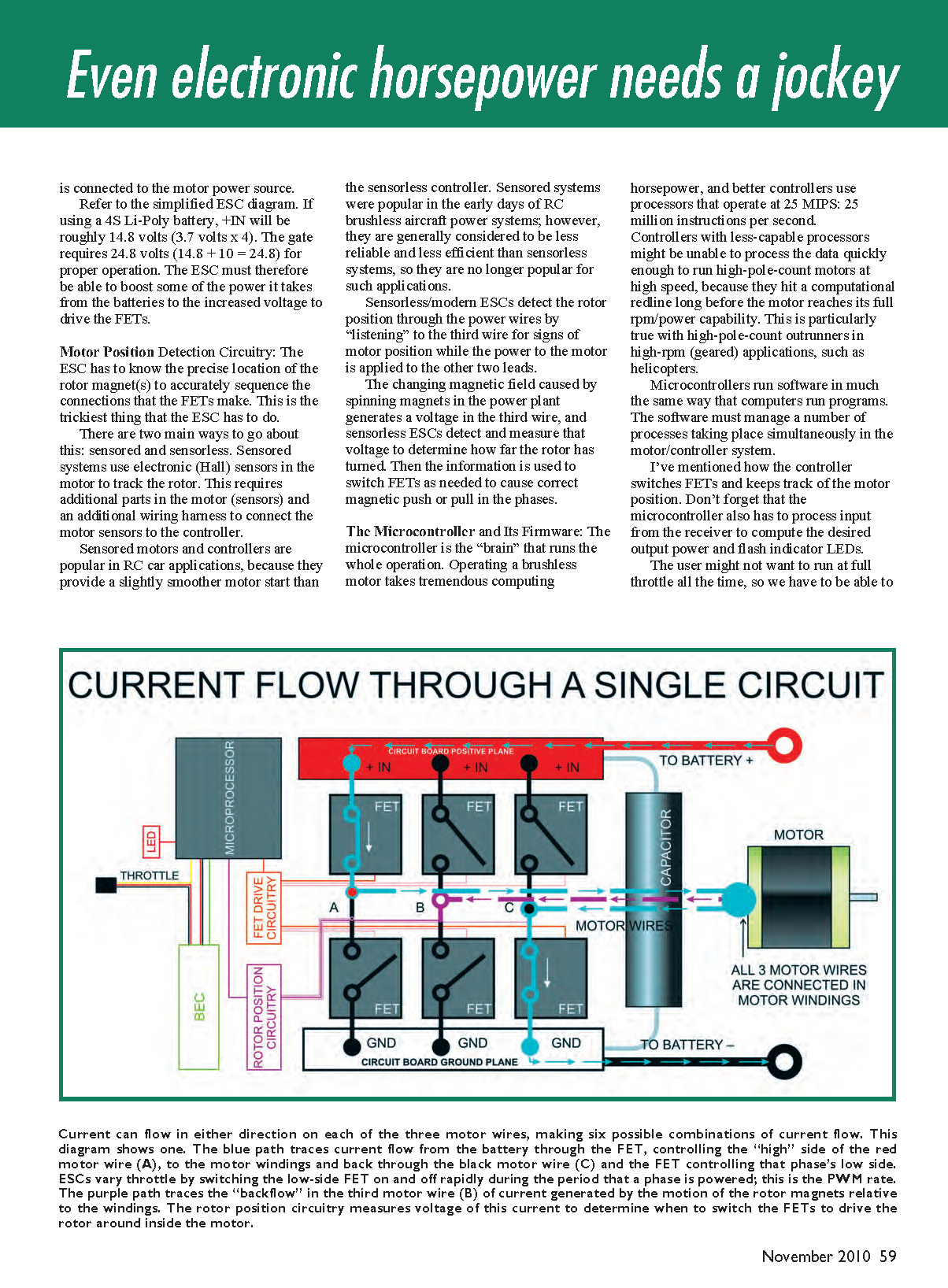
Let's call the three motor wires "A," "B," and "C." Their free ends, those that stick out of the motor, are connected to the ESC. The ESC uses electronics to connect any of these wires to positive or negative to achieve one of six possible combinations that results in an electromagnetic field in a precise location in the motor. The timing and duration of these connections is critical—and unbelievably short. Mechanical switches are simply incapable of the task. But high-power electronic switches—known as Metal Oxide Semiconductor Field Effect Transistors (MOSFETs, or FETs for short)—can turn on and off in a fraction of a second and are ideally suited for this application.
Let's do a bit of math to get an idea of the incredible activity going on inside the ESC. An outrunner motor with 12 poles that has a Kv (rpm per volt) of 1,500 and is powered with 24 volts (6S Li-Poly) will spin at 36,000 rpm (24 × 1,500 = 36,000).
The six coil combinations needed for a full magnetic rotation must be repeated for every north pole in the motor. The example motor has 12 poles, so the controller must switch the FETs 36 times per revolution of the shaft (6 north poles × 6 steps per magnetic rotation).
That means there are 1,296,000 electrical cycles per minute (36,000 rpm × 36 switches = 1,296,000), or 21,600 cycles per second. The controller must successfully switch between the phases every 1/21,600 second!
FET Drive Circuitry
Turning an FET on and off is not as easy as it might sound. Each FET has three connections: gate, drain, and source. To turn the FET on and create a circuit, the gate leg has to be driven to a point that is typically 5–10 volts higher than the voltage of the source leg on the FET, which is connected to the motor power source. In a simplified ESC diagram, if using a 4S Li-Poly battery, +IN will be roughly 14.8 volts (3.7 volts × 4). The gate requires about 24.8 volts (14.8 + 10 = 24.8) for proper operation. The ESC must therefore be able to boost some of the power it takes from the batteries to the increased voltage to drive the FETs.
Motor Position Detection Circuitry
The ESC has to know the precise location of the rotor magnet(s) to accurately sequence the connections that the FETs make. This is the trickiest thing that the ESC has to do.
There are two main ways to go about this: sensored and sensorless. Sensored systems use electronic (Hall) sensors in the motor to track the rotor. This requires additional parts in the motor (sensors) and an additional wiring harness to connect the motor sensors to the controller.
Sensored motors and controllers are popular in RC car applications because they provide a slightly smoother motor start than sensorless controllers. Sensored systems were popular in the early days of RC brushless aircraft power systems; however, they are generally considered to be less reliable and less efficient than sensorless systems, so they are no longer popular for such aircraft applications.
Sensorless or modern ESCs detect rotor position through the power wires by “listening” to the third wire for signs of motor position while power is applied to the other two leads. The changing magnetic field caused by spinning magnets in the power plant generates a voltage in the third wire, and sensorless ESCs detect and measure that voltage to determine how far the rotor has turned. That information is then used to switch FETs as needed to cause correct magnetic push or pull in the phases.
The Microcontroller and Its Firmware
The microcontroller is the “brain” that runs the whole operation. Operating a brushless motor takes tremendous computing horsepower, and better controllers use processors that operate at 25 MIPS: 25 million instructions per second. Controllers with less-capable processors might be unable to process the data quickly enough to run high-pole-count motors at high speed, because they hit a computational redline long before the motor reaches its full rpm/power capability. This is particularly true with high-pole-count outrunners in high-rpm (geared) applications, such as helicopters.
Microcontrollers run software in much the same way that computers run programs. The software must manage a number of processes taking place simultaneously in the motor/controller system.
In addition to switching FETs and tracking motor position, the microcontroller also has to process input from the receiver to compute the desired output power and flash indicator LEDs. Users may not want full throttle all the time, so the controller must be able to limit output power by pulsing the FETs between the usual positional pulses. There may also be special routines that govern motor speed, record data, monitor battery voltage, watch for overcurrent or overtemperature conditions, and manage the switching BEC. There is a lot going on here!
Input Capacitors
The large tubular devices that are an obvious part of most ESCs are capacitors. These are essentially fast-acting reservoirs for electrical power, and ESC designers use them to smooth out the power as it enters the controller. But why is this an issue at all?
Remember that the FET gates need to see a stable voltage to operate properly. In practice, the voltage that comes from the battery is not a constant value; a graph of battery voltage would look like spurts of voltage. Each spurt starts at a higher level than at which it ends during each power cycle of the FETs, however brief. A graph of this would look like a ripple. This changing voltage is called ripple voltage. ESC designers can smooth out this ripple to some extent by using capacitors, but there is a limit to how much the capacitors can correct.
The FET gate must be about 10 volts higher than the source. If the source is crashing and recovering a bit between each cycle, the voltage in the gate circuitry might unexpectedly meet or exceed the 10-V margin over the source voltage on the FET. That causes the FETs to turn on unexpectedly—and create nasty connections in the controller that typically lead to a bad day at the field.
It's not such a bad thing if the FETs turn off. It is bad when they all turn on at the same time and the smoke comes out.
Improvements in FET packaging and in the way the internal silicon components are connected to the circuit board have played a huge role in ESC improvement over the past few years. Newer Power Pack FETs provide much larger connection pads to the circuit board, allowing more of the heat generated in the FET to be transferred directly to the board.
Advanced topics in ESC design include the following—any one of which would provide plenty of material for an engineering graduate paper. These are simple descriptions.
- Controlling Speed
- Running at partial throttle is merely a more complicated case of running at full throttle. Instead of leaving two FETs (positive and negative) on for the entire period of the motor pole's transit of the motor winding, one is turned on while the other is rapidly pulsed on and off to reduce the average power seen in the winding.
- At low throttle this second FET is barely on, but it is on almost the whole time near full throttle. The frequency (times per second) at which we pulse the power for speed control—not the polarity switches that drive the motor—is called the PWM rate, or switching frequency.
- One of the paradoxes of brushless-motor controllers is that partial-throttle operation generates more ESC heat than full-throttle operation. FETs have a small resistance when they are fully on and current is flowing through them, which generates a relatively small amount of heat. However, FETs don't simply go from an on to an off state; there is a transition during which the FET is neither fully on nor fully off. Electricity can flow through the FET during these periods, but the resistance is much higher than when the FET is fully on. This leakage across a higher resistance generates significant heat.
- At partial throttle, FETs cycle much more rapidly than at full throttle, so a great deal more heat is generated at partial throttle than at full throttle. Similarly, more heat is generated in controllers set to run at high switching rates than those set to run at lower switching rates.
- Hardware Voltage and Amperage Limitations
- Brushless ESCs are generally rated for a specific range of voltage. This is due in part to the voltage rating of the FETs themselves. Generally, higher-voltage FETs are more resistive than lower-voltage FETs, so higher-voltage controllers will require more FET capacity than lower-voltage controllers to handle the same amount of current. The drive circuitry must also be modified to handle higher voltages. The FET voltage limitation is a hard number. Exceeding the FETs' voltage limit usually results in instant destruction of the FET. Always pay attention to the voltage limits recommended by the ESC manufacturer.
- Amperage limitations are not always black-and-white. A number of considerations determine the current an ESC can handle successfully. There is a current above which the silicon inside the FETs or the metal legs or connections on the FET break down and fail. Damage from excessive amp draw can take place in an instant.
- It is difficult to anticipate high currents and shut down the controller in time to prevent a damaging current spike. Partial-throttle operation generates more heat, as does high PWM rates. The amperage capability of an ESC is limited by the device's ability to dissipate heat generated by the resistance of FETs and circuit boards. If a controller is making more heat than it can dissipate, a “runaway” condition occurs. This can lead to thermal destruction of the controller; solder holding the components to the boards literally melts, and the parts can come loose.
- A practical way to rate a controller is by its steady-state amperage: the maximum current it can carry at its rated voltage without further temperature rise. This can vary with ambient temperature and cooling airflow. A less useful rating is the controller's “surge” or “burst” capability—these indicate the controller might handle higher currents for short periods, but those periods may be shorter than a pilot would expect. Read the fine print on manufacturer specs.
Like the proverbial duck on water, things look calm on top but there’s a whole lot going on inside a brushless motor controller. A great deal of engineering goes into the physical design, and the software is surprisingly complex. Always use a power system inside its performance envelope for best performance and reliability.
Lee Estingoy lee@castlecreations.com
Sources
- Himax motors: Maxx Products International, (800) 416-6299, www.maxxprod.com
- E-flite, (800) 338-4639, www.e-flite.com
- ElectriFly, (800) 637-7660, www.electrifly.com
- AXi electronics: Hobby Lobby, (866) 512-1444, www.hobby-lobby.com
- Castle Creations, (913) 390-6939, www.castlecreations.com
Transcribed from original scans by AI. Minor OCR errors may remain.

