
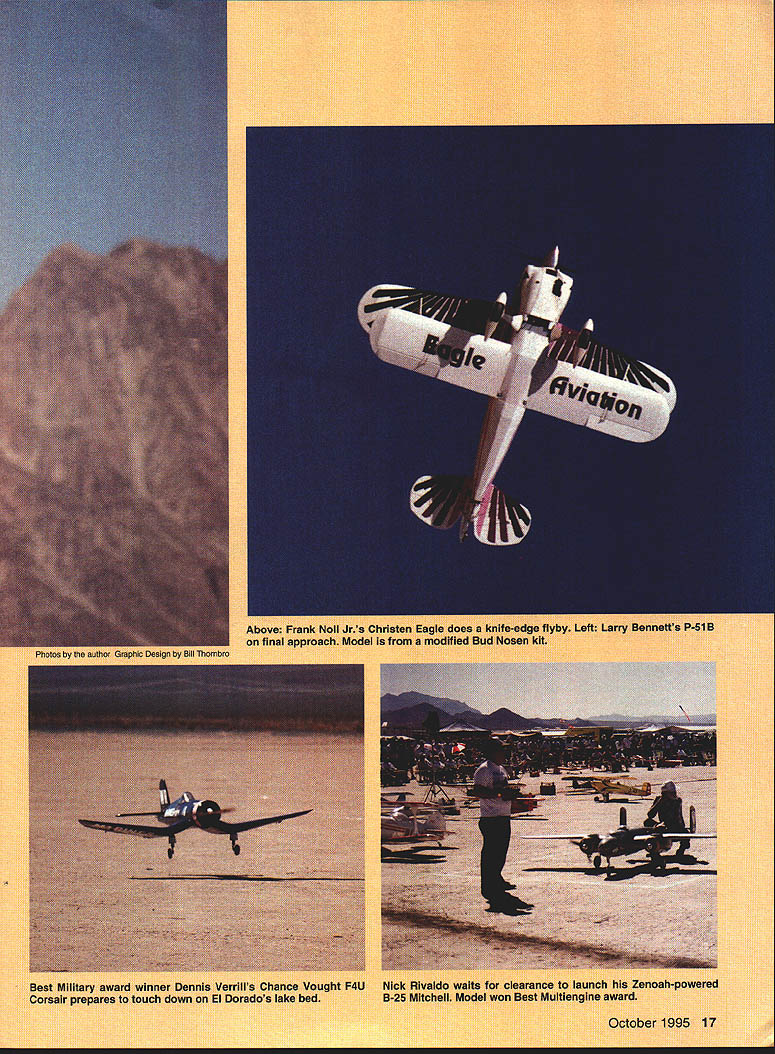
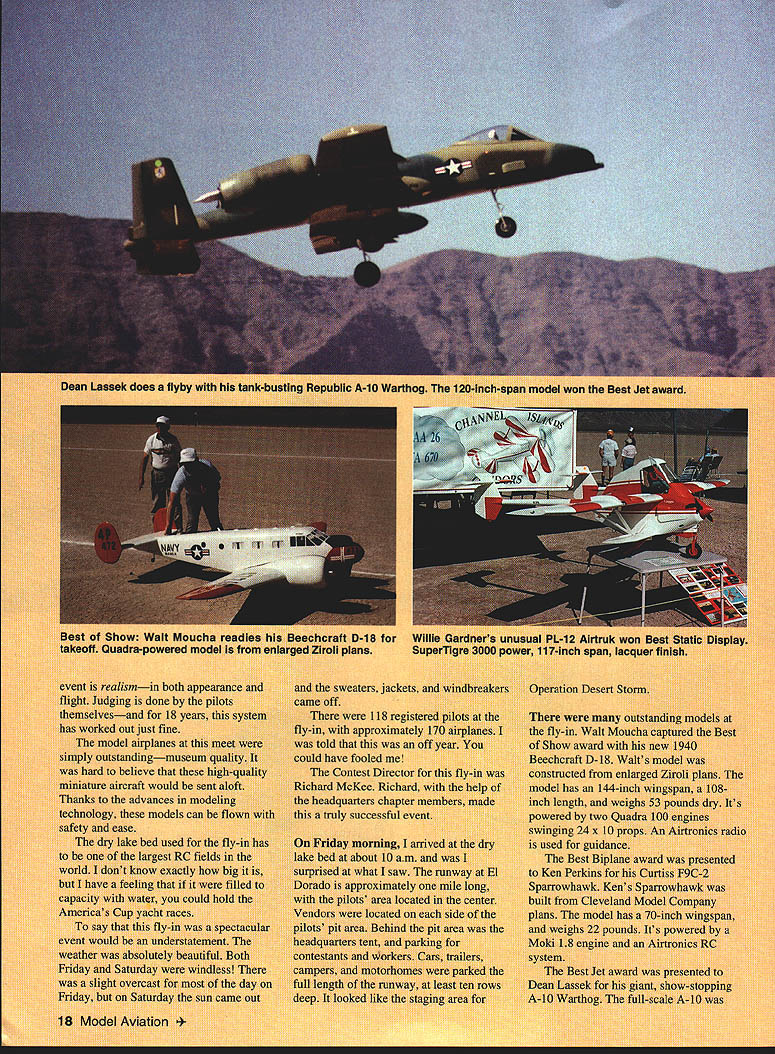
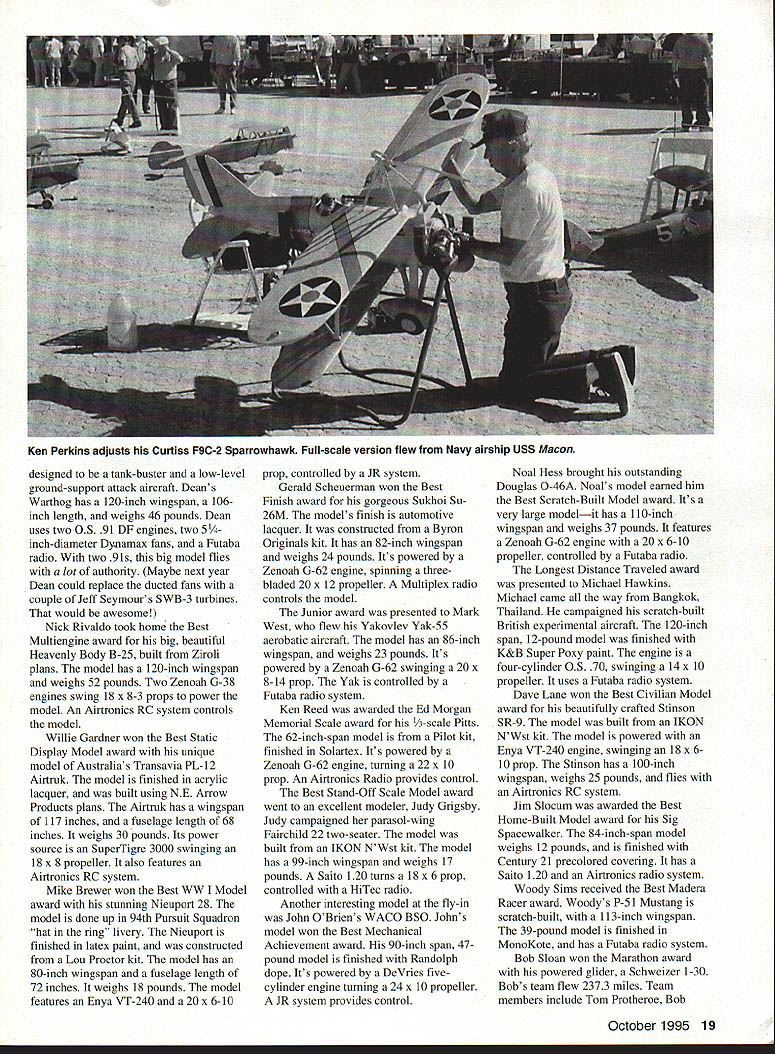
International Fly-In
Report from Las Vegas on the 18th annual affair
Wally Zober
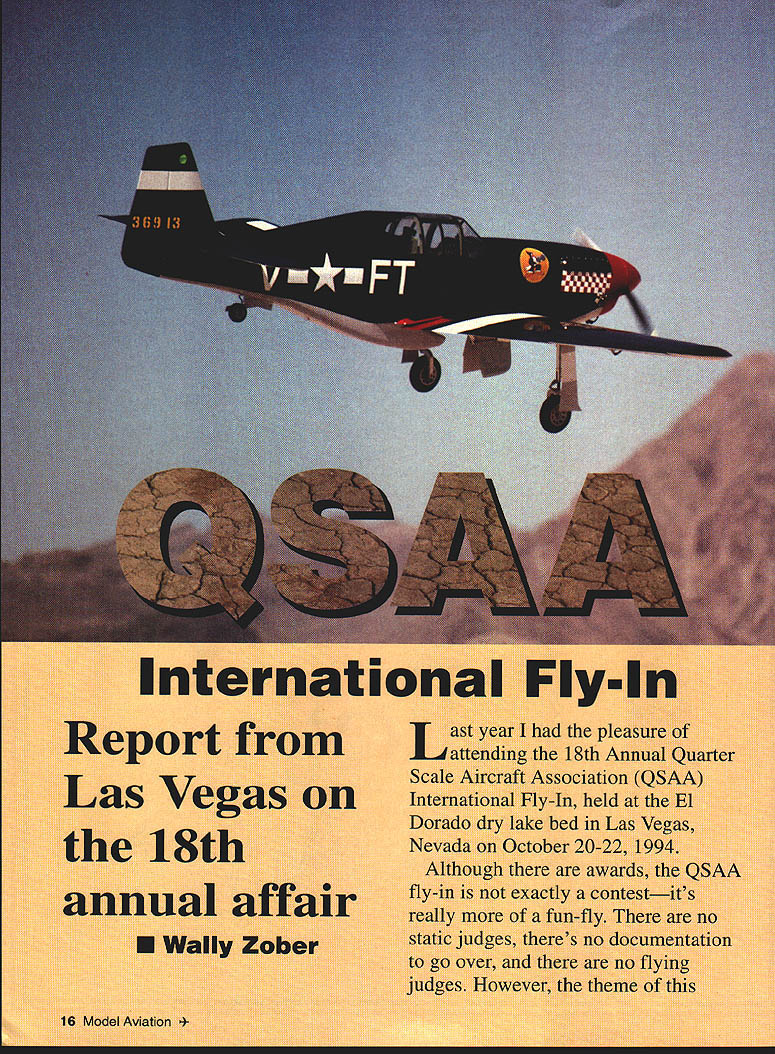
Last year I had the pleasure of attending the 18th Annual Quarter Scale Aircraft Association (QSAA) International Fly-In, held at the El Dorado dry lake bed in Las Vegas, Nevada on October 20–22, 1994.
Although there are awards, the QSAA fly-in is not exactly a contest — it's really more of a fun-fly. There are no static judges, no documentation to go over, and no flying judges. The theme of the event is realism in both appearance and flight. Judging is done by the pilots themselves, and for 18 years this system has worked out just fine.
The model airplanes on display were simply outstanding — museum quality. Advances in modeling technology allow these high-quality miniature aircraft to be flown safely and with ease. The dry lake bed used for the fly-in is one of the largest R/C fields in the world; the runway at El Dorado is approximately a mile long. To say the fly-in was a spectacular event would be an understatement.
The weather was beautiful. Both Friday and Saturday were windless, with a slight overcast on Friday. On Saturday the sun came out and sweaters, jackets and windbreakers came off. There were 118 registered pilots at the fly-in with approximately 170 airplanes. Contest Director Richard McKee and his headquarters chapter members made the event truly successful.
On Friday morning I arrived at the dry lake bed about 10 a.m. The pilots' area was located in the center of the mile-long runway, with vendors on each side of the pit area. Behind the pit area were the headquarters tent and parking for contestants and workers. Cars, trailers, campers and motorhomes were parked the full length of the runway in at least ten rows deep — it looked like a staging area.
Award winners and notable models
- Best of Show — Walt Moucha: 1940 Beechcraft D-18 built from enlarged Ziroli plans. 144" wingspan, 108" length, 53 lb dry. Powered by two Quadra 100 engines turning 24 x 10 props. Airtronics radio.
- Best Biplane — Ken Perkins: Curtiss F9C-2 Sparrowhawk built from Cleveland Model Company plans. 70" wingspan, 22 lb. Powered by a Moki 1.8 engine. Airtronics RC system.
- Best Jet — Dean Lassek: Giant A-10 Warthog. 120" wingspan, 106" length, 46 lb. Powered by two OS .91 DF engines and two 5" Dynamax fans. Futaba radio.
- Best Multiengine — Nick Rivaldo: "Heavenly Body" B-25 built from Ziroli plans. 120" wingspan, 52 lb. Powered by two Zenoah G-38 engines turning 18 x 8-3 props. Airtronics RC system.
- Best Static Display Model — Willie Gardner: Transavia PL-12 Airtruk built from NE Arrow Products plans. 117" wingspan, 68" fuselage, 30 lb. Powered by a SuperTigre 3000 turning an 18 x 8 prop. Finished in acrylic lacquer. Airtronics RC.
- Best WW I Model — Mike Brewer: Nieuport 28 in 94th Pursuit Squadron hat-in-ring livery, constructed from a Lou Proctor kit. 80" wingspan, 72" fuselage, 18 lb. Powered by an Enya VT-240 with 20 x 6-10 prop. JR radio. Finished in latex paint.
- Best Finish — Gerald Scheuerman: Sukhoi Su-26M from a Byron Originals kit. 82" wingspan, 24 lb. Finished in automotive lacquer. Powered by a Zenoah G-62 turning a three-bladed 20 x 12 prop. Multiplex radio.
- Junior Award — Mark West: Yakovlev Yak-55 aerobatic model. 86" wingspan, 23 lb. Powered by a Zenoah G-62 turning a 20 x 8-1/4 prop. Futaba radio.
- Ed Morgan Memorial Scale Award — Ken Reed: 1/3-scale Pitts from a Pilot kit. 62" span. Finished in Solartex. Powered by a Zenoah G-62 turning a 22 x 10 prop. Airtronics radio.
- Best Stand-Off Scale Model — Judy Grigsby: Parasol-wing Fairchild 22 two-seater from an IKON N'Wst kit. 99" wingspan, 17 lb. Saito 1.20 engine turning an 18 x 6 prop. HiTec radio.
- Best Mechanical Achievement — John O'Brien: WACO BSO. 90" span, 47 lb. Powered with Randolph Duo 91s and a DeVries five-cylinder turning a 24 x 10 prop. JR system.
- Best Scratch-Built Model — Noel Hess: Douglas O-46A. 110" wingspan, 37 lb. Powered by a Zenoah G-62 with a 20 x 6-10 prop. Futaba radio.
- Longest Distance Traveled — Michael Hawkins: Scratch-built British experimental aircraft, traveled from Bangkok, Thailand. 120" span, 12 lb, finished with K&B Super Poxy paint. Four-cylinder O.S. .70 engine turning a 14 x 10 prop. Futaba radio.
- Best Civilian Model — Dave Lane: Stinson SR-9 from an IKON N'Wst kit. 100" wingspan, 25 lb. Powered by an Enya VT-240 turning an 18 x 8 prop. Airtronics RC.
- Best Home-Built Model — Jim Slocum: Big Speck. 84" span, 12 lb. Finished with Century 21 precolored covering. Saito 1.20 engine. Airtronics radio.
- Best Scale Racer — Woody Sims: P-51 Mustang, scratch-built. 113" wingspan, 39 lb. Finished in Monokote. Futaba radio.
- Marathon Award — Bob Slocum: Powered glider (Schweizer 1-30). Team flew 237.3 miles. Model has 120" wingspan, 12 lb. Four-cylinder O.S. .70 engine turning a 14 x 10 prop. Futaba radio. Team members included Tom Protheroe, Carol Brown, Roger Grigsby, and Gordie Azevedo.
- Powder Puff Award — Ruth Sharp: de Havilland Tiger Moth from a Pilot kit. 88" span, 17 lb. Enya .120 engine turning a 16 x 6 prop. Futaba radio. Finished in acrylic Polytone paint.
- Best Military — Dennis Verrill: F4U Corsair, scratch-built. 100" wingspan, 26 lb. Powered by a Zenoah G-62 turning a 22 x 10 prop. Airtronics radio. Exceptional Monokote finish.
- Best Glider — Glenn Bennett: DG-500 sailplane.
- Best Crash — Dennis Rollins: Weeks Special suffered separation of the top wing. Prior to the crash the model had a 70" wingspan, weighed 19 lb, and was powered by a Zenoah G-62 turning a 21 x 12 prop. Futaba radio.
Other notable models and builders
- Bob Watson: 1966-vintage Aircoupe. 120" wingspan, 43 lb. Super Tartan glow engine. Balsa sheeting covered with fiberglass, finished with Imron paint. On-board engine starting and navigation lights. Airtronics radio.
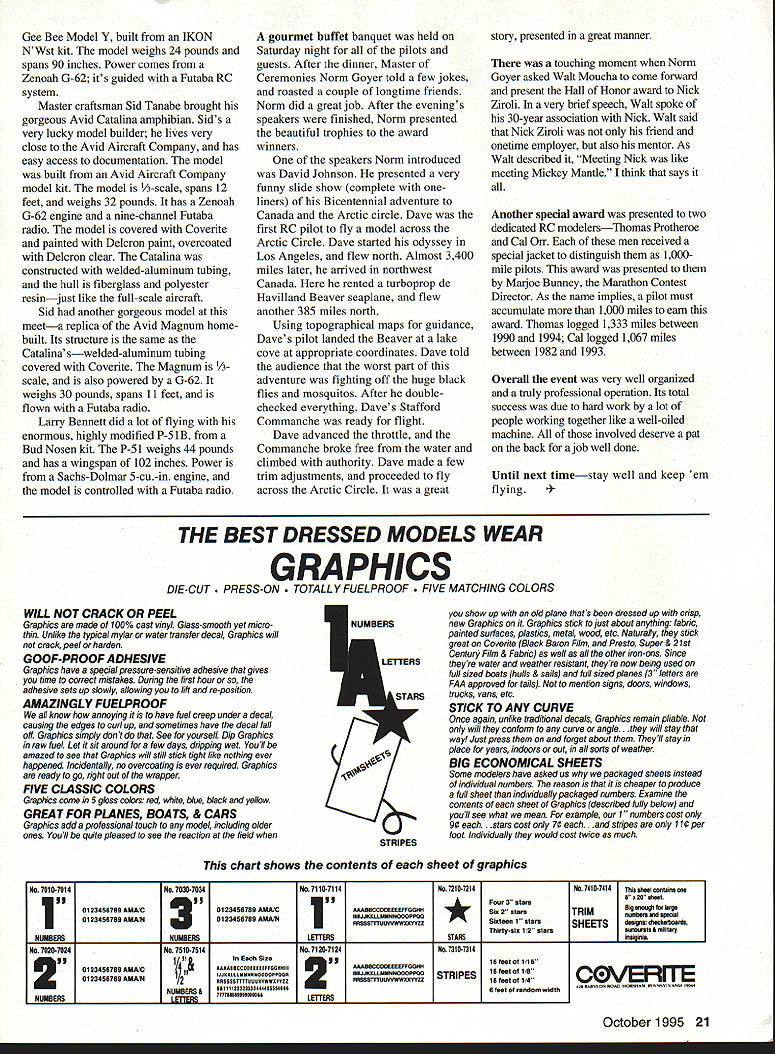
- Charles Murray: Wedell-Williams 44 "Miss Patterson" air racer. Competed in the Marathon event.
- Enrique Hara: 1/5-size Ultimate biplane, scratch-built. 120" wingspan, 49 lb dry. Walker 5.8 cu. in. engine. Construction: aircraft plywood, fiberglass, and foam covered with MonoKote. Futaba RC.
- Robert Mello: Ryan PT-22, scratch-built. 96" span, 24 lb. Powered by a Zenoah G-45. Futaba radio.
- Robert McKay: 1/4-scale Citabria in orange-and-white. 104" wingspan, 21 lb. Covered with 21st Century precolored fabric, powered by a Zenoah G-38 with a 28" Zinger prop. Airtronics PCM radio.
- Bud Atkinson: Sukhoi Su-26 from a Byron Originals kit. 84" wingspan, 25 lb. Finished with K&B epoxy paint. Powered by a Sachs 4.2 engine. Air RC system. Over 60 flights.
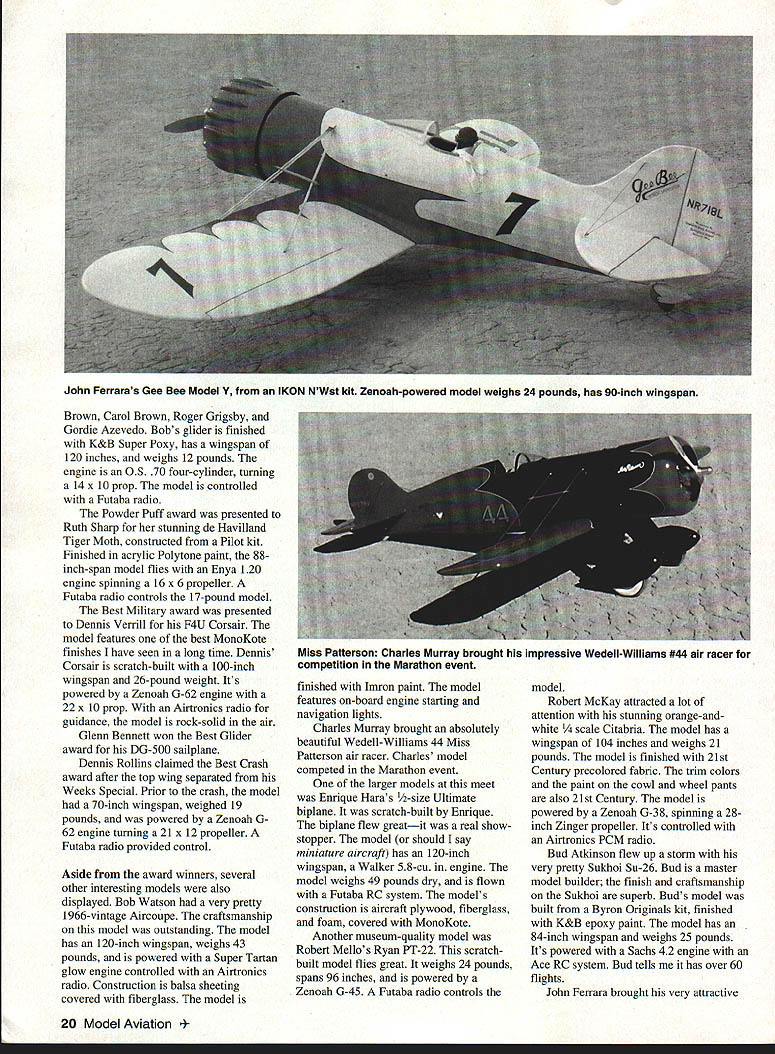
- John Ferrara: Gee Bee Model Y from an IKON N'West kit. 90" span, 24 lb. Powered by a Zenoah G-62. Futaba RC.
- Sid Tanabe: Avid Catalina amphibian (1/3-scale) built from an Avid kit. 12' span, 32 lb. Zenoah G-62 engine, nine-channel Futaba radio. Covered with Coverite and finished with Delcron paint/clear. Welded-aluminum tubing structure, fiberglass hull. Also brought an Avid Magnum replica (1/2-scale), 11' span, 30 lb, G-62, Futaba radio.
- Larry Bennett: Highly modified P-51B from a Bud Nosen kit. 102" wingspan, 44 lb. Sachs-Dolmar 5 cu. in. engine. Futaba radio.
Banquet, speakers and special honors
A gourmet buffet banquet was held Saturday night for pilots and guests. Master of Ceremonies Norm Goyer entertained with jokes and roasts, then presented the trophies.
David Johnson presented a humorous slide show of his Bicentennial adventure to Canada and the Arctic Circle. He was the first RC pilot to fly a model across the Arctic Circle, a journey that began in Los Angeles and covered almost 3,400 miles to northwest Canada. He then flew another 385 miles north by turboprop seaplane to a lake cove where he launched his Stafford Comanche, fighting off black flies and mosquitoes during the trip.
There was a touching moment when Walt Moucha presented the Hall of Honor award to Nick Ziroli. In a brief, witty speech Walt recalled 30 years of association with Nick and described him as a mentor and friend.
Thomas Protheroe and Cal Orr were presented special jackets as 1,000-mile pilots by Marathon Contest Director Marjoe Burney. A pilot must accumulate more than 1,000 miles to earn this honor; Thomas logged 1,333 miles between 1990 and 1994, and Cal logged 1,067 miles between 1982 and 1993.
Overall, the event was very well organized and a truly professional operation. Its success was due to the hard work of many people working together like a well-oiled machine. All involved deserve a pat on the back for a job well done.
Until next time — stay well and keep 'em flying.
Transcribed from original scans by AI. Minor OCR errors may remain.

