
International Hand Launch Glider Festival 2004
by John Erickson
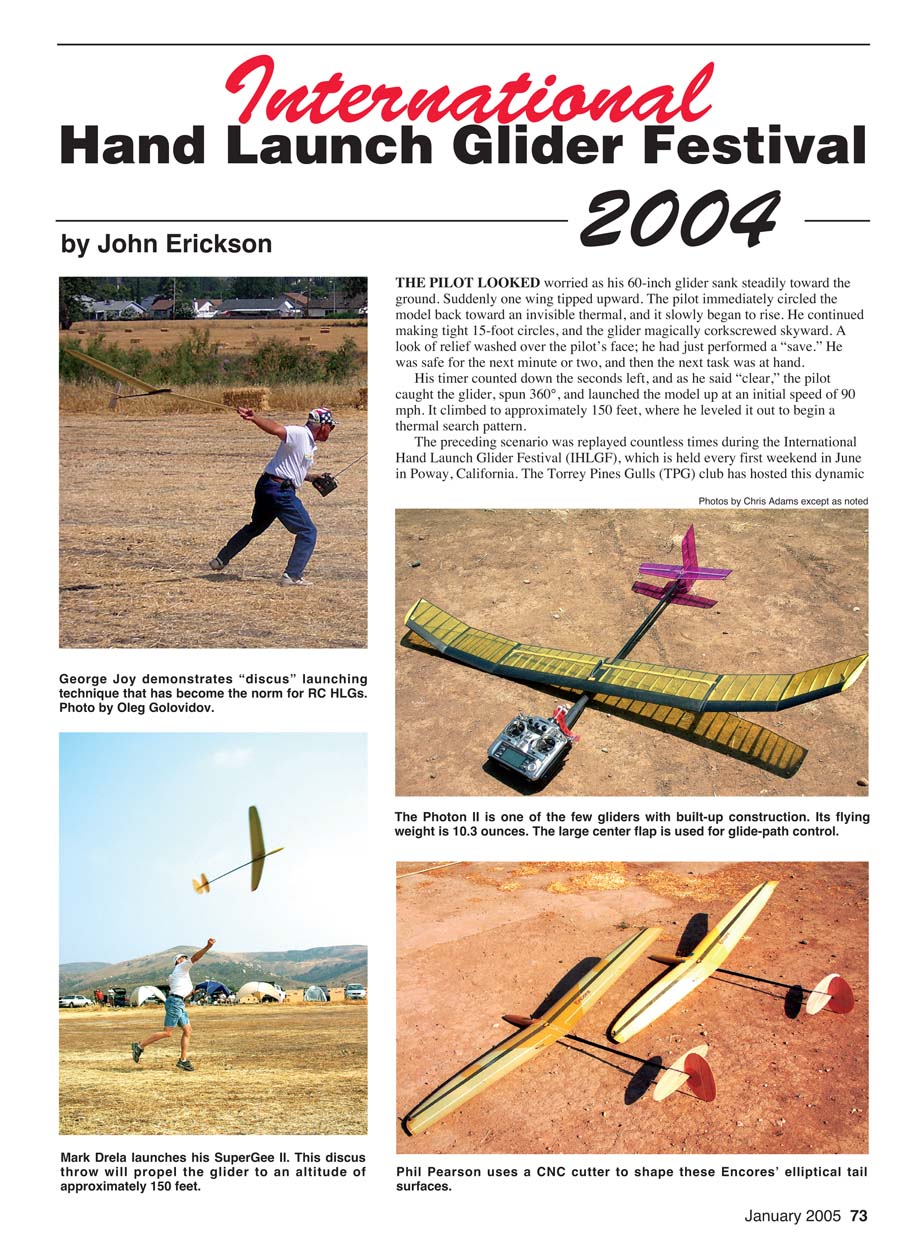
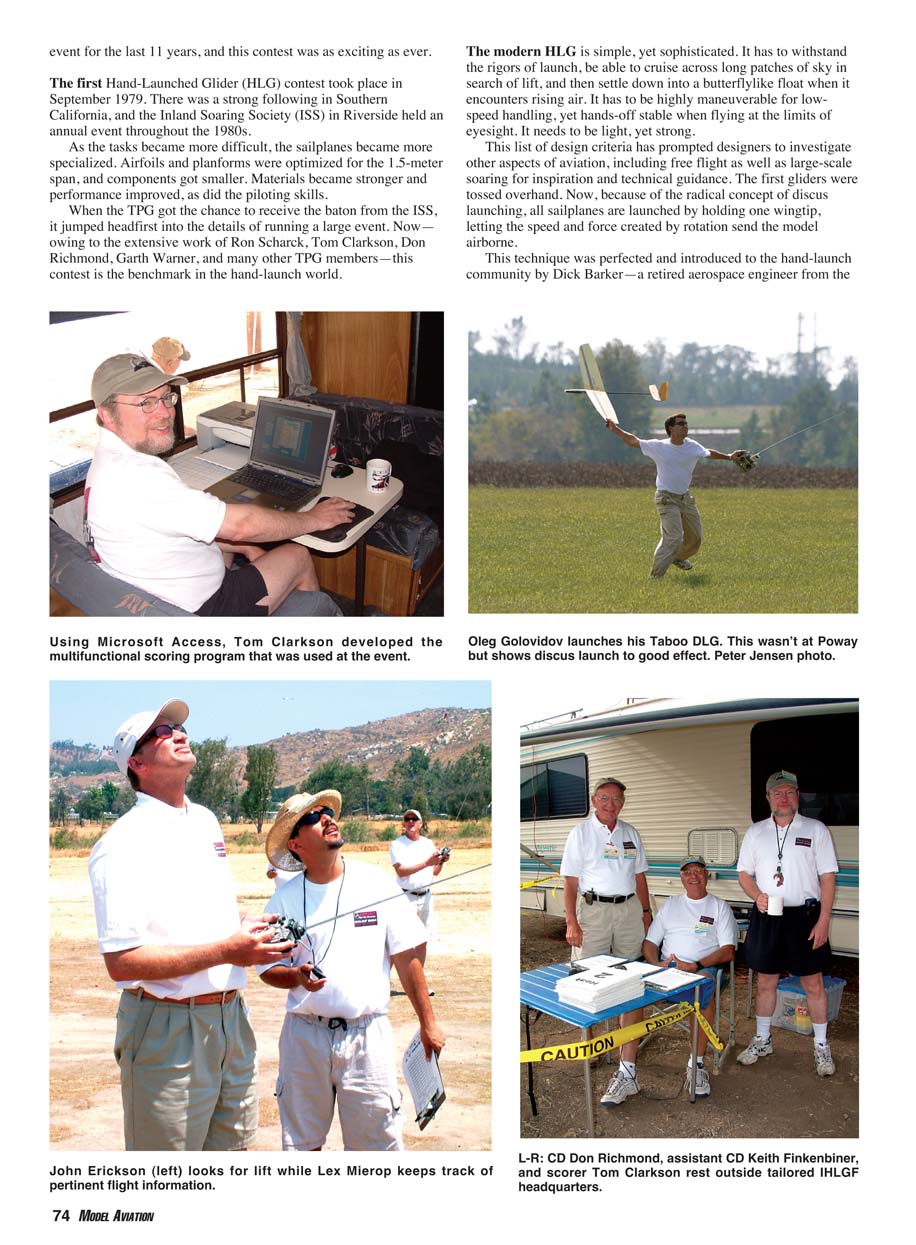
THE PILOT looked worried as his 60‑inch glider sank steadily toward the ground. Suddenly one wing tipped upward. The pilot immediately circled the model back toward an invisible thermal, and it slowly began to rise. He continued making tight 15‑foot circles, and the glider magically corkscrewed skyward. A look of relief washed over the pilot’s face; he had just performed a “save.” He was safe for the next minute or two, and then the next task was at hand. His timer counted down the seconds left, and as he said “clear,” the pilot caught the glider, spun 360°, and launched the model up at an initial speed of 90 mph. It climbed to approximately 150 feet, where he leveled it out to begin a thermal search pattern.
The preceding scenario was replayed countless times during the International Hand Launch Glider Festival (IHLGF), held every first weekend in June in Poway, California. The Torrey Pines Gulls (TPG) club has hosted this dynamic event for the last 11 years, and this contest was as exciting as ever.
The first hand‑launched glider (HLG) contest took place in September 1979. There was a strong following in Southern California, and the Inland Soaring Society (ISS) in Riverside held an annual event throughout the 1980s. As the tasks became more difficult, the sailplanes became more specialized. Airfoils and planforms were optimized for the 1.5‑meter span, components got smaller, materials became stronger, performance improved, and piloting skills sharpened. When the TPG got the chance to receive the baton from the ISS, it jumped headfirst into the details of running a large event. Now—owing to the extensive work of Ron Scharck, Tom Clarkson, Don Richmond, Garth Warner, and many other TPG members—this contest is the benchmark in the hand‑launch world.
The modern HLG is simple, yet sophisticated. It has to withstand the rigors of launch, be able to cruise across long patches of sky in search of lift, and then settle into a butterfly‑like float when it encounters rising air. It must be highly maneuverable for low‑speed handling, yet hands‑off stable when flying at the limits of eyesight. It needs to be light, yet strong. This list of design criteria has prompted designers to investigate other aspects of aviation, including free flight and large‑scale soaring, for inspiration and technical guidance.
Early gliders were tossed overhand. Now, because of the radical concept of discus launching, almost all sailplanes are launched by holding one wingtip and letting the speed and force created by rotation send the model airborne. This technique was perfected and introduced to the hand‑launch community by Dick Barker—a retired aerospace engineer from the Seattle, Washington, area. He had seen the ease with which high speeds could be generated via the discus technique and realized that it was much easier on the pilot’s shoulder.
Dick began designing a line of sailplanes that could take the sideways force of the launch. From that point, roughly five years ago, the prototypical glider found at the IHLGF owes much of its lineage to him.
Constructed from Kevlar, fiberglass, and carbon fiber vacuum‑bagged over a foam core, the glider’s wing has to withstand not only the upward force of the pullout but also the torsional force from twist caused by the throw. The pilot holds onto the wing with a small carbon dowel or blade securely mounted to the wingtip.
The wing usually has ailerons that control camber and help slow the model. They perform double duty as both aileron and flap; hence they are called "flaperons."
The pod is minimally sized for drag reduction but must be incredibly strong at the wing‑to‑pod connection. The pod houses a small 350 mAh NiMH battery, a six‑channel receiver, the elevator and rudder servos, and in some cases a tiny gyro for the rudder to counteract the glider’s initial yaw during launch.
The tapered boom is made from wrapped carbon and is roughly a half‑inch in diameter. Fishing‑pole rod used to be used but is far too flexible for the forces seen now. The tail surfaces are either fiberglass over foam or laminated balsa. Pushrods come in many flavors, including carbon rod, stainless steel, or Spectra fishing line for a "pull‑pull" setup.
Several manufacturers kit such gliders, including Don Peters of Maple Leaf Design (Encore), Denny Maize of Pole Cat Aeroplane Works (XP‑4), Jerry Krainock (Photon), and Oleg Golovidov (Taboo). All except the Photon are four‑channel designs with camber control.
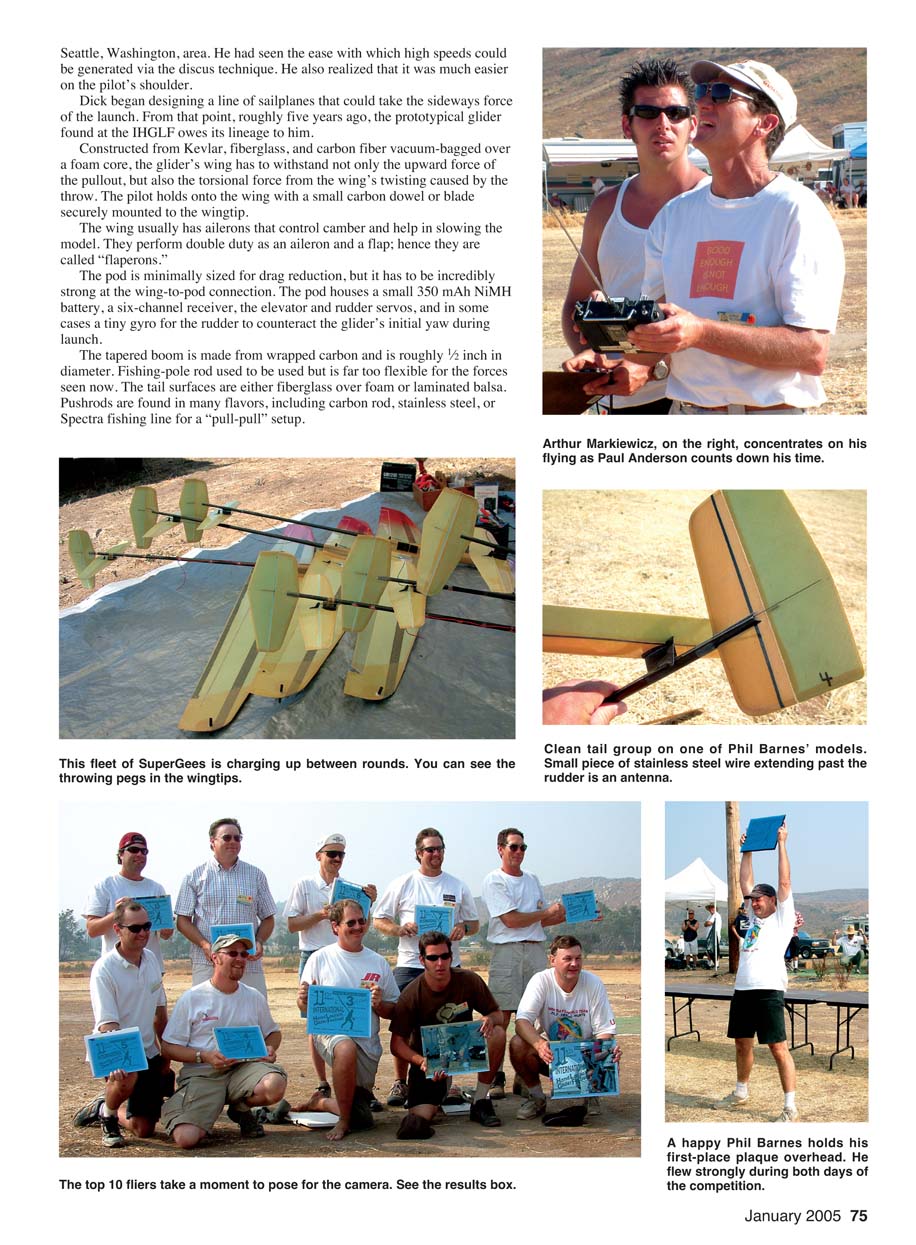
The Photon is the only built‑up wing model produced that is strong enough to take a discus launch. The balsa spar is capped with carbon fiber top and bottom, wrapped in Kevlar thread, and then dropped into a preformed carbon‑fiber D‑tube. It is a remarkably strong construction technique.
Roughly half of the IHLGF contestants flew home‑built designs, or at least modified designs from manufacturers. Innovation and experimentation have been hallmarks of this hobby. Mark Drela of the Massachusetts Institute of Technology has devoted his extensive knowledge of low‑speed aerodynamics to the modeling community. He developed XFOIL, a modeling program to analyze the polars of any airfoil.
In addition, Mark has optimized a set of hand‑launch airfoils that is the standard for many manufacturers. The AG44‑45‑46ct is used on nearly all sailplanes with camber‑changing systems because of its excellent combination of low drag and high lift. A fixed‑camber foil—the AG‑16—is used on the Photon.
Joe Wurts, an engineer for Lockheed Martin, has also spent considerable time optimizing airfoils and planforms. As with Mark Drela, he has made his work available to the community. However, it hasn't exactly given the answers to the question of how to fly like Joe. He has won the IHLGF seven times—a remarkable feat considering the outstanding quality of competing pilots.
Bill Watson is an "innovative prototyper" known for his many inventions and contributions. These include his participation on the teams for the Gossamer Albatross (the first man‑powered airplane to cross the English Channel) and the Sunracer by General Motors (the solar‑powered car that crossed the Australian continent).
Bill is a prolific builder and designer who has introduced several refinements, including the arrow or delta rudder, the asymmetric planform, and the framed pod design. This year he had a variable‑dihedral plan that launched flat and then kicked up a wing panel, similar in concept to F1C designs.
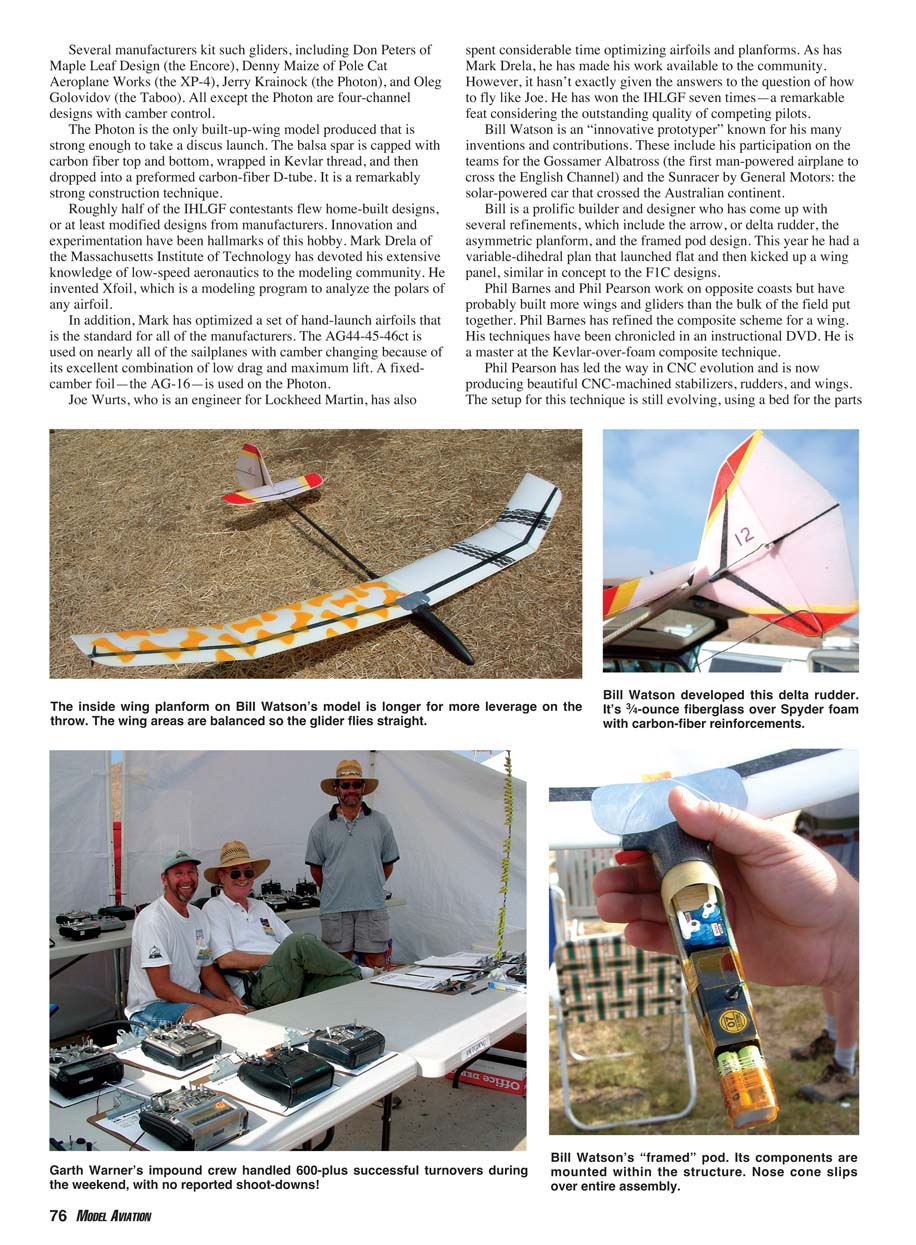
Phil Barnes and Phil Pearson work on opposite coasts but have probably built more wings and gliders than the bulk of the field put together. Phil Barnes has refined the composite scheme for a wing; his techniques have been chronicled in an instructional DVD. He is a master of the Kevlar‑over‑foam composite technique.
Phil Pearson has led the way in CNC evolution and is now producing beautiful CNC‑machined stabilizers, rudders, and wings. The setup for this technique is still evolving, using a bed for the parts that are held in place by vacuum. However, the results are fantastic: you can have a perfect airfoil in all parts of the wing, and the planform can be any shape, including elliptical.
It would be enough if these contributors just left their designs for the hobby, but all of them are pilots as well—very good pilots.
The IHLGF's format is man‑on‑man. Each round has a task with a certain window (working time). An example would be a 10‑minute window in which the tasks are a one‑, two‑, three‑, and four‑minute flight. A perfect score in this instance would be 600 seconds.
However, this perfection is unobtainable because there is "downtime" when the pilot catches and then relaunches the glider. The stopwatch stops when the model hits the ground or the pilot catches it, and it is started when the sailplane leaves his or her hand. An off‑field landing means a zero for that flight.
The man‑on‑man format means all pilots fly in the same air, so it really comes down to who can work the air the best. Many other factors come into play, including a predictable afternoon wind at the Poway field, tight, fast‑moving thermals, and split‑second tactical decision making while flying.
The one who bests the others in the heat (of roughly 10 pilots) gets 1,000 points, and the other pilots' scores are normalized to his or her score. With six rounds flown Saturday, four rounds Sunday morning, and three rounds for the flyoff of the top 10 pilots, the field is busy with activity.
Tom Clarkson of the TPG has created a scoring program and a CD that handles countdown duties. His program, created in Microsoft Access, has evolved in the last five years and now instantly scores all pilots and prints out scorecards, pilot tags, and heat scores. It even checks for duplicates or "over‑perfect" scores that may have been mistakenly recorded. It also generates a matrix that makes sure the pilots do not fly against the same competitors too often during the event.
The CD has a recorded voice that announces the prep time left before the heat begins, the window time, and then the time left all the way down to a buzzer as time expires. This has become a familiar sound across the field as each pilot tunes into the task at hand.
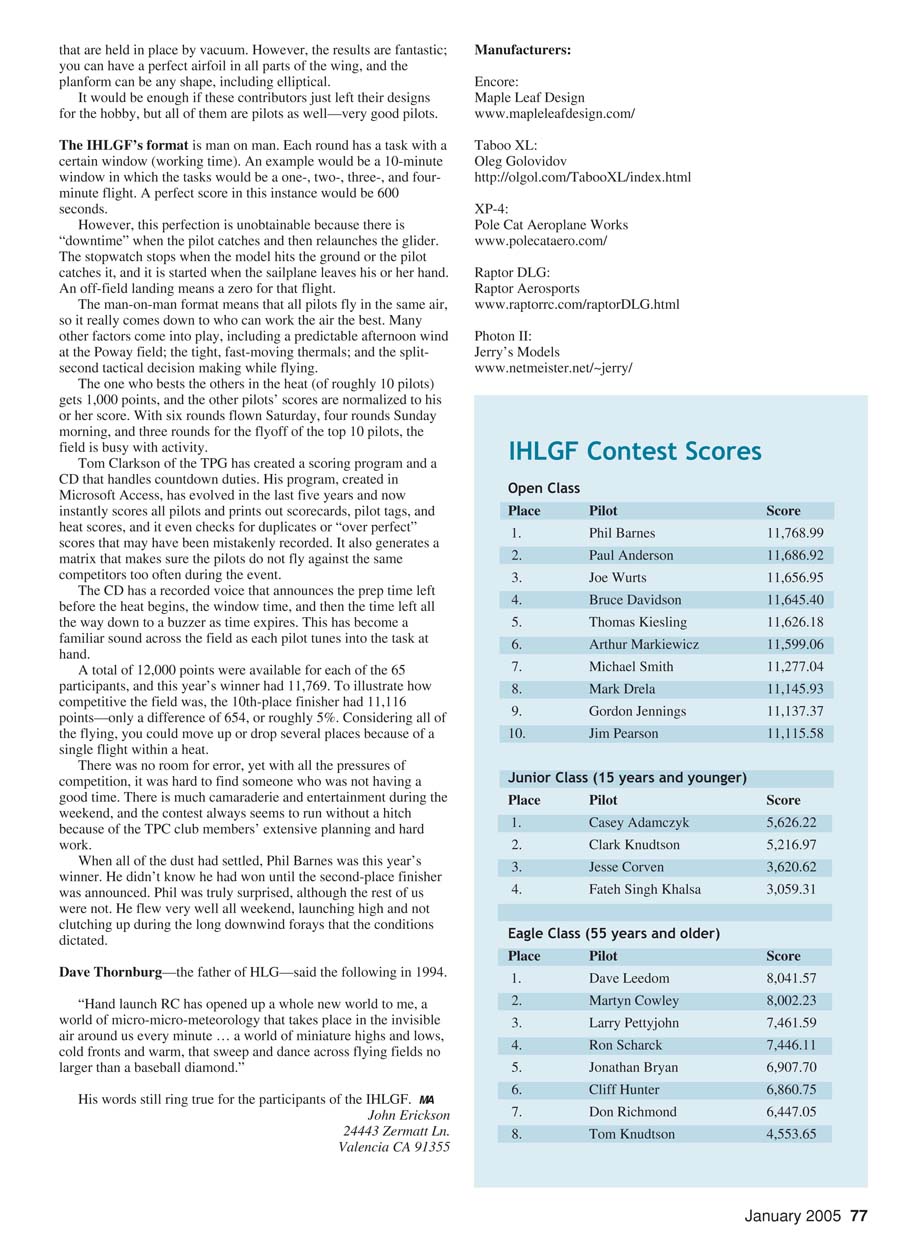
A total of 12,000 points were available for each of the 65 participants, and this year's winner had 11,768.99. To illustrate how competitive the field was, the 10th‑place finisher had 11,115.58 points—only a difference of 653.41, or roughly 5%. Considering all of the flying, you could move up or drop several places because of a single flight within a heat.
There was no room for error, yet with all the pressures of competition, it was hard to find someone who was not having a good time. There is much camaraderie and entertainment during the weekend, and the contest always seems to run without a hitch because of the TPG club members' extensive planning and hard work.
When all of the dust had settled, Phil Barnes was this year's winner. He didn't know he had won until the second‑place finisher was announced. Phil was truly surprised, although the rest of us were not. He flew very well all weekend, launching high and not clutching up during the long downwind forays that the conditions dictated.
Dave Thornburg—the father of HLG—said the following in 1994:
"Hand launch RC has opened up a whole new world to me, a world of micro‑meteorology that takes place in the invisible air around us every minute ... a world of miniature highs and lows, cold fronts and warm, that sweep and dance across flying fields no larger than a baseball diamond."
His words still ring true for the participants of the IHLGF.
Mailing address: John Erickson 24443 Zermatt Ln. Valencia, CA 91355
Manufacturers:
- Encore: Maple Leaf Design — www.mapleleafdesign.com/
- Taboo XL: Oleg Golovidov — http://olgol.com/TabooXL/index.html
- XP‑4: Pole Cat Aeroplane Works — www.polecataero.com/
- Raptor DLG: Raptor Aerosports — www.raptorrc.com/raptorDLG.html
- Photon II: Jerry's Models — www.netmeister.net/~jerry/
IHLGF Contest Scores
Open Class
- Phil Barnes — 11,768.99
- Paul Anderson — 11,686.92
- Joe Wurts — 11,656.95
- Bruce Davidson — 11,645.40
- Thomas Kiesling — 11,626.18
- Arthur Markiewicz — 11,599.06
- Michael Smith — 11,277.04
- Mark Drela — 11,145.93
- Gordon Jennings — 11,137.37
- Jim Pearson — 11,115.58
Junior Class (15 years and younger)
- Casey Adamczyk — 5,626.22
- Clark Knudtson — 5,216.97
- Jesse Corven — 3,620.62
- Fateh Singh Khalsa — 3,059.31
Eagle Class (55 years and older)
- Dave Leedom — 8,041.57
- Martyn Cowley — 8,002.23
- Larry Pettyjohn — 7,461.59
- Ron Scharck — 7,446.11
- Jonathan Bryan — 6,907.70
- Cliff Hunter — 6,860.75
- Don Richmond — 6,447.05
- Tom Knudtson — 4,553.65
Transcribed from original scans by AI. Minor OCR errors may remain.

