
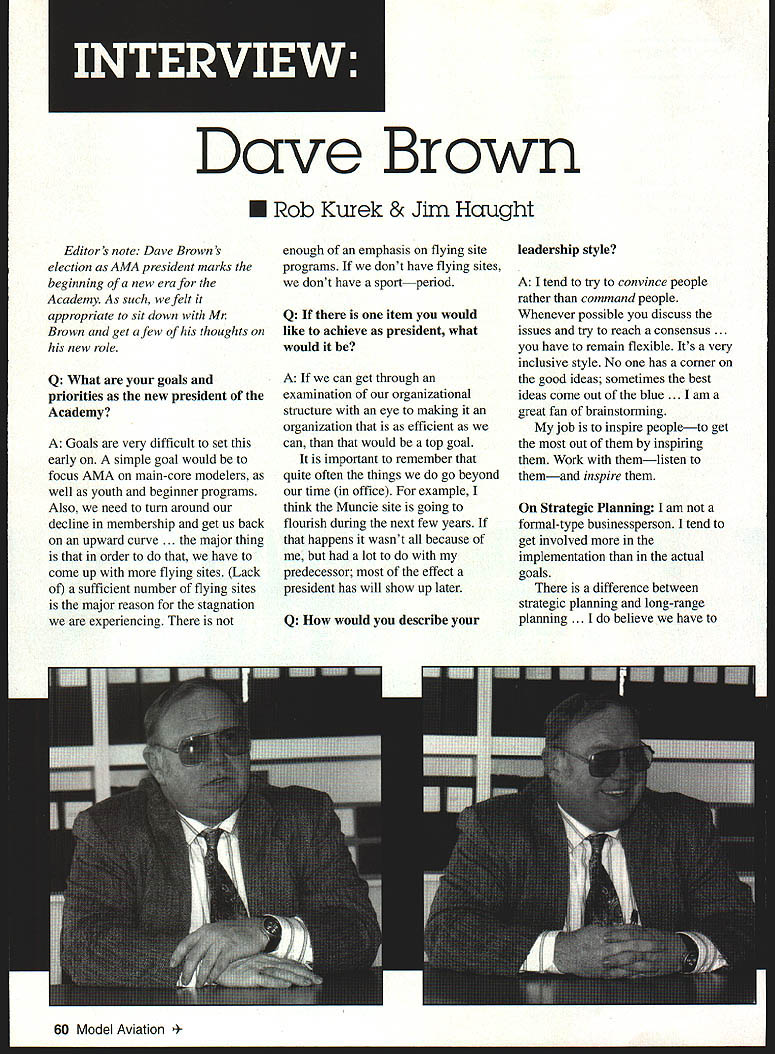
Interview: Dave Brown
By
Rob Kurek & Jim Haught
Editor's note
Dave Brown's election as AMA president marks the beginning of a new era for the Academy. As such, we sat down with Mr. Brown to get a few of his thoughts on his new role.
Q: What are your goals and priorities as the new president of the Academy?
Goals are difficult to set this early on. A simple goal would be to focus AMA on main-core modelers, as well as youth and beginner programs. We also need to reverse the decline in membership and get back on an upward curve. The major thing is that, in order to do that, we have to develop more flying sites. A lack of a sufficient number of flying sites is the primary reason for the stagnation we are experiencing. There is not enough emphasis on flying-site programs. If we don't have flying sites, we don't have a sport—period.
Q: If there is one item you would like to achieve as president, what would it be?
If we can complete an examination of our organizational structure with an eye toward making the organization as efficient as possible, that would be a top goal.
It is important to remember that quite often the things we do go beyond our time in office. For example, I think the Muncie site is going to flourish during the next few years. If that happens, it wasn't all because of me; it had a lot to do with my predecessor. Most of the effect a president has will show up later.
Q: How would you describe your leadership style?
I tend to try to convince people rather than command people. Whenever possible you discuss the issues and try to reach a consensus—you have to remain flexible. It's a very inclusive style. No one has a corner on good ideas; sometimes the best ideas come out of the blue. I am a great fan of brainstorming.
My job is to inspire people—to get the most out of them by inspiring them. Work with them, listen to them, and inspire them.
On strategic planning
I am not a formal-type businessperson. I tend to get involved more in the implementation than in defining the actual goals.
There is a difference between strategic planning and long-range planning. I do believe we have to have some long-range direction and goals. The problem is that people do it once, ignore it, and then three years later do it again. We on the Executive Council do that very often.
On the role of the Executive Council
The Executive Council needs to focus more on direction and policy. I think sometimes the Council becomes too involved in today's problems while ignoring tomorrow's direction. A lot of people refer to this kind of thing as micromanaging.
I don't see what I'm doing as things that necessarily have to be accomplished in my term. I think the president of the organization should be looking farther down the road than his three-year term.
Keeping the train on track today is more the responsibility of staff, and the direction of the train is more the purview of the Executive Council, but we have to work together.
We must be willing to admit when we make a wrong decision and change course as necessary to keep going in the right direction. I don't want to continue to follow a course that I don't believe in.
Q: Is your role different than your predecessors?
Each president of AMA has faced his own challenges. What that basic challenge will be for me, I don't know yet.
I happened to come in at a period of time where there are a few bumps in the road—but bumps can make the ride delightful!
I have a huge amount of faith in the staff we have and a lot of faith in the diversity of our Council. Council is often castigated for changing decisions, but more often than not it's a situation where a decision made in good faith just didn't work. Then it's time to try something different.
Life and business are not about perfection; you have to deal with reality. The thing I've regretted most about my own performance has been situations where I saw something was wrong but didn't speak up. If you refuse to admit a mistake, that's not healthy for the organization.
Q: Do you see parallels between AMA and Dave Brown Products?
Both really are businesses. I want to maximize the efficiency of both.
Q: What has been the most important factor in your success to date?
Believe it or not, it was my six years spent as a carnie. I learned to deal with people of all flavors—from roustabouts to cooks to owners to politicians. It was there that I learned a person's worth and value are not necessarily determined by their position.
Q: How do you view the relationship between the president and the Executive Director?
We are like two people in a three-legged race. For us to be effective, we have to communicate the way we want to go. We don't necessarily have to agree all the time, but that communication is the most important thing. And I will say this: Joyce Hager is my kind of manager.
Transcribed from original scans by AI. Minor OCR errors may remain.

