
INTRO TO AERO AT CRESSKILL HS
Do we really have to give up on getting kids interested in modeling? Youngsters show up at building sessions, get excited about flying their own models, and never come back. After a dozen classes and contests with children aged 10–13 and only minor success, Walt Schwarz and I decided to try a new approach — this time with a different age group. We reasoned that high-school students, with better attention spans and an interest in technology, offered a better profile for the problem-solving aspects of modeling.
We contacted Ron Banta, drafting teacher at Cresskill (NJ) High School, and proposed a program combining design concepts, engineering tradeoffs, and practical construction. In essence, we would create a NASA-style competition that required original model designs, fully drafted plans, and actual flying models constructed by teams from his classes. There would be design and materials restrictions and performance targets — all rewarded by cash prizes. Mr. Banta was immediately enthusiastic and we quickly settled on a workable program.
DESIGN PARAMETERS
- Maximum dimension in any direction: 18 inches
- Wood sizes to be used: 1/16" square, 1/16" x 1/8", and 3/32"
- Models must use 6-inch plastic props; one or two props permitted
- Only one loop of 1/8" rubber, 12 inches long, per motor
- Models must be covered with tissue; single- or doped-surface OK
- All materials furnished by organizers to ensure uniform wood weight
Cresskill is an above-median-income bedroom suburb 25 minutes from Manhattan. None of the students in Mr. Banta's senior class (all boys, average age 18, and including several ethnic groups) had built a stick-and-tissue model. We divided the class into eight teams of three students and established the parameters above.
THE CLASS AND BUILD PROCESS
- Walt and I spent one hour each week with the class, guiding them through a real-world design procedure and discussing the tradeoffs every engineer faces.
- Teams began with concept sketches covering basic aeronautics. We edited designs for prop clearance, joint strength, span, and tail-area adjustments.
- Once sketches were approved, groups produced three-view drawings; some made paper mockups for extra credit.
- After three-views were approved and graded, teams drew full-size plan components. Wood sizes and material choices were discussed in terms of cross-section, hardness vs. weight, and strength.
- Models were built over a three-week period. Finished models were judged for workmanship. Walt and I also spent after-school hours helping groups flight-trim their entries.
Each assignment had deadlines with credits and penalties proportioned to the contest score. Word circulated through the school during the two-month design and building period.
THE CONTEST DAY AND RESULTS
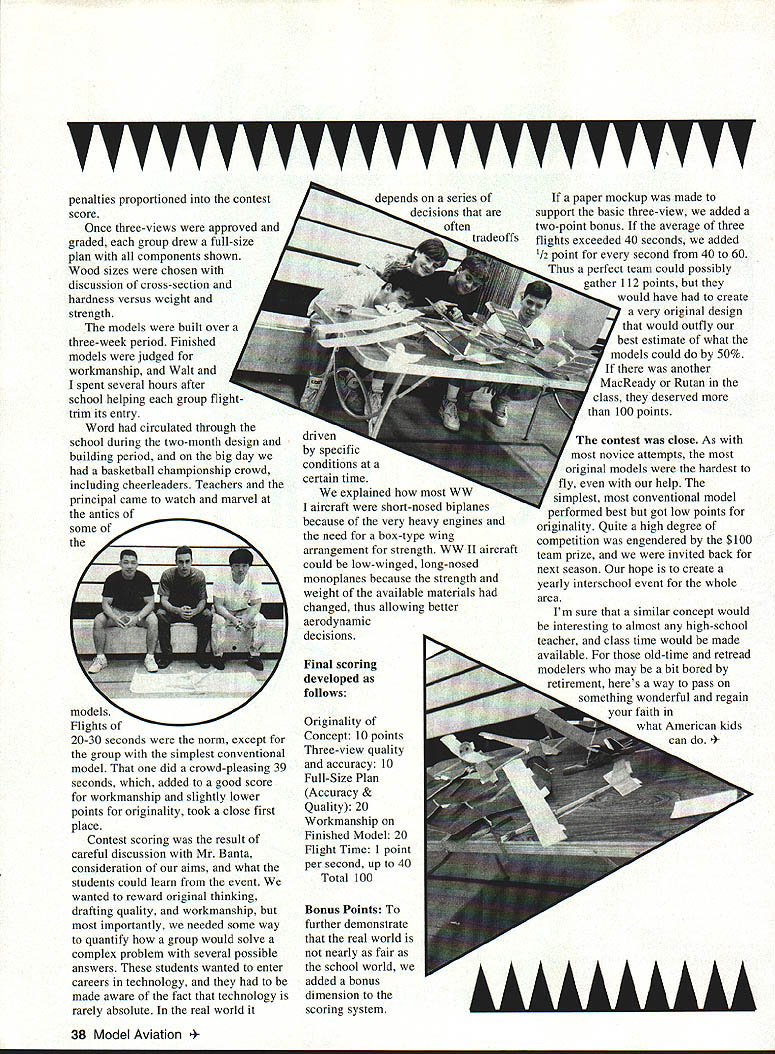
On the big day — during a basketball championship — a crowd including cheerleaders, teachers, and the principal came to watch and marvel at the antics. Flights of 20–30 seconds were the norm. One group's simplest conventional model did a crowd-pleasing 39 seconds; it scored well for flight time and workmanship but earned lower points for originality and took close first place.
The $100 team prize generated a high degree of competition, and we were invited back for the next season. Our hope is to create a yearly interschool event for the whole area.
SCORING
Final scoring was developed to reward original thinking, drafting quality, workmanship, and the ability to solve a complex problem with multiple possible answers.
- Originality / Concept: 10 points
- Three-view quality & accuracy: 10 points
- Full-size plan accuracy & quality: 20 points
- Workmanship / Finished model: 20 points
- Flight time: 1 point per second up to 40 seconds
Total: 100 points
Bonus points:
- Paper mockup supporting the three-view: +2 points
- Average of three flights exceeding 40 seconds: +0.5 point per second from 40 to 60
Thus a perfect team could possibly gather 112 points. To reach that total a team would need an original design that significantly outflew our estimates — the kind of result deserving of more than 100 points if there were another MacReady or Rutan in the class.
LESSONS AND CONCLUSION
We wanted students who plan careers in technology to understand that technology is rarely absolute; it depends on tradeoffs driven by specific conditions. For example, most World War I aircraft were short-nosed biplanes because very heavy engines required box-type wing arrangements for strength. World War II aircraft, with different material strength and weight characteristics, could be low-winged, long-nosed monoplanes, allowing better aerodynamic decisions.
As with most novice attempts, the most original models were the hardest to fly, even with our help. The simplest conventional models tended to perform best in flight but scored lower for originality. Still, the program sparked enthusiasm, produced lively competition, and demonstrated that high-school students can engage deeply with design, drafting, and hands-on construction.
For retired modelers or teachers looking for meaningful projects, a similar concept would likely be of interest to many high schools. It's a way to pass on skills, inspire students, and regain faith in what American kids can do.
DON ROSS
Transcribed from original scans by AI. Minor OCR errors may remain.

