
Introduction to Indoor Radio Control
by Bob Aberle baberle@optonline.com
I wrote a feature article published in last month's MA titled "Introduction to Parking Lot Flying." That category involves flying relatively small, easy-to-build, and relatively inexpensive RC models close in. Aircraft in that size category (up to roughly 16 ounces total weight) can also, under certain circumstances, be flown in indoor facilities. From a practical standpoint, the larger parking lot–size models can be flown easily and safely in extra-large indoor facilities such as golf practice domes (inflatable) and field houses used for football practice.
Since winter weather hits many areas of our country, indoor RC flying during those months is increasing in popularity. Not everyone has a golf dome or a field house in his or her community, but almost everyone has a school gymnasium or auditorium that can be an excellent substitute. To be able to use these smaller indoor flying facilities, you have to plan accordingly.
Let's get into the details of these small, or as we call them, "microsize" RC aircraft.
Micromodel Sizing
Micro-size models dedicated to indoor RC flying can range from roughly 8 ounces total weight down to only a few grams. For this presentation I'm concentrating on 4 ounces total weight and less. Right now the range of 4 ounces down to approximately 2.5 ounces can be enjoyed while employing the available equipment technology at relatively moderate prices. From 2.5 ounces down to roughly 0.75 ounce, you will need one of the several submicroservos on the market or magnetic actuators. For less than 0.75 ounce down to a few grams, you need highly specialized equipment and considerable model-building skills.
Typical 4-ounce models can have approximately 80–120 square inches of wing area, which will yield wing loadings in the range of roughly 4–6 ounces per square foot. The 4-ounce total weight could consist of 2.25 ounces of equipment (receiver, two servos, Li-Poly battery, motor, propeller, and motor speed controller). The remaining 1.75 ounces includes the model structure (covering, finish, wheels, hinges, and control linkages).
This typical 4-ounce model can employ traditional RC equipment, but it will be smaller in size and weight. The servos will provide regular proportional control, operating from a conventional RC transmitter.
I have a little indoor sport model that I fly at 74 square inches of wing area and 1.2 ounces total weight. The wing loading works out to only 2.3 ounces per square foot. It employs two magnetic actuators, and a 145 mAh Li-Poly battery cell provides all the power. When flown outdoors, this model doesn’t like any wind! I’ll get into the specifics of the RC equipment later.
Safety
As is the case with parking lot flying, indoor RC flying has certain safety issues about which you should be concerned. Even though you are flying inside, radio signals can travel through buildings easily without much attenuation of strength. Someone might be flying right outside your indoor facility, so please check around first. It’s best to check local hobby shops and RC clubs too.
Also safety related is your model’s speed in flight. An airplane with less than 100 square inches of wing area and weighing approximately 10 ounces might be capable of speeds in excess of 60–75 mph. If it hits something or someone, it could cause physical or property damage.
Common sense must prevail and reasonable weights and flying speeds must be commensurate with the size of the facility. A leader-type person should be in charge of each flying session. That person must have the last word on who can or can’t fly, and his or her judgment must be respected at all times.
Micromodel Design
I’ve already suggested weights and wing loadings, and soon I will get into power systems. There aren’t many ARF models in the less-than-4-ounce category; that might be considered the bad news. The good news is that a 4-ounce airplane can, for the most part, be constructed from scratch with a minimum of materials and a minimum of assembly time and skills. I’ve built 1-ounce RC models from a single sheet of 1/32 x 3 x 36-inch balsa. That is almost as inexpensive as you can get!
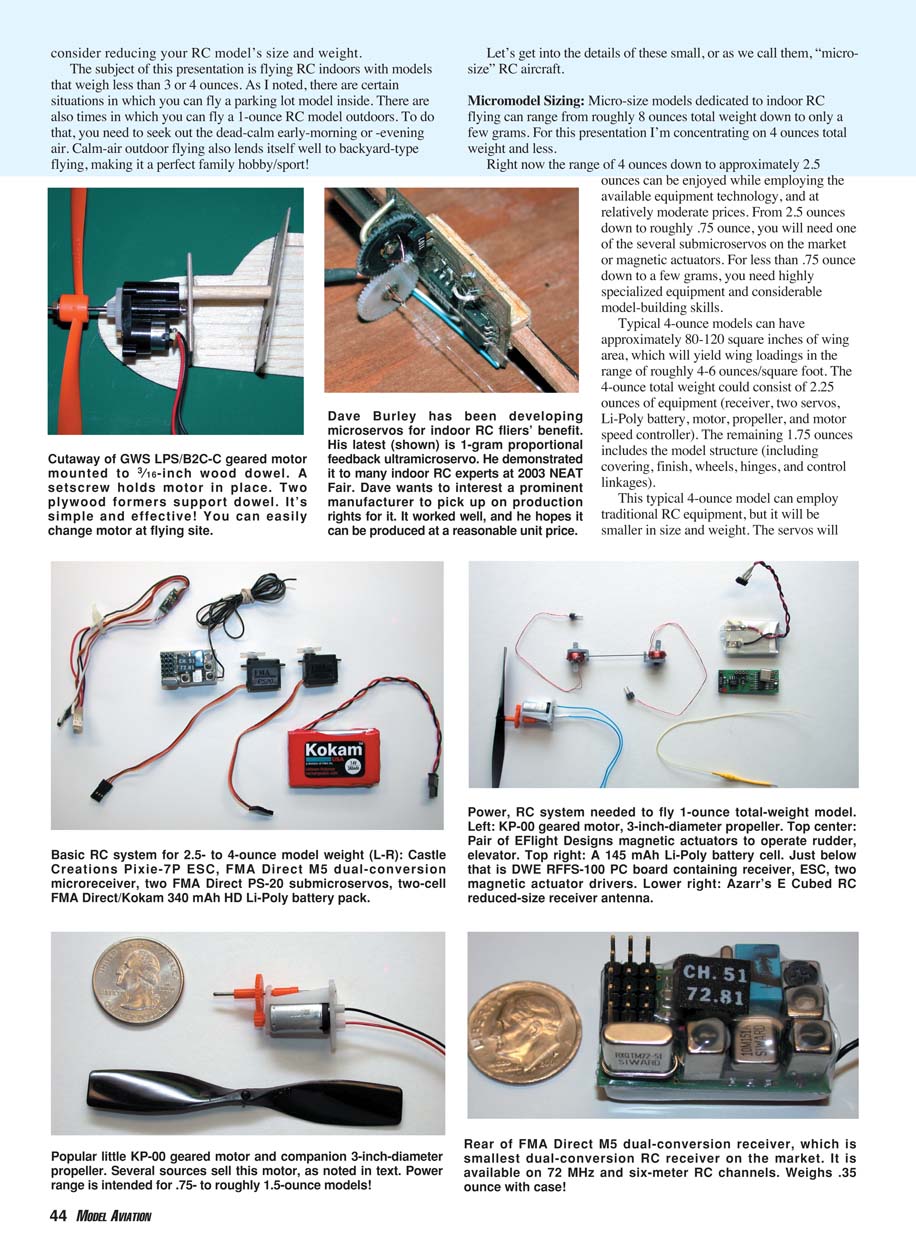
The 2- to 4-ounce models can often be built up from the many rubber-powered kits on the hobby market; doing this has become popular. Another possibility is profile semiscale models, such as DJ Aerotech’s Roadkill series. Those are easy to build, inexpensive, and are even supplied with the recommended motor.
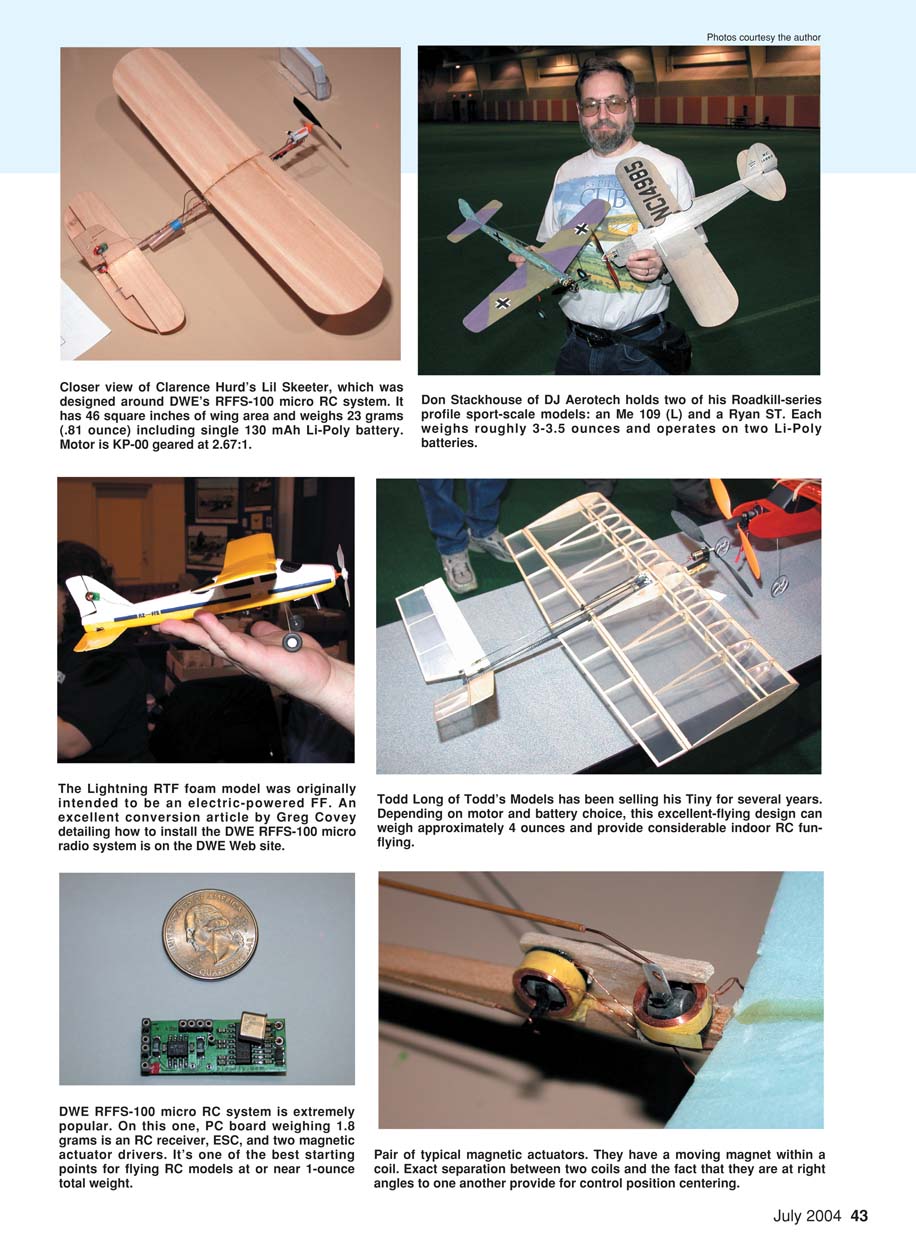
If you want to try a 1-ounce model for the first time, the best trainer is the Lil Skeeter designed by Clarence Hurd of Dynamic Web Enterprises (DWE). This design was reviewed in the June 2002 RC MicroFlight newsletter. Plans are available from DWE, and you receive a free plans copy when you purchase the DWE RFFS-100 micro RC system.
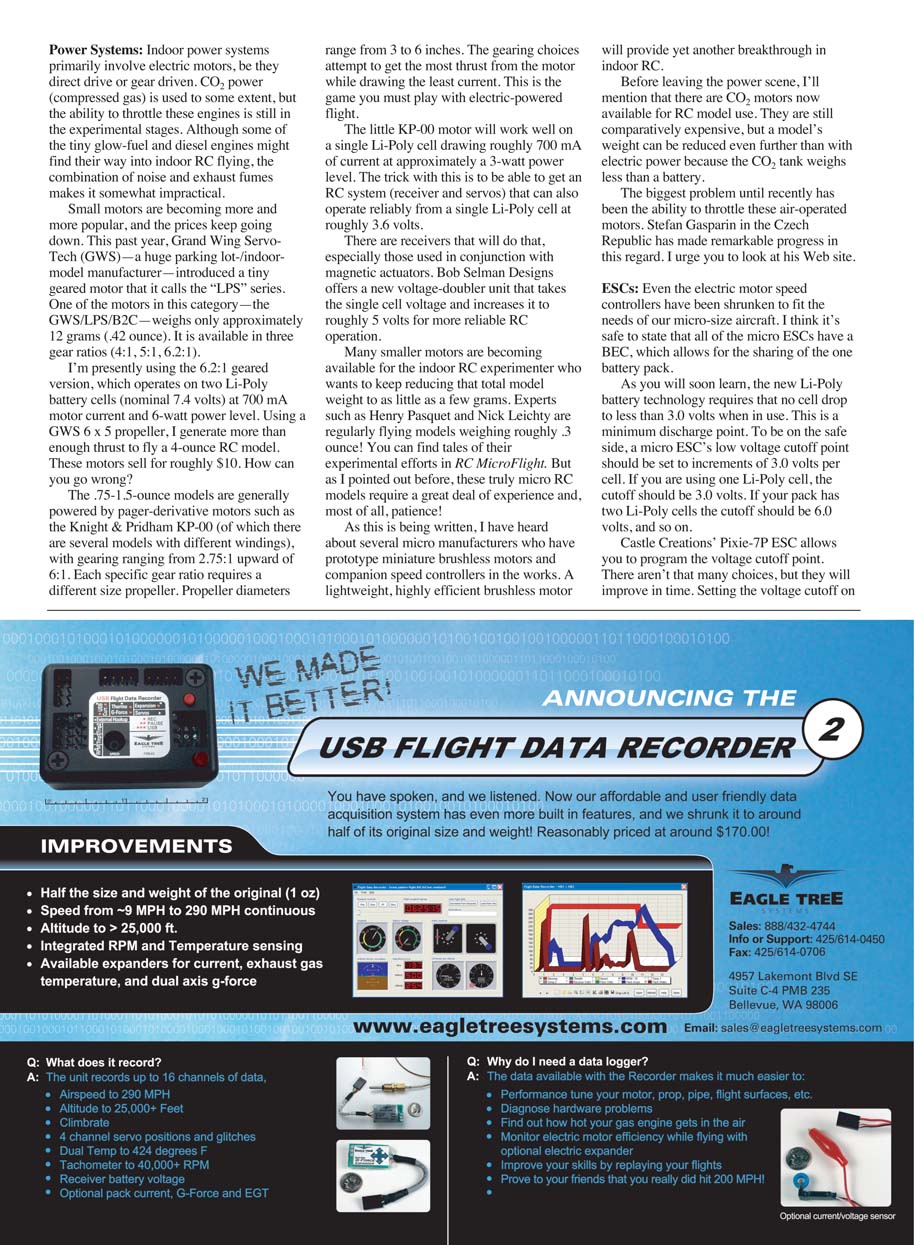
A more ambitious project is Dave Robelen’s Walker, which he calls an “ultralite indoor floater.” Dave designed a 1-ounce model with an amazing 357 square inches of wing area. The resulting wing loading works out to only 0.4 ounce per square foot and provides flying speeds of just 3–4 mph. You can walk under this model while it is flying. The Walker was featured in the July 2003 RC MicroFlight.
Power Systems
Indoor power systems primarily involve electric motors, be they direct drive or gear driven. CO2 power (compressed gas) is used to some extent, but the ability to throttle these engines is still in the experimental stages. Although some of the tiny glow-fuel and diesel engines might find their way into indoor RC flying, the combination of noise and exhaust fumes makes them somewhat impractical.
Small motors are becoming more and more popular, and prices keep going down. Grand Wing Servo-Tech (GWS) introduced a tiny geared motor called the LPS series. One motor in this category—the GWS/LPS/B2C—weighs only approximately 12 grams (0.42 ounce) and is available in three gear ratios (4:1, 5:1, 6.2:1).
I'm using the 6.2:1 geared version, which operates on two Li-Poly battery cells (nominal 7.4 volts) at about 700 mA motor current and a 4-watt power level. Using a GWS 6 x 5 propeller, I generate more than enough thrust to fly a 4-ounce RC model. These motors sell for roughly $10.
The 0.75–1.5-ounce models are generally powered by pager-derivative motors such as the Knight & Pridham KP-00 (available in several windings), with gearing ranging from about 2.75:1 upward to 6:1. Each specific gear ratio requires a different size propeller; propeller diameters range from 3 to 6 inches. The gearing choices attempt to get the most thrust from the motor while drawing the least current.
The little KP-00 motor will work well on a single Li-Poly cell drawing roughly 700 mA of current at approximately a 3-watt power level. The trick is to get an RC system (receiver and servos) that can operate reliably from a single Li-Poly cell at roughly 3.6 volts. There are receivers that will do that, especially those used with magnetic actuators. Bob Selman Designs offers a new voltage-doubler unit that takes the single-cell voltage and increases it to roughly 5 volts for more reliable RC operation.
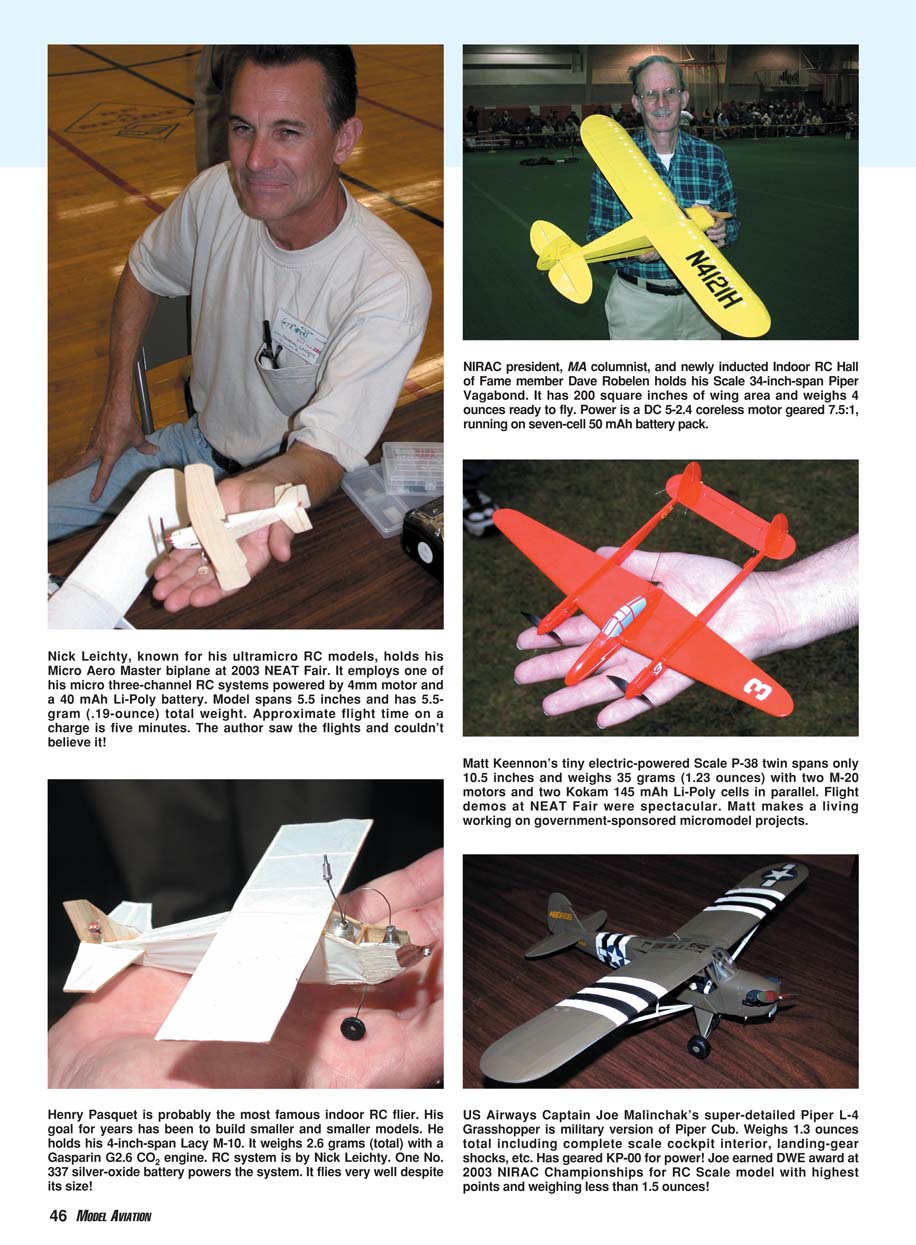
Many smaller motors are becoming available for the indoor RC experimenter who wants to keep reducing total model weight to just a few grams. Experts such as Henry Pasquet and Nick Leichtly are regularly flying models weighing roughly 0.3 ounce. You can find accounts of their experimental efforts in RC MicroFlight. These tiny micro RC models require a great deal of experience and patience.
As this is being written, several micro manufacturers have prototype miniature brushless motors and companion speed controllers in the works. A lightweight, highly efficient brushless motor will provide another breakthrough in indoor RC.
CO2 motors are now available for RC model use. They are still comparatively expensive, but a model's weight can be reduced even further than with electric power because the CO2 tank weighs less than a battery. The biggest problem until recently has been the ability to throttle these air-operated motors. Stefan Gasparin in the Czech Republic has made remarkable progress in this regard.
ESCs
Even the electric motor speed controllers have been shrunken to fit the needs of micro-size aircraft. Most micro ESCs include a BEC, which allows sharing of the one battery pack.
Li-Poly battery technology requires that no cell drop below 3.0 volts when in use. This is a minimum discharge point. A micro ESC's low-voltage cutoff point should be set in increments of 3.0 volts per cell. If you are using one Li-Poly cell, the cutoff should be 3.0 volts. If your pack has two Li-Poly cells, the cutoff should be 6.0 volts, and so on.
Castle Creations' Pixie-7P ESC allows you to program the voltage cutoff point. There aren't that many choices yet, but they will improve in time. Setting the voltage cutoff on the Pixie isn't all that easy and does require some patience, but this is the concept you want to look for going forward.
Batteries
Until recently, the batteries of choice for 4-ounce and lighter models were 100–125 mAh NiMH packs (usually seven or eight cells). In the past year we have been introduced to lithium-polymer (Li-Poly) cells. These provide more capacity in a lighter-weight package—exactly what you want for micro RC models.
Each Li-Poly cell has a characteristic voltage close to 4.0 volts; older Ni-Cd/NiMH cells had only 1.2 volts per cell. So two Li-Poly cells work like a six- or seven-cell Ni-Cd/NiMH pack.
Typical two-cell packs are 145 mAh or 340 mAh for 3- to 4-ounce models. A two-cell 145 mAh Li-Poly pack weighs 8.7 grams (0.31 ounce) and can power a 3- to 4-ounce model at 700 mA current (around 6 watts) for 10–12 minutes or more, depending on throttle usage. Two 340 mAh Li-Poly cells (weighing 20.1 grams, or 0.71 ounce) could provide up to 30 minutes of motor run time.
Li-Poly cells must be taken care of carefully. They require a dedicated charger and should not be charged at more than a 1C rate (roughly one hour). Li-Poly batteries should not be discharged below 3.0 volts per cell.
Li-Poly cells were initially limited to load capabilities up to approximately 5C, but newer varieties can withstand loads upward of 20C—a significant improvement.
Li-Poly batteries are a subject unto themselves. I wrote a comprehensive article titled "Introduction to Lithium-Polymer Batteries" published in the May 2004 MA. If you haven't read that piece, I highly recommend you do so before attempting to use Li-Poly batteries in any model airplane.
Micro RC System and Components
The RC equipment is conventional technology, but made smaller and lighter.
- A popular inexpensive micro receiver is the GWS R-4P: four-channel, single-conversion circuit, weighs 6.8 grams (0.25 ounce), and costs about $30.
- For good range and selectivity in crowded environments, the FMA Direct M5 dual-conversion receiver is an excellent choice for the 2.5- to 4-ounce weight class. The M5 weighs 9.5 grams (0.35 ounce).
- The Berg-5*DSP (.35 ounce) and the Berg-4*DSP Micro Stamp (.25 ounce) are other strong options. Berg and FMA Direct receivers can have their cases removed for additional weight savings.
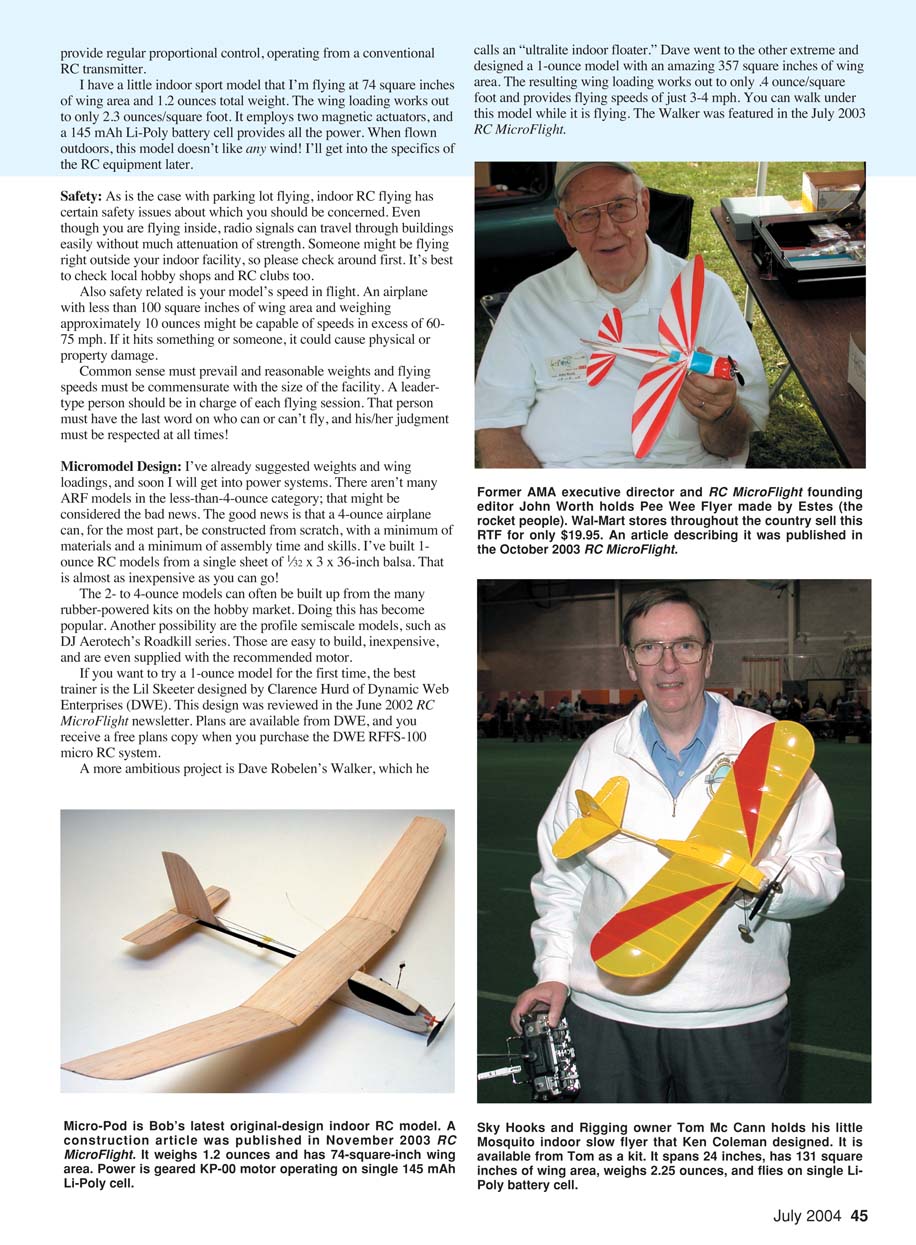
- For extra-small models (1.5 ounces and lighter), the DWE RFFS-100 has been a popular microsystem: microreceiver, built-in ESC with BEC, and drivers for two magnetic actuators on a single PCB. The entire board weighs only 1.8 grams (0.06 ounce). The RFFS-100 receiver is not very selective, so you should avoid crowded frequency use.
- Jean-Marie Piednoir (JMP) of France makes a narrow-band selective microreceiver sold in the U.S. by Bob Selman Designs. It includes an ESC and two magnetic actuator drivers, weighs 2.2 grams (0.08 ounce), and sells for $89 without connectors.
- The Gasparin Penta 2.4-gram (0.08 ounce) four-channel receiver is claimed to be incredibly selective and will be sold in the U.S. at a reasonable $39.
Servos and actuators:
- Conventional proportional feedback servos are available at roughly 5.6 grams (0.20 ounce), such as the Hitec HS-50 and the FMA Direct PS-20. Each sells for less than $30 and has been reliable.
- WES-Technik makes a linear-output microservo weighing 2.1 grams (0.07 ounce) but comparatively expensive ($70–$80).
- Stefan Gasparin and Diedel designed the GServo, a rotary-output servo weighing 1.33 grams (without a case) priced around $98. Gasparin also introduced a "Proportional Magnetic Actuator" concept priced around $39 each.
- At the bottom of the weight scale are magnetic actuators (coil devices with moving magnets). They require patience to install and offer limited control force, so hinges and linkages must minimize friction. These actuators make RC models under 1 ounce possible. Good sources include Bob Selman Designs, Cloud-9 RC, E-Flight Design, and DWE.
Another concept is the "brick" design popular in the early 1970s: one PCB that includes a narrow-band receiver, ESC, control actuator drivers, and two servos or two magnetic actuators. FMA Direct is close to releasing a microbrick that will simplify wiring and reduce weight. This concept will likely fit the 2.5- to 4-ounce model category.
Connectors
Connector and wire size (gauge) selection is important. You want sufficient current-carrying capacity without carrying unnecessary weight.
- Anderson Power Pole-type connectors are suitable from roughly 6 amps upward.
- Deans four-pin connectors are popular for 3–6 amps. Gang two pins to make a single connection when needed.
- For 1.5–3 amps, the JST red plastic housing connector is fine.
- For less than 1.5 amps, the JST white plastic or Cloud 9 RC Unisex connectors will do.
- EFlight Designs carries a line of submicroconnectors.
- Wire sizes can start with 16 AWG for 8–10 amp current and progress to 22, 28, or even 32 AWG for lower currents. Hobby suppliers can recommend sizes for specific current levels. JST connectors often come prewired.
Indoor Flying Tips
If you are already an RC sport flier or a parking lot flier, you are certainly qualified to fly indoors; but the generally restricted airspace can be extremely challenging. If you can fly a 4-ounce model in an inflated dome, it's almost the same as flying outdoors—no problem.
However, in a double- or single-size gymnasium you often feel like you are always turning the airplane; there isn’t enough space for appreciable straightaway flight. Inside domes my aircraft have occasionally hit walls or even the top center of the ceiling. Being so lightweight, they tend to just bounce off these soft surfaces. Most of the time I lose altitude but can easily recover to normal flight.
At the Toledo, Ohio PERF (Perrysburg Electric River Fliers) indoor fly a couple years ago (when it was a smaller facility), I "shot a basket" with my little 4.7-ounce AIKA and we had to get a large stepladder to remove the model from the basketball hoop/net.
Midair collisions do occur occasionally, but if you build your entire model from a single sheet of balsa, it's usually no big deal.
NIRAC and Organized Indoor RC
AMA encourages SIGs to help organize various groups within model aviation. The National Indoor Remote-Control Aircraft Council (NIRAC) represents indoor RC flying within the Academy. National Indoor Electric Duration record-holder Bob Wilder of Texas founded the organization several years ago.
You can access general information about this SIG at www.nirac.org. Look it up, get familiar with the organization, and show your support by joining.
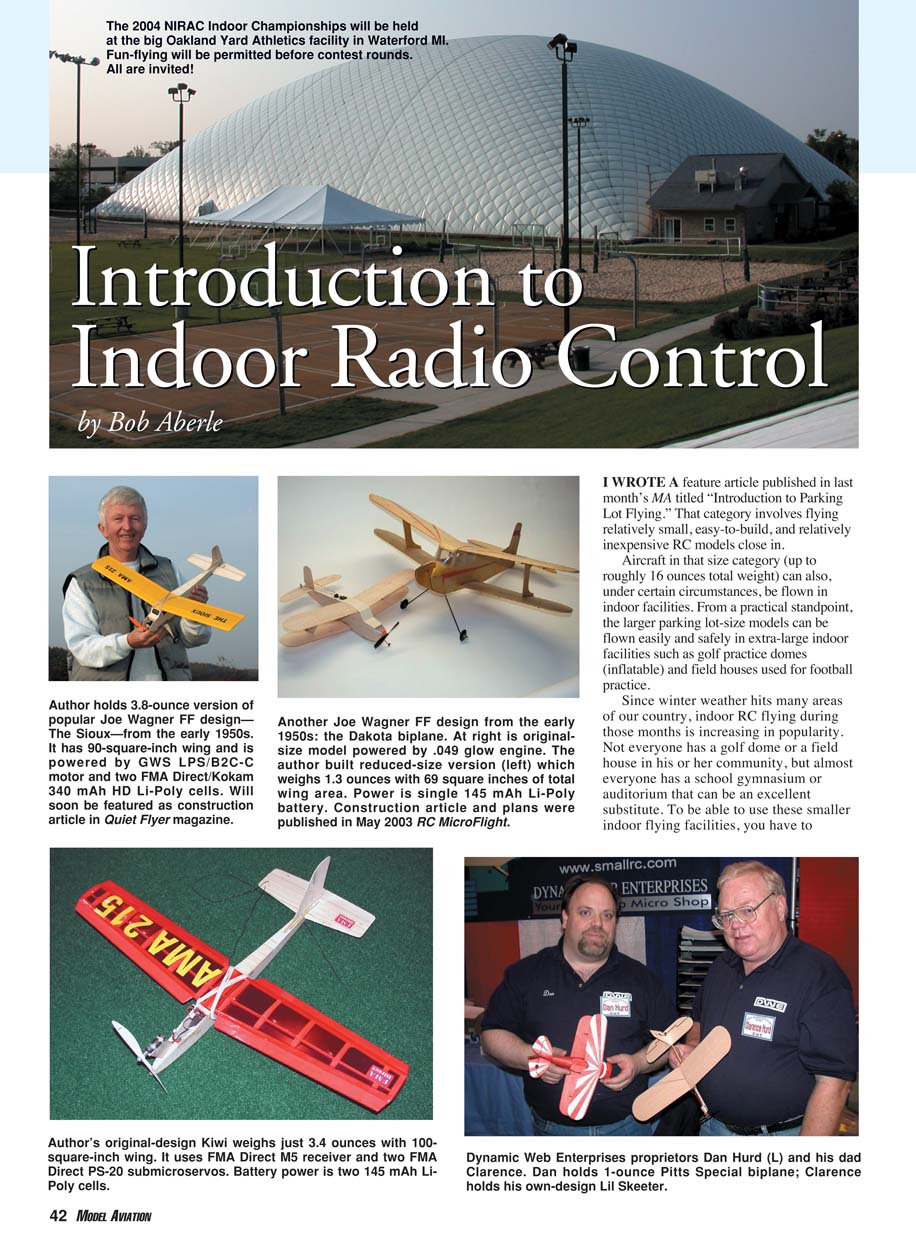
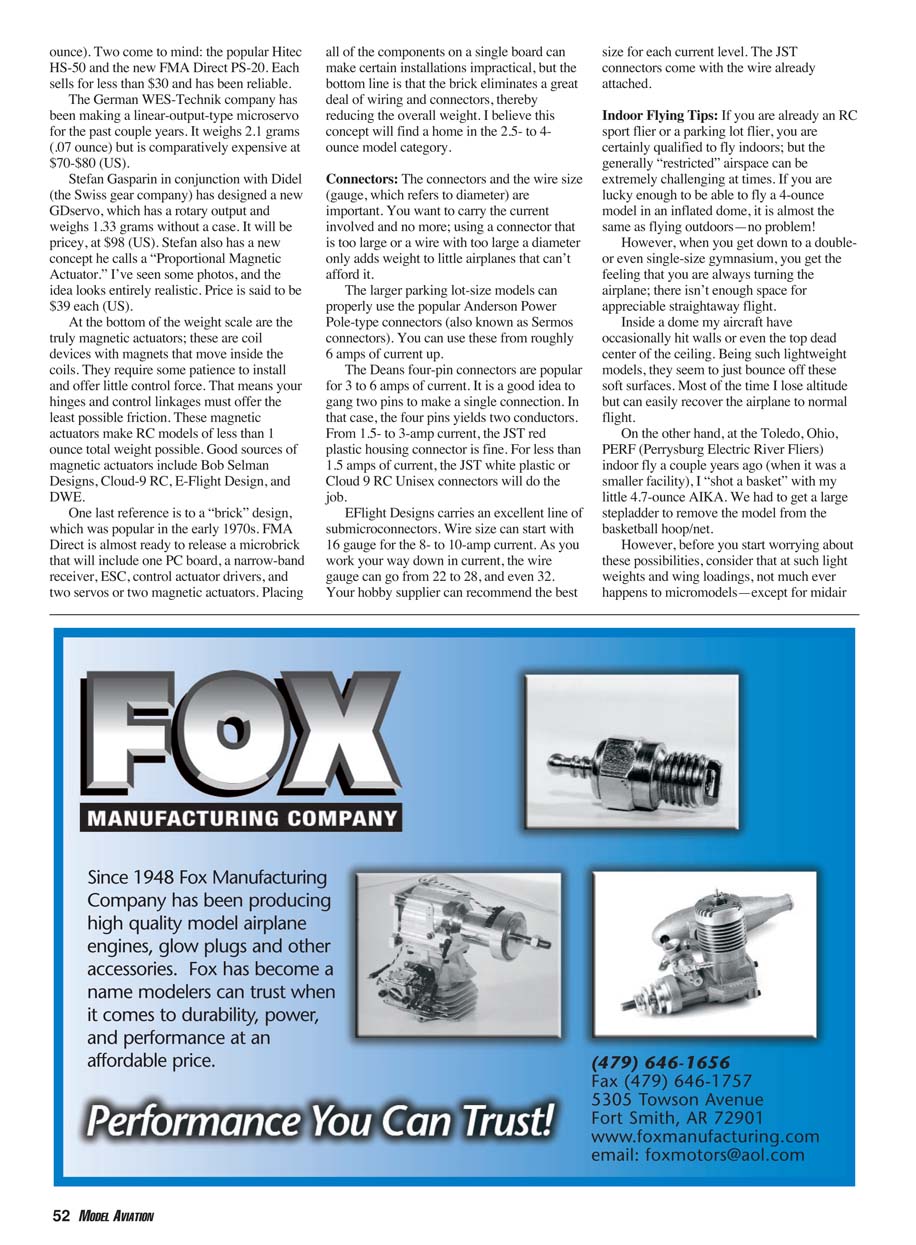
Once a year NIRAC sponsors a major indoor RC championship. For 2004 the dates were June 4–6 at the Oakland Yard Athletics inflated dome in Waterford, Michigan (www.oaklandyard.com/model_aviation.htm). The three-day flying plan typically includes official indoor RC events such as Scale, racing, cargo lift, Old-Timer climb-and-glide, endurance, and RC gliders. Between events the dome is opened for fun-flying.
NIRAC can also help you find local domes and large indoor flying facilities. The current NIRAC president, Dave Robelen, is one of the most experienced indoor/micro RC fliers.
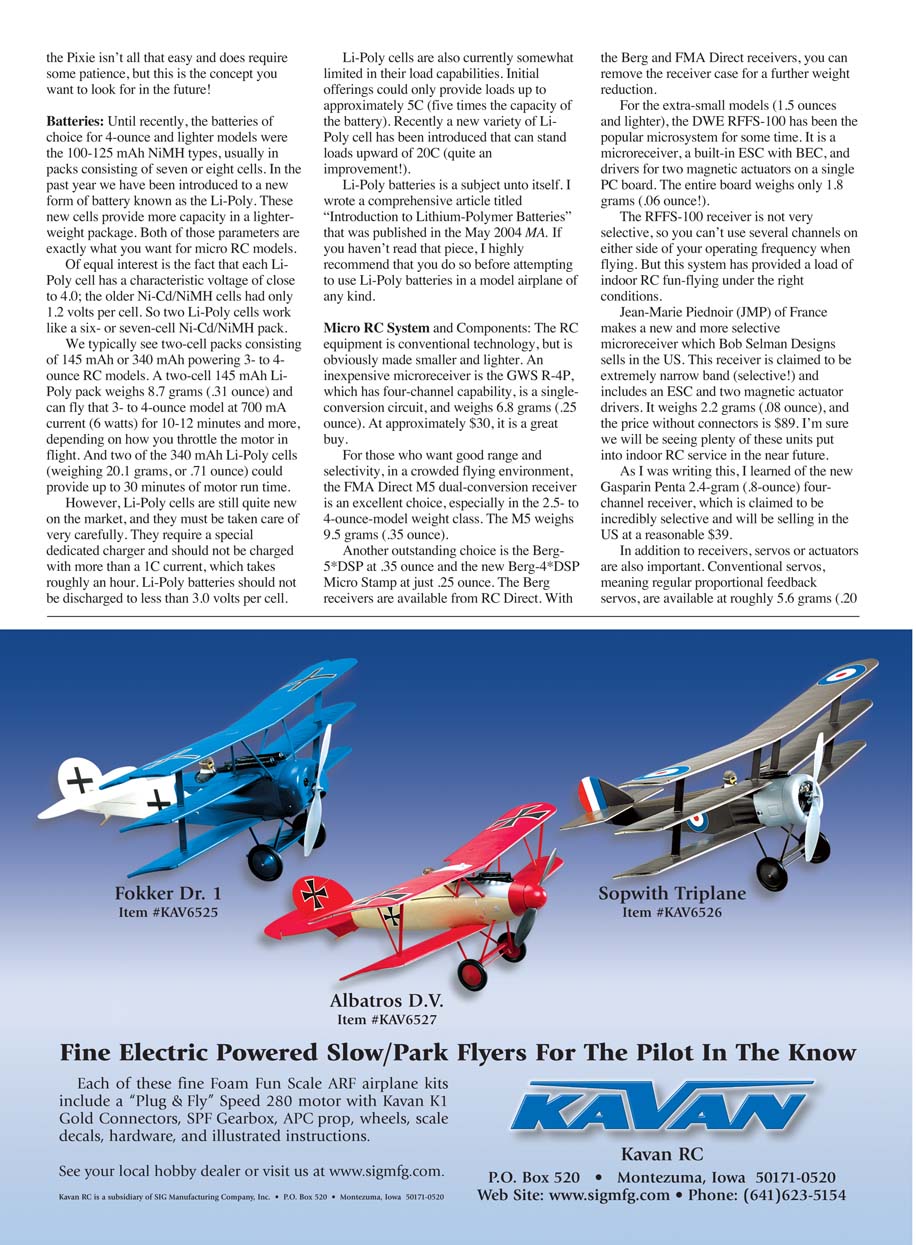
With indoor RC growing rapidly, there is much to be learned and new technology seems to emerge almost weekly. The annual NEAT (Northeast Electric Aircraft Technology) Fair in upstate New York includes indoor RC lectures coordinated by Sergio Sigras, with presentations by leading names in microflight. Gordon Johnson organizes a Saturday-night indoor flight demonstration in a double-size gym at Walton Senior High School during the Fair. Learn more at www.neatfair.org.
When attempting to gain permission to fly indoor RC at local school facilities, offer to lecture or give classes to offset your use of the venue: "Yes, you can use our gym, but why not come in and let our young people learn how they can participate?"
References
- NIRAC — www.nirac.org
- RC MicroFlight (Air Age Media) — print and online archive
- Micro-Flying column by Dave Robelen (MA)
- Small-Field Flying column by Paul Bradley (MA)
- Quiet Flyer (publisher Wil Byers)
- Flying Models magazine (Don Belfort, Stew Meyers)
- RC Modeler (Tim Zare)
- Bob Aberle, Getting Started in Backyard Flying (book) — available from AMA, Tower Hobbies, Balsa Products, and www.rcstore.com/rs/general/books.asp
- Bob Aberle, "Introduction to Lithium-Polymer Batteries," May 2004 MA
In the late 1960s, experimenters like Dave Robelen, John Worth, and Howard McEntee worked with multichannel proportional RC control on glow-fueled models weighing only 5–8 ounces. Later, Bill Cannon of Cannon Electronics produced subminiature RC systems that helped make small-scale RC-model flying practical for many. Recently we have seen the development of micro RC systems, servos, actuators, Li-Poly batteries, tiny motors, and a growing group of dedicated RC modelers. With modern large inflatable domes and field houses, it is now possible to enjoy RC flying in almost any weather, at any time of day or night.
Want more fun in RC? Try flying indoors.
MA Bob Aberle baberle@optonline.com
Manufacturers/distributors
- AstroFlight Inc. — Firefly coreless micro motors (direct and geared): www.astroflight.com
- Balsa Products — GWS motors, propellers, Li-Poly batteries: www.balsapr.com
- Batteries America — Li-Poly batteries: www.batteriesamerica.com
- Bob Selman Designs — JMP receivers, magnetic actuators, Li-Poly chargers: http://users.joplin.com/~bselman/
- Castle Creations — Voltage cutoff programmable ESCs: www.castlecreations.com
- Cloud 9 RC (John Worth) — Assortment of micro hardware and products: (703) 273-0607
- David Lewis — Hard-to-get gears, motors, propellers, wire, connectors: www.homefly.com
- DJ Aerotech — Profile Roadkill series stand-off scale models: www.djaerotech.com
- Dynamic Web Enterprises (DWE) — RFFS-100 micro RC systems, magnetic actuators, JMP receivers: www.smallrc.com
- E Cubed R/C — Reduced-size receiver antennas: www.azarr.com
- EFlight Designs — Magnetic actuators, control-linkage accessories, connectors: www.eflightdesigns.com
- E-Tec (Air Craft) — Li-Poly batteries, chargers: www.aircraft-world.com
- FMA Direct — M5 micro DC receivers, submicroservos, Kokam Li-Poly batteries, chargers: www.fmadirect.com
- Gasparin — Penta 2.4-gram receivers, GDservo 1.33-gram servos, proportional magnetic actuators: www.gasparin.cz
- Grand Wing Servo-Tech (GWS) — Motors, propellers, wheels, accessories: www.gws.com.tw
- Global Hobby Distributors — Cirrus Micro Joule receivers, ESCs, 3-gram servos: www.globalhobby.com
- Great Planes Model Distributors — Triton Li-Poly chargers: www.electricfly.com / www.greatplanes.com
- Hitec RCD — HS-50 submicroservo: www.hitecrcd.com
- Hobby Club — Cirrus Micro Joule receiver, ESC, 3-gram servos: www.hobbyclub.com
- Horizon Hobby (GWS) — Motors, JR radios, Hobby Zone ARF indoor models, Thunder Power Li-Poly batteries: www.horizonhobby.com
- Kenway Motors — Assortment of tiny direct- and gear-drive motors: (908) 850-9571
- Maxx Products International — GWS motors, propellers, Li-Poly batteries: www.maxxprod.com
- Megatech — ARF and RTF indoor models: www.megatech.com
- Radical RC — Li-Poly batteries, connectors, wire: www.radicalrc.com
- RC Direct — Berg receivers: www.rc-direct.com
- RCS Technik (Chris Stewart) — Tiny geared motors, scale model kits: www.falconmodels.uk.com
- Sky Hooks and Rigging — Microreceivers, ESCs, Li-Poly batteries, chargers, model kits: www.microrc.com
- Thunder Power (Advanced Energy Technology Inc.) — Li-Poly batteries: (702) 228-8883
- Todd Long Models — Indoor model kits and supplies: www.toddsmodels.com
- Tower Hobbies — Li-Poly chargers, ARF and RTF model kits: www.towerhobbies.com
Transcribed from original scans by AI. Minor OCR errors may remain.

