

Introduction to: RC Slope Soaring
By Mark Triebes
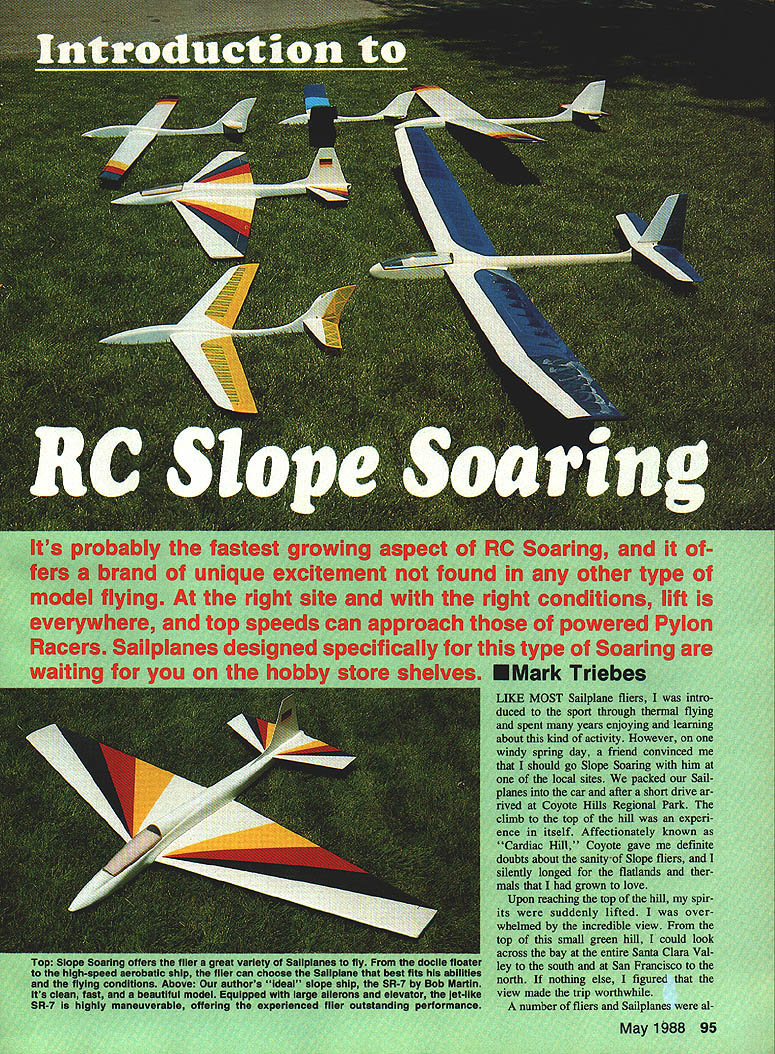
It's probably the fastest growing aspect of RC soaring, and it offers a brand of unique excitement not found in any other type of model flying. At the right site and with the right conditions, lift is everywhere, and top speeds can approach those of powered pylon racers. Sailplanes designed specifically for this type of soaring are waiting for you on hobby store shelves.
First experience on the slope
Like most sailplane fliers, I was introduced to the sport through thermal flying and spent many years enjoying and learning that style of activity. However, on one windy spring day a friend convinced me to go slope soaring with him at a local site. We packed our sailplanes into the car and after a short drive arrived at Coyote Hills Regional Park. The climb to the top of the hill was an experience in itself. Affectionately known as "Cardiac Hill," Coyote gave me definite doubts about the sanity of slope fliers, and I silently longed for the flatlands and thermals that I had grown to love.
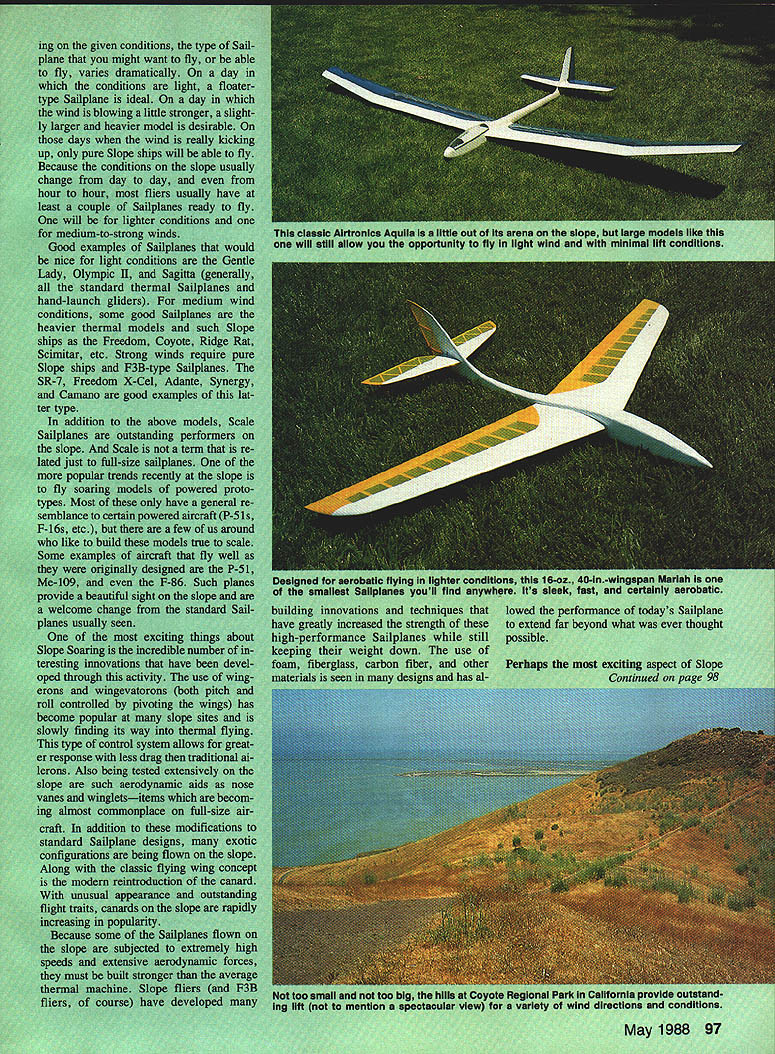
Upon reaching the top of the hill, my spirits were suddenly lifted. I was overwhelmed by the incredible view. From the top of this small green hill I could look across the bay at the entire Santa Clara Valley to the south and at San Francisco to the north. If nothing else, the view made the trip worthwhile.
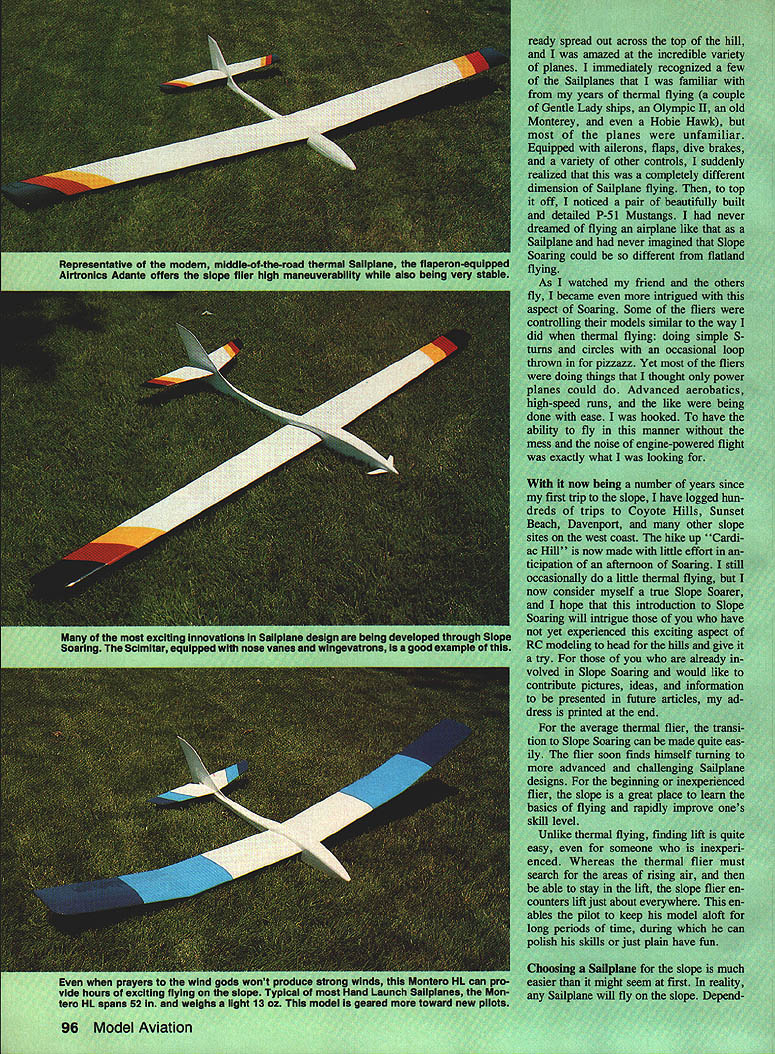
A number of fliers and sailplanes were already spread out across the top of the hill, and I was amazed at the incredible variety of planes. I immediately recognized a few sailplanes I was familiar with from my years of thermal flying (a couple of Gentle Lady ships, an Olympic II, an old Monterey, and even a Hobie Hawk), but most of the planes were unfamiliar. Equipped with ailerons, flaps, dive brakes, and a variety of other controls, I suddenly realized that this was a completely different dimension of sailplane flying. Then, to top it off, I noticed a pair of beautifully built and detailed P-51 Mustangs. I had never dreamed of flying an airplane like that as a sailplane and had never imagined that slope soaring could be so different from flatland flying.
As I watched my friend and the others fly, I became even more intrigued. Some fliers were controlling their models similar to the way I did when thermal flying—simple S-turns and circles with an occasional loop for pizzazz. Yet most of the fliers were doing things I had thought only power planes could do: advanced aerobatics, high-speed runs, and the like, all done with ease. I was hooked. To have the ability to fly in this manner without the mess and noise of engine-powered flight was exactly what I was looking for.
With it now being a number of years since my first trip to the slope, I have logged hundreds of trips to Coyote Hills, Sunset Beach, Davenport, and many other slope sites on the West Coast. The hike up "Cardiac Hill" is now made with little effort in anticipation of an afternoon of soaring. I still occasionally do thermal flying, but I now consider myself a true slope soarer. If this introduction intrigues you, head for the hills and give it a try. If you are already involved in slope soaring and would like to contribute pictures, ideas, or information for future articles, my address is printed at the end.
Transition from thermal to slope
For the average thermal flier, the transition to slope soaring can be made quite easily. The flier soon finds himself turning to more advanced and challenging sailplane designs. For the beginning or inexperienced flier, the slope is a great place to learn the basics and rapidly improve one's skill level.
Unlike thermal flying, finding lift on the slope is quite easy, even for someone inexperienced. Whereas the thermal flier must search for areas of rising air and then be able to stay in the lift, the slope flier encounters lift just about everywhere. This enables the pilot to keep a model aloft for long periods, during which he can polish skills or just plain have fun.
Choosing a sailplane for the slope
In reality, any sailplane will fly on the slope. Depending on the kind of flying you want to do, choose one of the many available designs. For those who have mainly flown thermals, I recommend beginning with a simple, rugged ship with plenty of stability and good low-speed handling. Many modern thermal designs meet this description and will make good slope ships.
Because slope conditions vary dramatically from day to day, and even hour to hour, most fliers usually have at least a couple of sailplanes ready to fly—one for lighter conditions and one for medium-to-strong winds.
Good examples by condition:
- Light conditions: Gentle Lady, Olympic II, Sagitta (standard thermal sailplanes and hand-launch gliders).
- Medium winds: heavier thermal models and slope ships such as Freedom, Coyote, Ridge Rat, Scimitar.
- Strong winds: pure slope ships and F3B-type sailplanes such as the SR-7, Freedom X-Cel, Adante, Synergy, and Camano.
Scale sailplanes and prototypes
Scale sailplanes are outstanding performers on the slope. Scale here is not limited to full-size sailplanes—there is a popular trend to fly soaring models that resemble powered prototypes (P-51s, Me-109s, F-86s, etc.). Some builders prefer true scale models, and aircraft like the P-51, Me-109, and F-86 make a beautiful sight on the slope and are a welcome change from the standard sailplanes usually seen.
Innovations and aerodynamic aids
One of the most exciting aspects of slope soaring is the number of interesting innovations developed through the activity. Examples include:
- Wingerons and wingwarators (pitch and roll controlled by pivoting the wings), which give greater response with less drag than traditional ailerons.
- Aerodynamic aids such as nose vanes and winglets, now common on many designs.
- Exotic configurations like flying wings and the modern reintroduction of the canard, offering unusual appearance and outstanding flight traits.
Because many slope sailplanes are subjected to high speeds and large aerodynamic forces, they must be built stronger than an average thermal machine. Builders use foam, fiberglass, carbon fiber, and other materials to increase strength while keeping weight down. These materials and techniques have allowed sailplane performance to extend far beyond what was once thought possible.
Competitions on the slope
Competitions are a thrilling part of slope soaring. The most popular is slope racing, where high-performance sailplanes race wing tip to wing tip on a closed pylon course at incredible speeds. The best-known slope race is the ISR (International Slope Race, formerly sponsored by RC Modeler), now sponsored by the South Bay Soaring Society; it draws contestants from around the world.
Another form of competition is combat soaring: a one-on-one contest in which each sailplane trails a length of magnetic tape from a cassette. A point is scored when a plane contacts the other's tape (contact with the other plane also scores). Combat is an exciting and entertaining diversion from everyday flying.
The slope site
All you really need is a hill and some wind. More specifically, a respectable-sized hill in which the wind blows straight into the slope (thus producing rising air) is ideal. The best slope sites often form a "bowl" created by a curved hill or a series of hills; such a slope can produce lift with wind from a variety of directions.
Getting started
On the next windy day, grab your sailplane, find a hill, and prepare yourself for some of the most exciting and fun-filled flying you have ever done. If you have any contributions for future articles on slope soaring—pictures, ideas, stories, or whatever—you can send them to:
Mark Triebes 20794 Kreisler Ct. Saratoga, CA 95070
Transcribed from original scans by AI. Minor OCR errors may remain.

