

ISRAELI MODELING '85
Despite heavy economic burdens and other adversities, aeromodeling in Israel manages to flourish. Our author describes what he saw during a summer vacation.
By Norm Rosenstock
Traveling to Israel
I was on my way at last. I had not seen my daughter, who lives in Jerusalem, in two years, and I was eagerly looking forward to the trip. Coupled with this was the hope that I would get a chance to meet, and perhaps fly with, some Israeli modelers.
I had the name and address of Amos Hadas, the head of the aeromodeling section of the Aero Club of Israel, from the AMA. I had met him a number of years earlier in the States, and he had offered an open invitation: "If you ever get to Israel, please look me up."
Israel is an entirely different world than Americans are used to. Antiquity exists side-by-side with the most advanced technology. Ancient and modern, strange and wonderful — truly a paradox.
Riding a bus in Jerusalem is an experience. To start with, almost all bus drivers have radios which they play loudly — I suppose to overcome the noise made by the buses while underway. They drive as if they were racing at Indianapolis; you have to hang on for dear life. One morning while boarding a bus, I heard the unmistakable strains of Elvis Presley. Stunned by this time machine that took me back 25 years, I murmured, "Jailhouse Rock," and the bus driver responded with a low gleeful "Yeeaaaah!" As I said, it's paradox.
Meeting the Aero Club
As soon as I settled, I tried to telephone Mr. Hadas in Tel Aviv to arrange a meeting. I had traveled 6,000 miles to meet him, only to discover he had gone in the opposite direction — Wisconsin. Undaunted, I pressed on, telling the Aero Club of Israel folks that I wanted to meet some model fliers.
Their response was one of curiosity: "What type of modeling are you interested in? Do you build models?" I mentioned a few names I thought might impress them, but the person I was talking to had not heard of them. Only after I said I build quarter-scale did it stir up some interest. "Oh yes, we have a few members who build large models, that sort of thing," they said.
They took my phone number and said someone would contact me. Within 24 hours I got a call from Zvi Nave, a modeler.
"What kind of models do you build?" he asked.
"Giant scale," I answered.
"Well," he said, "members also build large models over three meters, weighing about 20 kilos (44 lb). Plans come to Tel Aviv." The prospect of meeting these modelers in Tel Aviv was exciting. I was invited to join Zvi and his friends to go flying that weekend: a typical weekend flying session the first day and a local contest the next.
Ein Shemer Flying Field
After arriving in Tel Aviv and staying at a friend's house, Zvi came to pick me up. Zvi was warm and friendly; his passion is RC sailplanes. In short order we felt as comfortable with each other as old flying buddies.
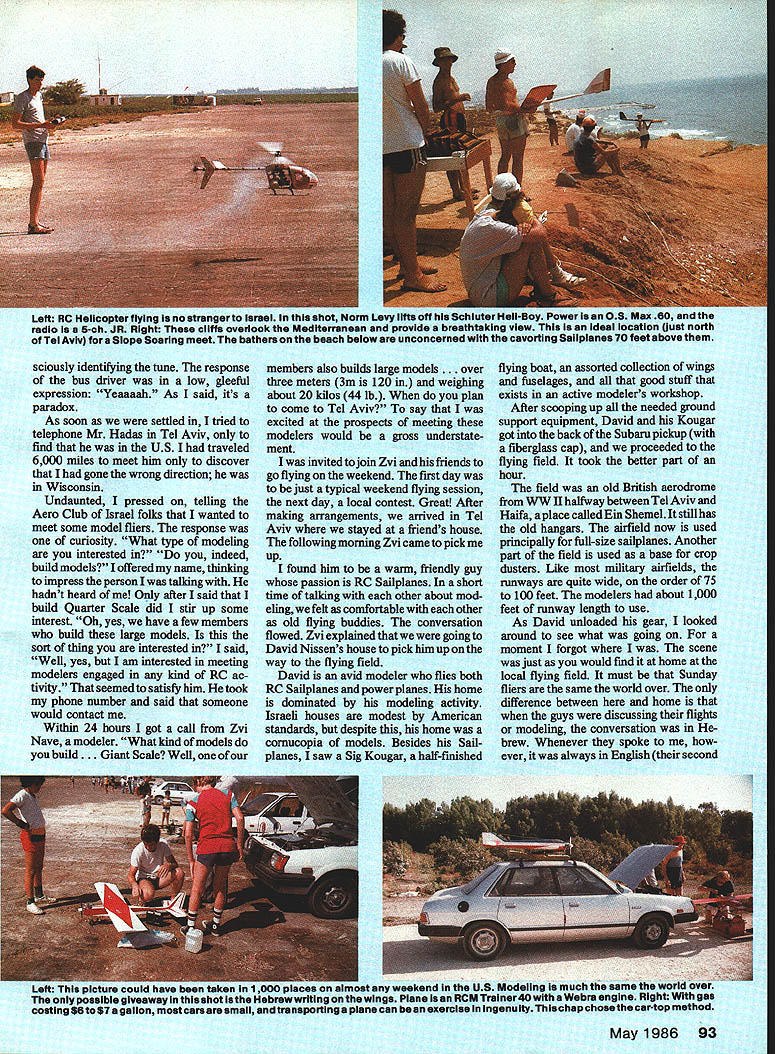
We were going to pick up David Nissen on the way to the flying field. David is an avid modeler who flies both RC sailplanes and powerplanes. His home, modest by Israeli standards, was a cornucopia of models: sailplanes, a SIG Cougar, a half-finished flying boat, and an assorted collection of wings and fuselages.
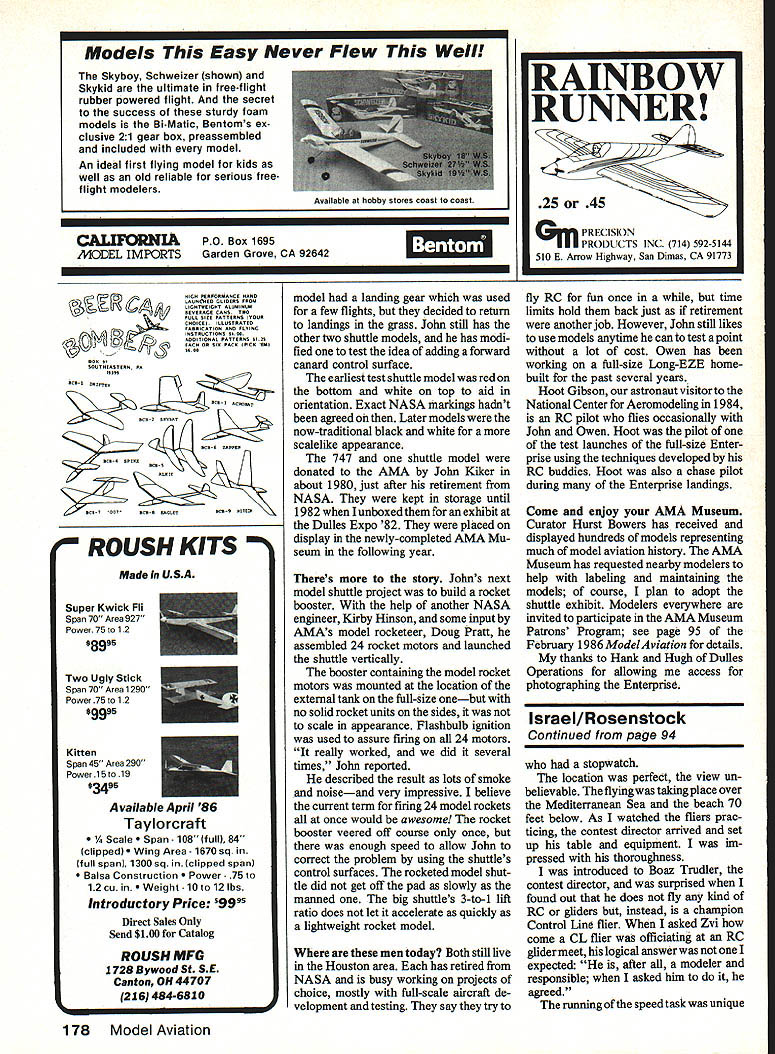
After scooping up ground support equipment, David and his Cougar got into the back of a Subaru pickup with a fiberglass cap, and we proceeded to the flying field. It took the better part of an hour.
The field was an old British aerodrome from WWII called Ein Shemer, halfway between Tel Aviv and Haifa. It still has the old hangars. The airfield is used principally for full-size sailplanes; another part serves as a base for crop dusters. Like most military airfields, the runways are quite wide — on the order of 75 to 100 feet. The modelers use about 1,000 feet of runway length.
As David unloaded his gear, the scene felt immediately familiar — just like at home. When the guys discussed their flights or modeling, the conversation was in Hebrew, but whenever they spoke to me it was always in English (their second language).
A Day at the Field
As I stood taking pictures, I felt a tap on my shoulder. Turning, I was confronted with a Futaba transmitter and the words, "It's your turn." I protested about responsibility and crashing someone else's airplane, but the transmitter would not go away. Seeing that I was outmaneuvered, I took it and found myself in charge of a .40-powered Cougar. I was so far away from home and yet felt so close.
We spent the better part of the day at Ein Shemer. I enjoyed watching the mix of models and pilots. One interesting aircraft looked like a Stimlaker; its builder, Morty Parid, explained that the model is a Skywalker with a Stimlaker lineage. It is highly modified and uses two servos with a mechanical mixer to achieve elevon control. Power is a Webra .40, and the inverted flat spins Morty performed were unbelievable.
I saw a variety of aircraft and modelers:
- Goldberg Jr. Falcons
- RCM 60s
- SIG Cougars
- Graupner Cirrus with power pod
- Skywalker
- Several European models (names unfamiliar to me)
There must have been at least 20–25 modelers who showed up at the field.
In conversation during the drive back, I learned there are about 10,000 modelers in Israel, most flying some kind of free flight, especially rubber-powered models. Some 4,000 of them are kids — pre-teens taught modeling by older members under the auspices of the Aero Club of Israel, similar in spirit to Boy Scouting.
Most serious modelers in Israel compete in various FAI events:
- Wakefield
- Rubber
- A-2 Towline Glider
- Free Flight Power
- RC Pattern
They attend meets in Israel and other countries such as France, Germany, Italy, and England. FAI World Championships are frequently held in Europe, and the Israeli team is always present.
Modeling in Israel requires dedication. With problems in the economy, the shekel does not go very far. Anything that must be imported — engines, balsa, radios — is very costly. When coupled with limited home sizes and the high cost of automobiles and gasoline, you have to take your hat off to these guys.
RC Sailplane Contest — Cliff Soaring
We planned for an RC sailplane contest the next day just north of town. Zvi told me little about the meet except that it was for gliders only. I had flown RC sailplanes from flat land using high-starts or power winch launches, but I had never tried or watched cliff soaring.
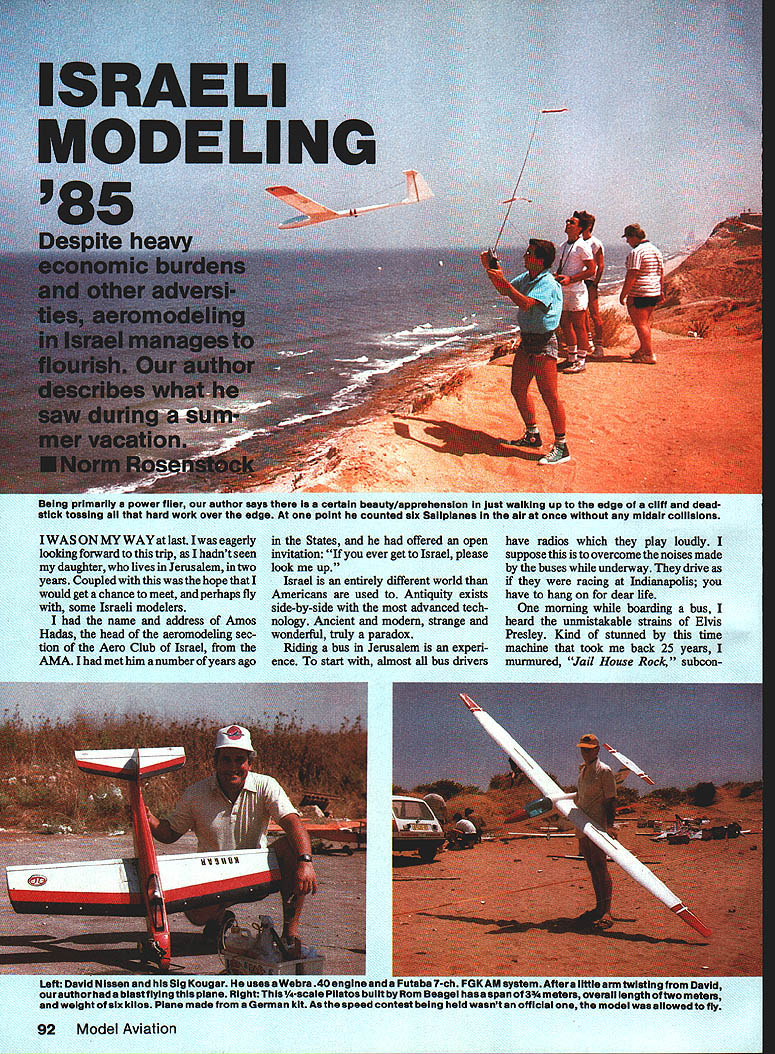
Surely you've guessed: it was cliff soaring — an "unofficial" meet with the task being speed. They rigged up two pylons about 200 meters apart at the edge of the cliff and stationed an observer at each pylon. Each observer had a microswitch cable-connected to a large box containing an auto-cut battery and a couple of auto horns. A third cable went to the contest director.
The location was perfect; the view was unbelievable. The flying took place over the Mediterranean Sea and the beach about 70 feet below. As the fliers practiced, the contest director arrived and set up his table and equipment with impressive thoroughness.
I was introduced to Boaz Trudler, the contest director, and was surprised to learn that he does not fly RC gliders; he is a champion control-line flier. When I asked Zvi why a CL flier was officiating at an RC meet, his answer was simple: "He is, after all, a modeler and responsible; when I asked him to do it, he agreed."
The running of the speed task was unique to me. The flier launches his glider and, after getting into position, gets a buzzer signal from the judge. At the same time the judge starts his stopwatch. The flier has three minutes to get in as many "legs" as he can before the judge's second horn blast ends the run. During the timed period, the flier turns when he hears the horn sounded by the pylon observer. (The pylon observers' horn sounds different from the judge's horn to avoid confusion.)
As I moved closer to the cliff edge to get a better view, I noticed the beach below was well occupied — bikini-clad young girls enjoying the day. Their pleasure was mine too, and I almost forgot where I was and why I was there.
The landing site at the top of the cliff was like a flat-bottomed bowl about 40 x 75 feet and strewn with rocks, some as large as my fist. The stoic Israeli fliers landed their gliders there, trying to avoid the big rocks and taking damage in stride. Most repairs were made on the cliff so flying could continue.
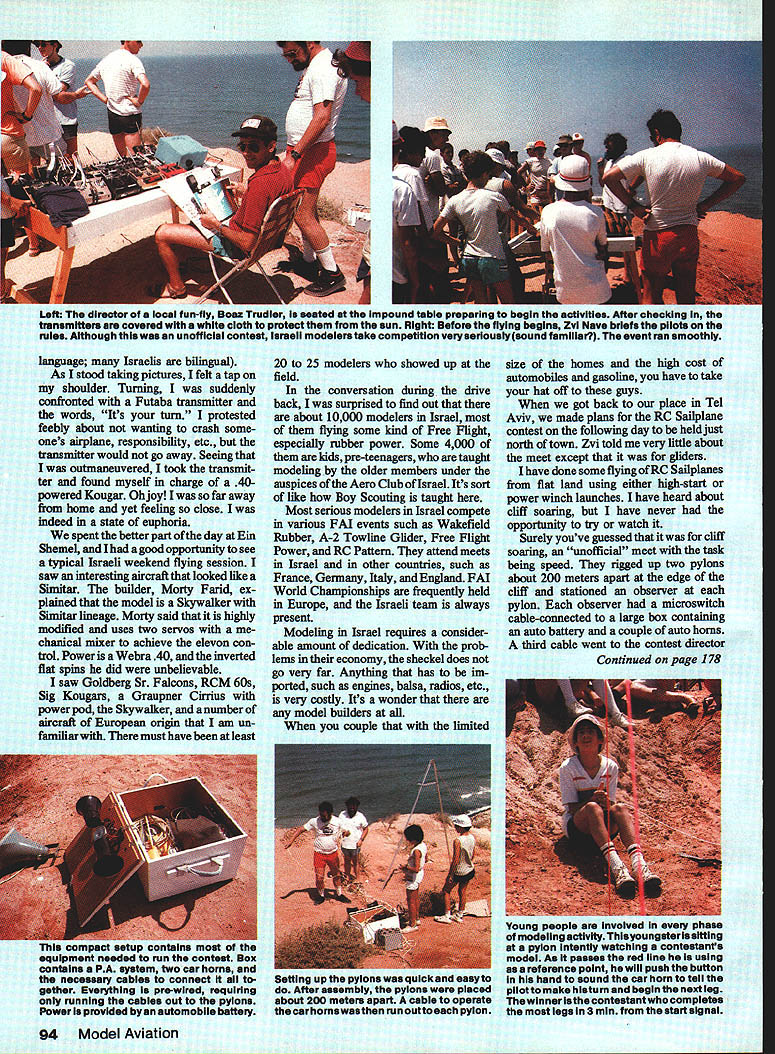
The sailplanes flown were largely of German origin — names like Pilatus and Piranha. I saw fantastic engineering involving coupled ailerons and flaps, variable-camber geometry, and other refinements. Some models used all seven RC channels (I fly my Olympic II with two or three channels).
Observations on Modeling in Israel
- Strong community: Clubs and the Aero Club of Israel support youth and competitive participation.
- Resourceful builders: Despite economic constraints, modelers import what they must and repair in the field.
- International involvement: Israelis compete in European events and at FAI World Championships.
- Wide interests: Free flight remains strong, but RC, towline, and control-line activities are all present.
Farewell
By four in the afternoon the meet was over. We returned to Tel Aviv, said our goodbyes, and promised to write. For me it was a sad parting. Although we had spent very little time together, a bond had grown, and we became chaverim — brothers.
Transcribed from original scans by AI. Minor OCR errors may remain.

