
It Really Works!
If you can muster the courage to do things a little differently than the next guy, and have the persistence to keep at it no matter what, you too can join the ranks of the innovators who add so much to the world of aviation. — Bill Evans
Resistance to Change
Throughout the years, dynamic field-model aviation changes have brought about significant progress. Model airplanes have evolved from the early stick-and-tissue, rubber-powered craft to today's sophisticated foam-and-glass, multi-engined ships with simultaneous, proportional, trimmable control. Every step along the way, someone had to have the courage to be different and the daring to try something new.
Too often, though, attempts to implement change are met with resistance. That slows advancement. How often have you come up with a new idea at work or at home only to be met with dismissal? Your listener closes his mind, convinced it won't work: "We tried that before! If it were any good, it would have already been done." Such attitudes take precedence over fact and prevent progress.
Why are the young generally more accepting of change? Perhaps it's because older people remember the past, which is certain and secure, while the future is unknown and therefore unsettling.
My Experience with the Simitar Flying Wing
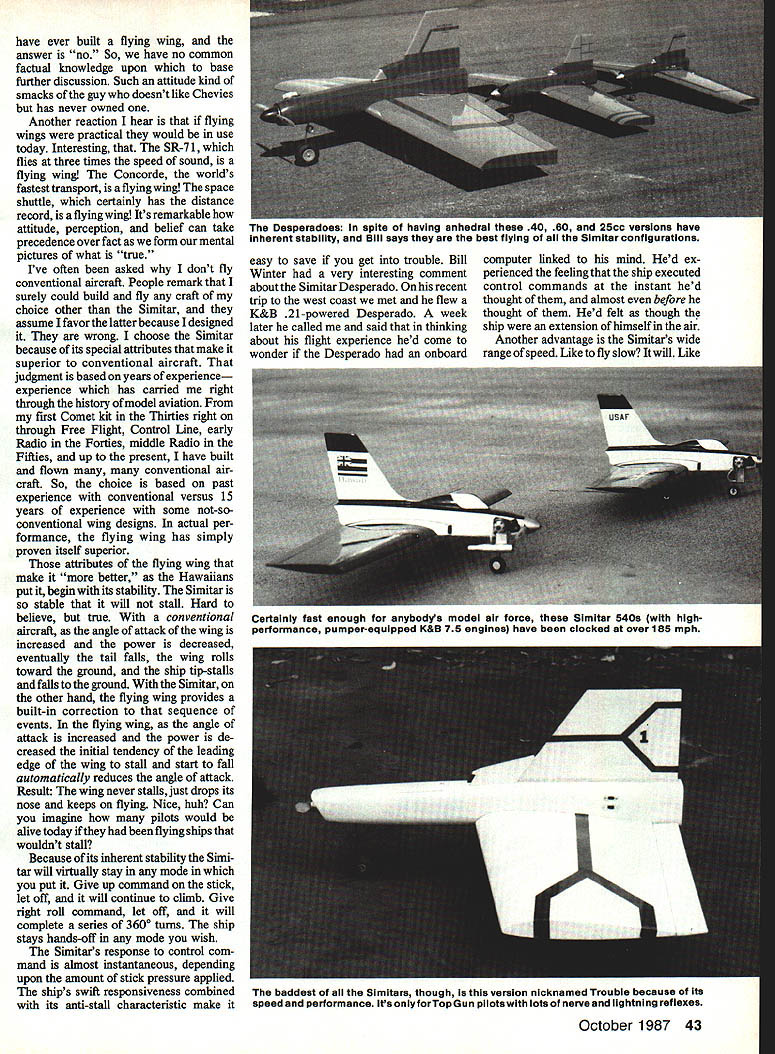
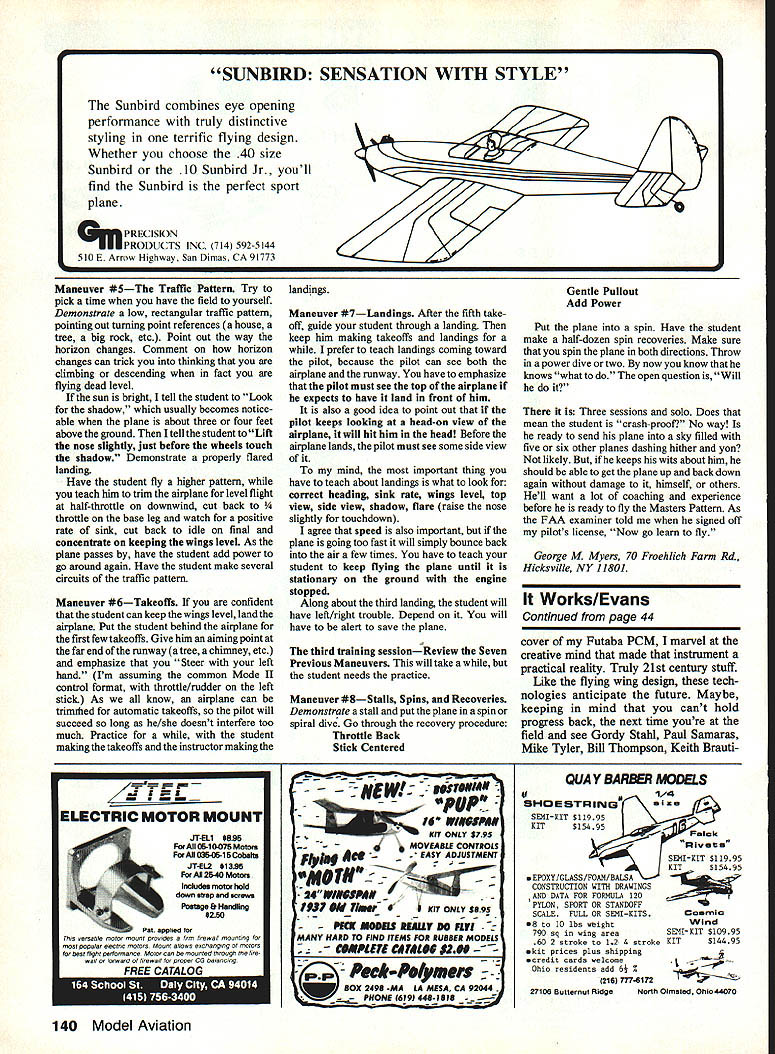
For the past 15 years of my 50-year modeling career I've been dealing with change in the form of the flying wing. I could have stuck with conventional, accepted aircraft, but I chose a different path. I designed the Simitar series, which now includes more than 20 different configurations of flying wings.
Reactions to the Simitar are often negative: "Flying wings are unstable," "They are inefficient," "Couldn't you afford a stab?" These comments exemplify the common attitudes and beliefs that block open discussion. Ask the objectors if they have hands-on experience or factual knowledge to support their claims — many have not.
My judgment is based on decades of experience. From my first Comet kit in the 1930s through Free Flight, Control Line, and the development of radio control in the 1940s and 1950s, I have built and flown many conventional aircraft. After 15 years working with various flying wing designs, actual performance has shown the flying wing to be superior in many respects.
Performance and Safety
Those attributes of the flying wing that make it "more better," as the Hawaiians put it, begin with its stability.
- Anti-stall characteristic: The Simitar is so stable it will not stall in the conventional sense. With a conventional aircraft, increasing angle of attack while reducing speed can lead to tail drop, wing roll, tip-stall, and a fall. The Simitar provides a built-in correction: as the leading edge begins to stall and the ship starts to fall, the wing automatically reduces its angle of attack, dropping the nose and keeping the plane flying instead of stalling.
- Inherent stability: The Simitar will virtually stay in whatever mode you put it. Release the stick and the wing may continue to climb. Give a roll command and let go — it can complete a 360° turn and remain stable in a hands-off mode.
- Responsiveness: The Simitar's response to control input is almost instantaneous, depending on stick pressure. The combination of swift responsiveness and anti-stall behavior makes it easy to save if you get into trouble.
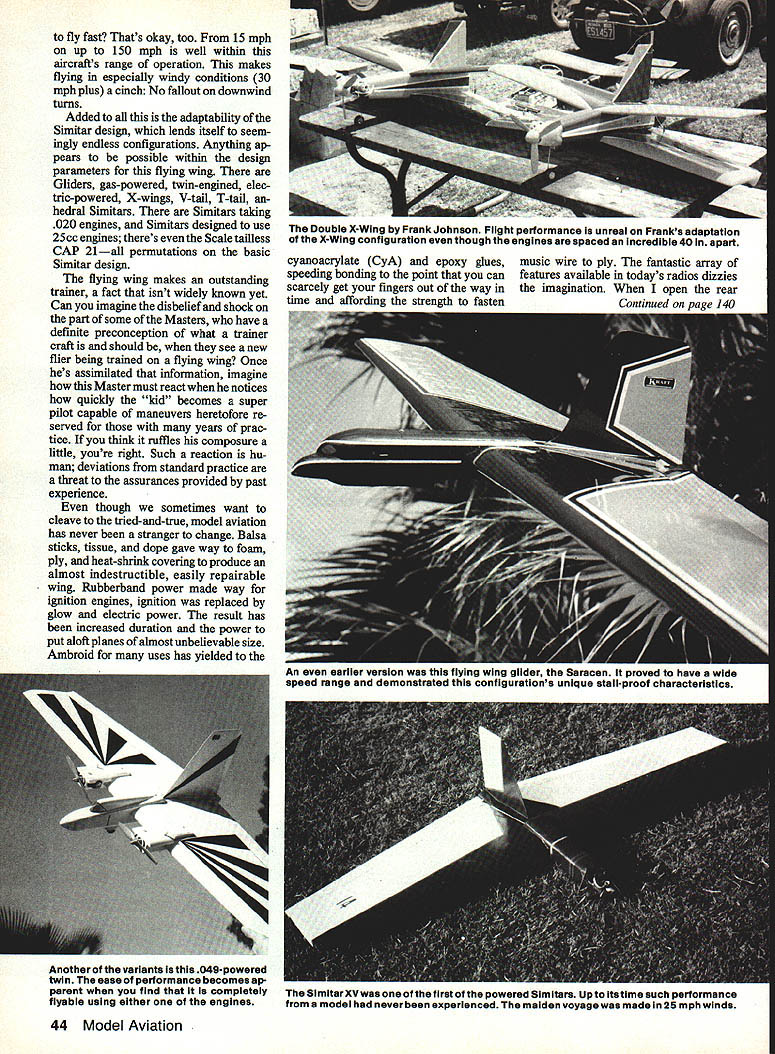
Bill Winter described flying a K&B .21-powered Desperado and afterward felt as if the ship executed commands at the instant he thought of them — as though the aircraft were an extension of himself.
Speed Range and Handling
The Simitar offers a wide range of speeds. Want to fly slow? It will. Want to fly fast? It will. Its operational range (roughly 15 mph up to 150 mph) makes it adaptable to many conditions, including especially windy days (30 mph plus). Downwind turns exhibit no fallout.
Adaptability and Configurations
The Simitar design is highly adaptable. Within its design parameters, many configurations are possible:
- Gliders
- Gas-powered models
- Twin-engined versions
- Electric-powered variants
- X-wings, V-tail, T-tail, and anhedral Simitars
- Small models using .020 engines to larger ones using .25 ci engines
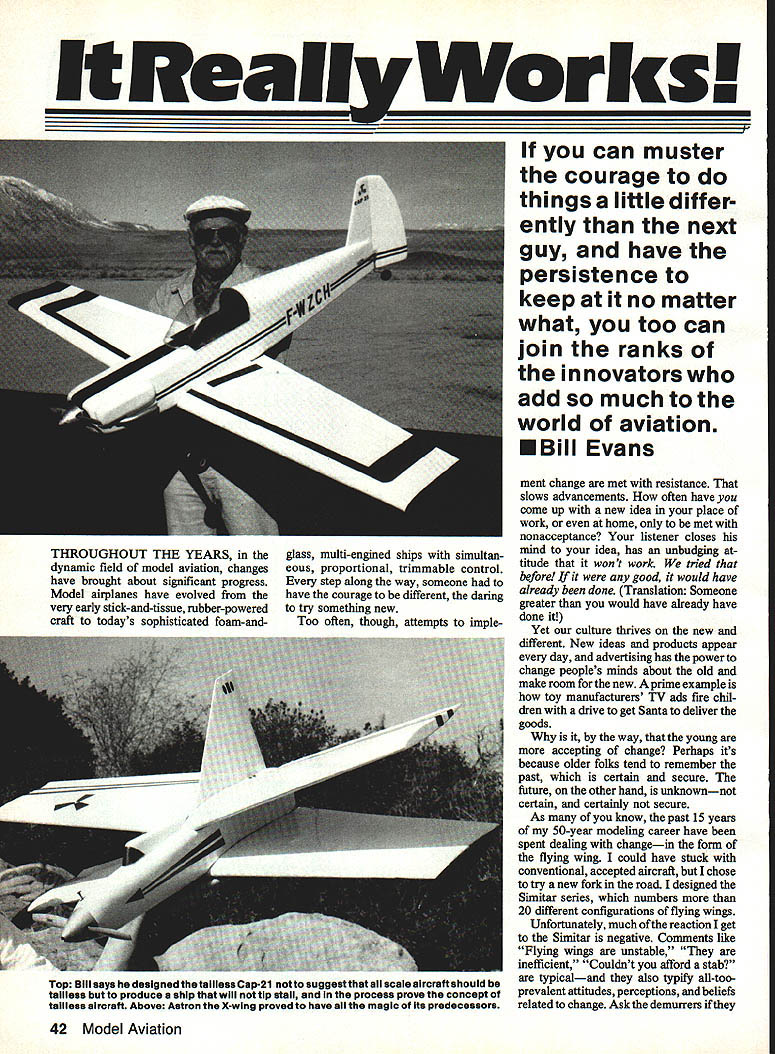
- Scale tailless designs (e.g., CAP 21)
This versatility makes the flying wing suitable for many roles and preferences.
The Flying Wing as a Trainer
The flying wing makes an outstanding trainer — a fact not yet widely appreciated. Imagine the surprise of traditionalists who see a novice becoming a proficient pilot quickly when trained on a flying wing. Deviations from standard practice can be threatening to those reassured by past experience, but the results speak for themselves: rapid skill development and advanced maneuver capability in less time.
Technology and Progress
Model aviation has never been a stranger to change. Balsa, tissue, and dope gave way to foam, plywood, and heat-shrink covering, producing durable, easily repaired models. Rubber power yielded to ignition engines, then glow and electric power, enabling longer duration and much larger aircraft. Ambroid glues have largely been replaced by cyanoacrylate (CyA) and epoxy, speeding bonding and increasing strength. Modern radios — with their remarkable features — are another leap forward; opening the rear cover of my Futaba PCM still amazes me.
Like the flying wing design, these technologies anticipate the future. You can't hold progress back.
Conclusion: Keep an Open Mind
The real issue is not the flying wing itself but what it represents: change. Many changes offered at the flying field are genuine improvements that advance the sport. Too often, change is rejected because of hearsay and attitude rather than facts. It's rewarding to discover the truth for yourself by trying something new.
Next time you're at the field and see Gordy Stahl, Paul Samaras, Mike Tyler, Bill Thompson, Keith Brautigam, Robert E. Byrd, John Cole, Steve Hosner, Bill Winter, or any of the many others who have embraced the Simitar, be a bit more understanding. Offer encouragement — or better yet, ask for a turn at the stick. It flies like any other aircraft, only better.
Why not keep an open mind about change, both the innovations you see around you today and those yet to come? Join me in flying into the 21st century.
Transcribed from original scans by AI. Minor OCR errors may remain.

