
It's All Done With Smoke
Forms of Aerobatics
There are three basic forms of public aerobatics (to say nothing of a lot of ways of doing it in private):
- Contest flying: the gut‑wrenching, eyeball‑popping kind, flown in high‑powered little biplanes and monoplanes in one‑at‑a‑time, all‑alone‑in‑the‑sky formal competition. It is meant to be judged by a panel of skilled, eagle‑eyed judges who know exactly what each pilot is supposed to do. The average spectator often finds it sleep‑inducing after the first dozen all‑alike performances, even though the flying is frequently superb.
- Air show stunt flying: show‑business pilots attempt to impress the crowd with fairly routine maneuvers made to look terribly exciting by threatening to hit the ground. It's fun for the whole family; most spectators don't care whether a local pilot is flying a clipped‑wing Piper J‑3 Cub or last year's World Champion is flying a $150,000 custom‑built Laser 360.
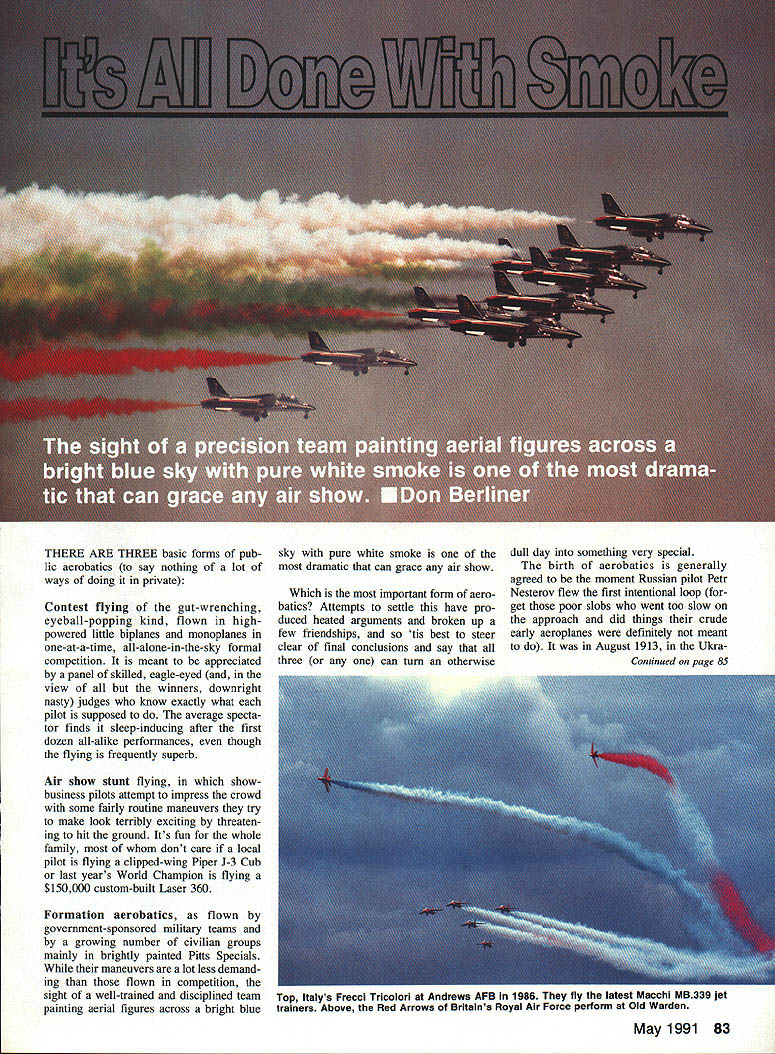
- Formation aerobatics: flown by government‑sponsored military teams and by a growing number of civilian groups, mainly in brightly painted Pitts Specials. While their maneuvers are a lot less demanding than those in competition, the sight of a well‑trained team painting aerial figures across a bright blue sky with pure white smoke is one of the most dramatic sights at any air show.
Which is the most important form of aerobatics? Attempts to settle that have produced heated arguments and broken up a few friendships. It's best to steer clear of final conclusions and say that all three (or any one) can turn an otherwise dull day into something very special.
Early History
The birth of aerobatics is generally agreed to be the moment Russian pilot Petr Nesterov flew the first intentional loop. It was in August 1913, in the Ukraine, somewhere near Kiev, that Nesterov did the trick in an ordinary Nieuport IV monoplane powered (just barely) by a 70‑hp Gnome rotary engine. All of today's inverted flat spins, tailslides and lomcevaks grew out of that single daring flight. Nesterov died the following year while ramming an enemy airplane in the first days of World War I, but his fame lives on. The Nesterov Trophy is presented to the World Champion Men's Team in the biennial World Aerobatics Championships.
Amazingly, less than two months after Nesterov's daring performance, formation aerobatics emerged. At Louis Bleriot's airfield at Buc (near Paris) on October 13, 1913, a trio of otherwise highly individual pilots in two‑seat Bleriot monoplanes performed before 200,000 spectators. In the words of the weekly Flight magazine:
"Perreyon, Domenjoz and Bleriot, each with a passenger, started off and carried out an extraordinary series of evolutions which could only be likened to the movements of a troupe of American step dancers. The machines flew together, rising and planing, and making very sharp turns following a prearranged program, all with a rhythmic harmony which was amazing."
This, of course, was merely the beginning.
Formation Aerobatics Develops
Formation teams became a popular part of the bigger air shows in the 1930s, with the U.S. Army and Navy thrilling hundreds of thousands at the annual Cleveland Air Races. Massed formations (called "gaggles") flew huge loops and lazy‑eights as demonstrations of piloting skill. As far back as 1928 both the Army and Navy fielded three‑plane teams which flew fairly close together through maneuvers that were flashy and dramatic, if not all that much more difficult than those of the larger groups.
The Navy started out with its Sea Hawks in Boeing F2B‑1s, then moved to the Three Flying Fish in Curtiss F6C‑4 Hawks and the oddly‑named T'Gallants in F2Bs. In the same period, the Army had its Three Musketeers, Three Mud Turtles, Three Mugs of Beer and finally the Skylarks in Boeing P‑12s.
Flying a trio of highly maneuverable pursuit planes tied together with long lines was one of the more popular air show acts. The Navy's High Hatters (Boeing F2Bs) and the Army's Three Men on a Flying Trapeze (Boeing P‑12s) were the best known of the groups that took off, maneuvered and then landed—usually without breaking the lines.
It was a time of great glamour and romance, with little serious thought of war. Only the very best were accepted into military flight training, and only the top few pilots from each service got a crack at the official air show teams. The impact on massed crowds was considerable as the latest in fighting machines were pushed to their limits in maneuvers that left permanent impressions on the memories of thousands of flying‑mad fans. Military aviation seemed to be all swooping and zooming, with no apparent concern for an enemy lurking beyond the clouds.
Military Displays and the Postwar Era
Military formation displays in the thirties were generally limited to the most important air shows of the year, which meant most people had little opportunity to see them. After World War II, that changed. Teams with P‑51 Mustangs and F8F Bearcats were assembled at many air bases and flown in impromptu shows in the immediate neighborhood. Among the most successful were a pair of North American AT‑6 trainers flown through some of the finest close‑formation work ever seen, including snap rolls while only a few feet apart.
In 1948 things became more organized. The brand‑new U.S. Air Force launched its Acrojets in Lockheed P‑80 Shooting Stars, while the U.S. Marine Corps created a jet team with McDonnell FH‑1 Phantoms it called either the Phantoms or the Flying Leathernecks.
The USAF Acrojets later moved on to two‑seat T‑33 trainers before disbanding in 1949. The Marine team was retired in 1949 and effectively replaced by the Navy's Blue Angels. A second USAF team—the Skyblazers—was formed in Europe and flew Republic F‑84 Thunderjets, North American F‑86 Sabres and F‑100 Super Sabres until 1961, when the Thunderbirds made their first of many European tours.
Unlike competition and solo air‑show aerobatics, where attention is focused on one individual, formation aerobatics submerges the individual. The idea is to follow rules without detours into spontaneous creativity. The leader calls changes by radio, and everyone does what he has long been trained to do. Months of practice produce a group that can act like one. The purpose of the military teams is to promote esprit de corps and a sense of patriotism. The vehicle is a squadron of identical first‑line airplanes dressed in very unmilitary color schemes, using precision, close formations and plenty of noise to make the point.
The Thunderbirds and Blue Angels
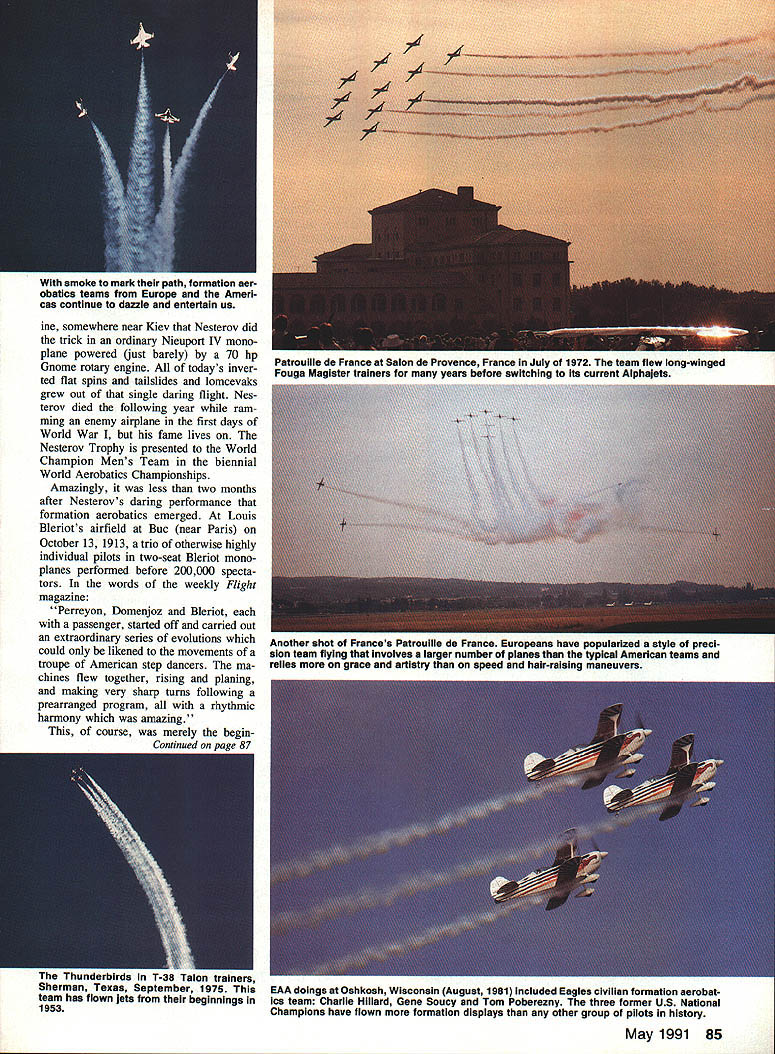
The Thunderbirds started out with jets and never looked back: F‑84 Thunderjets from 1953 to 1956, F‑100 Super Sabres from 1956 to 1968 (with a brief fling in F‑105 Thunderchiefs in 1964). In 1969 they began flying McDonnell F‑4E Phantom IIs, trading them for Northrop T‑38 Talon trainers in 1974. It was back to current fighters in the 1980s when they re‑equipped with McDonnell Douglas F‑18 Hornets.
The Navy's Blue Angels started in 1946 with Grumman F6F Hellcats, moved to F8F Bearcats in 1947 and finally equipped with jets—Grumman F9F Panthers—in 1950. Later came swept‑wing F9F Cougars and, in 1957, the Grumman F11F‑1F Tiger. In 1969 the Blue Angels adopted the McDonnell F‑4 Phantom II, which they flew until 1973 when they switched to Douglas A‑4 Skyhawk attack bombers—a major departure for any military team. The most recent change has been to the McDonnell Douglas F‑18 Hornet.
These two leading American teams set the style: a few airplanes in formations so close they're scary, roaring through grand, sweeping maneuvers. Millions of spectators around the world can attest to their appeal.
Other Styles and International Teams
There is another popular style, notably in smaller teams in Europe and Canada: larger numbers of slower, more maneuverable airplanes that rely on grace and artistry, often using several colors of smoke to accent their formations.
The Canadian Air Force Team—the Snowbirds—has become very well known in the U.S.A., thanks to performances at Oshkosh, the Reno Air Races and other major events. Flying Avro Tutor jet trainers, they combine the large groups of European formation flying with the precision and artistry of teams such as the British Red Arrows and the French Patrouille de France. Ideally, a show should have both the Snowbirds and one of the U.S. service teams for maximum contrast and entertainment value.
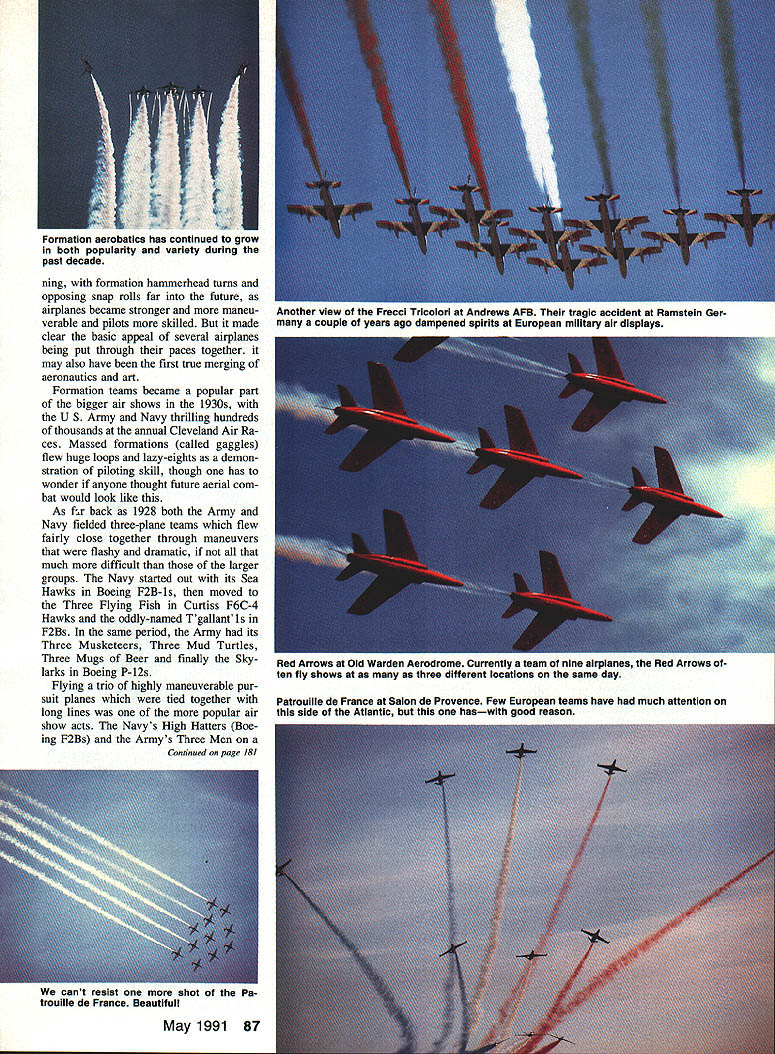
Military formation displays in Europe have long been dominated by the Red Arrows of the Royal Air Force, established in 1965 with bright red Folland Gnat trainers and later moving to red and white British Aerospace Hawk trainers in 1980. Prior to that, other RAF teams included the Black Arrows and Blue Diamonds in Hawker Hunter fighters; the Tigers and Firebirds in English Electric Lightnings; and the Red Pelicans in Jet Provost trainers.
The Red Arrows field a team of nine airplanes trailing red, white and blue smoke as they continually change formation during maneuvers with names such as "shackles and double rolls—synchro" and "big 7 (stepped down)—pass with gear synchro goose!" Because of the limited area of Great Britain it is not unusual for the Red Arrows to fly shows at as many as three different locations on the same day.
Other European teams have come and gone, but a few have developed continuity. The French Patrouille de France flew long‑winged Fouga Magister trainers for many years before switching to current Alphajets. The Italian Frecce Tricolori fly Macchi MB.339 jet trainers as a promotion for the aircraft industry, though a tragic accident at Ramstein, Germany, cast a pall over European military displays.
Civilian Formation Aerobatics
Civilian formation aerobatics is a more recent development but traces its origins far back. In the U.S.A., the first of the modern teams was the Red Devils, which emerged from the EAA in the early 1970s. By about 1972 they settled on the trio that has since flown more formation displays than any other group in history: Charlie Hillard, Gene Soucy and Tom Poberezny, all former U.S. National Champions. They flew stock red and white Pitts Special S‑1s for many years until Frank Christensen became a sponsor and they switched to his Pitts‑like Christen Eagles, becoming the Eagles Aerobatic Team.
Pitts teams have become extremely popular, with at least a half dozen performers regularly around the U.S.A. and Canada, along with others flying North American AT‑6 trainers, Stearman PT‑17s, Marchetti 260s and Van's RV‑3s. Like the European military teams, they can fly tight displays and remain in view at all times. They also cause less commotion, which pleases neighbors in these days of concern over noise pollution.
Among the best of the non‑Pitts teams is the French Connection, a pair of expatriate French pilots—Montaigne Mallet and Danny Heiligoin—who fly mirror aerobatics, with one airplane inverted just a few feet above the other. This exciting style was made popular in the 1960s by a pair of Belgian pilots who called themselves "Les Manchots" (the armless ones).
Formation aerobatics has grown steadily in popularity and variety during the past decades. Lots of different airplanes, pilots and styles—smooth and graceful, with smoke to mark their path—continue to show the aeronautically naive something of the beauty of flight. And then, of course, there were the Four Horsemen, flying not‑quite‑so‑nimble Lockheed C‑130 Hercules cargo planes, proving that even the military can have a sense of humor.
Transcribed from original scans by AI. Minor OCR errors may remain.

