
An A-J Test Pilot
By Frank D. Macy
An innovator and showman for modeling the likes of which are unparalleled—these words help describe the late, great Jim Walker. We are privileged to share a small glimpse of this man through the eyes of one of the people who worked with him.
Over the years so much has been written or rumored about the late Jim Walker that one may wonder if anything else can be said that isn't already known. In compiling the history of American Junior Aircraft and writing the Biography of Jim Walker, I've had the privilege of interviewing many people who knew him — members of his family, friends, former employees, associates, competitors, and even, as in most everyone's life, so‑called enemies. With this vast amount of information, most of which has never been published, it is certain that much will yet be written about him.
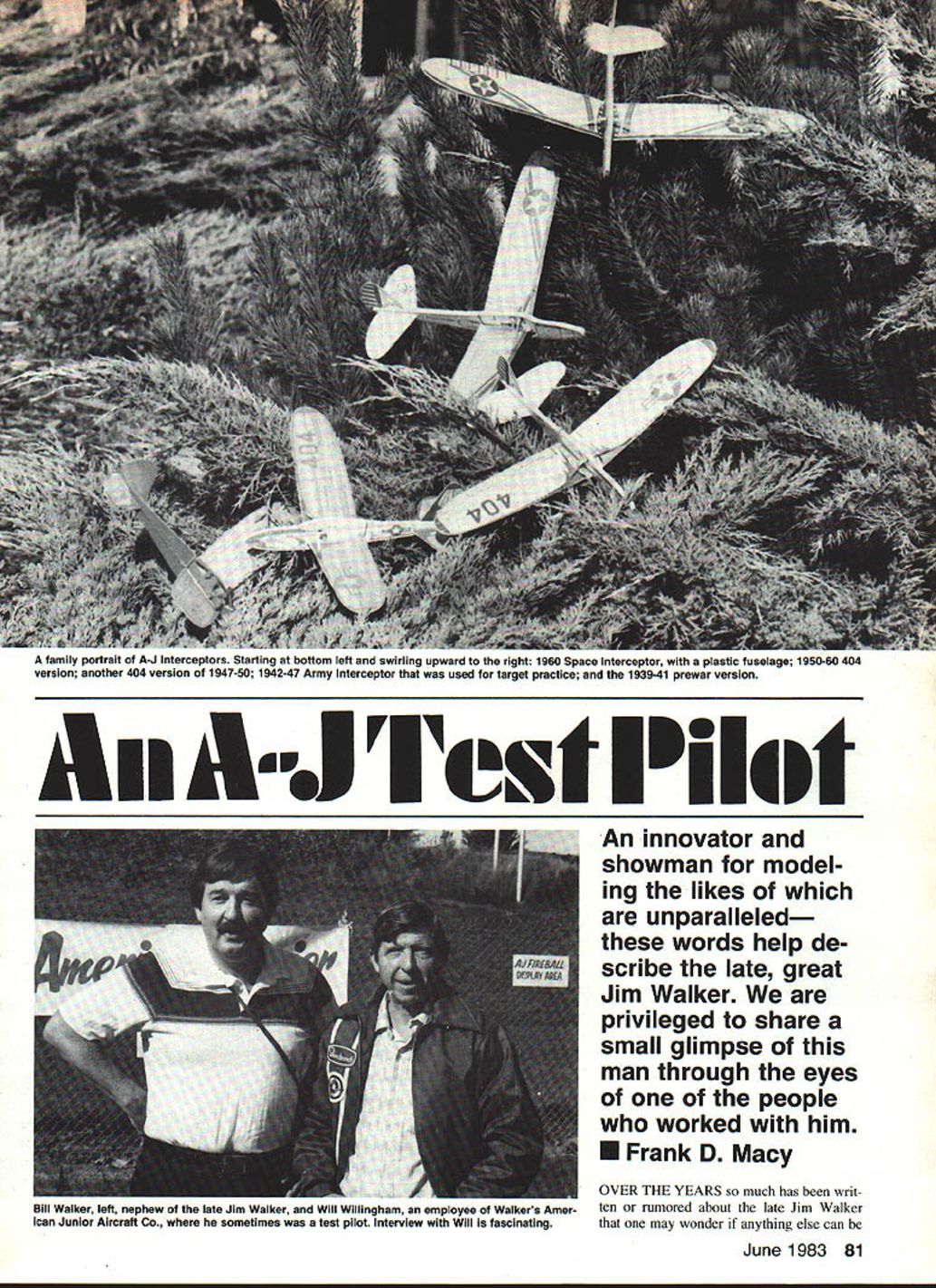
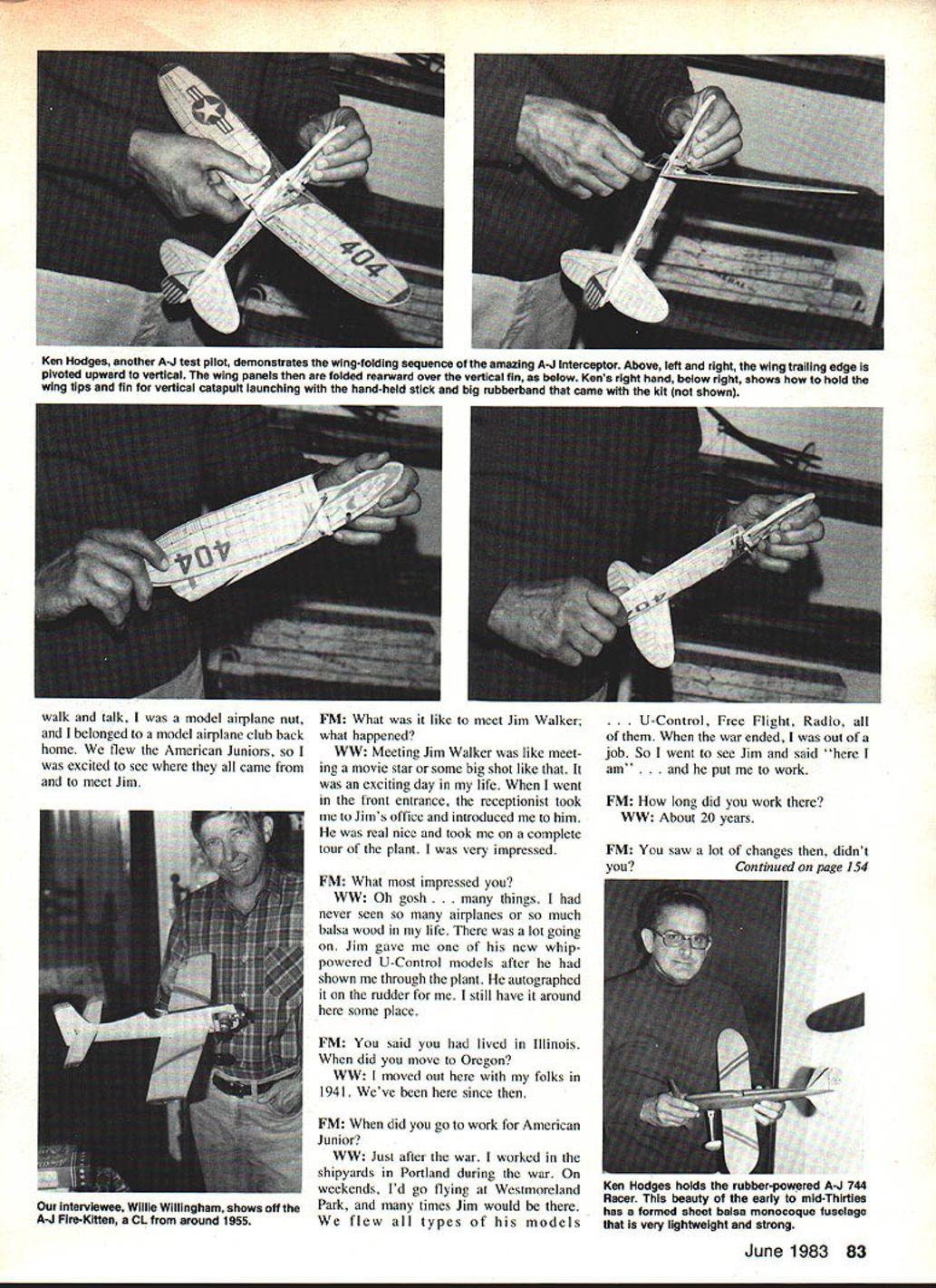
One of the marvelous things about Jim Walker's American Junior models is that they all flew very well. It didn't really matter which type you had; it would fly — sometimes too well. Perhaps the best one of all, though, was that magical folding‑wing thing called the A‑J Interceptor. Even today, articles appear in the model magazines about Jim's folding‑wing wonder, or at least make references thereto. A recent article in Model Builder magazine about the Interceptor (by Dave Thornburg) included plans for building one.
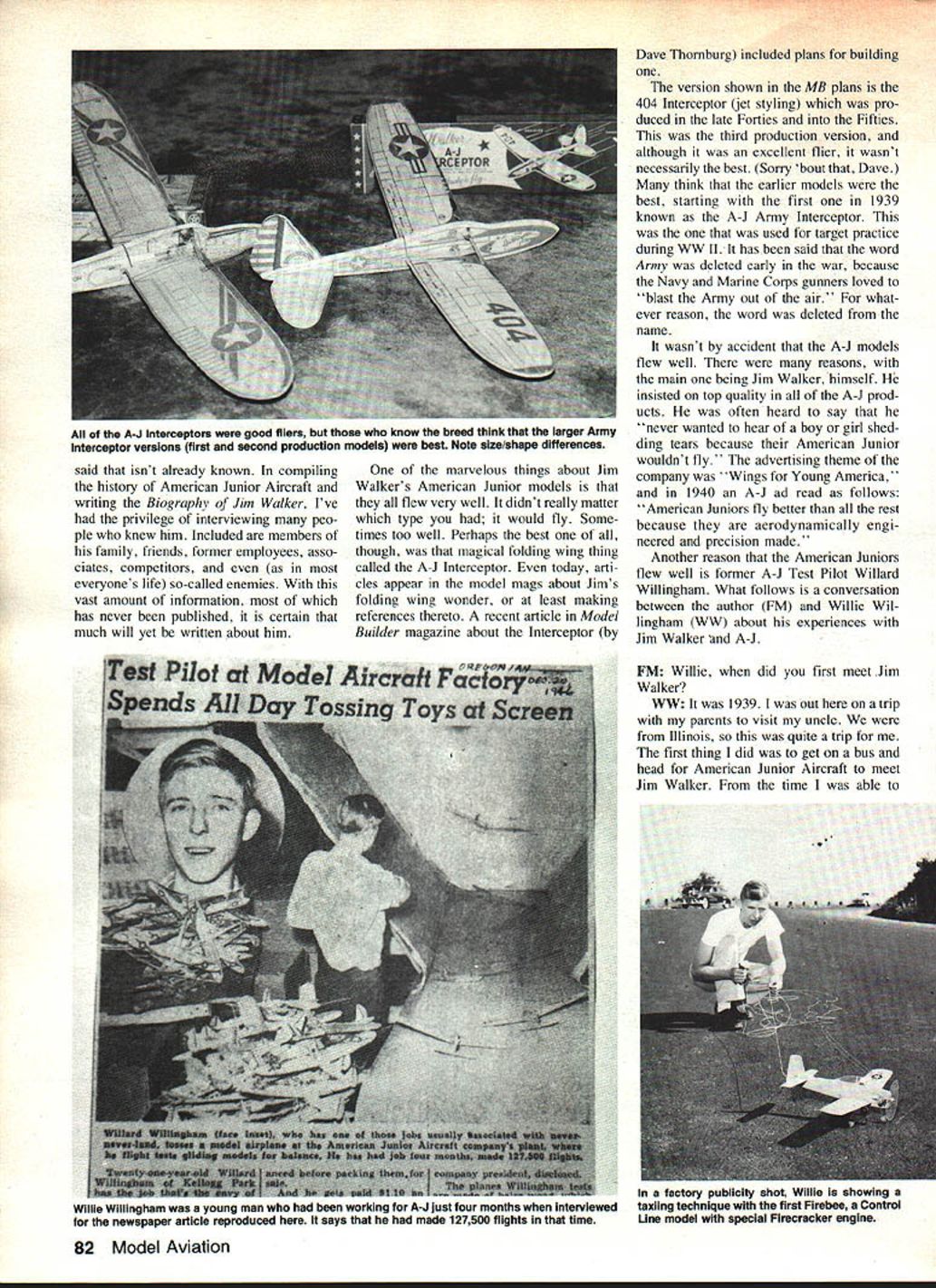
The version shown in the MB plans is the 404 Interceptor (jet styling) which was produced in the late Forties and into the Fifties. This was the third production version, and although it was an excellent flier, it wasn't necessarily the best. Many think that the earlier models were the best, starting with the first one in 1939 known as the A‑J Army Interceptor. This was the one that was used for target practice during WWII. It has been said that the word "Army" was deleted early in the war because the Navy and Marine Corps gunners loved to "blast the Army out of the air." For whatever reason, the word was deleted from the name.
It wasn't by accident that the A‑J models flew well. There were many reasons, the main one being Jim Walker himself. He insisted on top quality in all of the A‑J products. He was often heard to say that he "never wanted to hear of a boy or girl shedding tears because their American Junior wouldn't fly." The advertising theme of the company was "Wings for Young America," and in 1940 an A‑J ad read: "American Juniors fly better than all the rest because they are aerodynamically engineered and precision made."
Another reason the American Juniors flew well is former A‑J test pilot Willard Willingham. What follows is a conversation between the author (FM) and Willie Willingham (WW) about his experiences with Jim Walker and A‑J.
Conversation between Frank D. Macy (FM) and Willard "Willie" Willingham (WW)
FM: Willie, when did you first meet Jim Walker?
WW: It was 1939. I was out here on a trip with my parents to visit my uncle. We were from Illinois, so this was quite a trip for me. The first thing I did was get on a bus and head for American Junior Aircraft to meet Jim Walker. From the time I was able to walk and talk, I was a model‑airplane nut, and I belonged to a model airplane club back home. We flew the American Juniors, so I was excited to see where they all came from and to meet Jim.
FM: What was it like to meet Jim Walker; what happened?
WW: Meeting Jim Walker was like meeting a movie star or some big shot. It was an exciting day in my life. When I went in the front entrance, the receptionist took me to Jim’s office and introduced me to him. He was real nice and took me on a complete tour of the plant. I was very impressed.
FM: What most impressed you?
WW: Oh gosh… many things. I had never seen so many airplanes or so much balsa wood in my life. There was a lot going on. Jim gave me one of his new whip‑powered U‑Control models after he had shown me through the plant. He autographed it on the rudder for me. I still have it around here someplace.
FM: You said you had lived in Illinois. When did you move to Oregon?
WW: I moved out here with my folks in 1941. We’ve been here since then.
FM: When did you go to work for American Junior?
WW: Just after the war. I worked in the shipyards in Portland during the war. On weekends I’d go flying at Westmoreland Park, and many times Jim would be there. We flew all types of his models — U‑Control, free flight, radio — all of them. When the war ended, I was out of a job. So I went to see Jim and said, "Here I am," and he put me to work.
FM: How long did you work there?
WW: About 20 years.
FM: You saw a lot of changes then, didn’t you?
WW: Oh yes. Continuous changes and growth. In 1947 alone, we manufactured over nine million model airplanes. That was a big year for us.
FM: What was your first job at American Junior, Willie?
WW: I cut out the fuselage blocks for the Interceptor. This was done on the bandsaw. These blocks were first cut in the shape of a wedge. I cut them from balsa planks, usually 4 x 6 x 54 in. We used only the finest grade balsa. I cut 10 pieces and placed the wedge cut in a metal jig and cut the fuselage to shape. From there it was sliced 1/4 in. thick, 10 at a time. Then they were cut for the stab and rudder, and drilled for the wing bearing and nose weight. After that they were printed and then went to the assembly line. I also made a lot of the balsa wheels for the Hornet and Pursuit. We also used some of these wheels on the earlier models, too, like the A‑J 44.
FM: Willie, in a newspaper article in 1946 your job as an American Junior test pilot was described as a "young man's dream job." Was it?
WW: Well, it was a good job. I don't know whether it was a dream job or not, but it was a good job. It got pretty old standing out there throwing those things all day long. We'd have about six of them going at a time and it was tricky trying to remember which each did when it was flown. It took some concentration to get onto it.
FM: Will you describe the testing room or facility?
WW: It was a long conveyor belt with deep canvas sides and a canvas stop at one end. We would fly the models toward the end and they would drop to the conveyor and return to us. We always aimed for the center. If it turned to the right or left a little, it was OK; we just didn't want it to dive or stall.
FM: Were all the A‑J models tested in this manner?
WW: No, just the Interceptor. The others were flown outside.
FM: You keep saying "we." Were there other test pilots?
WW: Oh yes. We worked around the clock for a long time. There were several others. I remember Ken Hodges; he worked the swing shift mostly. I don't remember some of the other names, though.
FM: Did you have to assemble the models?
WW: No, the girls on the assembly line did this. Big boxes of them were delivered to us, assembled and ready to test fly. The first thing we did was fold the wings and let them flip open to make sure the mechanism worked properly. Then we'd test‑glide them toward the end canvas. If it flew correctly, it went into the packaging department. If it didn't, we would adjust it, trim it, and try again — up to three times. If it still didn't fly right, we destroyed the wings and recycled the rest to be fitted with new wings. We didn't have many total rejects.
FM: Did Jim personally check or test the models?
WW: Oh, you bet, and often. He'd pick them at random and test‑fly them himself. You never knew when he would do this. He did this with all the models. He was always checking the quality. He wanted everything right; he liked that.
FM: Willie, was Jim a difficult man to work for?
WW: Not for me, because I understood him. I knew what he wanted, and I think I knew him better than most. We traveled all over the country — to the Nats, shows, conventions, all over, and up into Canada. He really liked the Canadians. So you see, I got to know him very well. But once in a while we'd get on each other's nerves.
FM: Can you explain?
WW: We really got along well, but Jim was a very demanding guy, and sometimes very pushy. He wanted your attention 24 hours a day. You just can't do that with people, and finally I'd get mad and tell him so. After that he'd be OK for a long time. He just didn't realize he was so pushy and demanding. He only wanted to get things done. He always respected me for standing up to him, though, and he told me so.
FM: Why do some people say that Jim was a tyrant to work for?
WW: Probably because he'd get mad at them, or yell at them, or something. Some people never understood him or how to get along with him. He always wanted quality, and he wanted the employees to be proud and enthused, too. To some, it was just a job.
FM: You worked on many of Jim's special projects and experiments, didn't you?
WW: Yes, and there were many. A lot of them were duds, but many of them were great. He was always coming up with new ideas — not just models, but many different things. There were quite a few of us who worked on these special projects, not just me.
FM: What were some of the projects you worked on?
WW: Like I said, there were many things. I worked on all his RC ideas for planes, boats, golf carts, and lawn mowers. I worked a lot on the sonic‑controlled models and did much research at the University of Oregon on sonics and cavity resonance, which is the system we used. They flew, too, and we had a lot of fun (and problems) with different sounds. These are just a few examples. There were so many, it would be hard to list them all.
FM: Willie, this has been a special privilege for me to interview you, and I thank you for this opportunity. In closing, may I ask what kind of influence Jim Walker had on your life?
WW: He had a great influence. He opened my eyes to many things. He was a ham‑radio nut — electronics and all of it. He had a phone in his car and an electric shaver. This all impressed me, and so I, too, got into electronics. I learned the value of quality and the importance of having my own business today, and I fly my own private plane. Last year I purchased a nice sailboat, and my family and I spend a lot of time together enjoying these things. Jim Walker was a big influence in my life... a great guy and a good friend.
Transcribed from original scans by AI. Minor OCR errors may remain.

