
Jack Northrop's Metal Miracle — The ALPHA 4A
Text and drawings by Kenneth D. Wilson
One of the most innovative designers in U.S. aeronautical history, known for the Vega and the Douglas DC-1, John K. (Jack) Northrop's all-metal speedsters changed thinking in the air transport industry and opened a new era in aviation.
The Smithsonian Institution's National Air and Space Museum contains a Gallery of Air Transportation, and suspended there in midflight is one of the brightest stars of the NASM's collection: the Stearman‑Northrop Alpha 4A. Resplendently displayed in the original Transcontinental and Western Air color scheme of the 1932–35 era, the Alpha was the brainchild of John K. Northrop, whose aeronautical designs were very advanced for that period.
During 1918, Northrop was associated with the Loughead Aircraft Co. at Santa Barbara, CA, where the one‑of‑a‑kind Loughead Model S‑1 sport biplane was constructed. Many of Jack Northrop's innovations were applied to the S‑1, but due to poor business conditions Loughead closed in 1921.
By 1923 Northrop was at the Douglas Aircraft Co., assisting with the design of the World Cruiser. In 1926 he returned to the newly formed Lockheed Aircraft Co., where he revolutionized the industry by designing the highly successful all‑wood Vega series. Still wishing to experiment with his multi‑cellular structure theory of all‑metal aircraft and with interest in the flying‑wing concept, Northrop left Lockheed in 1928 and formed Avion Corp.
In 1929 William E. Boeing, founder of the Boeing Company, was serving as chairman of the board for United Aircraft and Transportation Corp. (UA&T). UA&T controlled United Air Lines, Hamilton‑Standard Propellers, Pratt & Whitney, Sikorsky, Stearman, and Vought, among others. Although Avion Corp. was solvent, finances for Northrop's creative work were sometimes lacking; with Boeing directly interested in Northrop's capabilities, Avion was absorbed into UA&T. The Northrop Aircraft Corp. emerged as a division of UA&T at United Airport, Burbank, CA, in the fall of 1929.
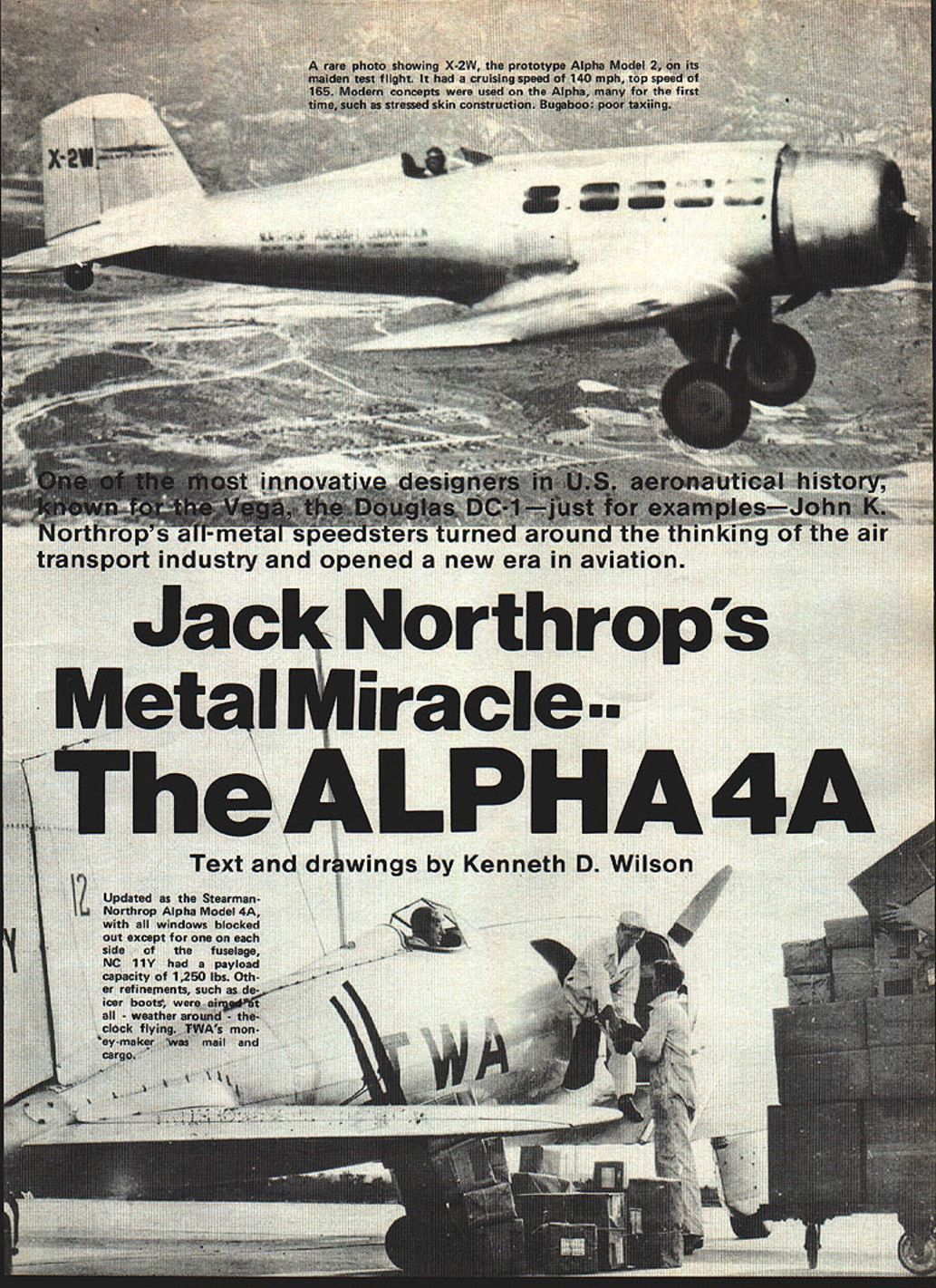
The aviation industry needed a light commercial transport, and John K. Northrop met the challenge with the Alpha. With the Pratt & Whitney 420‑hp Wasp R‑1340‑C engine throttled up, the prototype Alpha Model 2 (registration X‑2W) made its first flight from United Airport in May 1930. After exhaustive testing, the Alpha received Approved Type Certificate No. 381 on November 22, 1930.
The X‑2W was conventional aerodynamically but structurally exemplified Northrop's genius in new construction principles. Modern concepts endowed the Alpha, including the first application of ALCOA Alclad aluminum for corrosion protection in stressed‑skin construction. The wing and tail surfaces used cellular box spars for unusual torsional stiffness. The metal monocoque fuselage comprised Alclad skin with integrally formed longitudinal stiffeners and ring‑shaped bulkheads of channel cross section.
With production underway at Burbank in early 1931, the Alpha carried a flyaway factory price of $21,500 and was offered in two models: the Model 2 seated six passengers, while the Model 3 provided mail and cargo area plus seating for three passengers.
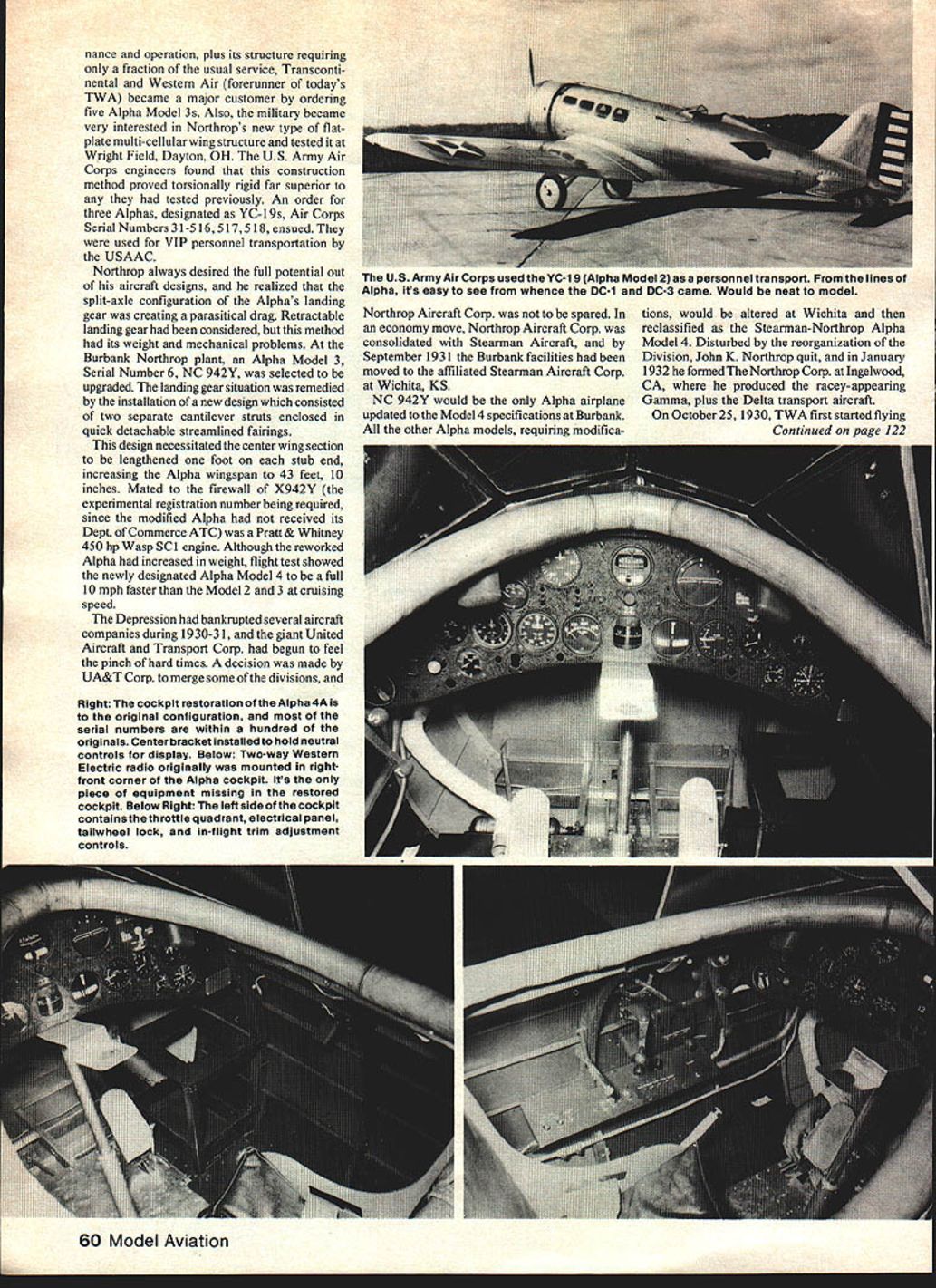
Recognizing the Alpha's economy of maintenance and operation, and that its structure required only a fraction of the usual service, Transcontinental and Western Air (forerunner of today's TWA) became a major customer, ordering five Alpha Model 3s. The military also took interest: U.S. Army Air Corps engineers at Wright Field found Northrop's flat‑plate multi‑cellular wing structure to be torsionally far more rigid than previously tested designs. An order for three Alphas, designated YC‑19s (Air Corps serials 31‑516, 31‑517, 31‑518), followed; they were used for VIP personnel transport.
Northrop wanted every advantage from his designs and realized the Alpha's split‑axle landing gear created parasitic drag. Retractable gear had weight and mechanical drawbacks, so at the Burbank plant an Alpha Model 3 (serial No. 6, NC 942Y) was selected for upgrade. The new design used two separate cantilever struts enclosed in quick‑detachable streamlined fairings. The center wing section was lengthened one foot on each stub end, increasing the wingspan to 43 ft 10 in. The modified NC 942Y was fitted with a Pratt & Whitney 450‑hp Wasp SC1 engine. Although weight increased, flight tests showed the newly designated Alpha Model 4 was 10 mph faster in cruising speed than the Model 2 and 3.
The Depression bankrupted several aircraft companies in 1930–31. UA&T consolidated divisions as an economy move, and Northrop Aircraft Corp. was merged with Stearman Aircraft. By September 1931 the Burbank facilities had been moved to the affiliated Stearman Aircraft Corp. in Wichita, KS. NC 942Y was the only Alpha updated to Model 4 specs at Burbank; other Alphas were modified at Wichita and reclassified as Stearman‑Northrop Alpha Model 4. Disturbed by the reorganization, John K. Northrop quit and in January 1932 formed The Northrop Corp. at Inglewood, CA, where he produced the sleek Gamma and the Delta transport.
On October 25, 1930, TWA began flying the new all‑air route from New York City to Los Angeles, cutting the previous 48‑hour airplane‑and‑train schedule to 36 hours (still including an overnight stop in Kansas City). With the introduction of the Alpha on April 20, 1931, coast‑to‑coast mail time dropped to 24 hours. By July 20, 1931, the airway lighting system permitted night flying. Westbound flights were made in 21 hours 40 minutes; eastbound Alpha flights, departing Los Angeles and stopping at Winslow, Albuquerque, Amarillo, Wichita, Kansas City, St. Louis, Terre Haute, Indianapolis, Columbus, Pittsburgh, Harrisburg, Philadelphia and New York, were reduced to 19 hours 19 minutes.
TWA's Alpha fleet grew to 13 aircraft, and TWA learned the real money‑maker was U.S. Mail contracts and cargo hauling—areas in which the Alpha excelled. During 1932 TWA flew all its Alphas to Wichita for further modifications at the Stearman factory. Stearman employees installed Grimes landing lights under the wings and outfitted cockpits with additional navigational aids, including Western Electric two‑way radios with long‑ and short‑range receivers. Passenger seating was removed and cargo area increased to provide for a 1,250 lb gross weight allowance.
The revamped cargo‑hauling Stearman‑Northrop Alpha, with most windows blocked out, underwent another redesignation: the Alpha Model 4A. TWA promoted the 4As for all‑weather, around‑the‑clock operations, installing the first commercial Goodrich de‑icer boots on wing and empennage leading edges to prevent ice buildup. The Alpha launched a new chapter in aviation and improved TWA's finances.
The Alphas represented a romantic, colorful, and dangerous phase of aviation. Piloting the Alphas on night mail flights "separated the men from the boys." While passenger flights waited out weather, daring airmail pilots took off into adverse conditions in the Alpha 4As because contract air mail routes were the airline's lifeblood. While TWA carried the mail, the mail carried TWA.
Alpha pilots generally flew by visual sight, using ground landmarks, city lights and airway beacons. When following a railroad, pilots flew to the right side of the tracks—there had been instances of two aircraft flying opposite directions on the same side and a head‑on collision. Flying under clouds or overcast was preferable; getting above a solid overcast presented the risk of not finding a hole to descend through at the next airport. Radio and direction‑finder reception were often unreliable due to static and interference, so pilots learned to fly by sight until radio aids improved.
Many TWA pilots had experience with Ford Tri‑Motors, Fokker F‑14s, Stearman 4Ds, Douglas M‑2s, Boeing 40‑Bs, and Lockheed Vegas, yet the fast new Alpha had its own tricks. Alphas were hard to taxi; an unlocked tailwheel plus a sudden gust could spin a 4A 360 degrees on the taxiway. Forward visibility was limited, so S‑turns were used when taxiing. Brakes could be touchy; too much pressure could stand the 4A on its nose and slam the tail down, often warping the rear fuselage.
The Alpha's single‑place cockpit did not allow an instructor aboard for checkout; a new pilot usually received advice from an experienced Alpha pilot followed by practice for day and night landings, but scheduling often prevented that. Frequently the relief pilot received only a brief explanation and then was on his own.
A total of five Alphas were lost while serving TWA; only one crash was fatal in that period. Hal George was killed when his Alpha struck a mountain near Steubenville, OH, on March 1, 1932, during a blinding snowstorm.
From October 1930 through August 1935 TWA operations logged 25,050,710 airplane miles; the TWA Alpha fleet accounted for 5,413,736 of those miles. Without the skills of Alpha pilots such as Dean Furford, Andy Andrews, Carl Noel (later killed at Kansas City in 1933), Howard "Sonny Boy" Hall, Joe Bartles, Ted Hereford, Floyd Church and many others who braved the elements in the exposed cockpit, this record could not have been achieved. Furford and Andrews both had to bail out of their aircraft within 50 miles and a few minutes of each other when icing forced them down.
The odds against these aviators are summed up by the report of Walt Seyerleh's parachute exit near Cross Forks, PA, in February 1933. The accident board cited "a combination of personnel, radio and weather failure—fatigue of the pilot due to excessive flying hours and severe icing conditions, strong gale west winds and restricted visibility."
There were heroes on the ground as well. On December 28, 1933, at Allegheny County Airport (Pittsburgh), TWA pilot J. H. "Jack" Zimmerman taxied NC992Y into service on a bitter cold clear night. Shortly after takeoff the engine quit. Zimmerman stalled and crashed while trying to return. With the plane burning and 120 gallons of gasoline aboard, Robert Totten (a U.S. weather observer) and H. A. Dugan (night operations officer) rushed to free the unconscious Zimmerman from the burning wreck. As they dragged the fuselage clear, a violent explosion rocked the airfield. Dugan and Totten received the Carnegie Medal and were honored by the Aero Club of Pittsburgh. Zimmerman later became TWA's chief pilot.
In February 1935 TWA went to an all Douglas DC‑2 fleet, and the last TWA Alpha 4A was retired on February 19, 1935; all Alphas were sold off by mid‑1935. The Alpha had made important contributions to commercial aviation and set a new standard for future transport aircraft.
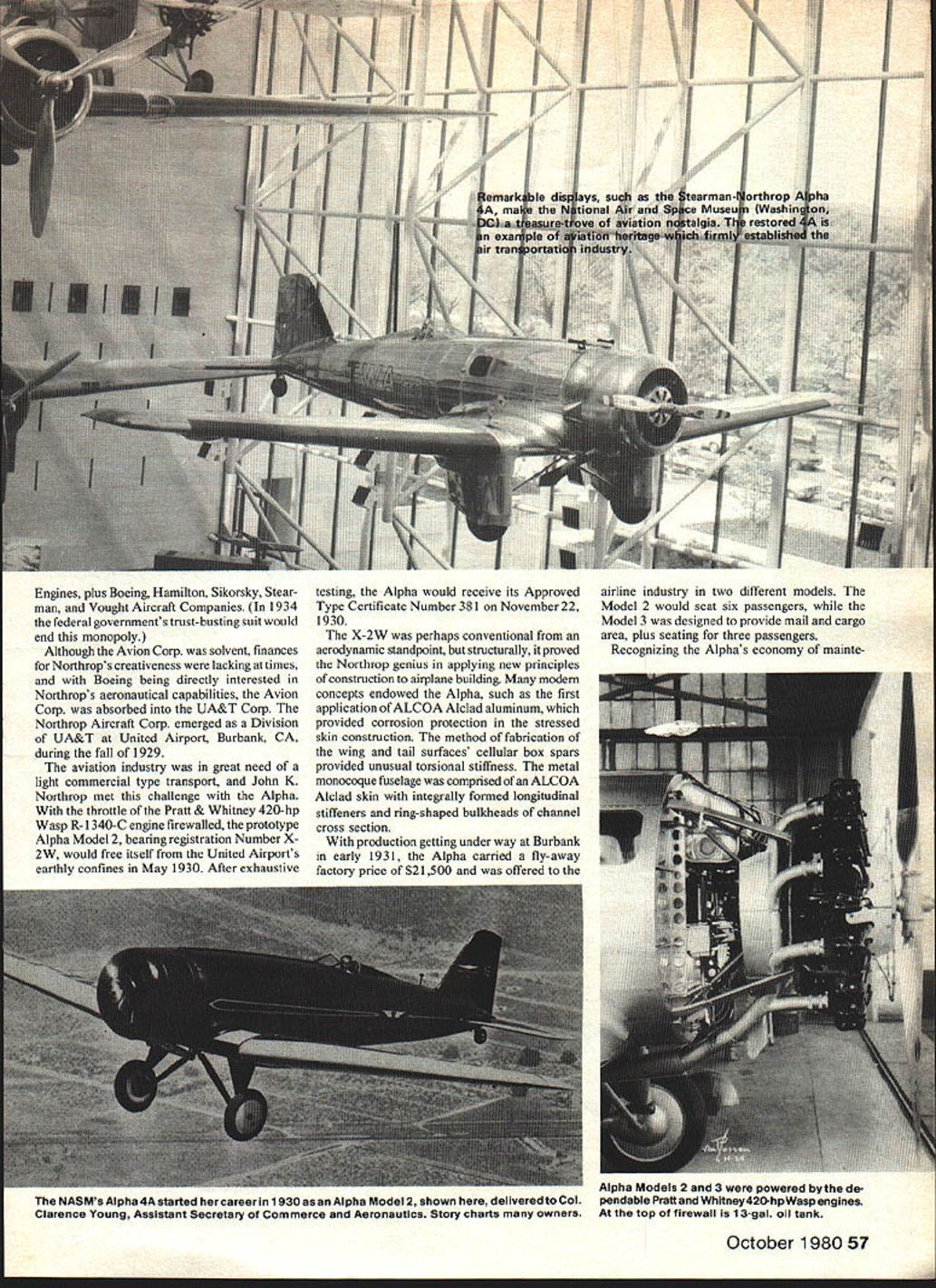
NC11Y, serial No. 3—the last Alpha of its kind—occupies a prominent display position at the NASM in Washington, DC. Among the museum's transports and mail‑haulers is the DC‑3. The similar structural design of the 4A and the DC‑3 is no coincidence: John K. Northrop served as principal design engineer for the DC‑1. Many metal‑working techniques proven on the Alpha were used on the DC‑1, forerunner of the DC‑3.
NC11Y started as an Alpha Model 2, built at Northrop Aircraft Corp., Burbank, in November 1930. Bearing registration NS‑1 and finished in sleek orange and black, Col. Clarence M. Young, Assistant Secretary of Commerce for Aeronautics, took delivery and used the Alpha for airport and airway inspections. The Ford Motor Company purchased the craft on April 16, 1931, and operated NS‑1 out of Dearborn, MI, briefly. On April 30, 1931, she was sold to National Air Transport (NAT) of Chicago, where the Model 2 received registration NC11Y.
Transcontinental and Western Air obtained NC11Y from NAT on November 27, 1931. She carried cargo for TWA until February 1932, when she was flown to the Stearman plant at Wichita for conversion to Model 4A specifications. By that time NC11Y had accumulated 1,826.38 flying hours. As a Model 4A, NC11Y shared in TWA's 24‑hour coast‑to‑coast service and its mishaps. On March 1, 1932, at Columbus, OH, a bent streamlined wheel fairing resulted from mud accumulating and freezing. NC11Y suffered delays from tire blowouts and hitting obstructions where boundary lights had been moved without notifying Alpha pilots. On March 15, 1933, TWA pilot Ted Hereford (flying TWA fleet No. 12, NC11Y) collided with a bird, which dented the wing leading edge.
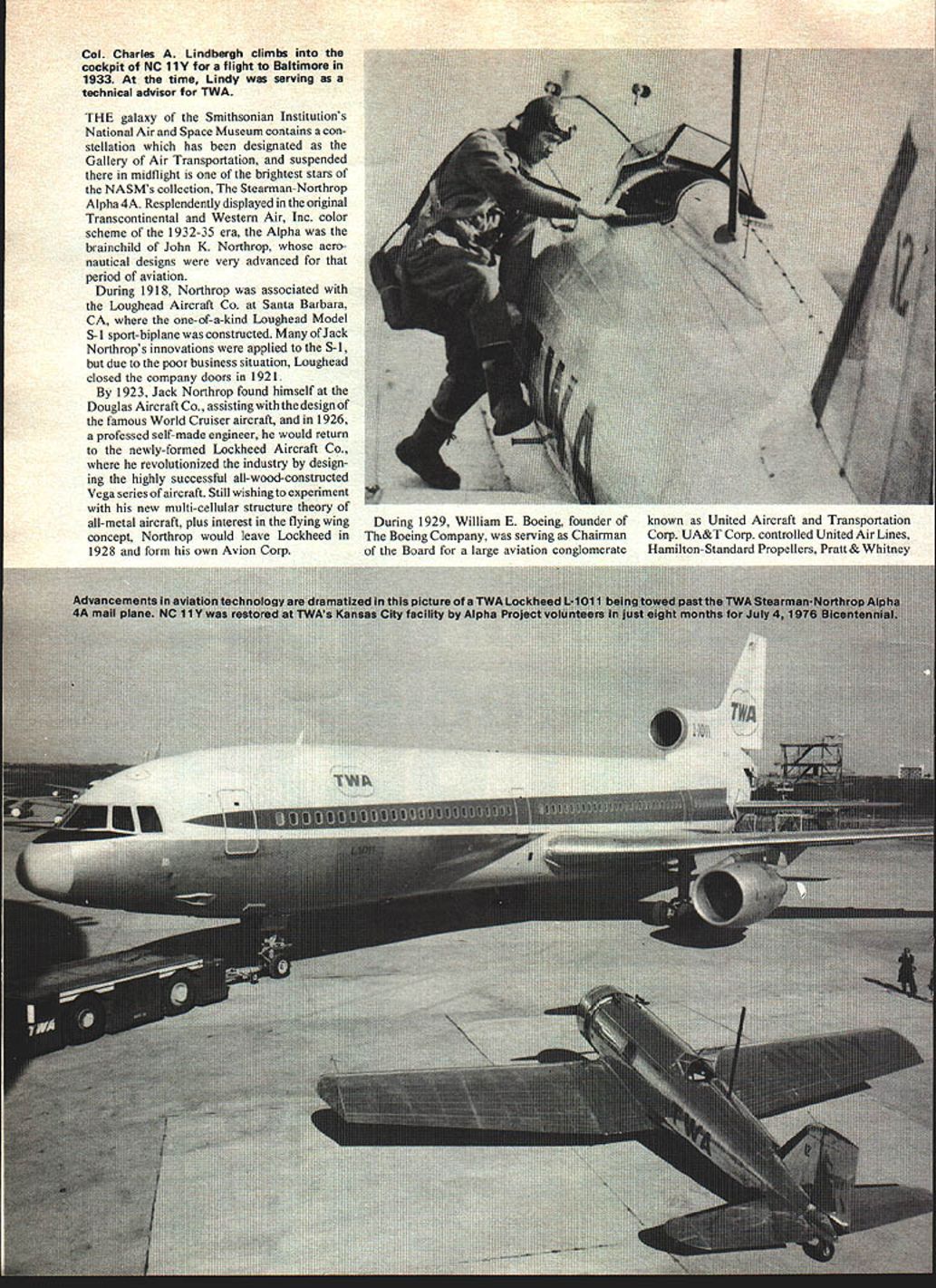
NC11Y felt the hands of fame on February 21, 1933, when Col. Charles A. Lindbergh, serving as TWA technical advisor, piloted her. Lindbergh departed Newark at 10:30 a.m., stopped at North Beach Airport (NY) to pick up Ernest R. Breech (president of General Aviation Mfg. Corp.), and after an inspection at Baltimore returned to Newark at 5:35 p.m.
Number 12 represented TWA until April 26, 1935, when she was sold to Frederick B. Lee of New York. Lee fitted NC11Y with floats hoping to fly around the world—a dream never realized. The Model 4A was converted back to a landplane. In August 1937 Harry Spaulding bought NC11Y and later sold her to Richard E. Connelly of Ridgefield, CT, in December 1937. Passing through several owners, the Alpha was acquired in May 1946 by Foster Hannaford Jr. of Winnetka, IL. Hannaford searched the country for Alpha airframes and accessories with the purpose of preserving the aircraft. He died in 1971, and NC11Y, with parts of a sister Alpha, was bequeathed to the Experimental Aircraft Association (EAA) in Hales Corners, WI.
EAA stored the Alpha assemblage at Burlington, WI. In the fall of 1974 a trade was arranged: the Model 4A for the NASM in exchange for a North American XP‑51A. The Smithsonian contacted TWA to determine if the Alpha could be saved and made presentable for the July 4, 1976 bicentennial dedication of the National Air and Space Museum.
The Alpha Project was set in motion by TWA volunteers in March 1975. The Alpha collection was gathered from EAA storage and transported to the TWA Technical Services Center in Kansas City, MO. A restoration of such magnitude normally requires two to three years; volunteer TWAers logged more than 3,500 man‑hours and completed the job in eight months.
The TWA Stearman‑Northrop Alpha 4A was unveiled publicly at TWA's 747 hangar in Kansas City on January 26, 1976, and presented to the National Air and Space Museum on February 2, 1976, as a gift to aviation history in celebration of TWA's Golden Anniversary and the U.S. Bicentennial.
Thanks to the following for invaluable assistance on the Stearman‑Northrop Alpha 4A project
- ALCOA
- Cathy Snodgrass — Public Relations
- Duane Wykoff — Public Relations
- Aviation Archives of
- Arthur J. Hall
- Thomas J. Hauck
- National Air & Space Museum
- Walter J. Boyne — Executive Officer & Curator of Aeronautics
- Don Lopez — Assistant Director of Aeronautics
- Jay P. Spender — Researcher
- E. J. Thomas — Senior Museum Technician
- Trans World Airlines
- J. W. Cosley — Director, Corporate Communications
- Dan W. McGrogan — Alpha Project Technical Coordinator
- L. Greer — J.N. Aviation
Photo credits
- Aluminum Company of America
- Joe Albanese
- Arthur J. Hall
- Mitch Mayborn
- Roy Russell
- Trans World Airlines
- Kenneth D. Wilson
Dimensional & drawing research
- Stearman Aircraft Company, Wichita, Kansas — Alpha 4A mail plane drawing by Harold Zipp, Plate DEC‑133
- Northrop Aircraft Corporation sales brochures
- Measurement of Stearman‑Northrop Alpha 4A, NC11Y, at the National Air & Space Museum, Washington, D.C.
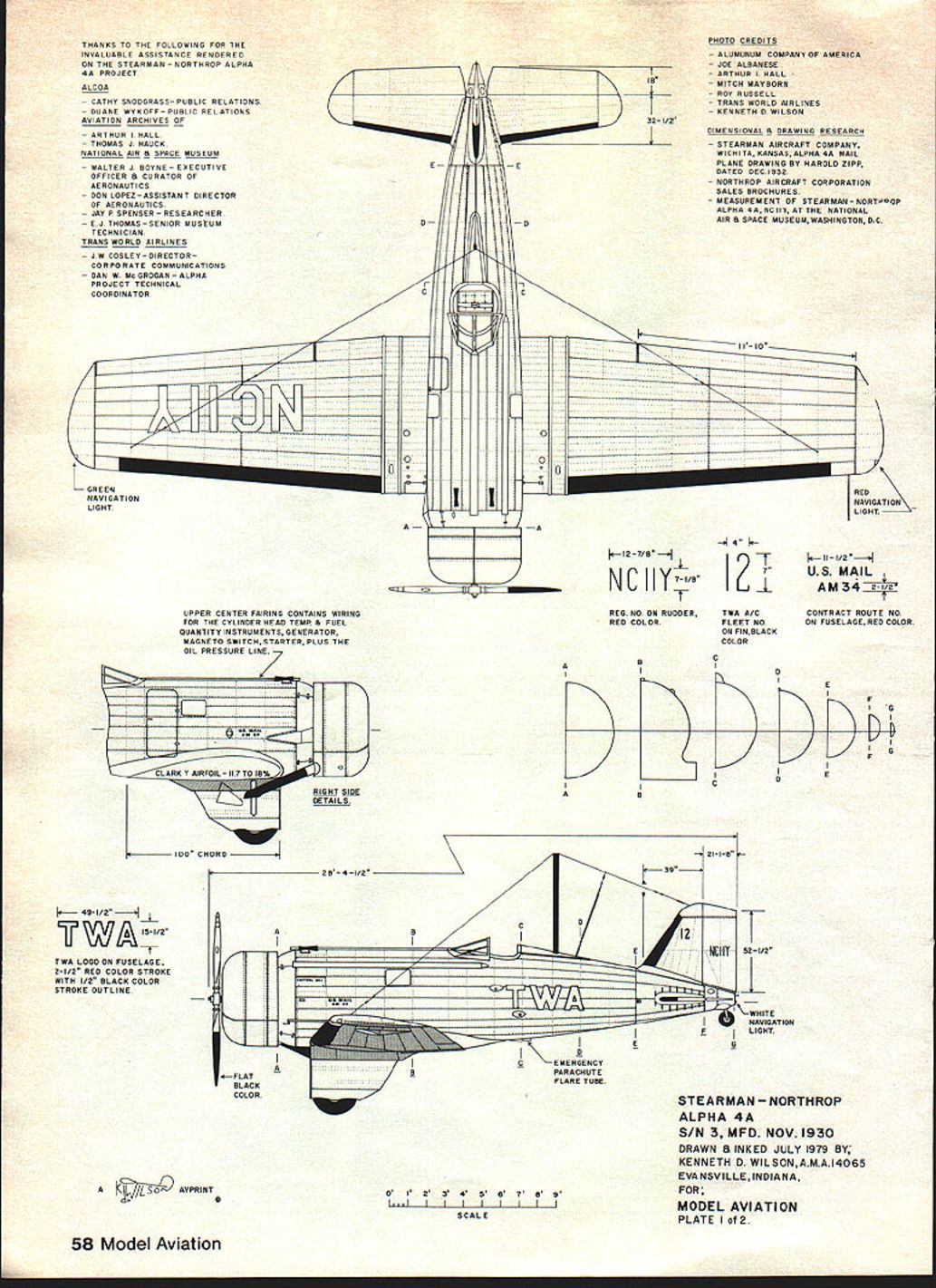
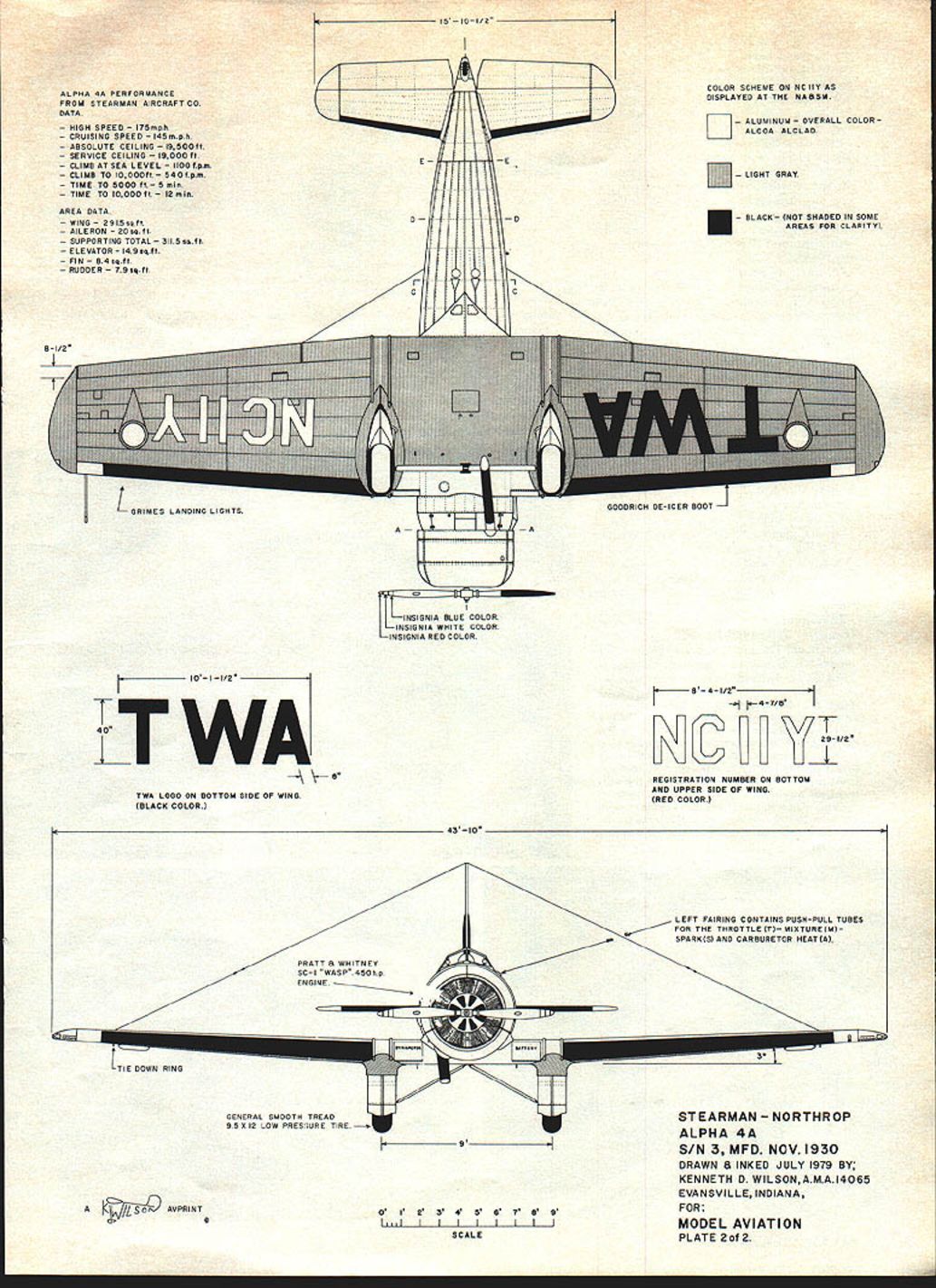
Stearman–Northrop Alpha 4A — Drawing & data
Identification
- Stearman–Northrop Alpha 4A
- S/N 3, manufactured Nov. 1930
- Drawn & inked July 1979 by Kenneth D. Wilson, A.M.A. 14065, Evansville, Indiana
- For: Model Aviation
- Plate 1 of 2; Plate 2 of 2
Alpha 4A performance (from Stearman Aircraft Co. data)
- High speed: 175 mph
- Cruising speed: 145 mph
- Absolute ceiling: 19,500 ft
- Service ceiling: 19,000 ft
- Climb at sea level: 1,000 fpm
- Climb to 10,000 ft: 540 fpm
- Time to 5,000 ft: 5 min
- Time to 10,000 ft: 12 min
Area data
- Wing: 291.55 sq. ft.
- Aileron: 20 sq. ft.
- Supporting total: 311.55 sq. ft.
- Elevator: 14.9 sq. ft.
- Fin: 8.4 sq. ft.
- Rudder: 7.9 sq. ft.
Color scheme on NC11Y as displayed at the NASM
- Aluminum overall color — ALCOA Alclad
- Light gray
- Black (not shaded in some areas for clarity)
- Insignia blue
- Insignia white
- Insignia red
- TWA logo on bottom side of wing (black)
- NC11Y registration number on bottom and upper side of wing (red)
Equipment & features
- Grimes landing lights
- Goodrich de‑icer boot
- Pratt & Whitney SC‑1 "Wasp" — 450 hp engine (on modified models)
- Tie down ring
- General smooth tread 9.5 × 12 low pressure tire
- Left fairing contains push‑pull tubes for throttle (T), mixture (M), spark (S) and carburetor heat (C)
Transcribed from original scans by AI. Minor OCR errors may remain.

