
Jammin' Jets
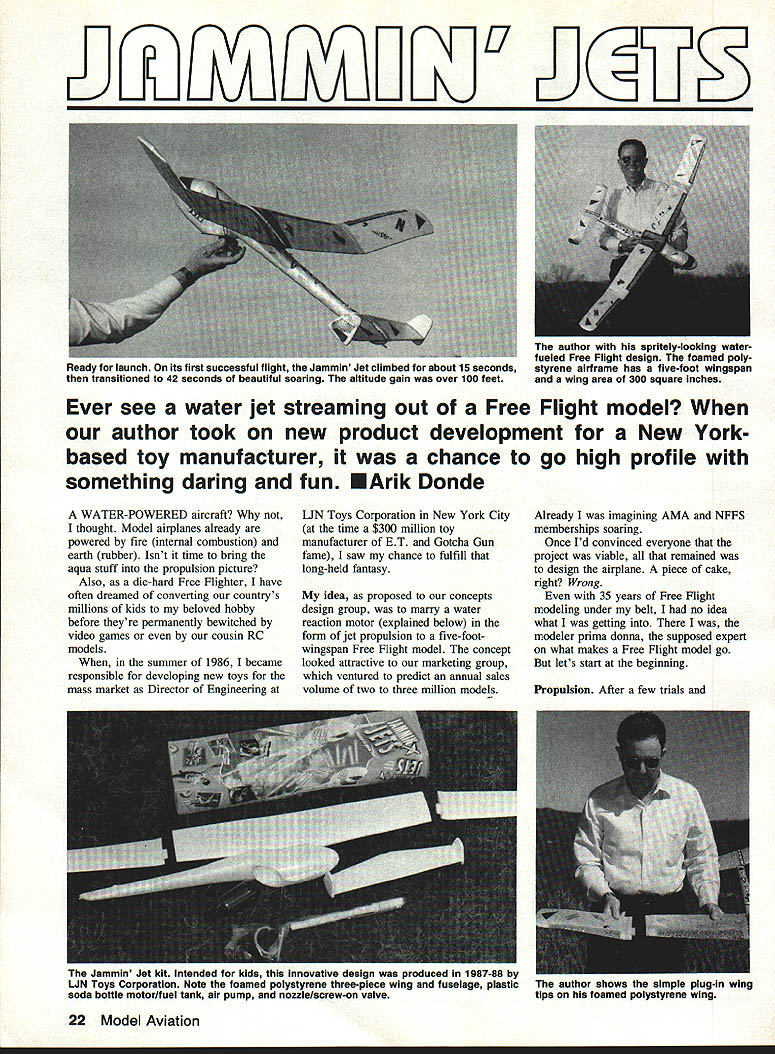
Ever see a water jet streaming out of a Free Flight model? When I took on new product development for a New York–based toy manufacturer, it was a chance to go high profile with something daring and fun.
A water-powered aircraft? Why not. Model airplanes already are powered by fire (internal combustion) and earth (rubber). Isn't it time to bring the aqua stuff into the propulsion picture?
As a die-hard Free Flighter, I had often dreamed of converting our country's millions of kids to my beloved hobby before they were permanently bewitched by video games or RC models. In the summer of 1986, as Director of Engineering at LJN Toys Corporation in New York City, I had a chance to pursue that fantasy.
My idea, proposed to our concepts design group, was to marry a water reaction motor in the form of jet propulsion to a five-foot-wingspan Free Flight model. The concept looked attractive to marketing, which predicted annual sales of two to three million models. I imagined AMA and NFFS memberships soaring.
Once I convinced everyone the project was viable, all that remained was to design the airplane. A piece of cake, right? Wrong.
Propulsion
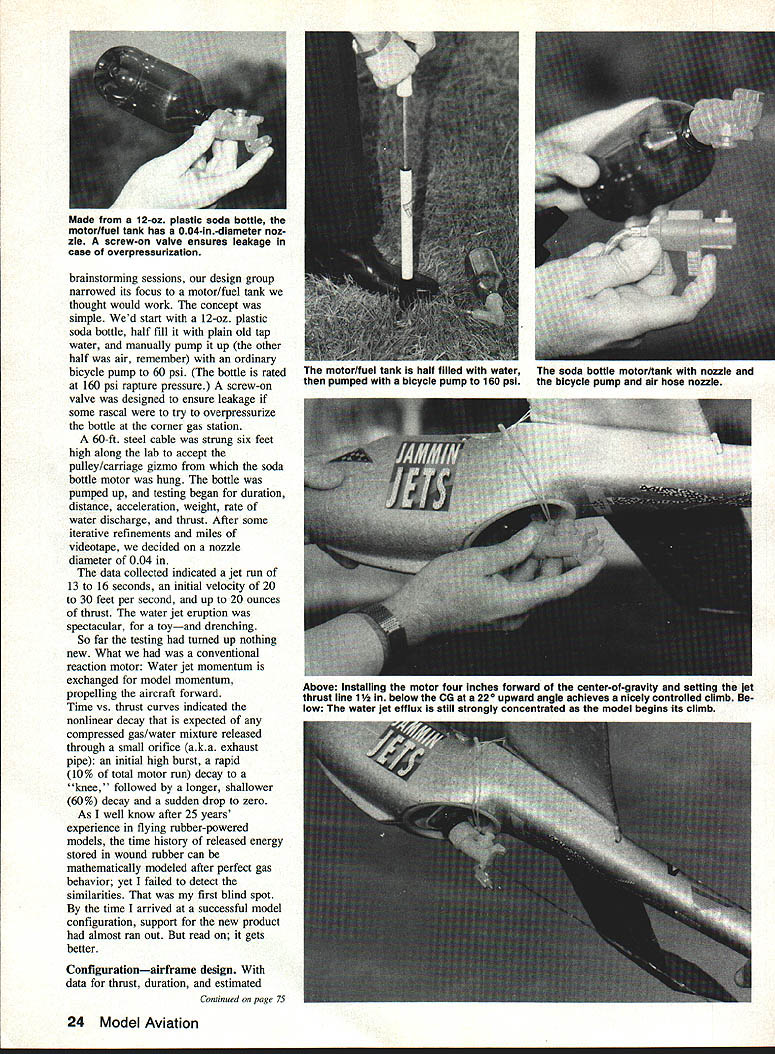
After trials and brainstorming, the design group narrowed its focus to a motor/fuel tank we thought would work. The concept was simple: start with a 12-oz plastic soda bottle, half-fill it with plain tap water, and manually pump the other half with air (an ordinary bicycle pump) to about 60 psi. The bottle was rated at 160 psi rupture pressure; a screw-on valve was designed to ensure leakage if someone tried to overpressurize it.
A 60-ft steel cable was strung six feet high along the lab to accept a pulley/carriage gizmo. The soda-bottle motor was hung, pumped up, and testing began. We measured duration, distance, acceleration, weight, rate of water discharge, and thrust. After iterative refinements and miles of videotape we decided on a nozzle diameter of .004 in.
Data indicated:
- Jet run: 13–16 seconds
- Initial velocity: 20–30 ft/s
- Peak thrust: up to 20 oz
The water-jet eruption was spectacular—and drenching. What we had was a conventional reaction motor: water-jet momentum exchanged for model momentum, propelling the aircraft forward. Time-vs.-thrust curves showed a nonlinear decay typical of a compressed gas/water mixture released through a small orifice: an initial high burst (about 10% of total motor run), a decay “knee,” a longer shallower decay (about 60%), then a sudden drop to zero.
Having flown rubber-powered models for 25 years, I tried to compare the thrust-time history to wound-rubber torque-time history (which can be modeled with perfect-gas behavior) but initially failed to detect the similarity. That was my first blind spot.
Configuration — airframe design
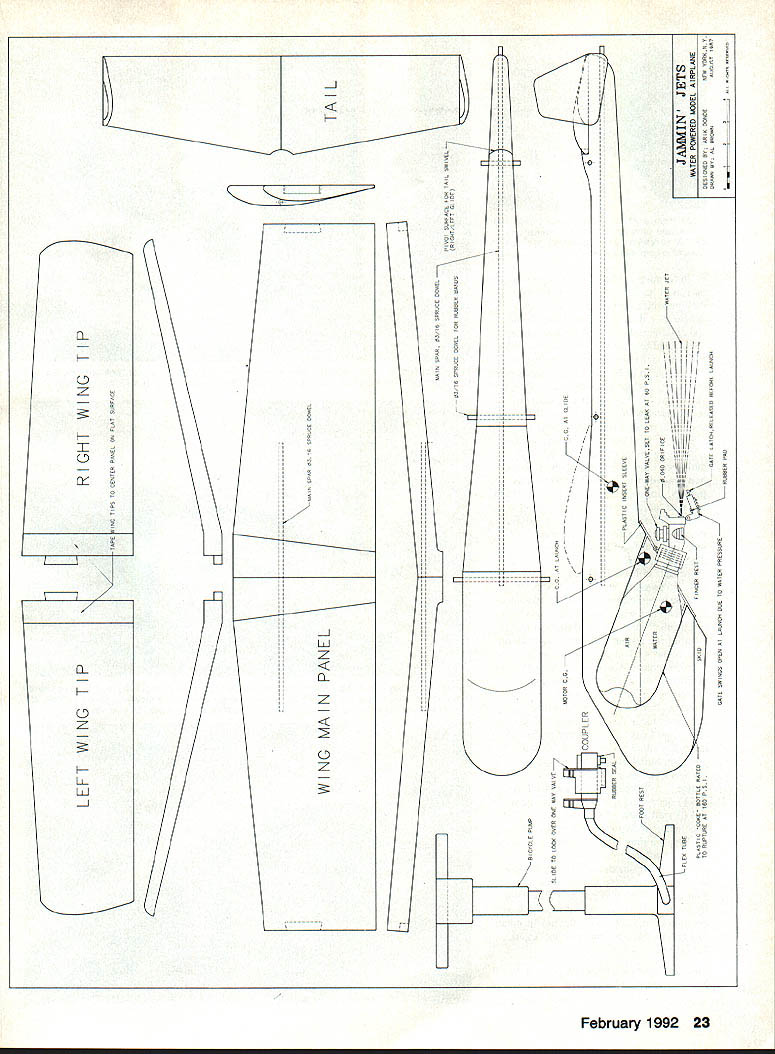
With thrust, duration, and weight data in hand, I designed an airframe that looked attractive and flyable. The fueled motor/tank weighed nearly 9 oz and available initial thrust was about 20 oz, so I made a 5-ft wingspan, 300-sq.-in. wing-area airframe from foamed polystyrene of 2-lb/cu.-ft. density (classic Unlimited Rubber style). This yielded an all-up weight of 12–14 oz. To add structural integrity and durability, we insert-molded 3/16-inch-diameter spruce dowels as main spars in the wing and fuselage.
Engine location and orientation
The next task was to install the "jet engine" (the valved soda bottle) at the correct location. The motor is also the fuel tank, and the fuel (water) would be depleted about 15 seconds after launch, shaving roughly 7 oz off the model's weight. I prioritized keeping the center of gravity (CG) stable as fuel was exhausted, since a fluctuating CG would affect trim. I initially situated the motor just under the CG, where a jettisonable auxiliary tank on a full-scale jet fighter might be located.
That reasoning was logical as far as it went—but I was still overlooking similarities with rubber models.
Failure
In late July 1987, the ad hoc flight test section of LJN headed for a public park in South Hackensack, New Jersey to test fly our aquaplane. Cameras ready, motor pumped up, surfaces checked and wind noted, I launched. Nothing. The ship went out straight, almost level, gained about 10 feet of altitude before the jet stream exhausted, then nosed down and landed. Total flight time: about 20 seconds.
We did more test flights with no better results. My worst nightmares were substantiated—the toy model was a dud. I was humbled; the aura of greatness had vanished.
Over the next two weeks we mass-produced about 20 models (hot-wire cut and sanded) and videotaped miles of disastrous flights. We sometimes caught thermals, which gave us hope, then replayed slow-motion videotapes late into the night. A faithful but jeering audience gathered at the park, waiting for the daily afternoon flops. By early August I had to either succeed and tool up for mass production for the Christmas season or scrap the project. August 15 (my birthday) was the drop-dead date.
Solution
Back at the drawing board, I reexamined the thrust graphs, weight data, and equations for elusive flaws. Was wing loading too large for available thrust, or was there simply insufficient thrust?
Finally the light bulb came on: the thrust-time history resembled wound-rubber torque-time history. If the similarity extended to trimming, the CG and moments during the power pulse needed to be treated like a rubber-powered model.
Determining a model's CG is three-dimensional: the CG must be located correctly about the pitch (lateral) axis and the roll (longitudinal) axis. Unlike a rubber motor, which releases energy but retains its weight, a water-jet motor expends both energy and weight. The conventional approach of placing the tank at the CG would not work without accounting for the changing moments as water was expelled.
The solution was to set the motor thrust line below the CG and position the motor/fuel tank forward of, rather than at, the CG. With the thrust line below the CG the model gets a nose-up pitching moment; with the motor ahead of the CG the model is nose-heavy and wants to dive. Both nose-up and nose-down moments are thus present. As the water is depleted, the nose-down moment decreases (the nose lightens), and as thrust decays the nose-up moment also lessens. If you match the rates of decay so the nose-up moment's decline lags slightly behind the nose-down moment's decline, you get a nicely controlled net climb.
After calculations and matching the graphs, I moved the motor/tank 4 inches forward of the CG and set the jet thrust line 1-1/2 inches below the CG at a 22° upward angle.
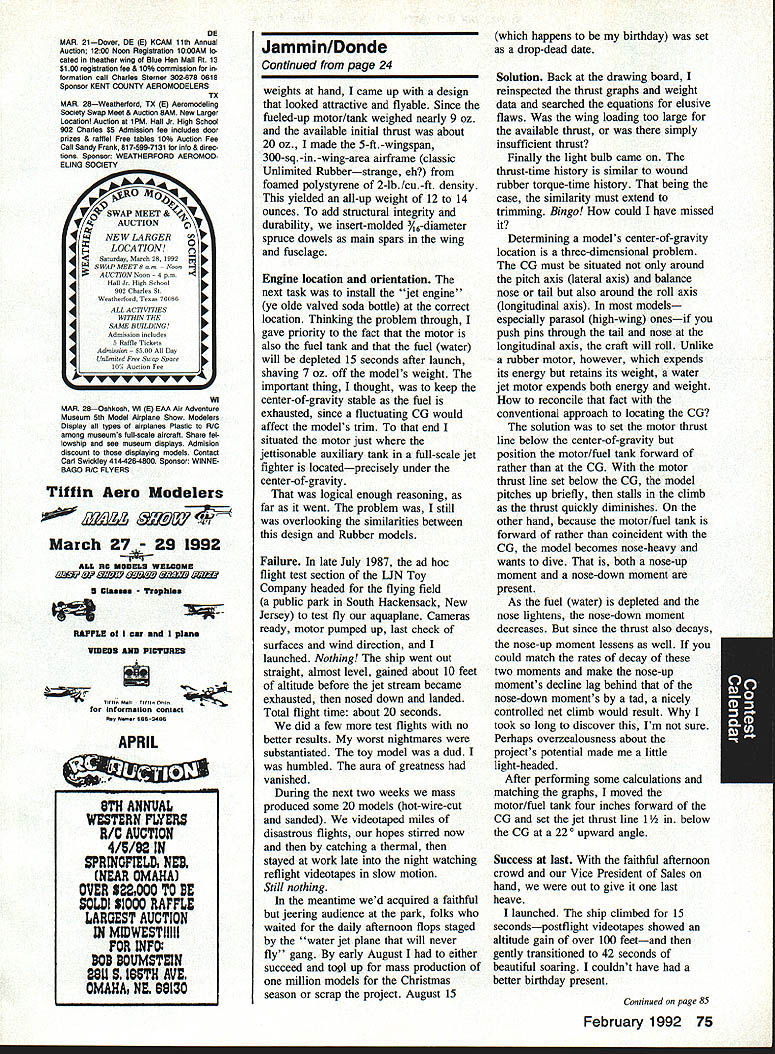
Success at last. With the afternoon crowd and our Vice President of Sales watching, I launched. The ship climbed for 15 seconds—videotape showed altitude gain of over 100 feet—and then gently transitioned to 42 seconds of beautiful soaring. It was the best birthday present I could have had.
Production
Over the next weeks the company manufactured nearly 50 models, christened Jammin' Jets by a Madison Avenue ad agency. Every engineer, technician, and salesman learned to fly them. Some novice fliers achieved durations of one to one-and-a-half minutes without thermals.
To improve the power phase, we emulated delayed prop release used in Wakefield contests, modifying the valve so the water jet does not start until after the model is launched. That way stored energy is fully utilized.
Tooling came next. Foam molding is done in cast-aluminum cavities, so a wood pattern had to be fabricated first. Fortunately, one of the master patternmakers at the assigned pattern shop was an old-time modeler, which made communication of airfoil, washout, angle of incidence, and other terms straightforward.
The happy ending
Concurrently with tooling and preparation for mass production, the company backed a children's prime-time TV ad campaign and hired the same agency that named the model to produce a 30-second commercial. A Hollywood company filmed the commercial at the Osmond Brothers studios in Provo, Utah. Our engineering group supplied models and technical support.
We built and test-flew 50 models, and enlisted Scott Crozier of Cleveland, Ohio to build two electrically powered RC airplanes with the Jammin' Jet silhouette for flybys and remote filming. The RC models were ultimately not used, but we had fun flying them.
Child actors were trained on the spot to launch Free Flight models; most learned within an hour and became so engrossed that impromptu contests were staged. Filming yielded 18,000 feet of celluloid, from which 3,000 feet were selected. Accompanied by a catchy theme song, "How High Can You Fly," the commercial showed kids flying Jammin' Jets against the Utah mountain horizon. It was beautiful, spectacular—and successful. A million and a half models were shipped the next year.
Free Flight forever.
This article is dedicated to my late, good friend Scott Crozier—Free Flight modeler, family man, professional pilot, and brave spirit. Scott left us last year.
Transcribed from original scans by AI. Minor OCR errors may remain.

