
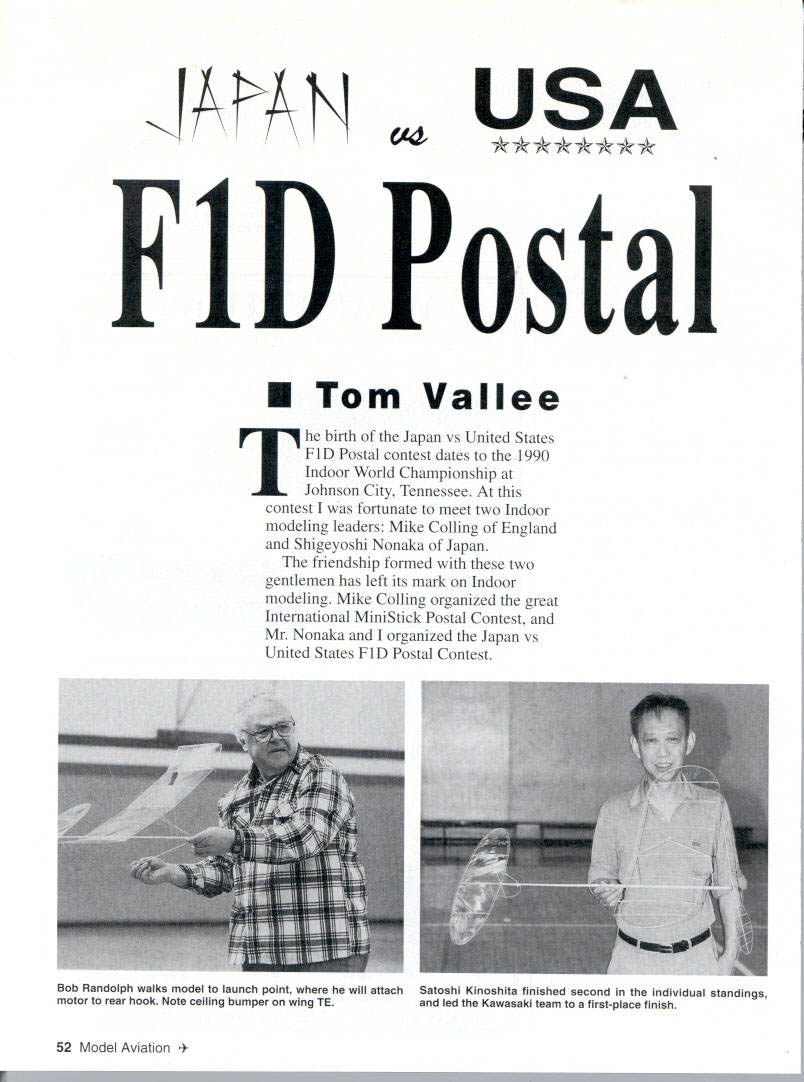
Japan vs USA F1D Postal
Tom Vallee
Background
The Japan vs United States F1D Postal contest began with the 1990 Indoor World Championship at Johnson City, Tennessee. At that contest I was fortunate to meet two indoor modeling leaders: Mike Colling of England and Shigeyoshi Nonaka of Japan.
The friendship formed with these two gentlemen has left its mark on indoor modeling. Mike Colling organized the International MiniStick Postal Contest, and Mr. Nonaka and I organized the Japan vs United States F1D Postal Contest.
F1D model specifications
The F1D model is rubber powered, with a maximum projected wingspan of 65 centimeters (25.61 inches) and a minimum weight of 1 gram (0.035 ounce). The competition is for duration, scored on the best two of six flights.
Postal rules
- Three-person teams.
- F1D models flown six rounds per FAI rules.
- Category I (eight-meter-ceiling) flying sites; no fudge factor; the best time wins.
Editor's note
In theory, a model flown under a higher ceiling will fly longer. A "fudge factor" is sometimes used in indoor contests to allow for ceiling-height differences and to level the playing/flying field. By restricting the ceiling height to Category I for this contest, no adjustment was needed.
The 1993 contest
The 1993 F1D Postal was the third contest of the series. Like the first two contests, it featured top times from some of the best modelers in each country. Consider that a little more than two years earlier, no one had made a 30-minute flight under a Category I ceiling. In the 1993 F1D Postal, six fliers posted flights of more than 30 minutes. This is remarkable and sets a new standard for low-ceiling indoor competition.
Each side of the 1993 contest was represented by three teams:
- Japan: Kawasaki, Tokyo, Toyota.
- United States: USA West Coast (team captain Bob Randolph); USA Southwest (team captain Jesse Shepherd Jr.); USA East Coast (team captain Tom Vallee).
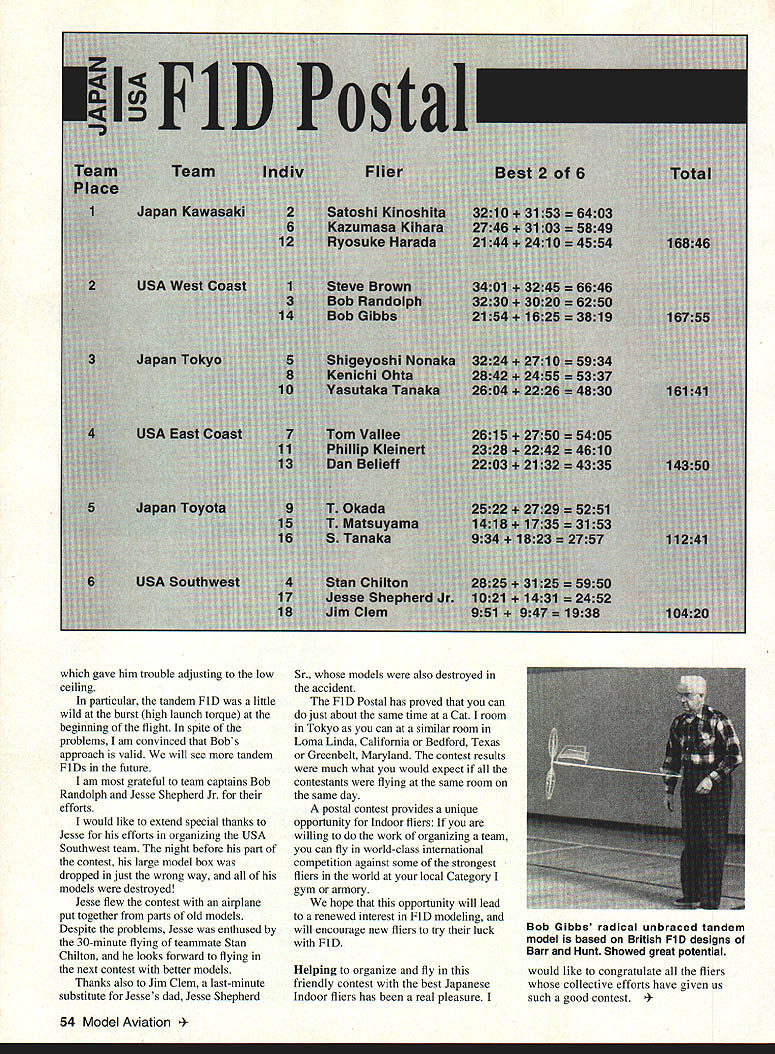
The competition was strong and very close. Fliers for both sides can be proud of their results. The Japan Kawasaki team won first place in the team standings, just 51 seconds ahead of Bob Randolph's USA West Coast team.
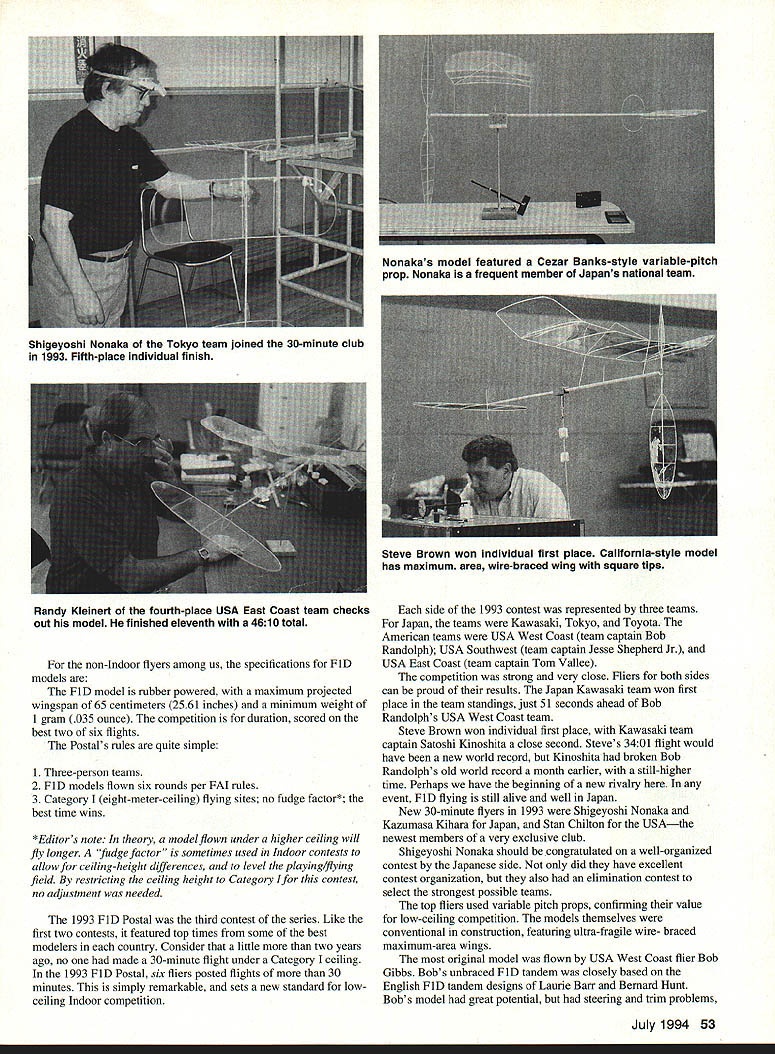
Steve Brown won individual first place, with Kawasaki team captain Satoshi Kinoshita a close second. Steve's 34:01 flight would have been a new world record, but Kinoshita had broken Bob Randolph's old world record a month earlier with a still higher time. Perhaps we have the beginning of a new rivalry here. In any event, F1D flying is still alive and well in Japan.
New 30-minute flyers in 1993 were:
- Shigeyoshi Nonaka (Japan)
- Kazumasa Kihara (Japan)
- Stan Chilton (USA)
Shigeyoshi Nonaka should be congratulated for a well-organized contest on the Japanese side. Not only did they have excellent contest organization, but they also held an elimination contest to select the strongest possible teams.
The top fliers used variable-pitch props, confirming their value for low-ceiling competition. The models themselves were conventional in construction, featuring ultra-fragile wire-braced maximum-area wings.
The most original model was flown by USA West Coast flier Bob Gibbs. Bob's unbraced F1D tandem was closely based on English F1D tandem designs of Laurie Barr and Bernard Hunt. Bob's model had great potential but suffered steering and trim problems.
I'm grateful to the team captains Bob Randolph and Jesse Shepherd Jr. for their efforts and would like to extend special thanks to Jesse for organizing the USA Southwest team. The night before part of the contest, a large model box was dropped the wrong way and models were destroyed. Jesse flew the contest airplane put together from parts of old models. Despite the problems, Jesse remained enthused. Thirty-minute flying teammate Stan Chilton looks forward to flying the next contest with better models. Thanks also to Jim Clem, a last-minute substitute, and to Jesse's dad, Jesse Shepherd Sr., whose models also were destroyed.
The F1D Postal has proved that you can achieve essentially the same times at a Category I room in Tokyo as you can in a similar room in Loma Linda, California; Bedford, Texas; or Greenbelt, Maryland. The contest results were much what you would expect if all the contestants were flying in the same room on the same day.
A postal contest provides a unique opportunity for indoor fliers: if you are willing to do the work of organizing a team, you can fly in world-class international competition against some of the strongest fliers in the world at your local Category I gym or armory.
We hope that this opportunity will lead to renewed interest in F1D modeling and will encourage new fliers to try their luck with F1D.
Helping to organize and fly in this friendly contest with the best Japanese indoor fliers has been a real pleasure. I would like to congratulate all the fliers whose collective efforts have given us such a good contest.
Transcribed from original scans by AI. Minor OCR errors may remain.

