
The Jedenastka
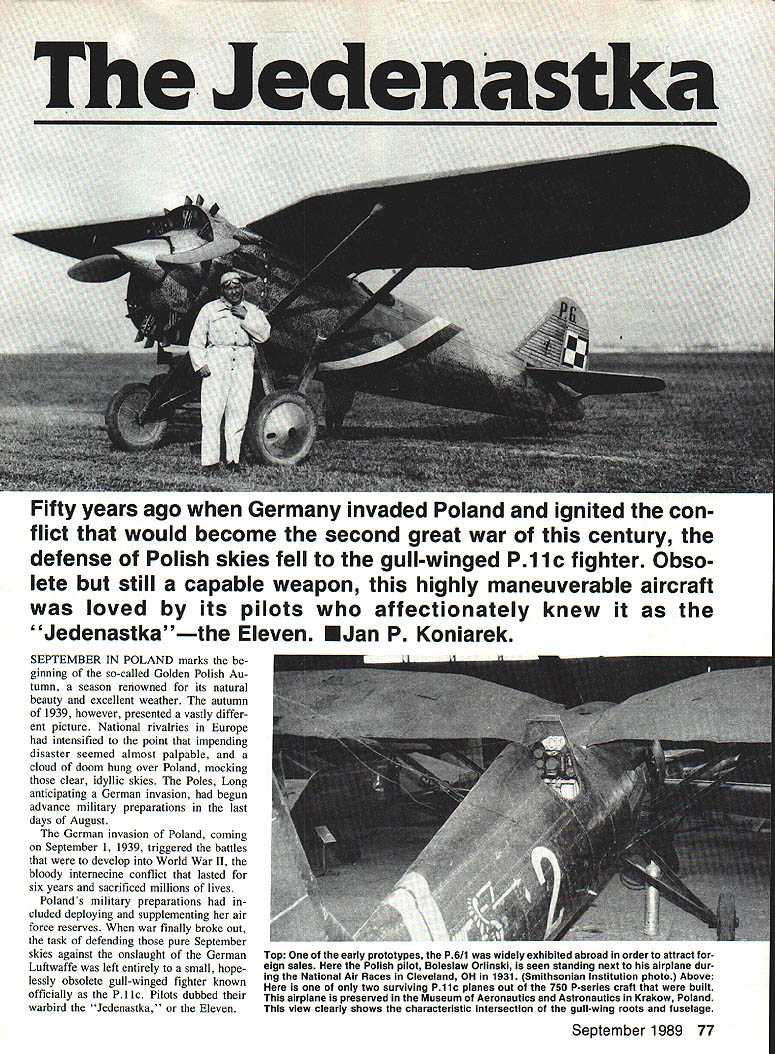
Fifty years ago, when Germany invaded Poland and ignited the conflict that would become the second great war of this century, the defense of Polish skies fell to the gull‑winged P.11c fighter. Obsolete but still a capable weapon, this highly maneuverable aircraft was loved by its pilots, who affectionately knew it as the "Jedenastka" — the Eleven.
September in Poland usually marks the beginning of the so‑called Golden Polish Autumn, a season renowned for its natural beauty and excellent weather. The autumn of 1939, however, presented a vastly different picture. National rivalries in Europe had intensified to the point that impending disaster seemed almost palpable, and a cloud of doom hung over Poland, mocking those clear, idyllic skies. The Poles, long anticipating a German invasion, had begun advance military preparations in the last days of August.
The German invasion of Poland on September 1, 1939, triggered the battles that were to develop into World War II, the bloody internecine conflict that lasted six years and sacrificed millions of lives. Poland's military preparations included deploying and supplementing her air force reserves. When war broke out, the task of defending those September skies against the onslaught of the German Luftwaffe fell largely to the small, gull‑winged P.11c.
Some 150 P.11c Jedenastkas were thrown into the opening stage of the war, later known as the September Campaign. They were supplemented by two earlier, less advanced variants — about 20 P.11a and roughly 105 P.7a aircraft. Due to obsolescence, the older types were used mainly for reconnaissance. The Polish Air Force also employed bombers and observation aircraft to support army operations, but coordination between these and the fighters was almost nonexistent in the rapidly developing chaos of the combat situation.
Opposing the Luftwaffe, Polish fighter strength was organized around ten squadrons assigned to various armies located throughout the country. In addition, five squadrons stationed around the capital formed a specially constituted Pursuit Brigade.
The P.11c in combat
Germany's design for the invasion was to destroy the Polish Air Force on the ground, striking military targets and major population centers. The invaders had not anticipated the fierceness of the Polish resistance, however.
On the initial September 1 attacks, Luftwaffe strikes concentrated south against several airfields around Kraków in the very early morning. Near one airfield, returning German bombers surprised two P.11c fighters of the 12th (or 1st) Squadron as they scrambled to reach altitude. One Jedenastka shot down a Junkers Ju‑87 dive bomber; the other, piloted by Lt. Władysław Gnys, avoided the attackers. Later that day Gnys intercepted and followed a pair of Dornier Do‑17 bombers, firing until his ammunition was exhausted; both Dorniers later crashed in the surrounding countryside. Thus, in short succession, two Jedenastkas became celebrated — the first victim and the first victor — of an air war still in its infancy.
As the day progressed the center of the air war shifted to Warsaw. The Luftwaffe carried out devastating attacks designed to break the city's will to fight. Battles over Warsaw became famous and bloody. During a week of intense fighting, the Pursuit Brigade shot down 42 German airplanes while losing 37 of its own. The vast majority of the 126 aerial victories credited to Polish forces during the September Campaign are attributed to the P.11 family.
The P.11c's lack of speed and range, compared with modern German fighters and bombers, was offset in part by superior maneuverability — a decisive advantage in many dogfights — and by the excellent training and spirit of Polish pilots. The Jedenastkas were not used exclusively for defending large cities; they were employed as fighters, ground‑attack aircraft, and reconnaissance machines across Poland.
Despite their grit, Polish air forces suffered severe losses of aircraft, spare parts, fuel, and ammunition. By mid‑September they had begun to approach extinction. Most airplanes were destroyed on the ground; some fell into German hands, and a few escaped abroad. The majority of pilots survived, and many eventually reached France and then England, where their training and experience served them well in the RAF.
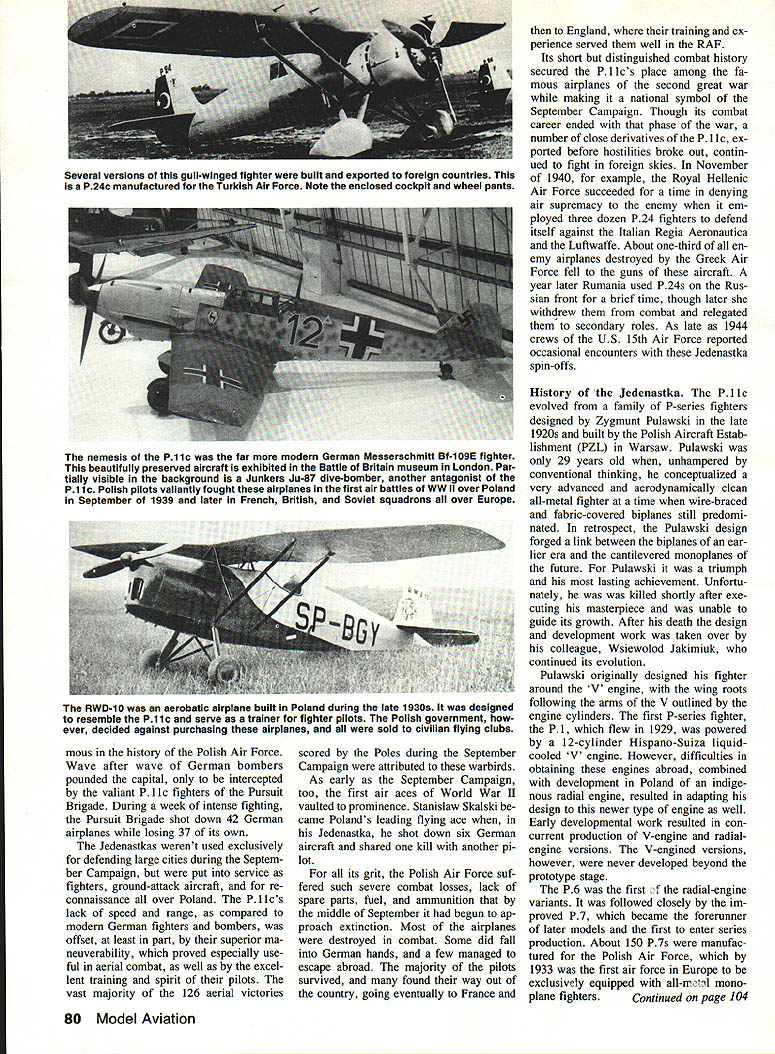
Although the P.11c's frontline combat career ended with the September Campaign, several close derivatives exported before hostilities continued to see action abroad. In November 1940, for example, the Royal Hellenic Air Force temporarily denied air superiority to its enemies by employing about three dozen P.24 fighters against the Italian Regia Aeronautica and the Luftwaffe; roughly one‑third of Greek air victories fell to these aircraft. A year later Romania used P.24s on the Russian front for a brief time before relegating them to secondary roles. As late as 1944, crews of the U.S. 15th Air Force reported occasional encounters with these P.11/P.24 spin‑offs.
Its short but distinguished combat history secured the P.11c's place among the famous airplanes of World War II and made it a national symbol of the September Campaign.
History of the Jedenastka
The P.11c evolved from a family of P‑series fighters designed by Zygmunt Puławski in the late 1920s and built by the Polish Aircraft Establishment (PZL) in Warsaw. Puławski was only 29 when, unhampered by conventional thinking, he conceptualized a very advanced and aerodynamically clean all‑metal fighter at a time when wire‑braced, fabric‑covered biplanes still predominated. In retrospect, the Puławski design forged a link between the biplanes of an earlier era and the cantilevered monoplanes of the future. For Puławski it was a triumph and his most lasting achievement. Unfortunately, he was killed shortly after completing his masterpiece and could not guide its continued development. After his death, design and development work were taken over by his colleague, Wiesław Jakimiuk.
Puławski originally designed his fighter around a "V"‑type engine, with the wings following the form of the "V" outlined by the engine cylinders. The first P‑series fighter, the P.1, which flew in 1929, was powered by a 12‑cylinder Hispano‑Suiza liquid‑cooled V engine. Difficulties in obtaining these engines abroad, combined with development in Poland of an indigenous radial engine, resulted in adopting the radial type as well. Early work produced both V‑engine and radial‑engined versions, though the V‑engined variants never progressed beyond the prototype stage.
The P.6 was the first radial‑engine variant, followed closely by the improved P.7, which became the forerunner of later models and the first to enter series production. About 150 P.7s were manufactured for the Polish Air Force, which by 1933 was the first air force in Europe to be exclusively equipped with all‑metal monoplane fighters.
The improved P.11 was developed almost in parallel with the P.7. In 1932 the P.11/I prototype was exhibited in Paris at the Salon Internationale d'Aéronautique, where its advanced design aroused considerable interest. Two other prototypes were built and entered in international contests to showcase their design and performance — and to attract foreign buyers. The P.11/III prototype participated in the U.S. National Air Races in Cleveland, Ohio, in 1932; its predecessors, the P.6/I, had taken part in 1931.
The P.11a was introduced into service in 1934 and was followed immediately by the P.11c, an updated variant with a slightly better engine and improved performance. The P.11c was chosen as the standard fighter for the Polish Air Force. Within a year, 175 were built by PZL and deployed to most fighter squadrons. Romania was the first foreign customer.
In the mid‑1930s the private manufacturer RWD designed and built a small, nimble aerobatic airplane, the RWD‑10, which somewhat resembled the P.11c in appearance and matched it in several performance aspects. Although RWD had hoped to sell the RWD‑10 as a trainer for P.11c pilots, the Polish government proved unreceptive; the roughly 30 aircraft built were instead sold to civilian flying clubs.
By the late 1930s, as tensions with Germany peaked, Poland began development of an improved P‑series variant, the P.24 Kobuz — a desperate gesture dictated by the lack of any realistic alternative that could be rapidly put into production. Only two P.24 Kobuz prototypes were built before the outbreak of war; one served in combat and shot down two German airplanes in mid‑September.
Several export versions of the P.24 (differing by suffixes and customer equipment) represented the apogee of the Puławski fighter line. At its 1933 debut the P.24 was claimed to be the fastest and best‑armed single‑seat fighter in the world. Improved performance came from more powerful radial engines (Gnome‑Rhone or Mistral‑Major, depending on customer preference) and features such as an enclosed cockpit, wheel spats, and stronger wing‑mounted armament.
These fighters attracted many foreign buyers. In the mid‑1930s Romania purchased six P.24Es and built another 15 under license. Greece and Bulgaria each bought 36 P.24s in various versions. Turkey purchased 44, assembled 20 from imported Polish kits, and built roughly three dozen more under license. Toward the end of the decade, despite the design's growing obsolescence, several other countries contemplated orders.
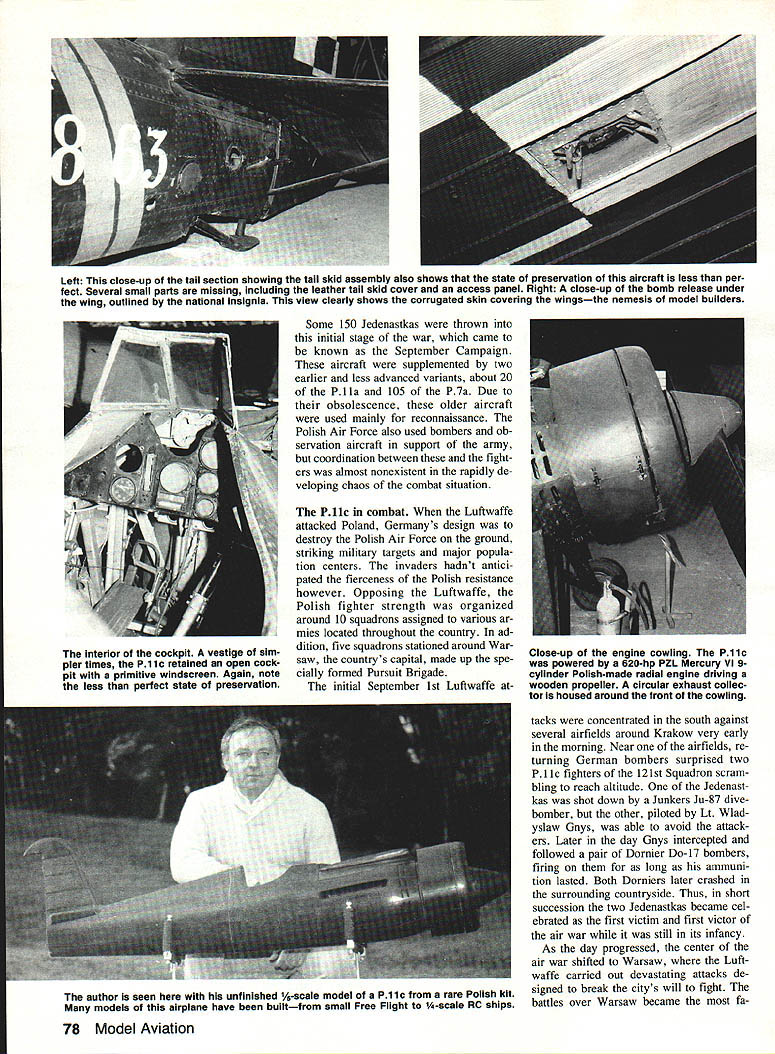
Although over 750 P‑series fighters were manufactured in total, only two survive today. One, a well‑preserved P.11c, is the prize exhibit of the Polish Museum of Aeronautics and Astronautics in Kraków. This aircraft served with the 121st Squadron during the September Campaign. Found intact by the Germans, it was sent for evaluation to the Erprobungsgruppe Rechlin test center and later displayed as a war trophy in the Armee Museum in Berlin. Near the end of the war it was recovered in northwestern Poland; after being exhibited at several locations, it ended up in Kraków, not far from where it was originally stationed.
The other survivor, a P.24G, is reportedly preserved in Turkey; its whereabouts are variously given as the Etimesgut base in Ankara or the Turkish Air Force Museum at Yeşilköy Airport in Istanbul.
Design and technical characteristics
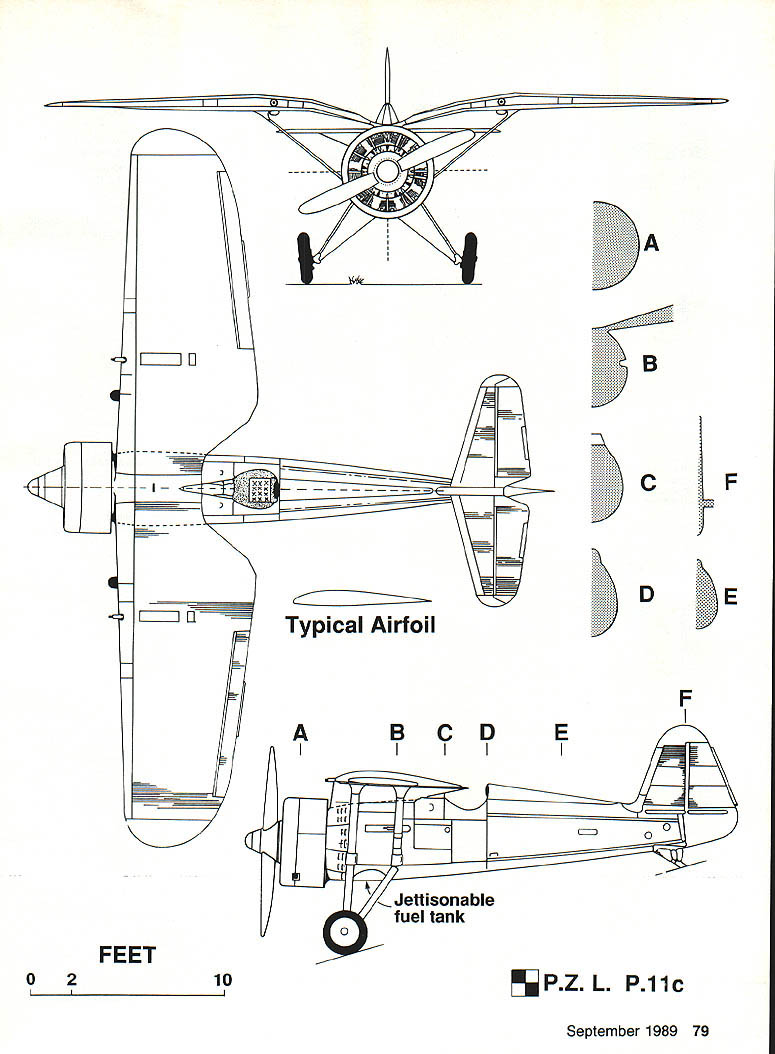
The original P.11c was an all‑metal airplane with shoulder wings that gave it a characteristic gull shape. This configuration reduced drag compared with a high‑wing monoplane and provided unobstructed forward visibility for the pilot. The idea proved sound and was widely copied in the 1930s (examples include the French Loire 45/46 and Dewoitine D.560, the German Henschel Hs 121, and the American Douglas O‑31).
The wings were roughly double‑tapered, with the widest and thickest section at the strut attachment. The inner sections sloped down and became thinner as they approached the fuselage. Wings and most of the empennage were covered with corrugated metal and incorporated long ailerons that also served as flaps.
The fuselage was oval in cross section except at the extreme front, where it was circular. The open cockpit was fully equipped with instruments (all Polish‑made apart from the compass). The fixed V‑shaped landing gear was built of profiled metal tubing; its shock absorbers were placed inside the fuselage to lower drag and protect them from dirt.
The P.11c was powered by a Polish‑built 620‑hp PZL Mercury VI nine‑cylinder radial engine driving a wooden propeller. The main fuel tank, located behind the engine, could be jettisoned in flight to reduce the danger of explosion in case of fire during combat. A small auxiliary fuel tank in the right wing near the leading edge had sufficient capacity for a safe landing if the main tank were jettisoned.
Some 40% of the P.11c fighters used during World War II were equipped with radios. With or without radios, most had radio aerials and coded paintings on the underside of their wings. Armament typically consisted of a pair of 7.7‑mm machine guns in the wings with an additional pair in the fuselage; some versions carried an extra pair in the wings.
Typical dimensions and performance:
- Wingspan: 35 ft 2 in
- Length: 24 ft 9 in
- Height: 9 ft 4 in
- Empty weight: 2,443 lb
- Top speed: about 242 mph
- Range: slightly over 500 miles
Modeling the P.11c
Several characteristics of the P.11c make it an attractive subject for modelers. As a small fighter, the prototype was very stable in flight and exceedingly maneuverable — virtues that often carry through to scale models. The rather short nose requires careful placement of the engine as far forward as possible to achieve a proper center of gravity.
A P.11c model can sport the colorful markings used by Polish squadrons in wartime service. Fighters were often painted olive green overall with blue and red undersurfaces on wings and empennage. Most bore distinctive squadron markings, from simple to elaborate, painted toward the rear of the fuselage. One of the more complex emblems was the stars, stripes, and crossed scythes of the 111th Kościuszko Squadron, a design created by the American pilot Elliott W. Chess during the Russo‑Polish war of 1919–20. This emblem was later adopted for the Hawker Hurricanes of the Polish 303 Squadron in England, the highest‑scoring squadron during the Battle of Britain; most pilots of that squadron had flown P.11c's in the September Campaign.
The red‑and‑white chequerboard national insignia on the upper wing surfaces were placed asymmetrically in an attempt to confuse enemy gunners. During the September Campaign the chequerboards and squadron markings were frequently painted over for greater camouflage.
One drawback for modelers is the corrugated skin on the wings and on the vertical and horizontal control surfaces — eight to nine corrugations that can be difficult to reproduce. For small‑scale models (less than about 1/6 scale), the corrugations can be omitted or suggested by painting without unduly sacrificing fidelity. For larger models, the corrugations must be accurately represented. One method for constructing corrugated sheeting is described by Bob and Dolly Wisch in Model Aviation (February 1989). Despite this additional work, the P.11c is an unusually eye‑catching and historically significant subject.
References
- Cynk, Jerzy B. Polish Aircraft. London: Putnam & Company Limited, 1971.
- Cynk, J.B. The P.Z.L. P.24. (Profile Publication No. 170.) Leatherhead, Surrey, England: Profile Publications, 1967.
- Cynk, J.B. and Z.A. Daktiewicz. "Poland's Greatest Fighter, P.Z.L. P.11c." Aeromodeller, June 1960. (Excellent description and detailed plans of the P.11c. These plans and a reprint of the article can also be obtained from Replaton International, 48500 McKenzie Hwy., Vida, OR 97488.)
- Franks, Norman. Aircraft Versus Aircraft: The Illustrated Story of Fighter Pilot Combat Since 1914. New York: Macmillan Publishing Company, 1986.
- Liss, Witold. The PZL P.11. (Profile Publication No. 75.) Leatherhead, Surrey, England: Profile Publications, 1966. Also reprinted in Aircraft in Profile, volume 46, Profile Publications, Windsor, England, 1966.
- Mathews, W.R. "From the 'Jedenastka' to the P.Z.L. P.24." Flying Review International, vol. 21, no. 9, May 1966, 574–576. Color diagrams of the P.11c and P.24 fighters.
- Nogoy, Chris and Larry Kruse. "Polish Fighter." Flying Models, December 1982: 24–27. Construction article and plans for a 3/4‑scale radio control model of the P.11c.
- "The Era of the Gulls: The Chronicles of the Puławski Fighter Line." Air Enthusiast 28, July–October 1985.
Transcribed from original scans by AI. Minor OCR errors may remain.

