
Jet Rally '85
Overview
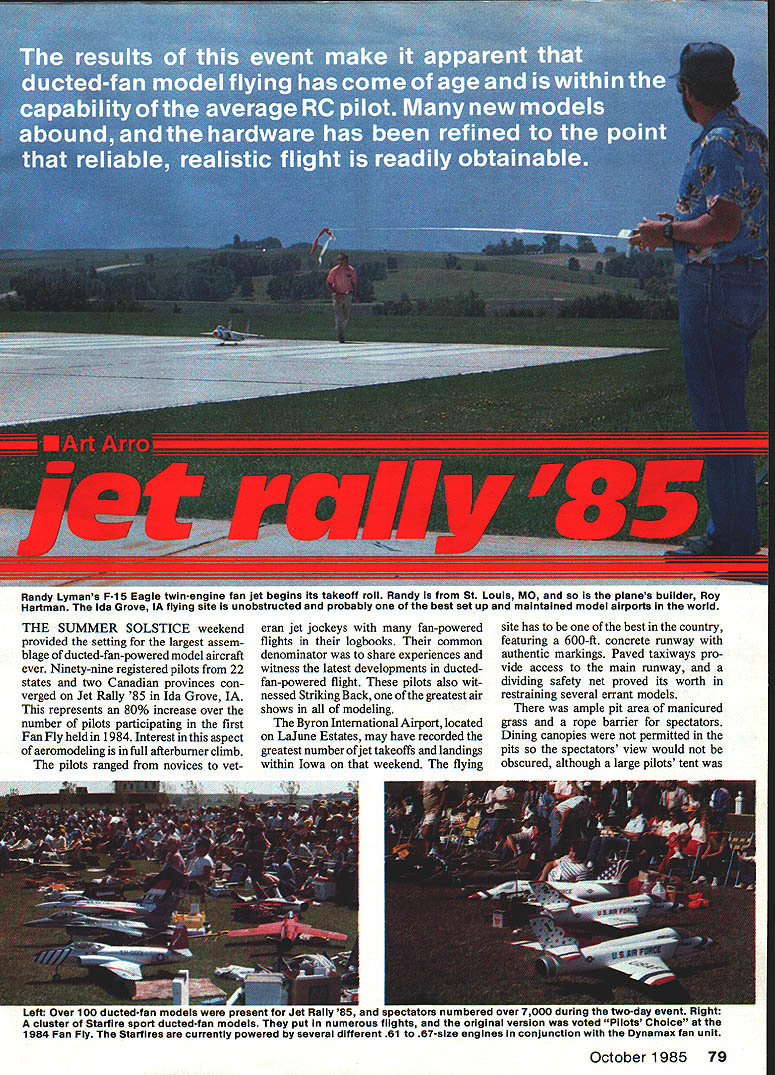
The summer solstice weekend provided the setting for the largest assemblage of ducted-fan–powered model aircraft ever. Ninety-nine registered pilots from 22 states and two Canadian provinces converged on Jet Rally '85 in Ida Grove, IA — an 80% increase over the number of pilots at the first Fan Fly held in 1984. Interest in this aspect of aeromodeling is in full afterburner climb.
Pilots ranged from novices to veteran jet jockeys with many fan-powered flights in their logbooks. Their common denominator was to share experiences and witness the latest developments in ducted-fan flight. They also witnessed Striking Back, one of the greatest air shows in modeling.
Venue and Facilities
The Byron International Airport, located on LaJune Estates, proved one of the best flying sites in the country. Features included:
- A 600-ft concrete runway with authentic markings.
- Paved taxiways and a dividing safety net that restrained several errant models.
- A large manicured grass pit area with a rope barrier for spectators (dining canopies were not permitted in the pits to avoid obscuring views).
- A large pilots' tent with power outlets for overnight charging and a well-run transmitter impound.
- Two model hangars — Byron's One-Fifth-Scale Air Force — and an instrumented control tower directing flight operations.
- A hilltop location clear of trees, power lines, and buildings, providing excellent visibility and safety for pilots and spectators.
Attendance and Registration
- Over 7,000 spectators attended, coming from many directions, including Canada, Mexico, and Venezuela, making Jet Rally '85 a first-class international affair.
- Official activities began early Saturday with pilot registration at the Byron factory in Ida Grove, about 1½ miles from the flying site. Pre-registration minimized on-site paperwork; only AMA safety-declaration requirements were completed.
- A pilots' meeting was held shortly after at the pilots' tent, presided over by Dean Copeland.
Safety Procedures
Safety was emphasized throughout:
- Flight safety procedures were explained; strict airworthiness inspections were conducted on each model slated for flight, focusing on structural and mechanical integrity.
- Each flying pilot was required to have an assistant/caller to spot for traffic and act as copilot if necessary.
- A left-hand pattern was adopted due to prevailing winds; overflying the pit area or crowds resulted in immediate grounding.
- Low-time pilots received special assistance to prevent unscheduled maneuvers.
- Several Byron staff members were continually available to coordinate safe flight conditions.
- The overall theme was to have fun while sharing the exhibition of ducted-fan flight.
Flying Activities
- Engine run-ups and preflight procedures began immediately after the 9:00 a.m. pilots' meeting. The eagerness of pilots who traveled far was evident.
- Steve Orr of East Peoria, Ill., was first airborne with his Byron F-16 model powered by a Rossi .81 engine and Byrojet fan unit; his flight was good except for minor landing-gear problems.
- The sky filled with fan-jets and their distinctive whining sound as others joined in.
- A public address system provided information on models aloft and kept spectator interest high.
- As an incentive, each registered pilot who completed a first flight received a Byrojet fan unit.
Weather
- Saturday: fair but windy, with gusts up to 25 mph. Wind direction was perpendicular to the fixed runway heading, producing tricky crosswind takeoffs and landings; several models were lost to the wind. Air temperature and density were pleasant, favorable for ducted-fan efficiency.
- Sunday: winds abated to light and variable; generally sunny skies prevailed.
- Surrounding days: severe storms impacted the region before and after the event — wind advisories, tornado warnings, and thunderstorms occurred on Friday and Sunday evenings; driving conditions were hazardous and some full-scale flights were delayed or canceled.
Competition and Speed Runs
- The low-key fan-fly format of the previous year gave way to open flying and timed speed runs.
- A radar system was replaced with manual timing and electronic processing of ground speed. A large digital scoreboard displayed each speed run in real time for pilots and spectators.
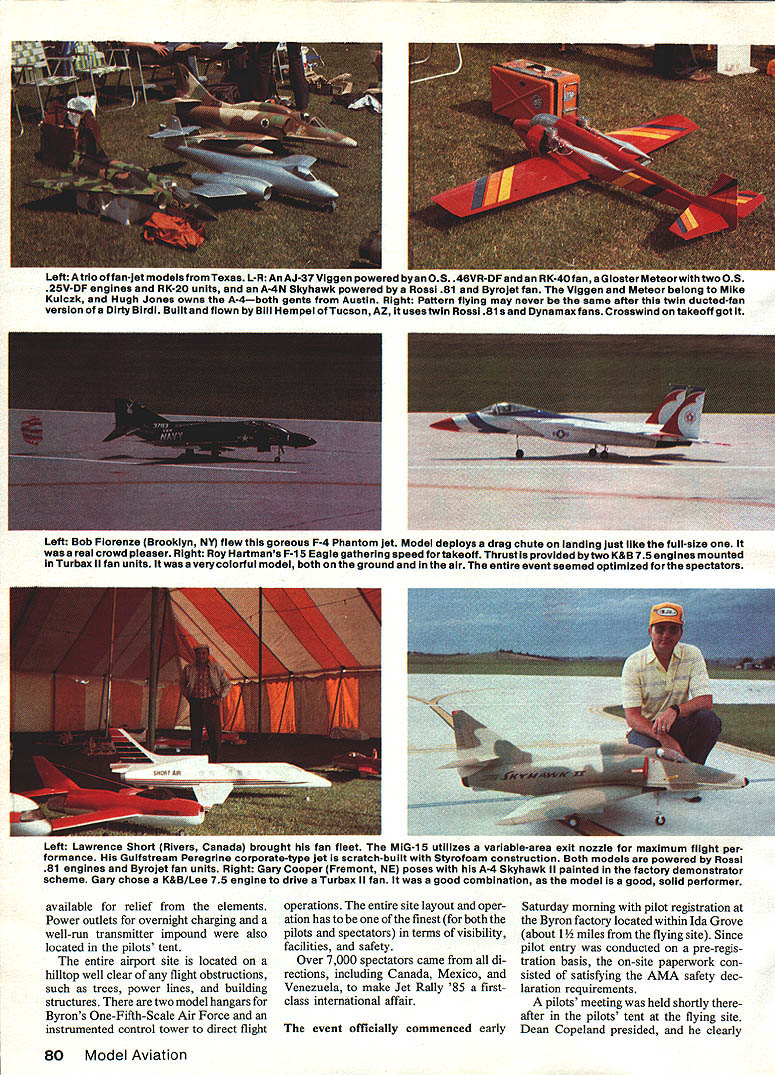
- Many passes were clocked in the 130–140 mph range. Bob Fiorenze's A-4 Skyhawk topped the field at 152 mph.
- Several Byron fan jets and Tom Cook's Starfire design exceeded 140 mph.
- For comparison, the highest speed run at the 1984 Fan Fly was 124 mph.
Demonstrations and Notable Models
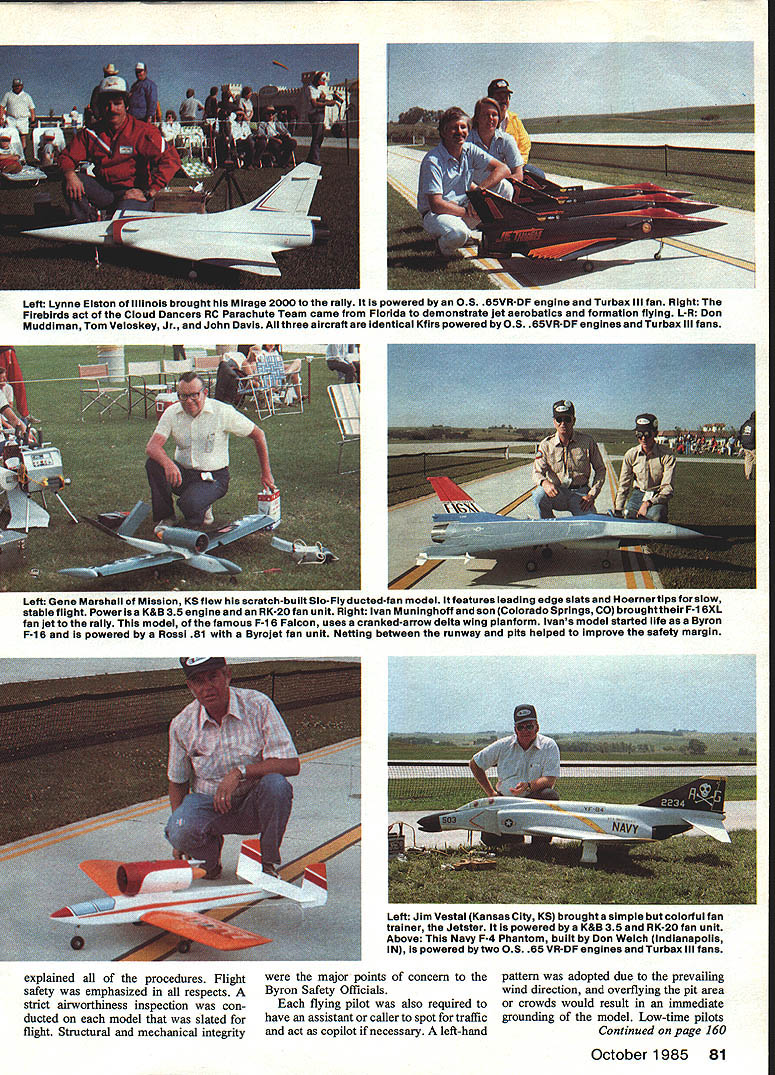
- Tom Velosky, Jr. of the Cloud Dancers Firebird Team demonstrated excellent agility in roll rate, outside loops, and knife-edge flight. Their Florida-based team performs with three identical Kfir models, each powered by the O.S. .65VR-DF engine and a Turbax III fan unit; their formation routine was impressive.
- Byron Originals unveiled new models: the F-15 Eagle twin jet and the F-20 Tigershark. Both flew during the weekend and met performance expectations; release by Byron was anticipated.
- Byron's SR-71 Blackbird was flown on Sunday after resolving previous slow-speed stability issues with a simple center-of-gravity shift.
- Kenny Sterner of Sterner Engineering (Bath, PA) performed about a dozen demonstration flights with a T-33 version of his new F-80 Shooting Star design, built for larger-displacement engines and the Byrojet fan unit. The T-33 flew well though wing-tip tanks were suggested to improve appearance.
- Bob Violett was conspicuously absent; his F-86 Sabre and Sport Shark jet (with the expected Violett fan system) were scheduled to debut later at the Greater Southwest Fan Rally.
- Many equipment suppliers attended, providing information and demonstrations — the event had the overtones of an air expo or bazaar.
Striking Back Finale
The culmination of each flying day was Striking Back, a panoramic spectacle of model action:
- Byron unveiled a Giant Scale C-47 Dakota (Gooney Bird) equipped with onboard engine starters and a full squad of paratroopers; the engine-start sequence was especially realistic.
- The C-47 was joined by 1/5-scale B-25 Mitchell bombers, a squadron of A6M5 Zero fighters, P-47 Thunderbolts, P-51 Mustangs, and an F4U Corsair.
- Manned 1/2.5-scale M-4 Sherman tanks and extensive pyrotechnics completed the extravaganza.
Conclusion and Thanks
Jet Rally '85 was an unqualified success in exhibiting ducted-fan airplanes to modelers and the public. Fan equipment is evolving into a third generation of units, and realistic jet performance is now achievable. Current developments are focused on improving operability and simplifying usage for the average R/C modeler. Ducted-fan technology has matured, as evidenced by the wide variety of models present. The future is bright, and continued events of this type will promote this dimension of R/C powered flight.
My sincere thanks are extended to Byron Godbersen and his able staff, who worked long and hard to provide the setting and hospitality for one of the most memorable events in modeling history.
If you missed this one and are interested, Jet Rally '86 has been scheduled for June 21–22, 1986 in Ida Grove, IA. Plan now to attend. I look forward to seeing you there.
Transcribed from original scans by AI. Minor OCR errors may remain.

