
Jets over DeLand 1995
Wally Zober
The Sixth Annual International Jets Over DeLand Fly-in was held January 26–29, 1995. The Golden Hawks RC Club organized another very successful event—what the British might call "a successful jet meeting." Contest Director Al Tuttle ran a tight show with his able assistant Dave Valdez. The meet drew 190 contestants and 280 models from:
- Belgium
- Canada
- England
- France
- Germany
- Norway
- Scotland
- Switzerland
- United States
The Golden Hawks use one of the finest jet model flying sites in the country: an abandoned concrete runway at the DeLand County Airport. The runway is approximately 2,000 feet long and 400 feet wide, with good takeoff and landing approaches. Other facilities included:
- A cooking area (capable of serving several thousand people per day)
- A control tower
- A PA system
- A sun shed
- Comfort stations
- Camping (no hookups)
- A chain-link fence to protect spectators from stray models
Safety was a major focus. A significant issue in the U.S. is the 400-foot altitude restriction near airports. For this event, the airport and the FAA allowed a maximum flying height of 1,200 feet, and full-scale aircraft were notified about the designated flying area. The event had no problems with full-scale traffic, demonstrating that, with cooperation and common sense, RC model airplanes and full-scale aircraft can operate compatibly.
The event was designed to bring the best jet models and pilots from around the world to compete, share ideas, and show off technology, craftsmanship, and flying skills. Official flying was to begin on Thursday, January 26, but contestants from out of state and Europe arrived as early as Tuesday, January 24 for practice. Jets were in the air at all times, with five active flight stations. Weather was favorable: partly cloudy with light winds down the runway, though occasional wind changes tested pilots' landing skills.
The most popular scale jets (standard size) included:
- F-16s
- F-86s
- Rafales
- F-18s
- A-4 Skyhawks
- MiG-29 Fulcrums
The most popular large jets included:
- T-33 (T-Birds)
- MiG-29 Fulcrums
- F-15s
- F-16s
- A-7 Corsairs
- F4D Skyrays
- A couple of F-117 Stealth fighters
There were several turbine-powered aircraft at the meet. Notable turbine types were:
- JPX-T240 (propane fuel), mostly flown by Europeans
- SWB-3 and SWB-4 turbines (kerosene)
(See Del Ellis' report on turbines at DeLand in the June 1995 issue.)
Turbine highlights
- The SWB-3 turbine powered Jeff Seymour's large Yellow Aircraft F-18. With Bob Fiorenze at the controls, it defined realism in flight.
- Bob Violett Models (BVM) rep Kent Nogy came from California to demonstrate his BVM T-33 powered by a JPX-T240. Both the T-33 and the JPX-T240 performed flawlessly.
- Tom Cook flew a JMP T-33 powered by a Jeff Seymour SWB-4 turbine. After two excellent flights, a third flight suffered an engine shutdown attempt combined with flap deployment; raw fuel passing through the turbine created steam and a lot of tailpipe smoke. The model was not on fire, and Tom landed safely, though the landing was a bit hard.
- Scotland's Donald Emery flew his Fiat G-91, powered by a JPX-T240 and finished in Italian aerobatic livery. It flew great.
After watching turbine and ducted-fan models, the author posed a question: if two models competed—one ducted fan and one turbine—how should realism of flight be scored?
Ducted-fan highlights
There were spectacular ducted-fan models at the meet:
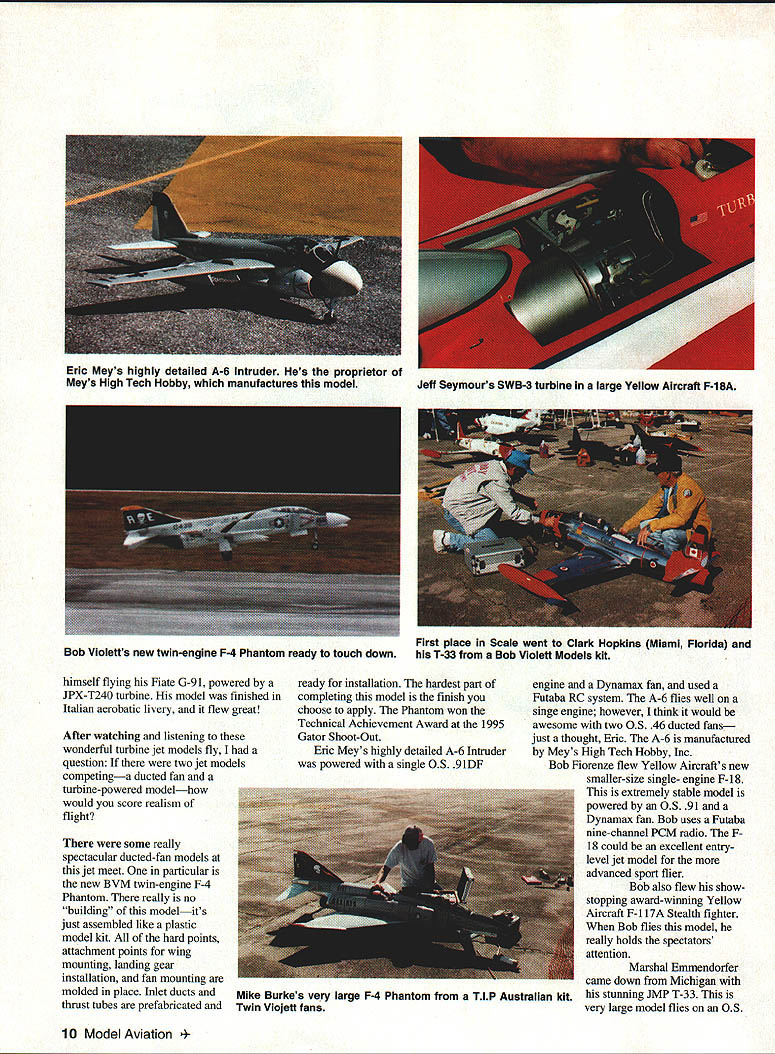
- BVM twin-engine F-4 Phantom: Highly prefabricated; assembly is like a plastic model kit. The Phantom won the Technical Achievement Award at the 1995 Gator Shoot-Out.
- Eric Mey's A-6 Intruder: Highly detailed, powered by a single O.S. .91DF engine and a Dynamax fan, using a Futaba RC system. The A-6 flies well on one engine; the author suggested it would be “awesome” with twin O.S. .46 ducted fans. The A-6 is manufactured by Mey's High Tech Hobby, Inc.
- Bob Fiorenze flew Yellow Aircraft's smaller single-engine F-18 (O.S. .91 with Dynamax fan) and his award-winning Yellow Aircraft F-117A Stealth fighter—both crowd-pleasers.
- Marshal Emmendorfer flew a large JMP T-33 built from composite materials (fiberglass, carbon fiber, and Kevlar). Powered by an O.S. .91 and Dynamax fan, the model is highly prefabricated, can accept ducted-fan or turbine power, and has a top speed around 160 mph.
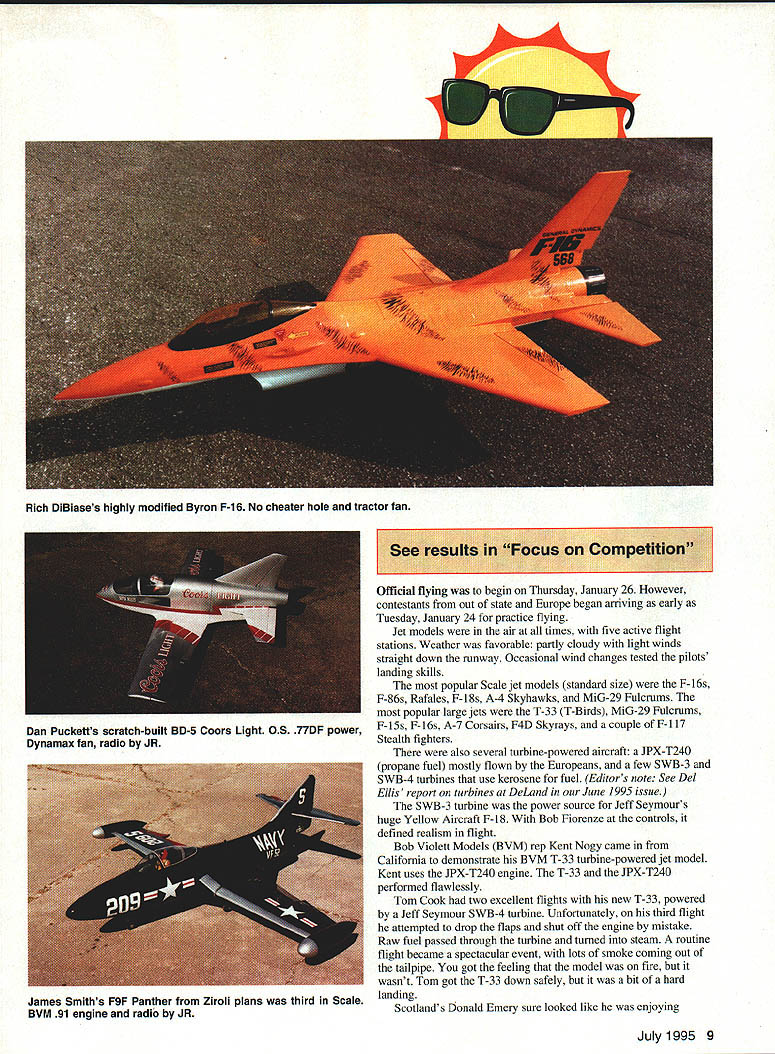
- Ralph DiBiase modified a Byron F-16 to accommodate a Dynamax fan, closing the cheater hole and adding sequential gear doors—gaining an estimated 25–30 mph.
- Peter Rutinom (Swiss team) flew a Rafale-A built from an Avonds kit, powered by an O.S. .91 and Ramtec fan.
- James Smith flew three models: a Jim Fox B.A.E. Hawk (O.S. .91, Ramtec fan, JR radio), an F-106 Delta Dart (Sickles kit, O.S. .91, Ramtec fan, JR radio, Spring Air retracts), and an F9F Panther (Ziroli plans, BVM-91 engine, JR radio). All finished with acrylic enamel and clear coat.
- Reco Compos (Miami) showed a new, smaller F-18 sport jet with a composite/honeycomb fuselage. Reco claims assembly and flight readiness in fourteen hours—an example of highly prefabricated kits aimed at a new generation who prefer flying to building.
- Roger Shipley brought a bright red BVM T-33 with onboard ignition, air gauge, inflight mixture control, a BVM-91 engine, Violett fan, and JR radio. He also had a BVM Viper and a BVM F-86.
- Terry (BVM representative) showed BVM models including an F-16, a Maverick, and the Ultra Viper (BVM-91 engines, retracts, Violett fans, JR radios).
- Dave Ribbice (Great Planes design engineer) brought a unique MiG-15 electric-powered jet able to take off without hand launch and fly about six minutes (Futaba radio).
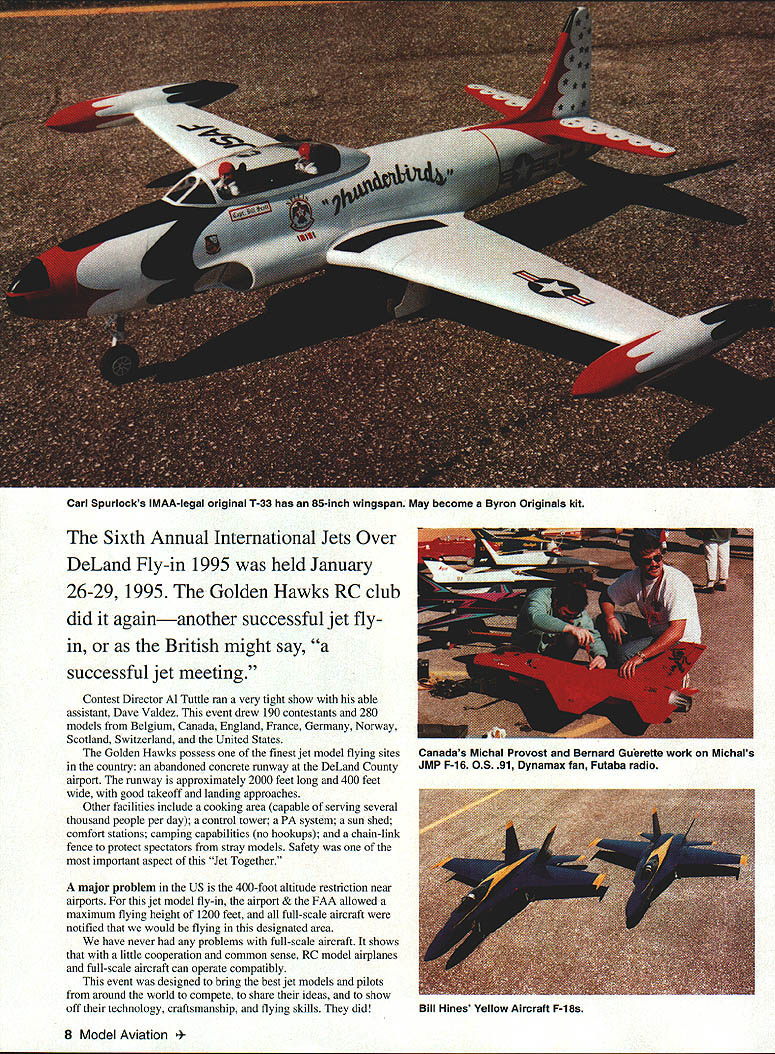
- Carl Spurlock arrived with several jets: a Byron F-16, a scratch-built A-7 Corsair, an F-20, and an original-design T-33 that Byron Originals is considering kitting. All used Byron fans, O.S. .91 engines, and Airtronics radios.
- Jeff Foley flew a Jet Model Products T-33 modeled after the 48th Fighter Interceptor Squadron. The T-33 has an 85-inch wingspan, weighs 24 pounds, and uses a Dynamax fan with an O.S. .91 and JR RC system.
- Rei Gonzalez and Louis Ontiveros brought several Yellow Aircraft Skyhawks, Rafales, and a Byron Originals MiG-15.
- Ralf Stumpf (Germany) flew a large F-15 (Schleicher kit) powered by two O.S. .91s with Gleichauf fans and a Futaba radio.
- Scott Stauffer entered a BPM Regal Eagle (Parkinson Eagle) with a Byron fan and a K&B .82 DF engine, flown with a JR radio.
- Mike Cherry (editor, Jet Model International) flew a Phillip Avonds F-15 powered by the K&B 100 engine (flown with a JR radio).
- Frank Tiano flew a colorful BVM F-86 powered by a BVM-82 engine and Violett fan (Airtronics radio).
- Dan Puckett flew a BD-5 Coors Light (Applebaum Production semikit) with a Violett fan and K&B .82 engine. Wingspan: 48 inches; fuselage length: 56 inches; weight: 12 lb.
- Paul Hopkins flew a neat Rafale-A powered by a BVM-91 engine with a Violett fan and JR radio. Covered with 21st Century material, clear coated, and decorated with Dry-Set markings.
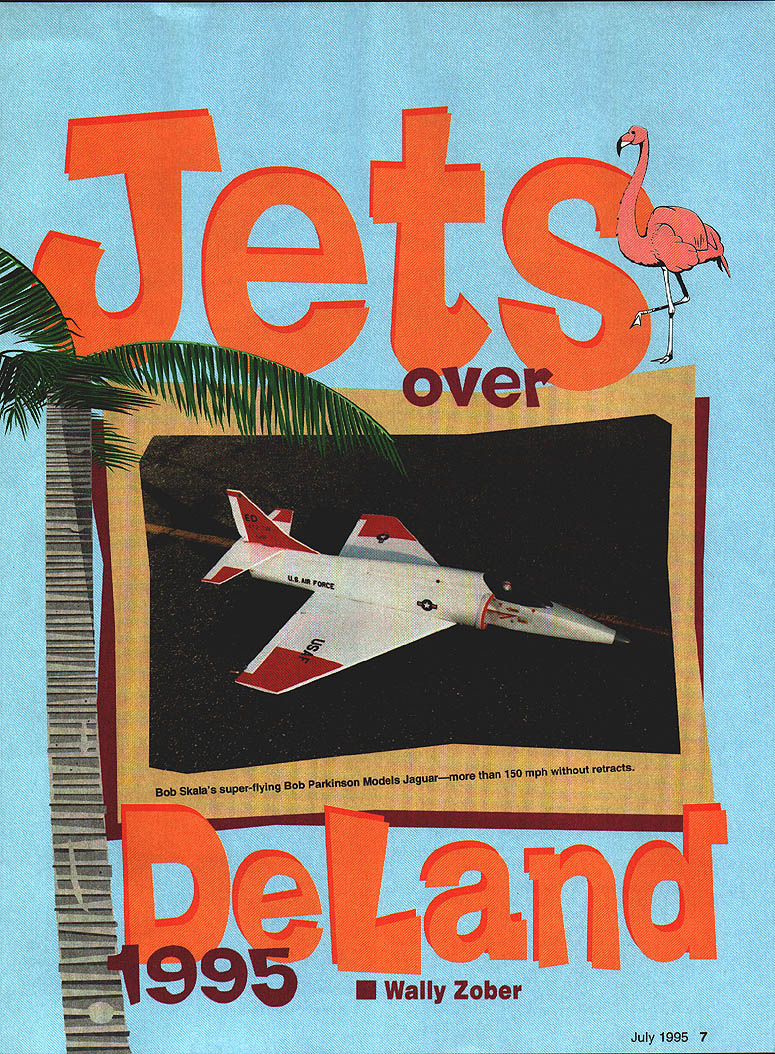
- Frank Skala flew a Parkinson Jaguar sport jet clocked at over 150 mph in straight-and-level flight—impressive for a sport jet.
- Clark Hopkins campaigned a BVM T-33, winning Pilot's Choice at DeLand and second place in Expert Scale at the 1995 Gator Shoot-Out.
- Jim Braun brought a BVM F-86 and two MiG-29s.
- Reinhard Pfeiffer flew a large MiG-29 Fulcrum (Kühr kit), powered by two O.S. .91s with Dynamax fans and a Multiplex radio.
- Jurgen Pfeiffer flew a Yellow Aircraft F-16A (O.S. .91, Dynamax fan).
- Steve Ray flew a JMP T-33 in Montana Air National Guard livery (85-inch wingspan, 24 pounds). Features trailing-edge retracts, Mars rotating beacons top and bottom, composite construction, and flown with a Futaba 1024 PCM radio.
- Pat McCurdy (West Palm Beach) won Best Sport Model with a BVM Maverick and also took 1st place Expert Scale at the 1995 Gator Shoot-Out.
Till next time, stay well and keep 'em flying!
Transcribed from original scans by AI. Minor OCR errors may remain.

