
JETS OVER DELAND
Thanks to the pioneering work of a cadre of ducted-fan buffs, jet modeling looks like it has finally come of age. This Southeast-based event drew even more enthusiasts the second time around than its premiere last year.
Event summary
With 55 registered pilots, 85 ducted-fan models, and unlimited flying, the Deland Golden Hawks RC Club's second annual RC Ducted-Fan Model Fly-In, held January 25–26, 1992, in Deland, Florida, was even bigger and more successful than last year's premiere.
Contest Director Ken Basso had lots of help from his club members in putting the event together. This is a first-class operation with one of the best flying sites anywhere. The Golden Hawks' flying field has a 2,000 by 500-foot paved runway bordered with close-cut grass. The club provided professional announcers to describe the jet models and the pilots' maneuvers. Food, soft drink, and souvenir concessions catered to spectators. There was plenty of parking space, and campsites were available for those who came in motor homes.
Ducted-fan pioneers and industry progress
Ducted-fan jet modeling has come of age thanks to American ingenuity and the pioneering spirit of enthusiasts such as:
- Bob Violett
- Byron Godberson
- Bob Kress
- Tom Cook
- George Miller
- Larry Wolf
- Bob Fiorenze
- Bob Parkinson
- Dr. Tse
- Nick Ziroli
We now have ducted-fan engines that don't self-destruct, a large variety of top-quality kits, and reliable RC systems that meet the sophisticated needs of ducted-fan models.
Notable manufacturers and popular models
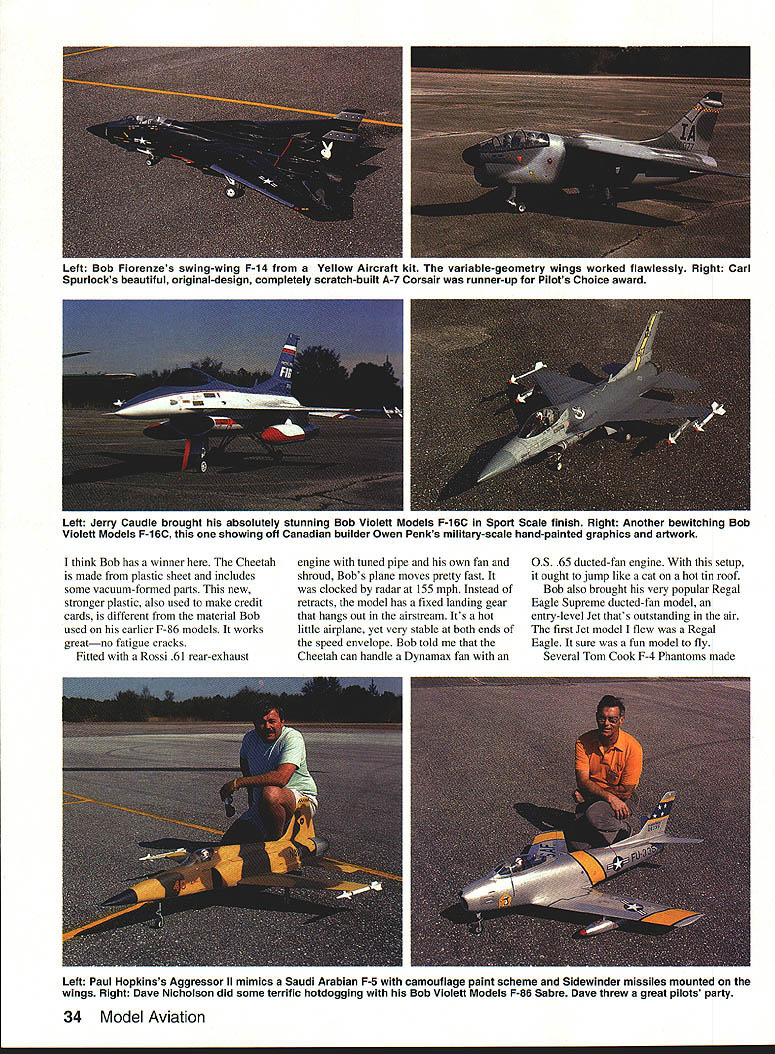
As usual, Bob Violett Models planes outnumbered all others. Popular Violett types included Aggressor IIs, Vipers, Super Sharks, F-86s, F-16Cs, and the newly released T-33 Shooting Star. Byron Originals was well represented with F-16s, MiG-15s, F-86s, F-18 Hornets, and T-20s. Yellow Aircraft designs were also well represented; the swing-wing F-14 twin-engine model flown by Bob Fiorenze proved especially popular. There were several F-4 Phantoms, F-16As, F-18 Hornets, and an A-4 Skyhawk.
Bob Parkinson traveled from Canada to show his new Cheetah kit. The Cheetah is made from plastic sheet with some vacuum-formed parts using a stronger plastic (similar to that used for credit cards), avoiding the fatigue cracks seen in earlier materials. Fitted with a Rossi .61 rear-exhaust engine with tuned pipe and Parkinson’s own fan and shroud, the Cheetah was clocked by radar at 155 mph. The model has fixed landing gear (no retracts) and remains stable across the speed envelope. Parkinson says the Cheetah can handle a Dynamax fan with an O.S. .65 ducted-fan engine.
Bob Parkinson also brought his Regal Eagle Supreme ducted-fan model, an entry-level jet noted for being outstanding in the air.
Awards and highlights
Awards and prizes were donated by Bob Violett, club president Ralph Bailey, the Jet Pilots Organization (JPO), Bob Fiorenze, and Bob Parkinson.
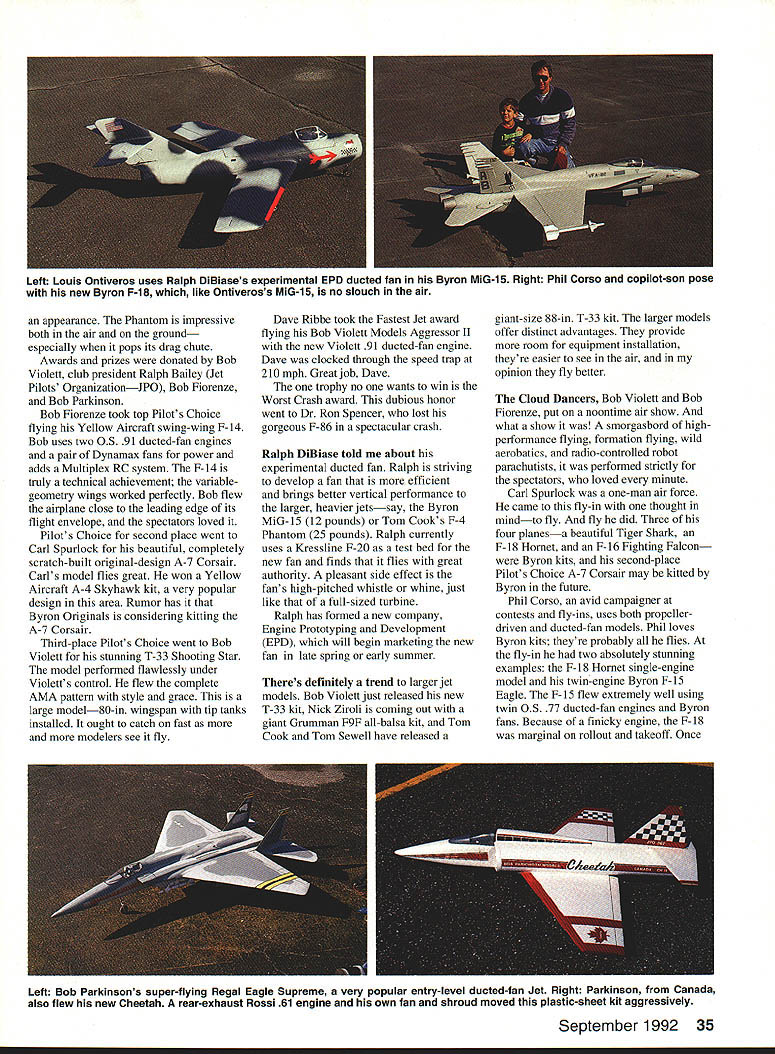
- Pilot's Choice — 1st: Bob Fiorenze, Yellow Aircraft swing-wing F-14
- Powered by two O.S. .91 ducted-fan engines with a pair of Dynamax fans and a Multiplex RC system. The variable-geometry wings worked perfectly and the display flew near the limits of its envelope to great applause.
- Pilot's Choice — 2nd: Carl Spurlock, scratch-built original-design A-7 Corsair
- A beautiful, well-flying model; rumor has Byron Originals considering kitting the A-7.
- Pilot's Choice — 3rd: Bob Violett, T-33 Shooting Star
- Large model (80 in. wingspan with tip tanks) that performed flawlessly; Violett flew the complete AMA pattern with style and grace.
- Fastest Jet: Dave Ribbe, Bob Violett Models Aggressor II with the new Violett .91 engine
- Clocked at 210 mph through the speed trap.
- Worst Crash (dubious honor): Dr. Ron Spencer, lost an F-86 in a spectacular crash.
Experimental development: Ralph DiBiase and EPD
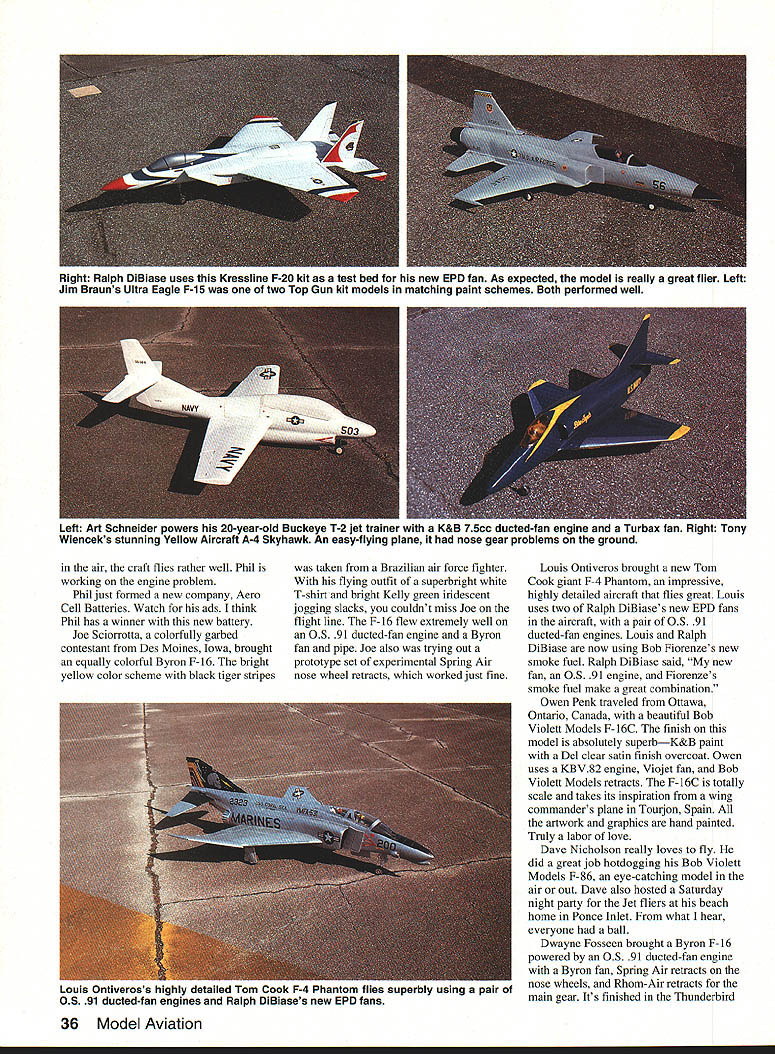
Ralph DiBiase described his experimental ducted fan designed for greater efficiency and better vertical performance on larger, heavier jets (for example, Byron MiG-15s at ~12 lb or Tom Cook's F-4 Phantom at ~25 lb). Ralph uses a Kressline F-20 as a test bed and reports the test craft flies with great authority and a high-pitched whistle similar to a full-size turbine. He has formed Engine Prototyping and Development (EPD), which will begin marketing the new fan in late spring or early summer.
Trend toward larger models
There is a clear trend to larger jet models. New or upcoming kits include:
- Bob Violett’s T-33
- Nick Ziroli’s giant Grumman F9F all-balsa kit
- Tom Cook and Tom Sewell’s 88-in. T-33
Larger models offer advantages: more room for equipment, better visibility in the air, and generally improved flying characteristics.
Demonstrations and notable pilots
The Cloud Dancers (Bob Violett and Bob Fiorenze) put on a noontime air show featuring high-performance flying, formation work, wild aerobatics, and radio-controlled robot parachutists for the spectators.
Other notable pilots and models:
- Carl Spurlock: a one-man air force; flew a Tiger Shark, an F-18 Hornet, an F-16 Fighting Falcon (Byron kits), and his scratch-built A-7 Corsair.
- Phil Corso: competitor in prop and ducted-fan classes; flew a single-engine F-18 and a twin-engine Byron F-15 (twin O.S. .77 engines). He has formed Aero Cell Batteries.
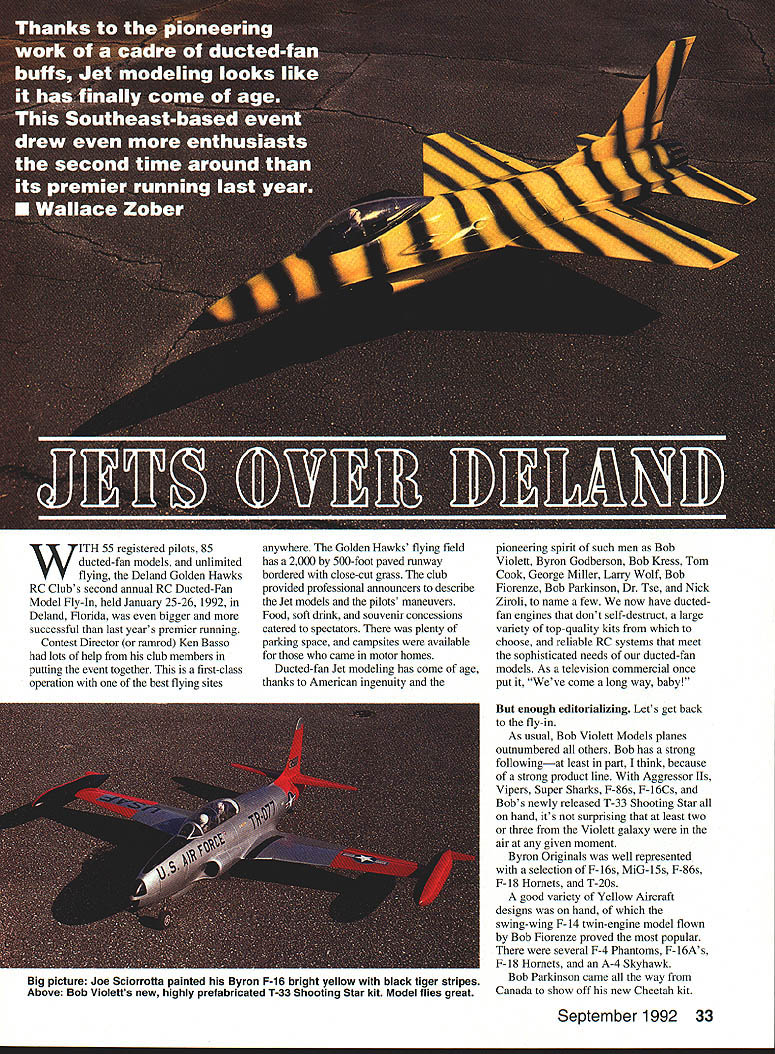
- Joe Sciorrotta (Des Moines): bright yellow Byron F-16 with black tiger stripes, O.S. .91 engine and Byron fan; tested prototype Spring Air nose-wheel retracts.
- Louis Ontiveros: Tom Cook giant F-4 Phantom using two EPD fans and a pair of O.S. .91 engines; uses Bob Fiorenze’s smoke fuel.
- Owen Penk (Ottawa, Ontario): Bob Violett Models F-16C with superb finish (K&B paint and DCL clear satin overcoat), K&B V.82 engine, Violett fan, and Violett retracts—scale detail inspired by a wing commander’s plane in Tourjon, Spain.
- Dave Nicholson: Bob Violett Models F-86; hosted a Saturday night party for jet fliers at his Ponce Inlet beach home.
- Dwayne Fossen: Byron F-16 (Thunderbirds scheme) with O.S. .91 engine, Byron fan, Spring Air and Rhom-Air retracts.
- Paul Hopkins: Aggressor II painted to mimic a Saudi Arabian fighter—clocked at 150–160 mph.
- Anthony Wiencek (Winston-Salem, NC): Yellow Aircraft A-4 Skyhawk (O.S. .91 engine, Dynamax fan, B & D main retracts, Impact Engineering nose strut); stable, easy to fly—an excellent entry-level jet.
- Bob Hodge (Naples, FL): Byron YF-16 prototype model with O.S. .91 engine, Byron fan, tuned pipe, Rhom-Air retracts, and a Futaba Super 7 RC system.
Atmosphere and competition
A fun-fly atmosphere prevailed throughout the meet. Most participants were relaxed and came to enjoy flying rather than to compete. For those seeking competition, a speed trial event was available: pilots flew through a radar speed trap to determine low- and high-speed boundaries. Recorded speeds ranged from about 40 mph up to the 210 mph maximum.
The wide selection of top-quality engines available today is the result of demand for speed and the efforts of pioneers like Bob Violett Models, K&B Manufacturing, and O.S. Engines. Their investment of time and energy gives today’s jet modelers engines that work reliably.
I expect the next phase of jet modeling will include lighter, smaller jets. As kits grow larger and the speed range becomes less intimidating, more sport modelers should enter the world of jet flying.
In all, the fly-in delivered a lot of fun, a lot of flying, good hangar talk, and plenty of fellowship.
Transcribed from original scans by AI. Minor OCR errors may remain.

