
Jets Over DeLand '96
Wally Zober
Event summary
JETS, JETS, JETS! Jets to the right of me, jets to the left of me. Jets in front of me, jets behind me, jets above me. That's the best way I can describe the Seventh Annual International Jets over DeLand Fly-In. The fly-in, sponsored by the DeLand Golden Hawks, was held January 25–28 at Sidney Taylor Field in DeLand, Florida. The event drew 150 registered pilots and 250 jet models.
Facilities and safety
The club has an arrangement with the city of DeLand to use an inactive runway at the DeLand city airport. The flying site features a 1,500 x 350-foot tarmac runway and an adjacent 300-foot-wide close-cut grass strip of the same length, often used for emergency landings when landing gear won't extend.
On the west side of the runway is a strong 2½-foot fence to stop aircraft that lose control on the ground; it also helps protect the radio-impound area, registration personnel, and the awards display. The gourmet kitchen is protected by a six-foot-high chain-link fence approximately 200 feet long. The safety arrangement at this meet is first-class. The Contest Director was Al Tuttle.
International entrants
This was truly an international event, with contestants from Canada, England, Puerto Rico, Venezuela, Scotland, the U.K., Austria, France, and Poland.
Weather and flying conditions
The weather for this ducted-fan fly-in was mostly partly cloudy and cool. The main problem was the crosswind. Most jet models do not have operating rudders, and those that do must work without the benefit of strong propwash. This handicapped some low-time jet modelers—there were several crashes on takeoffs and landings due to the crosswind.
Manufacturers and model types
The meet had a good selection of ducted-fan model manufacturers. There were scratch-built originals and sport jets that performed well. Scale jet models dominated—approximately 150 scale jets. There were 18 registered turbine jet models, impressive in the air; the turbines ran on kerosene and propane and produced an awesome sound on low-altitude high-speed flybys.
Notable aircraft and builders
- John Franklin and John Palmer (England)
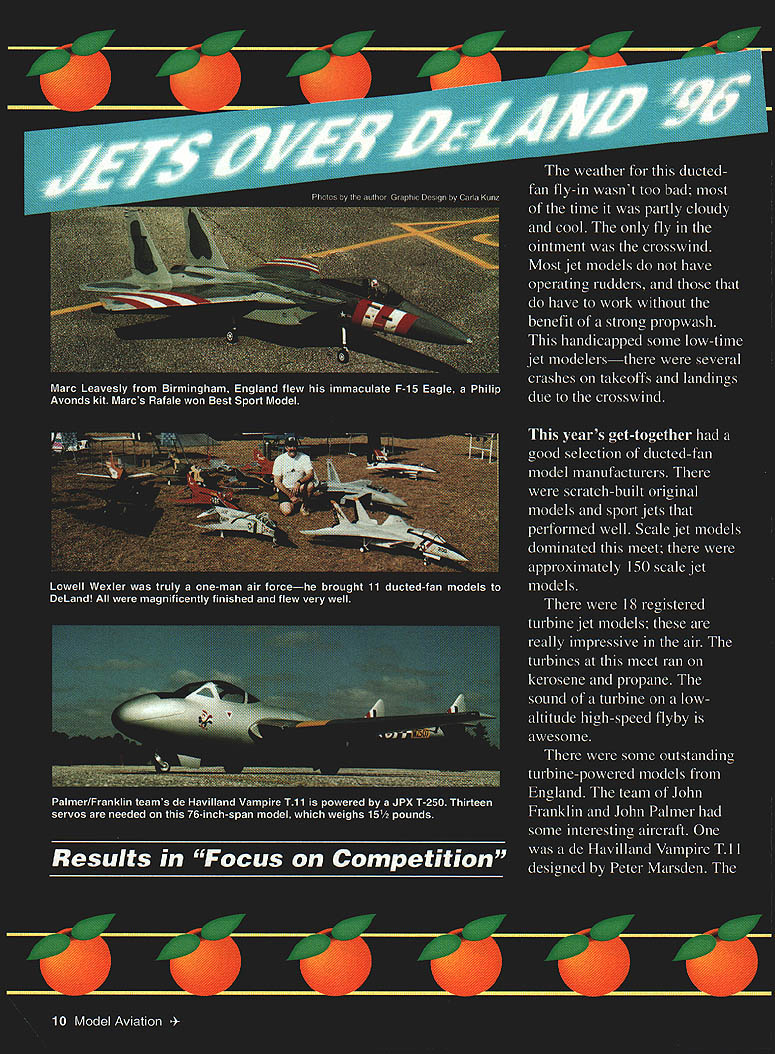
- de Havilland Vampire T.11 designed by Peter Marsden: 76-inch wingspan, 70 inches long, 15½ pounds. Uses 13 servos for ailerons, flaps, elevator, airbrakes, throttle, fuel valve, rudders, steerable nose wheel, and retractable landing gear. Powered by a JPX T-240 updated to a 250 for increased thrust; static thrust on the ground is 5 kilos. Rudder actuators operate via a closed-loop pull-pull cable system and cam. Flown with a JR PCM 10SX system.
- StarJet MC (Aviation Design kit): 64-inch wingspan, 60-inch fuselage, powered by a JPX 260P turbine giving a speed envelope of 180–200 mph. Flown with a JR PCM 10SX.
- JR representative Mike Stokes
- Provided extra receivers and crystals for pilots flying JR or Graupner-JR RC systems, a helpful company presence at the meet.
- Peter Hansl (Austria, part of the Polish team sponsored by Golden West Models)
- F9F Grumman Panther with a completely modular design: center fuselage houses the Schreckling turbine and related components (fuel tank, air tank for retracts, fuel mixture control, landing gear, receiver, flight pack, nose weight); removable wing panels house aileron and flap servos; tail assembly carries elevator and rudder servos and attaches to a rear bulkhead. Fiberglass nose cone covers electronics and mechanics.
- Peter Brenner
- YF-24 ducted-fan lifting body (original design): roughly 50% of lift from the fuselage, remainder from wings and stabilizer. Powered by three Tom Cook Dynamax fans (three OS .91 ducted-fan engines). Fiberglass fuselage; foam wing cores sheeted with balsa and covered with lightweight glass cloth and resin; stabilizer/elevator finished similarly. Wingspan 60½ inches, length 93 inches. Finished with K&B Super Poxy, with operating landing-gear doors and Jet Model Products retracts. Flown with a Futaba Super-7 PCM RC system.
- Tadeusz "Tad" Krzanowski and Bob Wilcox (Golden West Models)
- Golden West–designed Albatross LZ59 (soon to be a kit): ducted-fan model built for the Schreckling kerosene-powered turbine, finished in automotive lacquer and flown with a JR PCM RC system. Tad noted partner Bob Wilcox (WKR Productions) has produced models and special effects for movies including Cliffhanger, Terminal Velocity, and Steven Seagal's Under Siege II.
- Bob Wilcox also campaigned a Rafale (Aerolot kit) powered by a Schreckling FD 3/67 turbine, finished in clear-coated automotive lacquer and flown with a JR-PCM RC system.
- Paul Hopkins
- BVM F-16C powered by a K&B .82 engine with BVM quiet pipe. Features cycling doors, BVM retracts and brakes. Flown with a JR PCM-10 RC system. Excellent slow-flight characteristics, capable of high-angle-of-attack landing approaches with no tip-stall tendencies—an ideal entry-level jet model for an experienced RC flier wanting to get into jets.
- Lowell Wexler
- Brought 11 RC jet models, a one-man air force: F-14 (DCU kit); three Yellow Aircraft F-4 Phantoms; two F-117A Nighthawk stealth fighters (Aviation Design); a BVM F-86; a pair of Tom Cook Jet Model Products giant F-4 Phantoms; an Avonds F-15; and a BVM F-80 Shooting Star. All were magnificently finished and flew extremely well.
- Jim Smith
- F-104 jet fighter (Phillip Avonds kit) powered by a Ramtec Fan O.S. .91 engine; Century Model retracts; Presto Trim covering; wings painted with PPG paint. Flown with a JR-PCM RC system.
- F-117A stealth fighter (Eric Ranellet kit) powered by twin O.S. .91 engines turning Ramtec fans. Uses eight servos, Century Jet Retracts, and a 1,100-mAh battery pack. Flown with a JR RC system.
- Bob Violett
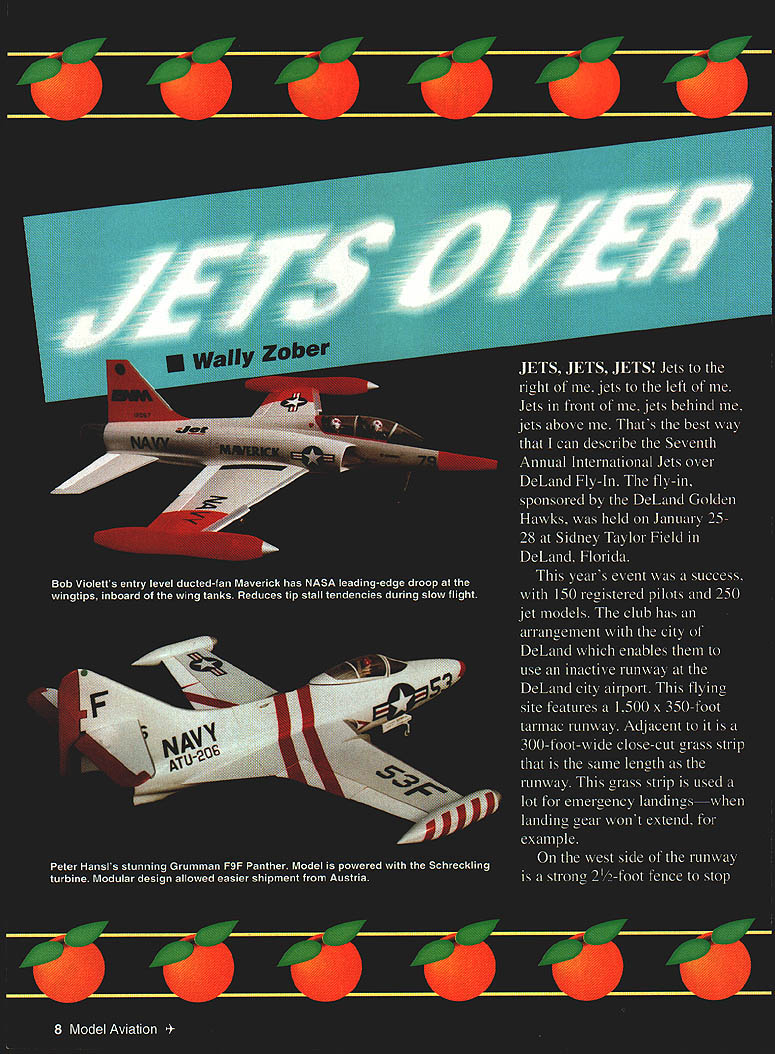
- Numerous models at the rally: Mavericks, Vipers, F-86s, F-80 Shooting Stars, and a new twin-engine F-4 Phantom. Introduced NASA leading-edge droops at the wingtips on the Maverick (installed with double-stick tape) to eliminate tip-stall tendencies during very slow flight—an effective innovation.
- Roger Shipley
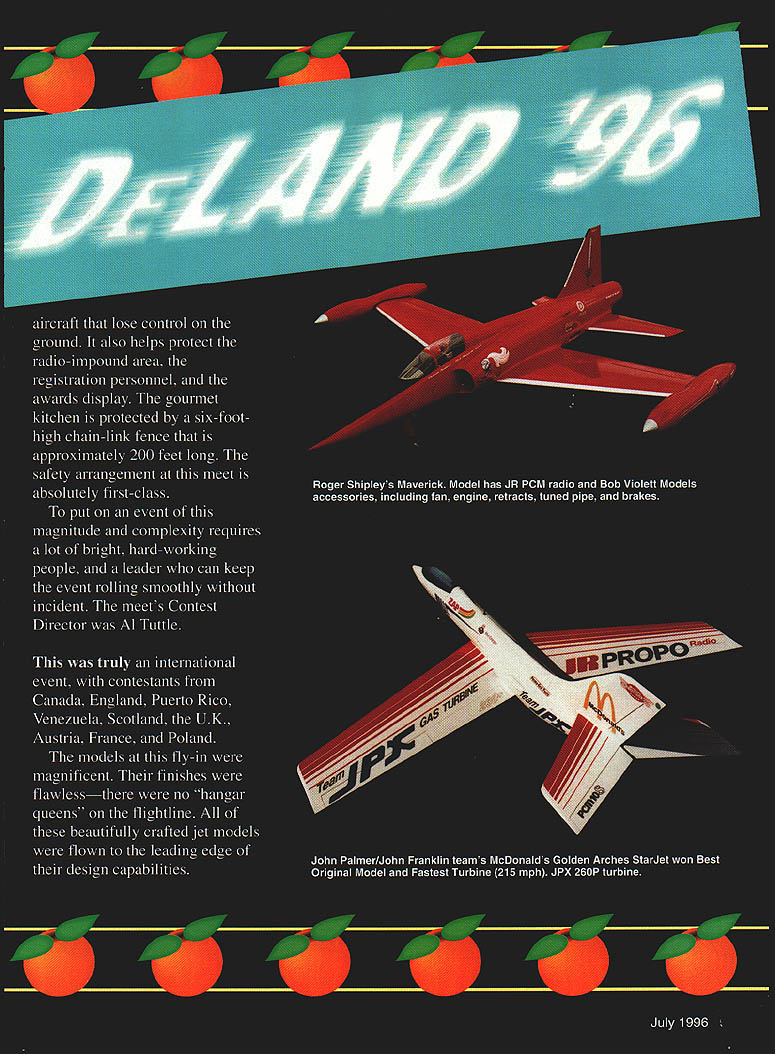
- Bright red Maverick with white markings, outfitted with BVM accessories (fan, engine, retracts, tuned pipe, brakes). Flown with a JR-PCM RC system.
- Dave Nicholson
- Highly modified Byron MiG-15 flown with a BVM K&B .72 engine, a BVM fan, and a BVM quiet pipe. Finished with K&B epoxy and flown with an Airtronics RC system.
- Lewis Patton
- Heinkel He 162 Salamander (Century Jet Models kit) powered with a Ramtec Fan and an O.S. .91 engine. Flown with a Galaxy eight-channel RC system.
- John Burden
- F-16A (Yellow Aircraft kit) finished in Royal Dutch Air Force demonstration team markings. Powered by an O.S. .91 turning a Dynamax fan; weighs 12½ pounds; Gear-Spring air retracts; seven servos; six-volt 1,200-mAh battery pack for receiver/servos. Finished with Hobbytech paint and flown with a Futaba RC system. Exhibits gentle stall and easy slow-flight characteristics.
- Jim Brown
- F-106 Delta Dart (Classified Model Products): powered by an O.S. .91 engine turning a Dynamax fan. Finished with clear-coated PPG paints; Spring-Air retracts; speed brakes; 1,200-mAh flight pack. Flown with a Futaba radio.
- Carl Spurlock
- Campaigned several Byron Originals models including an F-16, an F-15, and a great-flying F-20 Tiger Shark. All were outfitted with Byron components except engines and radios; Carl's jets were flown with Airtronics systems.
Wrap-up
This was a well-run, highly organized fly-in. Competitors, workers, and spectators liked it—that's what it's all about.
CONTRIBUTORS:
- Airtronics
- Futaba
- JR RC Systems
- Sig Manufacturing
- Ace R/C
- Byron Originals
- Bob Smith
- Boca Bearings
- Chevron Paints
- Coverite
- Du-Bro
- Hobby Lobby
- Klotz
- Spring-Air
- TNR Technical
- Ultra Precision
- Melrose
- FTE
- Rocket City
- S/R Batteries
- Dan Parsons
- RC Report
- Horizon Distributors
- Larry Tudor
Trophy Sponsor: Century Jet Models.
Transcribed from original scans by AI. Minor OCR errors may remain.

