
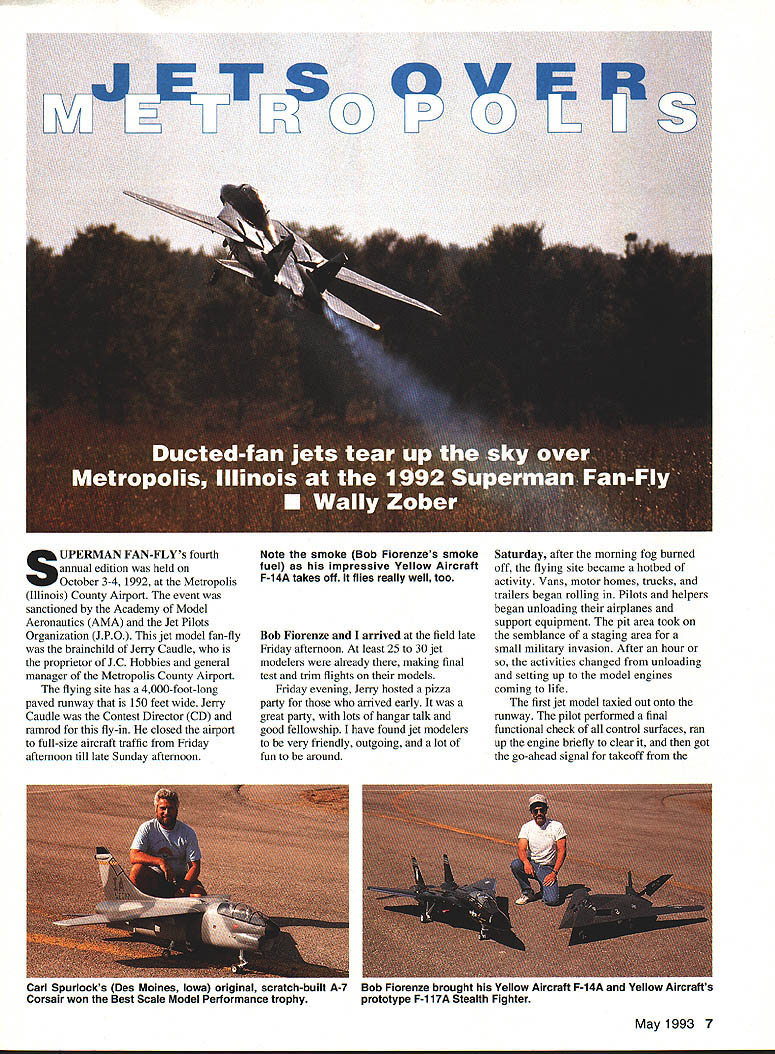
Jets Over Metropolis
Superman Fan-Fly's fourth annual edition was held on October 3–4, 1992, at the Metropolis (Illinois) County Airport. The event was sanctioned by the Academy of Model Aeronautics (AMA) and the Jet Pilots Organization (J.P.O.). This jet model fan-fly was the brainchild of Jerry Caudle, proprietor of J.C. Hobbies and general manager of the Metropolis County Airport.
The flying site has a 4,000-foot paved runway that is 150 feet wide. Jerry Caudle was the Contest Director (CD) and ramrod for this fly-in. He closed the airport to full-size aircraft traffic from Friday afternoon until late Sunday afternoon.
Bob Fiorenze and I arrived at the field late Friday afternoon. At least 25 to 30 jet modelers were already there, making final test and trim flights on their models. Friday evening, Jerry hosted a pizza party for those who had arrived early. It was a great party, with lots of hangar talk and good fellowship. I have found jet modelers to be very friendly, outgoing, and a lot of fun to be around.
Saturday, after the morning fog burned off, the flying site became a hotbed of activity. Vans, motor homes, trucks, and trailers rolled in. Pilots and helpers began unloading their airplanes and support equipment. The pit area took on the semblance of a staging area for a small military invasion. After an hour or so, activity changed from unloading and setting up to the model engines coming to life.
The first jet model taxied out onto the runway. The pilot performed a final functional check of all control surfaces, ran up the engine briefly to clear it, and then got the go-ahead signal for takeoff from the flight-line starter. The flier advanced his throttle, the jet model began its rollout, and when flying speed was reached, the model took to the air like a hungry eagle searching for prey. The fourth annual Superman Fan-Fly was under way.
Fan-Jet Kits and Manufacturers of Note
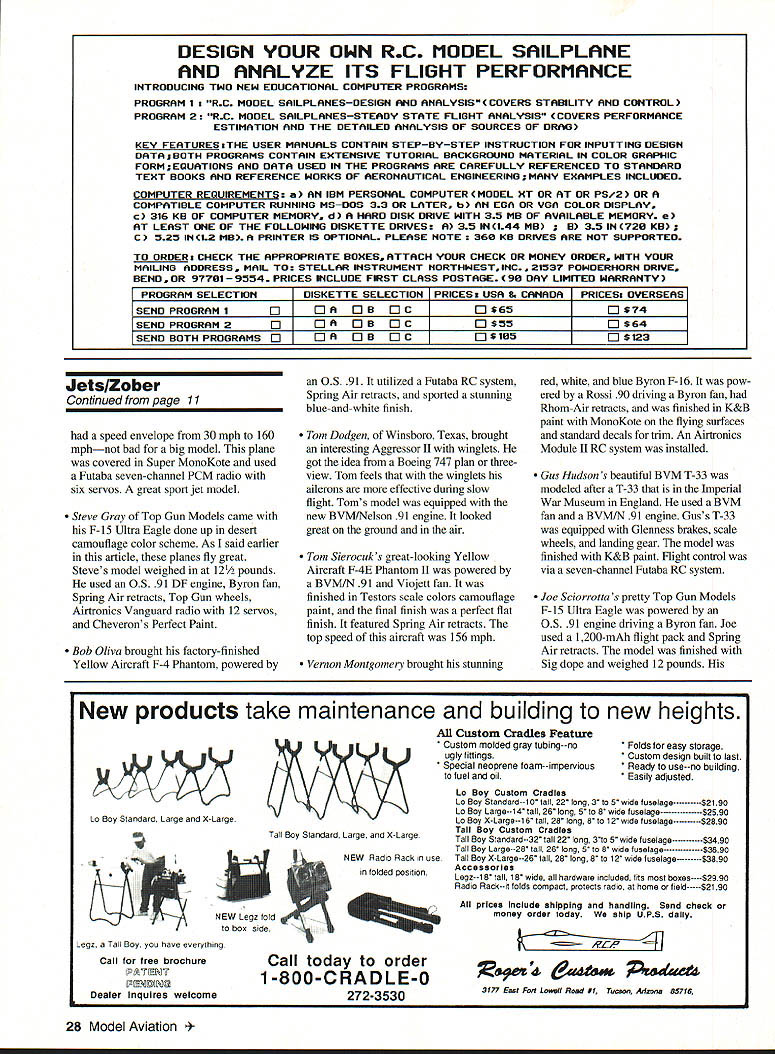
- Bob Violett Models: Sixty-three of the over 100 planes brought by the 82 registered pilots were examples of Bob Violett Models kits. Bob brought his new entry-level jet, the Maverick. It flies extremely well and has no intimidating characteristics. Bob also had his new T-33, F-16C, and an assortment of Vipers and Aggressors at this meet. They all flew well.
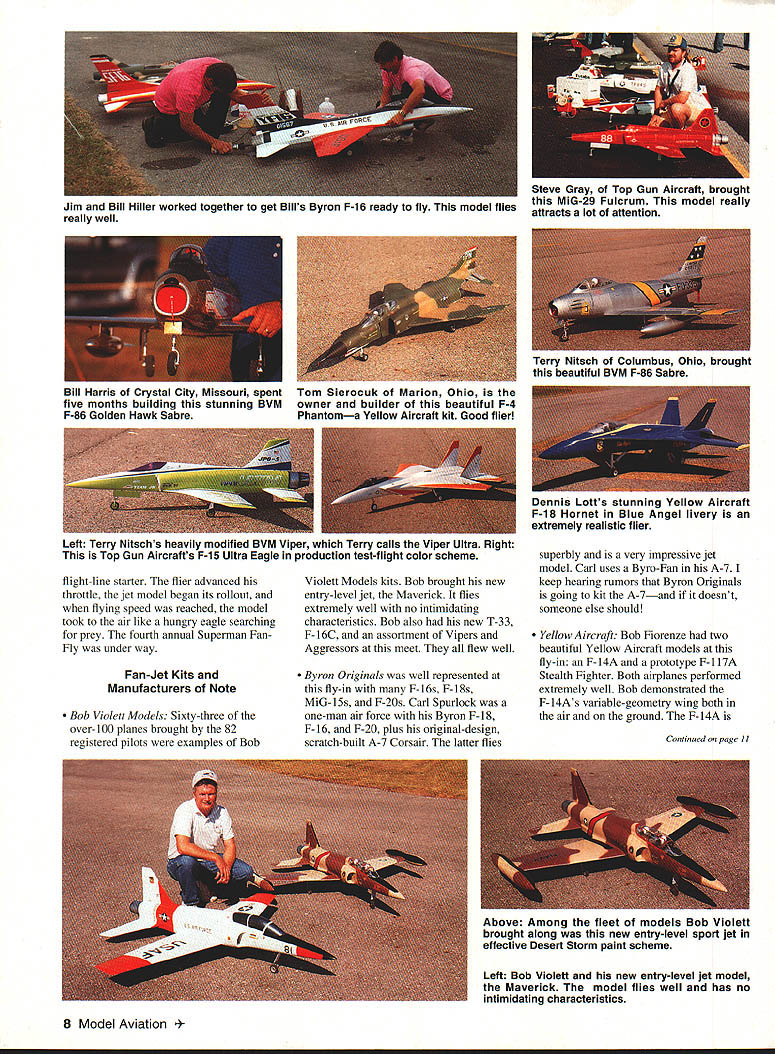
- Byron Originals: Byron was well represented with many F-16s, F-18s, MiG-15s, and F-20s. Carl Spurlock was a one-man air force with his Byron F-18, F-16, and F-20, plus his original-design, scratch-built A-7 Corsair. The latter flies superbly and is a very impressive jet model. Carl uses Byron-Fan in his A-7. I keep hearing rumors that Byron Originals is going to kit the A-7—and if it doesn't, someone else should.
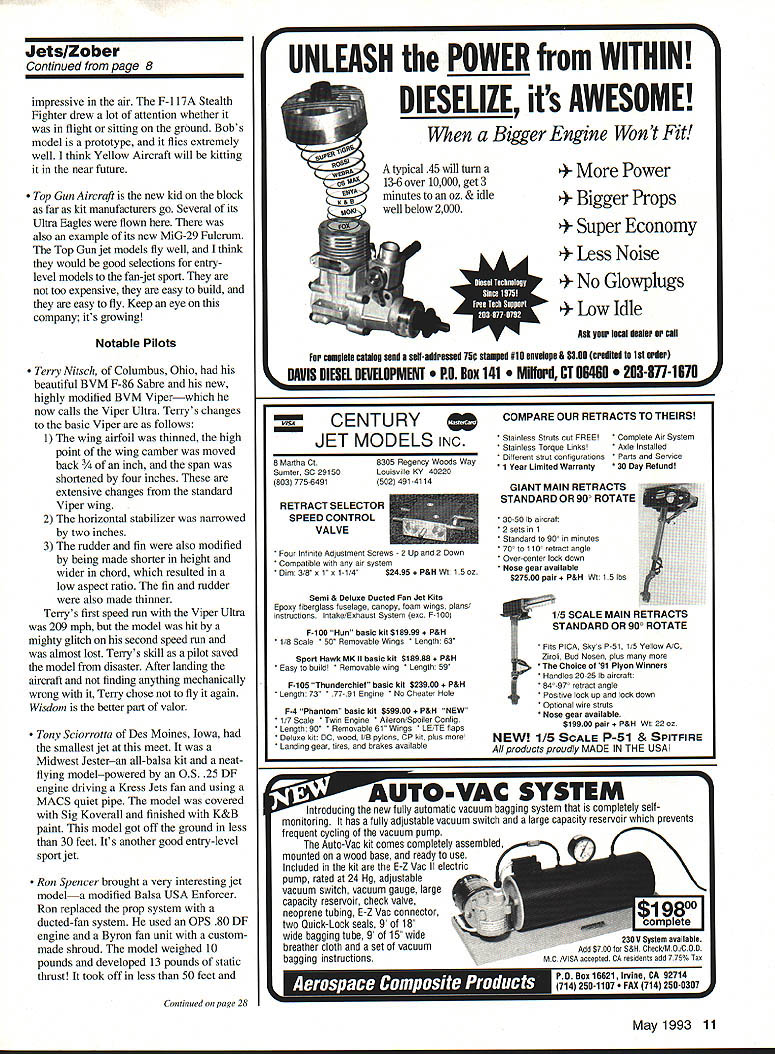
- Yellow Aircraft: Bob Fiorenze had two beautiful Yellow Aircraft models at this fly-in: an F-14A and a prototype F-117A Stealth Fighter. Both airplanes performed extremely well. Bob demonstrated the F-14A's variable-geometry wing both in the air and on the ground.
- Top Gun Aircraft: Top Gun is the new kid on the block as far as kit manufacturers go. Several of its Ultra Eagles were flown here. There was also an example of its new MiG-29 Fulcrum. The Top Gun jet models fly well, and I think they would be good selections for entry-level fan-jet sport. They are not too expensive, easy to build, and easy to fly. Keep an eye on this company; it's growing!
Notable Pilots
- Terry Nitsch (Columbus, Ohio): Terry had his beautiful BVM F-86 Sabre and his new, highly modified BVM Viper—which he now calls the Viper Ultra. Terry's changes to the basic Viper are as follows:
- The wing root was thinned, the high point of the wing camber was moved back 3/4 of an inch, and the span was shortened by four inches—extensive changes from the standard Viper wing.
- The horizontal stabilizer was narrowed by two inches.
- The rudder and fin were made shorter in height and wider in chord, resulting in a lower aspect ratio; the fin and rudder were also made thinner.
Terry's first speed run with the Viper Ultra was 209 mph, but the model suffered a serious glitch on his second speed run and was almost lost. Terry's skill as a pilot saved the model from disaster. After losing the aircraft and not finding anything mechanically wrong with it, Terry chose not to fly it again. Wisdom is the better part of valor.
- Tony Sciortino (Des Moines, Iowa): Tony had the smallest jet at this meet: a Midwest Jester—an all-balsa kit and a neat-flying model—powered by an O.S. .25 DF engine driving a Kress Jets fan and using a MACS quiet pipe. The model was covered with Sig Koverall and finished with K&B paints. It got off the ground in less than 30 feet. It's another good entry-level sport jet.
- Ron Spencer: Ron brought a very interesting jet model—a modified Balsa USA Enforcer. He replaced the prop system with a ducted-fan system using an OPS .80 DF engine and a Byron fan unit with a custom-made shroud. The model weighed 10 pounds and developed 13 pounds of static thrust. It took off in less than 50 feet and had a speed envelope from 30 mph to 160 mph—not bad for a big model. This plane was covered in Super MonoKote and used a Futaba seven-channel PCM radio with six servos. A great sport jet model.
- Steve Gray (Top Gun Models): Steve came with his F-15 Ultra Eagle done up in a desert camouflage color scheme. These planes fly great. Steve's model weighed in at 12+ pounds. He used an O.S. .91 DF engine, Byron fan, Spring Air retracts, Top Gun wheels, an Airtronics Vanguard radio with 12 servos, and Chevron's Perfect Paint.
- Bob Oliva: Bob brought his factory-finished Yellow Aircraft F-4 Phantom, powered by an O.S. .91. It utilized a Futaba R/C system, Spring Air retracts, and sported a stunning blue-and-white finish.
- Tom Dodgen (Winnsboro, Texas): Tom brought an interesting Aggressor III with winglets. He got the idea from a Boeing 747 three-view. Tom feels that with the winglets his ailerons are more effective during slow flight. Tom's model was equipped with the new BVM/Nelson .91 engine. It looked great on the ground and in the air.
- Tom Sierocuk: Tom's great-looking Yellow Aircraft F-4E Phantom II was powered by a BVM/Nelson .91 and a Violett fan. It was finished in Testors scale colors and camouflage paint, with a perfect flat final finish. It featured Spring Air retracts. The top speed of this aircraft was 156 mph.
- Vernon Montgomery: Vernon brought his stunning red, white, and blue Byron F-16. It was powered by a Rossi .90 driving a Byron fan, had Rhom-Air retracts, and was finished in K&B paint with MonoKote on the flying surfaces and standard decals for trim. An Airtronics module R/C system was installed.
- Gus Hlad: Gus's beautiful BVM T-33 was modeled after a T-33 in the Imperial War Museum in England. He used a BVM fan and a BVM/Nelson .91 engine. Gus's T-33 was equipped with Glenns brakes, scale wheels, and landing gear, and finished with K&B paint. Flight control was via a seven-channel Futaba R/C system.
- Joe Sciortino: Joe's Top Gun Models F-15 Ultra Eagle was powered by an O.S. .91 engine driving a Byron fan. Joe used a 1,200-mAh flight pack and Spring Air retracts. The model was finished with Sig dope and weighed 12 pounds. The Eagle was fast—just under 150 mph. Joe's goal is to do better than that.
- Charlie Trivits (Harrington, Delaware): Charlie brought two gorgeous models to this meet. Both big models—a Yellow Aircraft F-14A and a JMP F-4 Phantom—had twin engines. They were powered by O.S. .91s driving Dynamax fans. The Phantom used Tom Cook MK II landing gear, Tom Cook quiet pipes, and a JR PCM-10 RC system. The Phantom flew in the 135–140 mph range. Charlie's F-14A was flown for the first time by Bob Fiorenze; the first flight went really well.
- Don Hansen: Don had a ball flying his Byron MiG-15. The model was powered by an O.S. .77 engine. He used a five-channel Futaba PCM RC system, Spring Air retracts, and K&B paint. The speed envelope was 35–125 mph. His model weighed in at 12 pounds. The Byron MiG-15 is a delight to fly and is another good entry-level jet model.
- Dennis Lort: Dennis showed off his pretty and great-flying Yellow Aircraft giant F-18 Hornet. The 27-pound model was lacquer-finished in Blue Angels livery. It sported functional knuckle-joint main landing gear legs and disc brakes. The Hornet is definitely not an entry-level jet model.
- Bill Harris (Crystal City, Missouri): Bill flew his stunning BVM F-86, which he modified to look like one of the full-scale craft flown by the RCAF Air Sabre air show team that operated from 1959 to 1964. Bill used a stock BVM engine, stock muffler pipe, drop tanks, flaps, in-flight mixture control, and scale retracts. It took him five months to build the model, which weighed 12 1/4 pounds. He finished it with acrylic and clear lacquers and sported Aerolift markings. A JR 10-channel PCM RC system provided the guidance.
- Don Winn (Chicago, Illinois): Don flew his beautiful BVM F-16C. Don used the complete BVM Products line in his model: BVM .81 engine, scale landing gear, drop tanks, and accessories. The finish included Aerolift decals.
- Mike Stuart: Mike's pretty Sport Hawk was powered by an O.S. .91 engine driving a Dynamax fan. A Tom Cook quiet pipe kept the noise level down, and Spring Air retracts handled the landing gear. Mike used a Futaba nine-channel PCM RC system. This airplane flew extremely well—I call it the sweet stick of jet models. It's a good entry-level jet.
- David Ribbe (Champaign, Illinois): Dave came in with his Aggressor II to win the speed event with a 223-mph speed run. Dave's Aggressor was powered by the new BVM/Nelson .91 engine and included BVM retracts and landing gear doors. He used a JR PCM RC system.
- Rick Schafer (Texas): Rick came up from Texas to attend the fly-in. He brought his favorite BVM F-16C set up as a sport model for fun flying, equipped with stock BVM equipment. Rick is building a second F-16C that will be a true scale model for competition.
- Jim and Bill Hiller: Jim and his brother Bill were a very active team at this fly-in. Jim's Byron F-16 was modified to accommodate a BVM fan unit and the new BVM/Nelson .91 engine. Jim's F-16 was painted with acrylic lacquer. Brother Bill had a very nice Byron F-16 using a stock Byron fan with an O.S. .91 engine. Both airplanes flew well.
This fly-in was not a contest; however, awards were given for certain categories:
- Best of Show: Bob Fiorenze — Yellow Aircraft F-117A Stealth Fighter.
- Best Sport Model Finish: Terry Nitsch — BVM Viper-Ultra.
- Best Scale Model Finish: Charlie Trivits — Yellow Aircraft F-14A.
- Best Sport Performance: Terry Nitsch — BVM Viper-Ultra.
- Best Twin-Engine Performance: Bob Fiorenze — Yellow Aircraft F-14A.
- Best Scale Model Performance: Carl Spurlock — A-7 Corsair.
- Speed Event: David Ribbe — 223 mph.
There was also a pilots' draw raffle with some neat prizes:
- $100 gift certificate — won by Rick Schafer.
- Bob Violett Models kit — won by Mike Burton.
- Top Gun Aircraft F-15 Ultra Eagle kit — won by Dan Buckley.
When I come home from one of these events, I'm usually asked by my flying buddies whether there are any new trends. This time I'd have to say, "Big jets are here to stay." At this fly-in, there were lots of Bob Violett Models T-33s, Byron F-16s, and Yellow Aircraft F-18 Hornets.
I also saw a lot of entry-level jet models—such as Bob Violett Models' new Maverick and new T-33; Byron's F-16s (a good sport-scale jet) and the old standby MiG-15; Top Gun Aircraft's Ultra Eagle F-15; and Century Jet Models' Sport Shark—just to mention a few.
In closing, Contest Director Jerry Caudle ran a first-class operation. It was one of the nicest events I have had the privilege to report on. You did a great job, Jerry.
Till next time, stay well and keep 'em flying.
Transcribed from original scans by AI. Minor OCR errors may remain.

