
JOE NALL FLY-IN
Jerry Smith
GIANT-SCALE SOUTHERN HOSPITALITY AT HARTNESS FIELD
Event overview
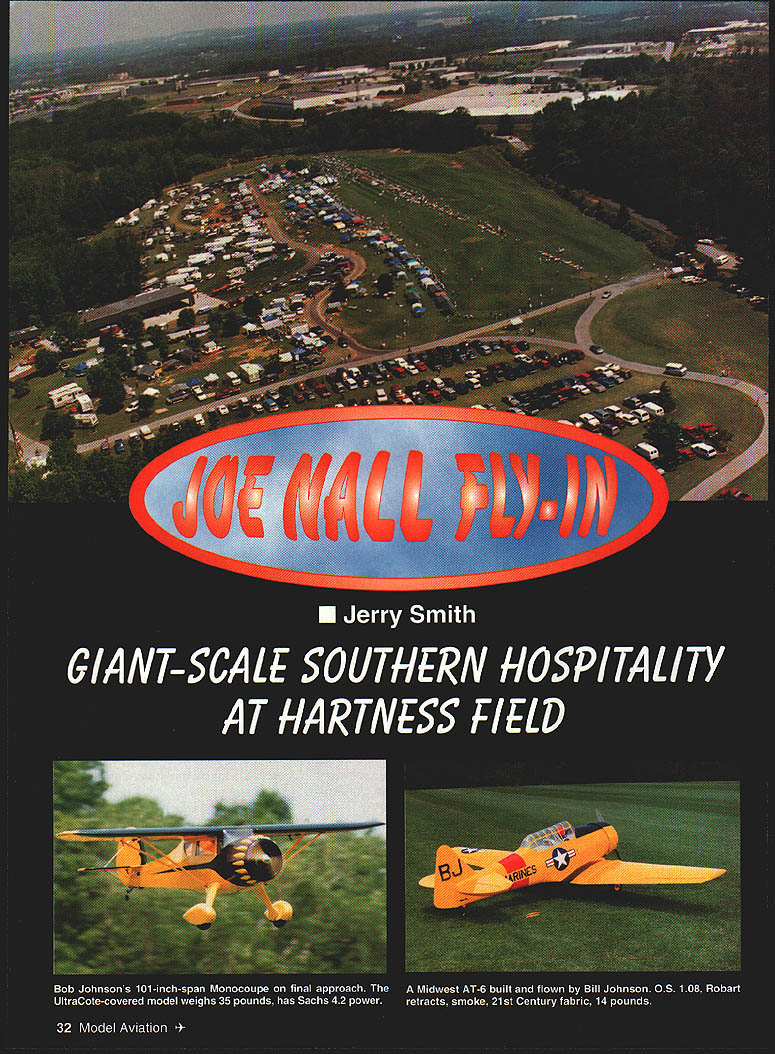
The Joe Nall Giant Scale Fly-In is unquestionably the premier event in the Southeast for giant-scale airplanes. The four-day annual event was held May 16–19, 1996, at Hartness Field, a private 400-acre estate in Greenville, South Carolina. This year's fly-in was sponsored by International Miniature Aircraft Association (IMAA) Chapter 94 and hosted by Pat Hartness, who generously allows it to happen on his front yard.
After 14 years the event is well organized: registration and the flightline are controlled by a computer database, a high-tech system that makes it all happen as smoothly as possible. Many fliers arrived early; according to Event Coordinator Kirby McKinney, some came as early as the previous Sunday to stake out a good place on the flightline.
One word fully describes this event: overwhelming. The Joe Nall Fly-In has become ingrained in the culture of the modeling world—much like the Nats, Toledo, and WRAM—so many make the event part of their vacation plans, camping for the whole week to see old friends, meet new ones, and learn new techniques. It’s one big social event, and if you can get in a few flights, all the better.
History and name
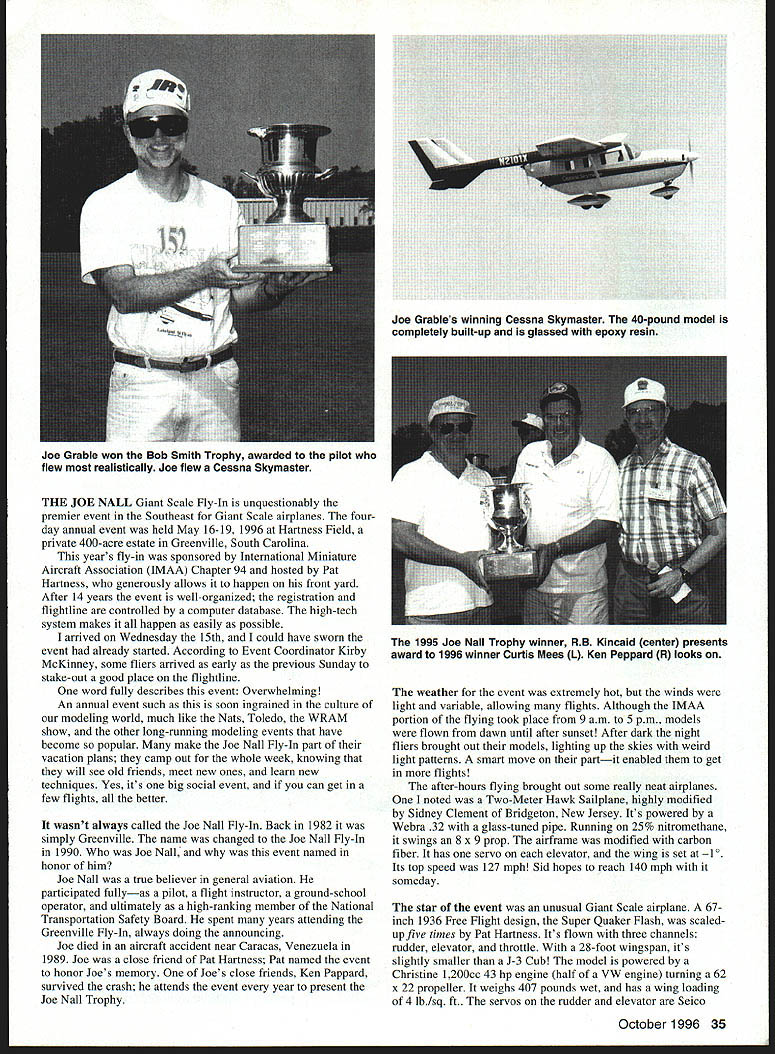
It wasn't always called the Joe Nall Fly-In. Back in 1982 it was simply the Greenville Fly-In; the name was changed to the Joe Nall Fly-In in 1990. Joe Nall was a true believer in general aviation—pilot, flight instructor, ground-school operator, and a high-ranking member of the National Transportation Safety Board—who spent many years attending the Greenville Fly-In, always doing the announcing. Joe died in an aircraft accident near Caracas, Venezuela, in 1989. Pat Hartness named the event in Joe’s memory. One of Joe’s close friends, Ken Peppard, survived the crash and attends the event every year to present the Joe Nall Trophy.
Flying and weather
The weather for the event was extremely hot, but winds were light and variable, allowing many flights. Although the IMAA portion of flying officially ran from 9 a.m. to 5 p.m., models were flown from dawn until after sunset. After dark the night fliers brought out their models, lighting up the skies with striking light patterns—a smart move that enabled them to get in extra flights.
Notable aircraft and performances
The after-hours flying brought out some very neat airplanes. One notable example was a two-meter Hawk sailplane highly modified by Sidney Clement of Bridgeton, New Jersey. It’s powered by a Webra .32 with a glass-tuned pipe, running on 25% nitromethane and swinging an 8x9 prop. The airframe was reinforced with carbon fiber. It has one servo on each elevator, the wing is set at -1°, and its top speed was recorded at 127 mph; Sid hopes to reach 140 mph someday.
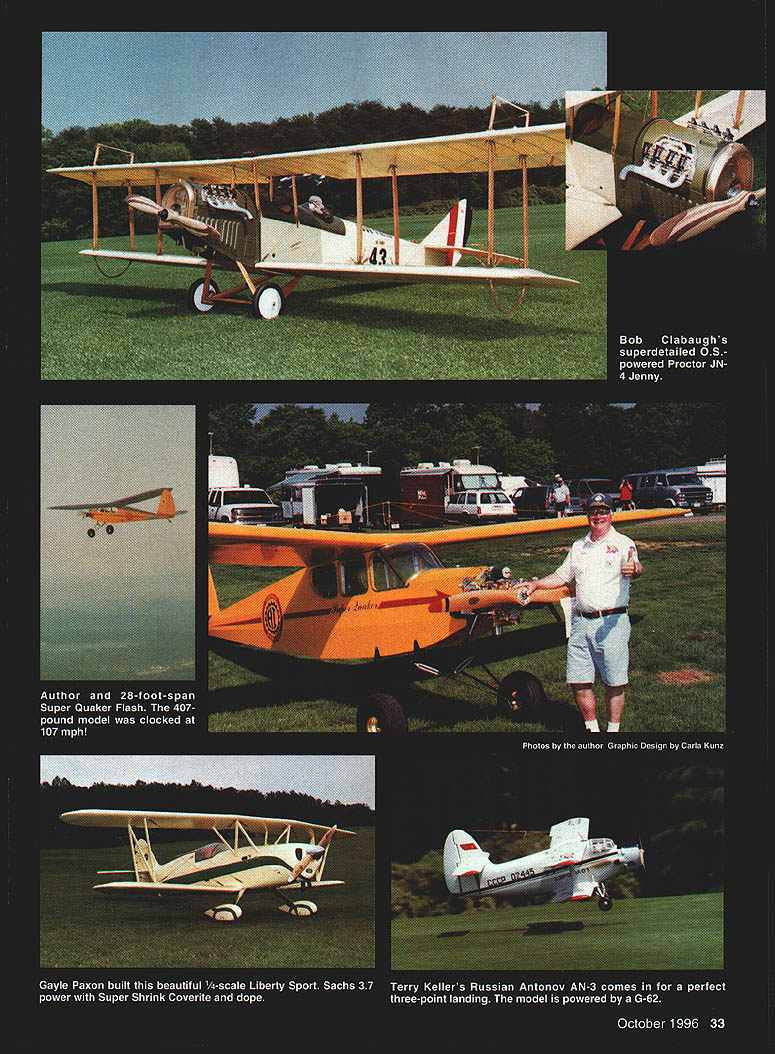
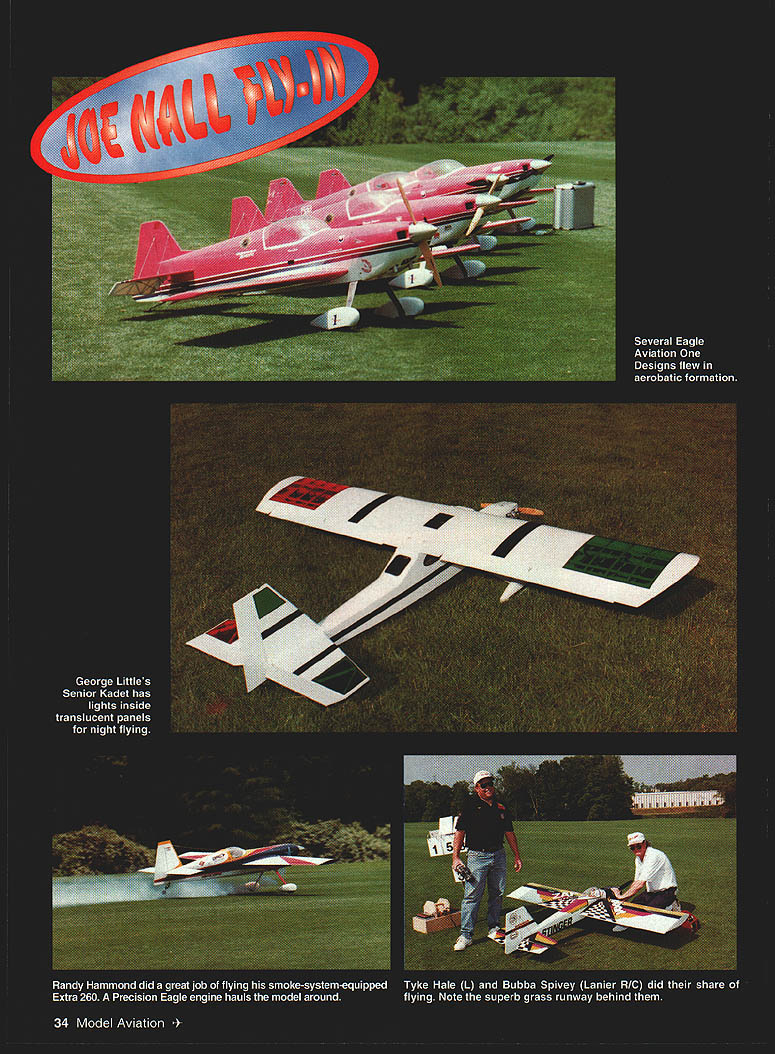
The star of the event was an unusual giant-scale airplane: a 67-inch 1936 Free Flight design called the Super Quaker Flash, scaled up five times by Pat Hartness. It’s flown with three channels—rudder, elevator, and throttle—and with a 28-foot wingspan is slightly smaller than a J-3 Cub. The model is powered by a Christen 1,200 cc, 43 hp engine (half of a VW engine) turning a 62x22 propeller. It has a wet weight of 407 pounds and a wing loading of 4 lb./sq. ft. The servos on the rudder and elevator are Seico SSPS105s; they deliver 5,278 oz./in. of torque. The model is covered with Stits 1.7-pound Dacron finished with Stits urethane enamel. Building began in October 1995 and the model’s first flight was in April 1996. Many people helped make this project possible.
Every time the Quaker was flown at the meet, pilots lined up for a turn and wrote their names in a flight logbook—Pat hoped to have more than 300 names by the end of the event. I had my turn at the controls; it flew like a trainer and was only flown after regular flying ended and under ideal wind and safety conditions.
Seminars and evening events
On Thursday evening Bruce Landsberg, Executive Director of the AOPA Air Safety Foundation, presented an interactive weather safety seminar in the Hartness hangar in memory of Joe Nall. The seminar, titled “Never Again,” dealt with deadly aviation weather challenges. Although not specifically aimed at RC models, it emphasized the importance of private pilots using common sense to avoid life-threatening situations—advice relevant to RC fliers as well.
Friday night, at the Hartness hangar, wildlife artist John Gribben presented a painting to Robert Kilby. Robert gave a personal account of a B-17 raid to Poznan, Poland, of which he was a part; 19 of 33 aircraft made it back. The painting portrayed the remaining B-17s returning over the English Channel. Afterwards we heard tall tales from Skip Sheldon, a retired corporate pilot.
Saturday evening featured the famous barbecue in the Hartness backyard. Approximately 1,000 people gathered to enjoy food, friendship, and a bluegrass band—possibly the largest crowd ever for this party. The organizers did a remarkable job serving large amounts of food quickly; everyone had plenty to eat and drink.
Awards and remembrance
One of the highlights is the awards program held on Saturday afternoon. The Joe Nall Award, a non-competition traveling trophy, is presented to the pilot who best exemplifies fairness, sharing, camaraderie, and the ideals of a good RC’er; past recipients select the winner. This year Curtis Mess of Lawrenceville, Georgia, a longtime member of the Peach State Quarter Scalers, received the honor.
The Bob Smith Award, another traveling trophy, is presented to the pilot whose models do the most realistic flying. The judges had a tough choice among many excellent pilots; Joe Grable of Winter Haven, Florida, won for his flying with a Cessna Skymaster.
A moment of silent prayer was held in remembrance of Neil Kilby of Monticello, Georgia, who passed away in February. Neil was a past recipient of the Joe Nall Award and will be missed.
Appreciation
I have attended this event for the past nine years and have watched it grow into what it is today. Pat Hartness is proud of his facilities and shares them generously: he allows modelers to use his model shop for repairs, conducts tours through his factory (Hartness International), provides a nature trail, and even hired a greenkeeper from the local golf course to prepare and care for the flying runway. Pat is a true modeler who expresses the warm Southern hospitality we all enjoyed—that’s why we keep coming back.
Special thanks to:
- Kirby McKinney (Event Coordinator)
- Contest Director Mike Gregory
- Joey Griffin (better known as “Buckwheat”) for his untiring efforts
- All those who helped make this super event possible
Until next year.
Photo order
An 8x12-inch aerial shot of the Joe Nall Fly-In is available for $10 (postage paid) from: Jerry Smith, 2416 Carina Terrace, Acworth, GA 30102.
Transcribed from original scans by AI. Minor OCR errors may remain.

