
Joe Raspante, RC Pioneer
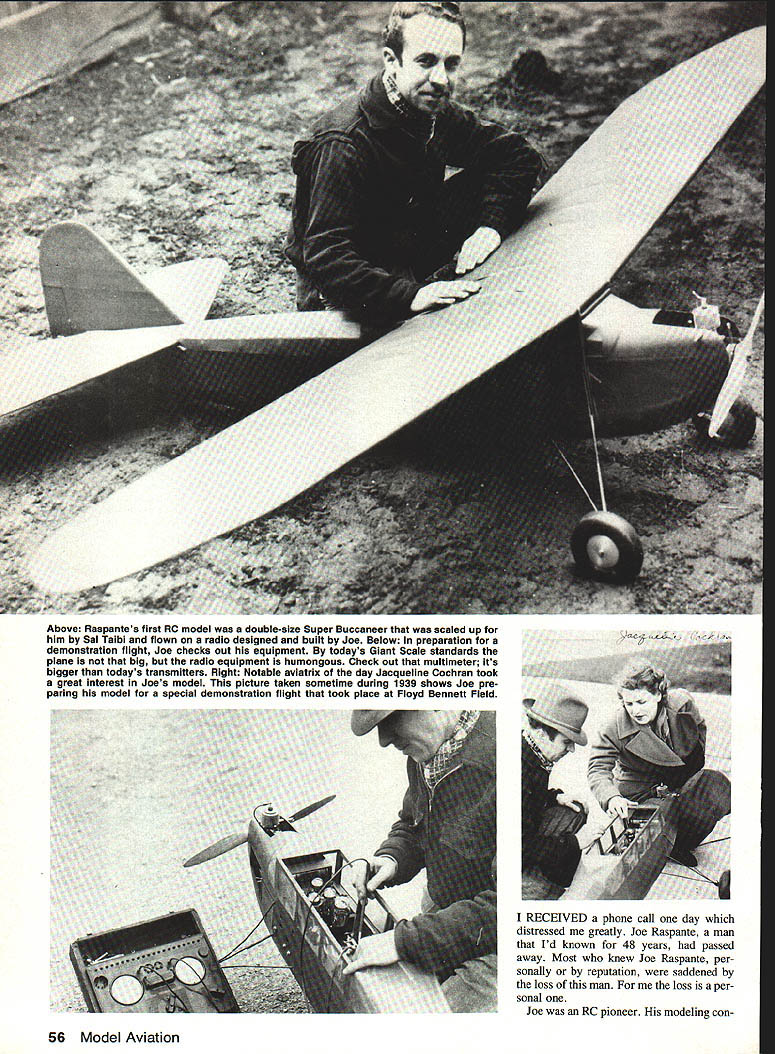
I received a phone call one day that distressed me greatly: Joe Raspante, a man I'd known for 48 years, had passed away. Most who knew Joe personally, or by reputation, were saddened by the loss. For many of us his passing was a personal loss. Joe was an RC pioneer whose modeling and radio contributions spanned decades.
Early life and radio work
- Joe began in ham radio in 1929 as a teenager.
- As his skills with radio equipment grew, he made a living repairing radios.
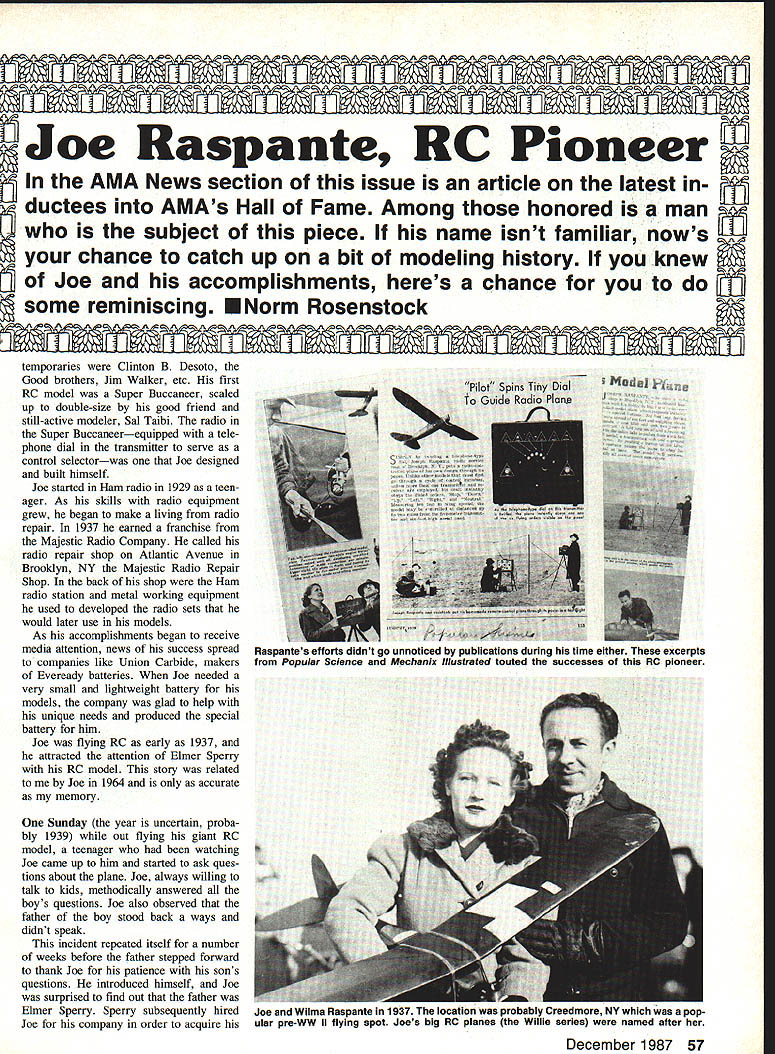
- In 1937 he earned a franchise from the Majestic Radio Company and opened the Majestic Radio Repair Shop on Atlantic Avenue in Brooklyn, N.Y.
- In the back of the shop he maintained his ham station and metal‑working equipment—tools he used to develop radio sets and later his models.
Companies such as Union Carbide (makers of Eveready batteries) noticed his work. When Joe needed very small, lightweight batteries for his models, manufacturers were glad to help and produced special batteries to meet his needs.
Early RC work and Elmer Sperry
Joe was flying RC as early as 1937 and attracted attention at pre‑WWII flying sites such as Creedmore, N.Y. A recurring anecdote involves Elmer Sperry:
One Sunday, probably in 1939, Joe was flying a giant RC model when a teenager who had been watching came up and asked questions. Joe patiently answered. The boy’s father had stood back for weeks before finally stepping forward, thanking Joe and introducing himself—Joe was surprised to learn the man was Elmer Sperry. Sperry subsequently hired Joe to bring his radio-control expertise to the company. Joe worked for Sperry for 27 years until his retirement in 1967.
Notable models and contest history
- Early RC: Joe's first RC model was a Super Buccaneer, scaled up to double size (with help from Sal Taibi). Joe designed and built the radio for it, using a telephone‑dial transmitter as a control selector.
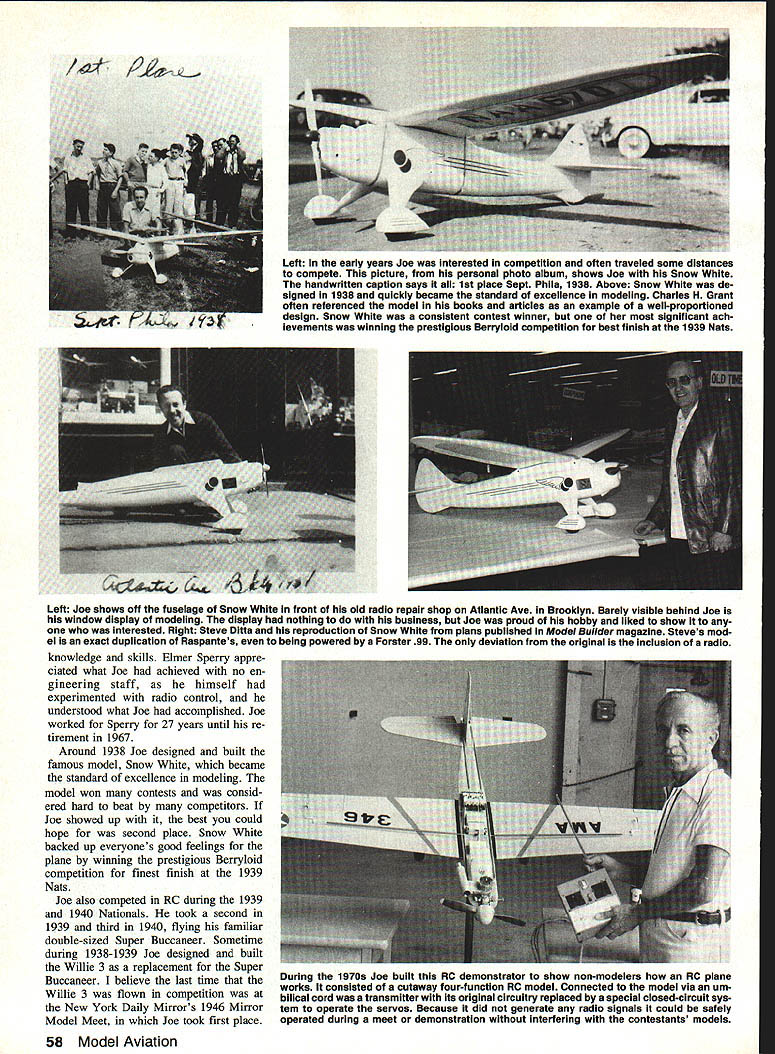
- Snow White (designed 1938): Joe’s most famous model. Only one Snow White was ever built; it became a standard of excellence and a consistent contest winner. Snow White won significant honors, including the prestigious Berryloid competition for finest finish at the 1939 Nationals. Charles H. Grant and others frequently referenced Snow White for its well‑proportioned design.
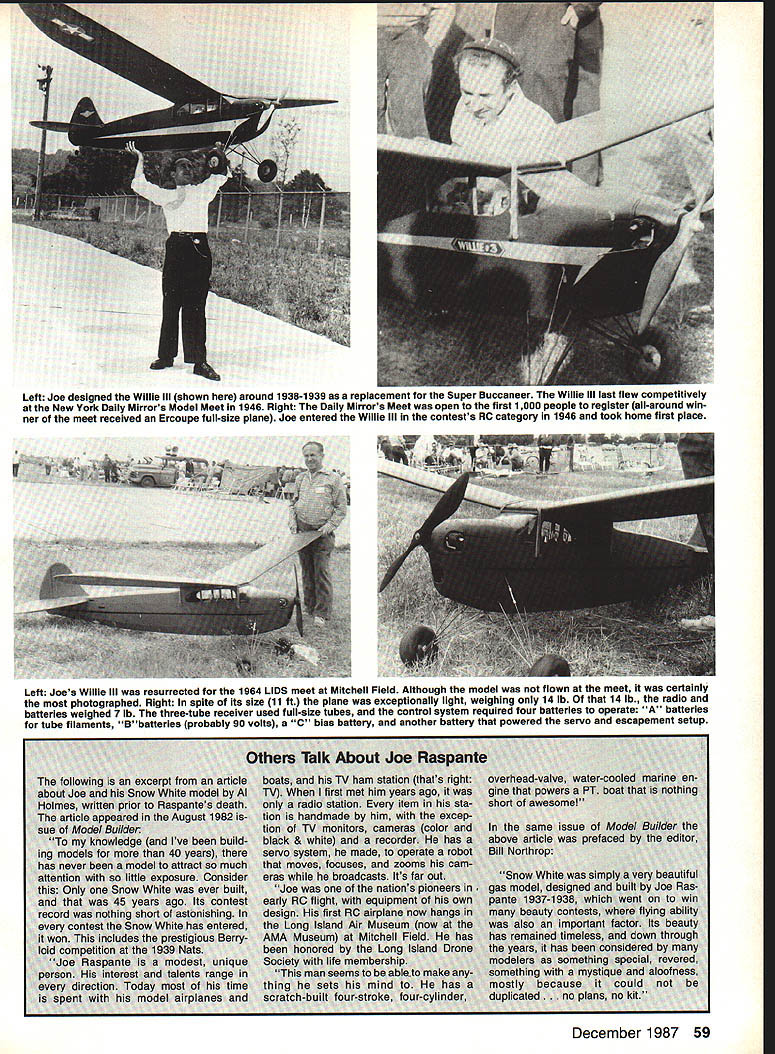
- Willie series: Sometime in 1938–39 Joe designed the Willie 3 as a replacement for the Super Buccaneer. The Willie 3 won first place at the New York Daily Mirror’s 1946 Mirror Model Meet.
- Nationals: Joe competed in the RC events at the 1939 and 1940 Nationals (second in 1939, third in 1940 flying his double‑sized Super Buccaneer).
Joe’s models were well known and respected; when he showed up at a contest, competitors knew they were facing one of the best.
Public appearances and media
- Joe’s accomplishments were featured in Popular Science and Mechanix Illustrated.
- He was a guest on John Gambling's "Model Airplane Club of the Air" program on the WOR‑Mutual Network on November 25, 1939, where he gave RC modeling tips.
- He attended local meets regularly and brought demonstrations to help the public understand RC modeling.
The Willie 3 revival (1964) — attic rescue and flight
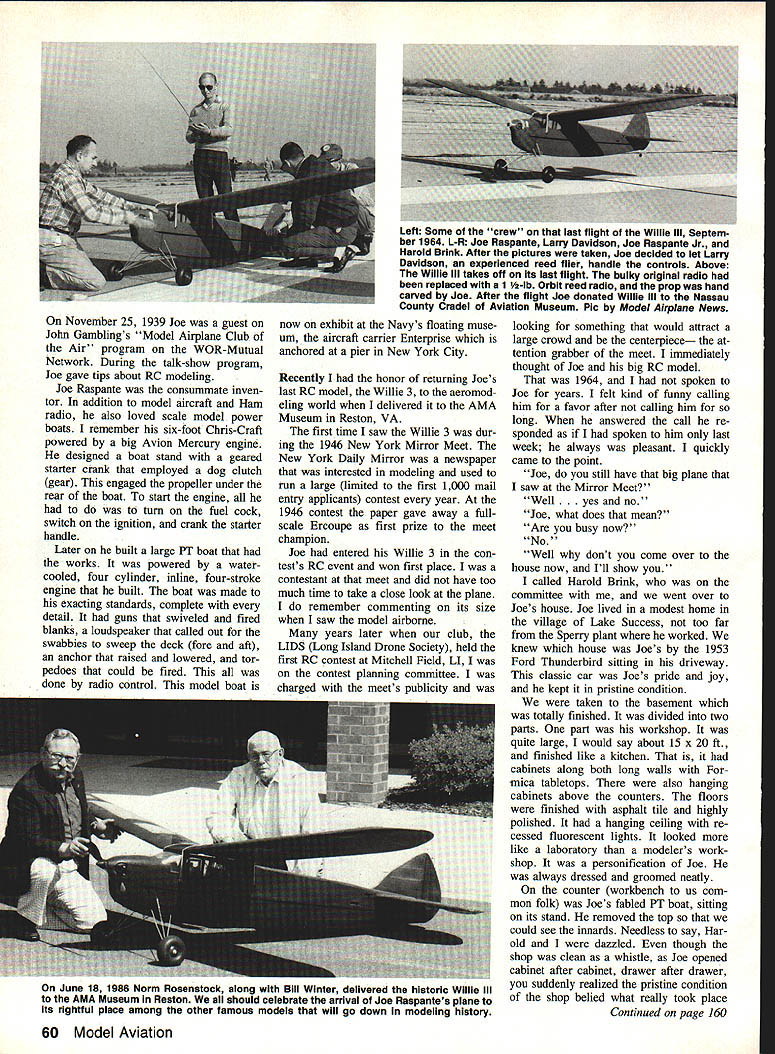
In 1964 the author and others sought a centerpiece to attract a crowd for an RC contest at Mitchell Field. Joe revealed that his large planes had long been stored in the eaves of his attic. From a small access panel they pulled out parts of Snow White and the Willie 3. The Willie 3 wing was brittle and needed recovering; with help from Harold Brink (who volunteered to silk‑cover the wing), they refurbished the plane in time for the meet.
Joe later equipped the Willie 3 with modern Orbit 8‑channel reed equipment. Because Joe built very light, the refurbished plane was lighter than the original and had handling challenges. On its 1964 flight, Larry Davidson flew the Willie 3. The model climbed and was difficult to bring down because it was so light; helpers had to run under it to grab the wheels and finally bring it safely to earth. That was the Willie 3’s last flight. Joe later planned to donate the plane to the Nassau County Museum, and the author delivered the Willie 3 to the AMA Museum in Reston, VA.
Photos of that 1964 flight were published in Model Airplane News (1965).
Boats, engines, and other inventions
Joe was a consummate inventor beyond aircraft. He loved scale power boats and built remarkable examples:
- He built a six‑foot Chris‑Craft powered by a large Avion Mercury engine.
- He designed a geared starter crank/ dog‑clutch boat stand that engaged the propeller to start engines.
- He scratch‑built a four‑stroke, four‑cylinder, overhead‑valve, water‑cooled marine engine to power a PT boat he built. The PT boat included radio‑operated features: swiveling guns that fired blanks, a loudspeaker for deck commands, anchor raise/lower, and radio‑fired torpedoes. That model boat is now on exhibit at the Navy’s floating museum, the aircraft carrier Enterprise, in New York.
Joe also built a servo system and robotics to operate TV cameras in his broadcast station; at one time he ran TV ham broadcasts with automated camera focus and zoom.
Demonstrator and public outreach
During the 1970s Joe built an RC demonstrator—a cutaway model with four control functions and an umbilical‑connected transmitter hooked to a closed‑circuit servo system. He took this demonstrator to local contests so the public could try controls without risk to contestants. Joe attended almost every local meet, helping educate spectators and promoting RC modeling widely.
Honors and recognition
- Honored in an AMA News item among inductees to the AMA’s Hall of Fame.
- Life membership awarded by the Long Island Drone Society.
- Joe’s first RC airplane now hangs in the Long Island Air Museum (AMRA Museum) at Mitchell Field.
- His boat exhibits are displayed at the USS Enterprise museum.
Others talk about Joe Raspante
The following excerpt is from an article about Joe and Snow White by Al Holmes (appearing in Model Builder, August 1982):
"To my knowledge (and I've been building models for more than 40 years), there has never been a model to attract so much attention with so little exposure. Consider this: Only one Snow White was ever built, and that was 45 years ago. Its contest record was nothing short of astonishing. In every contest the Snow White has entered, it won. This includes the prestigious Berryloid competition at the 1939 Nats.
"Joe Raspante is a modest, unique person. His interests and talents range in every direction. Today most of his time is spent with his model airplanes and boats, and his TV ham station (that's right: TV). When I first met him years ago, it was only a radio station. Every item in his station is handmade by him, with the exception of TV monitors, cameras (color and black & white) and a recorder. He has a servo system he made to operate a robot that moves, focuses, and zooms his cameras while he broadcasts. It's far out.
"Joe was one of the nation's pioneers in early RC flight, with equipment of his own design. His first RC airplane now hangs in the Long Island Air Museum (now at the AMRA Museum) at Mitchell Field. He has been honored by the Long Island Drone Society with life membership.
"This man seems to be able to make anything he sets his mind to. He has a scratch‑built four‑stroke, four‑cylinder, overhead‑valve, water‑cooled marine engine that powers a P.T. boat that is nothing short of awesome!"
Bill Northrop, editor of Model Builder, prefaced that article:
"Snow White was simply a very beautiful gas model, designed and built by Joe Raspante, 1937–1938, which went on to win many beauty contests, where flying ability was also an important factor. Its beauty has remained timeless, and down through the years it has been considered by many modelers as something special, revered, something with a mystique and aloneness, mostly because it could not be duplicated ... no plans, no kit."
Contemporaries
- Clinton B. DeSoto
- The Good brothers
- Jim Walker
- Sal Taibi (friend and modeler)
- Charles H. Grant (author who referenced Snow White)
Legacy
Joe Raspante was a modest, meticulous craftsman and an enthusiastic promoter of RC modeling. He combined radio expertise, mechanical skill, inventive imagination, and a gift for teaching. His demonstrations and public outreach helped enhance the image of RC modeling with the general public and the AMA. We have all suffered a loss now that he is no longer with us.
Transcribed from original scans by AI. Minor OCR errors may remain.

