
Jouster
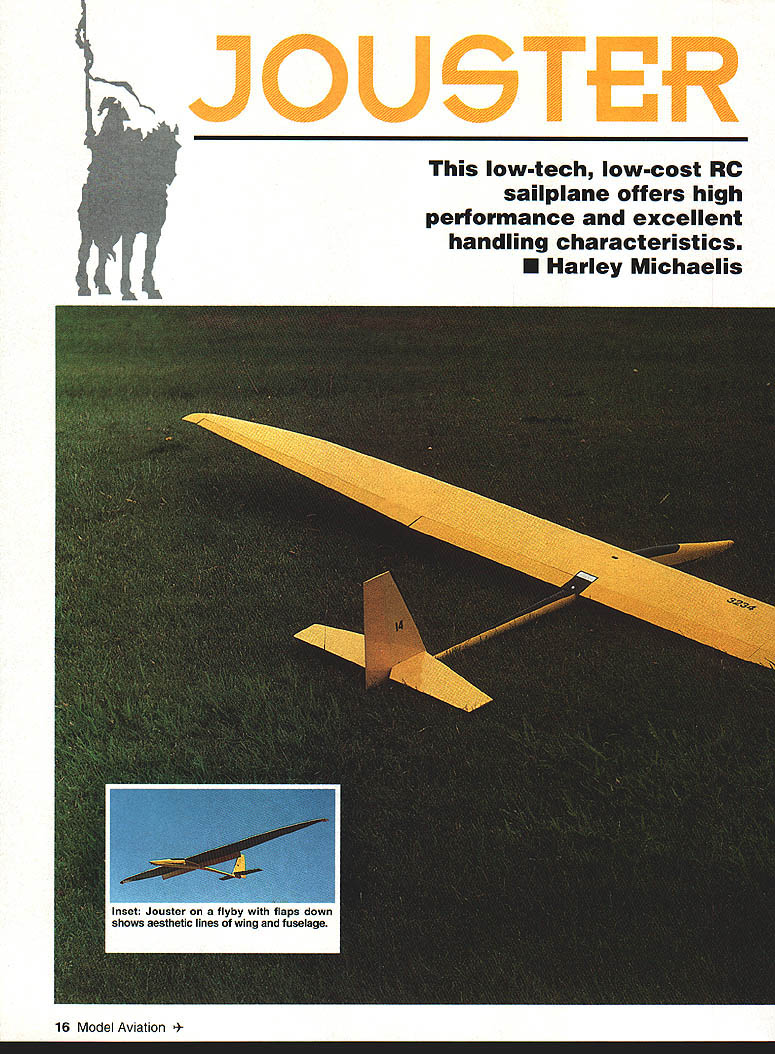
This low-tech, low-cost RC sailplane offers high performance and excellent handling characteristics. — Harley Michaelis
The Jouster originated with the Atrix (December 1986 MA). It is an efficient, sophisticated sailplane specifically designed for low-tech, low-cost scratch-building. When properly built and trimmed, it should please even the most discriminating soaring pilots. While designed for competition, its easy handling suits it to sport flying as well.
Performance and handling
- Excellent thermal performance: tows steeply, zooms well, buoyant and thermal-sensitive.
- Responsive to stick input: flat turns on rudder only; strong coupled turns with ailerons.
- Safe at speed; descends vertically with flaps down and slows well for landings.
- Gentle stalls; especially flat glide with low sink rate and good penetration without ballast.
- Predictable and free of bad habits.
- Can utilize advanced radio features but is flyable with a basic four-channel set.
Using the only Jouster flown in Expert class in 1990, Harley Michaelis finished first in season points standing in the NWSS. Although he has completed Level 5 League of Silent Flight (LSF) requirements, he credits the model rather than any special personal expertise.
Design origins and development
- The design evolved from the Atrix; Harley has built about 30 sailplanes of this general type, including 16 Jousters, refining the design over time.
- Various airfoils have been used: E205, S2091, S4061, SD7037, and the favored SD7032 with fully sheeted foam cores.
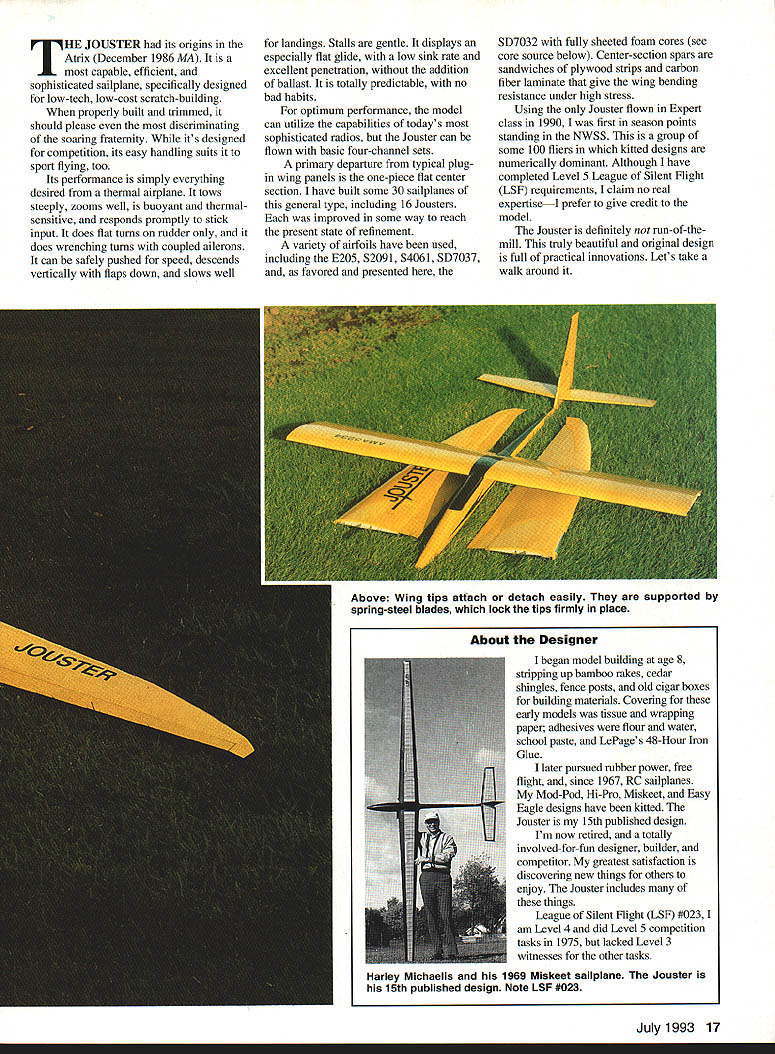
- The wing uses a one-piece flat center section (a primary departure from typical plug-in wing panels).
- Center-section spars are plywood-strip sandwiches with carbon-fiber laminate for bending resistance under high stress.
- Wing planform is a Schuemann variation with a straight trailing edge and several breaks to provide clean chordwise airflow.
Cleanliness and aerodynamic detailing
The model emphasizes aerodynamic cleanliness and tight fits:
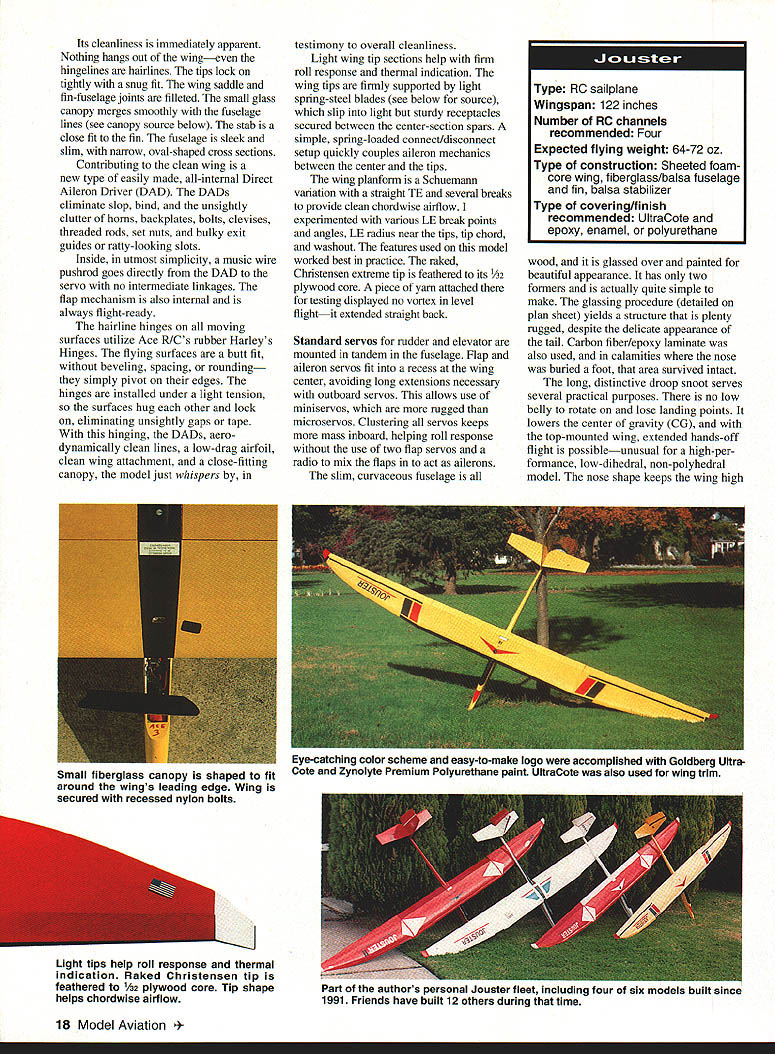
- Hairline hingelines; tips lock tightly and snugly at the wing saddle.
- Fin-fuselage joints filleted; small glass canopy merges smoothly with fuselage lines.
- Stab fits closely to fin; the fuselage has sleek, slim, narrow oval cross sections.
- Low-drag airfoil, close-fitting canopy, and clean wing attachment contribute to very low drag.
Control systems and mechanisms
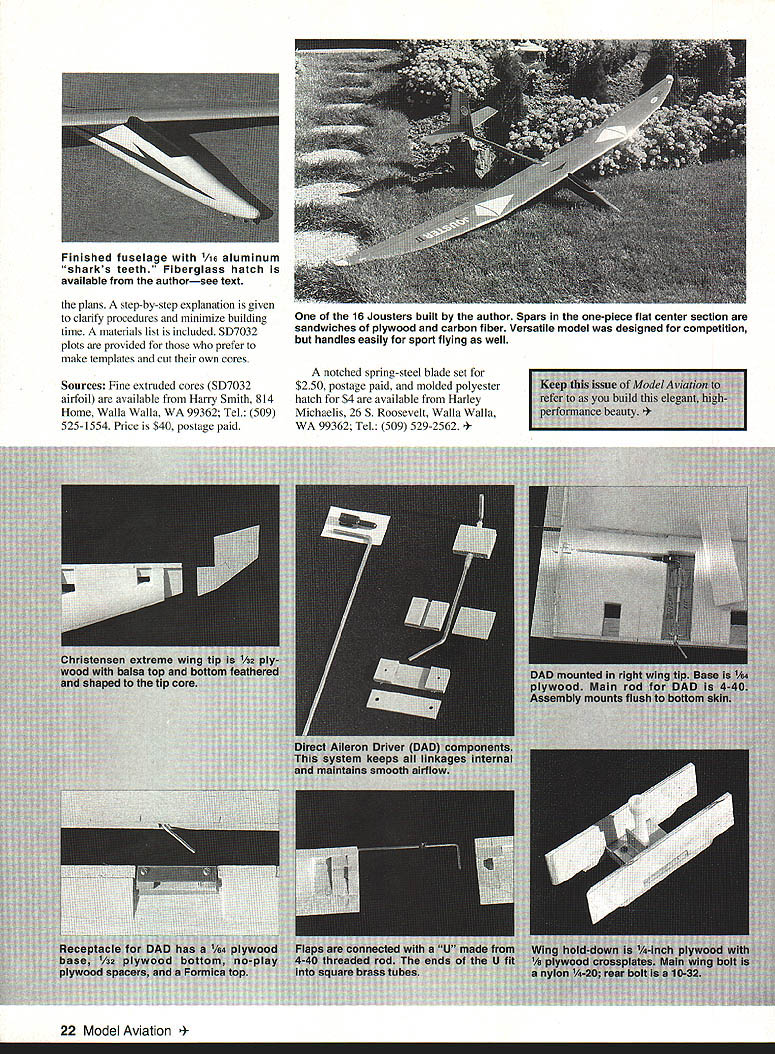
- Direct Aileron Driver (DAD): an easily made, all-internal device that eliminates slop, bind, and external clutter (horns, backplates, clevises, threaded rods, etc.). A music-wire pushrod goes directly from the DAD to the servo—no intermediate linkages.
- Flap mechanism is internal and always flight-ready.
- Hairline hinges on all moving surfaces use Ace R/C's rubber "Harley's Hinges."
- Flying surfaces are butt-fit and pivot on their edges; hinges installed under light tension make surfaces lock and eliminate gaps (tape hinging).
- Wing tips: light tip sections for firm roll response and thermal indication. Tips are supported by light spring-steel blades that slip into sturdy receptacles secured between center-section spars. A simple spring-loaded connect/disconnect couples aileron mechanics between the center section and tips.
- Standard rudder and elevator servos are mounted in tandem in the fuselage. Flap and aileron servos sit in a recess at the wing center, allowing use of mini servos (more rugged than microservos) and keeping mass inboard to help roll response. This avoids the need for two flap servos and radio mixing.
Fuselage, tail, and landing
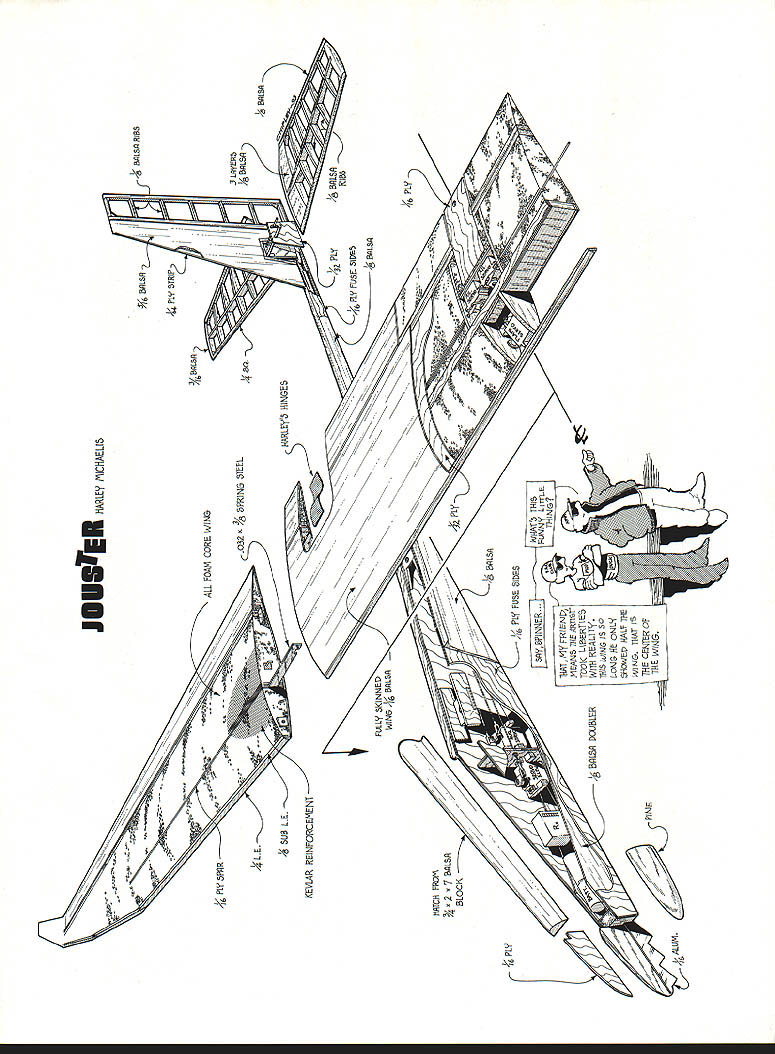
- The fuselage is all wood, glassed, and painted for a refined appearance. Construction uses only two formed frames and is relatively simple to build. Carbon fiber/epoxy reinforcement is used in high-stress areas.
- Long droop "snoot" nose: lowers the center of gravity, avoids a low belly that can catch at touchdown, and keeps the wing high with a top-mounted wing—allowing extended hands-off flight unusual for high-performance, low-dihedral designs.
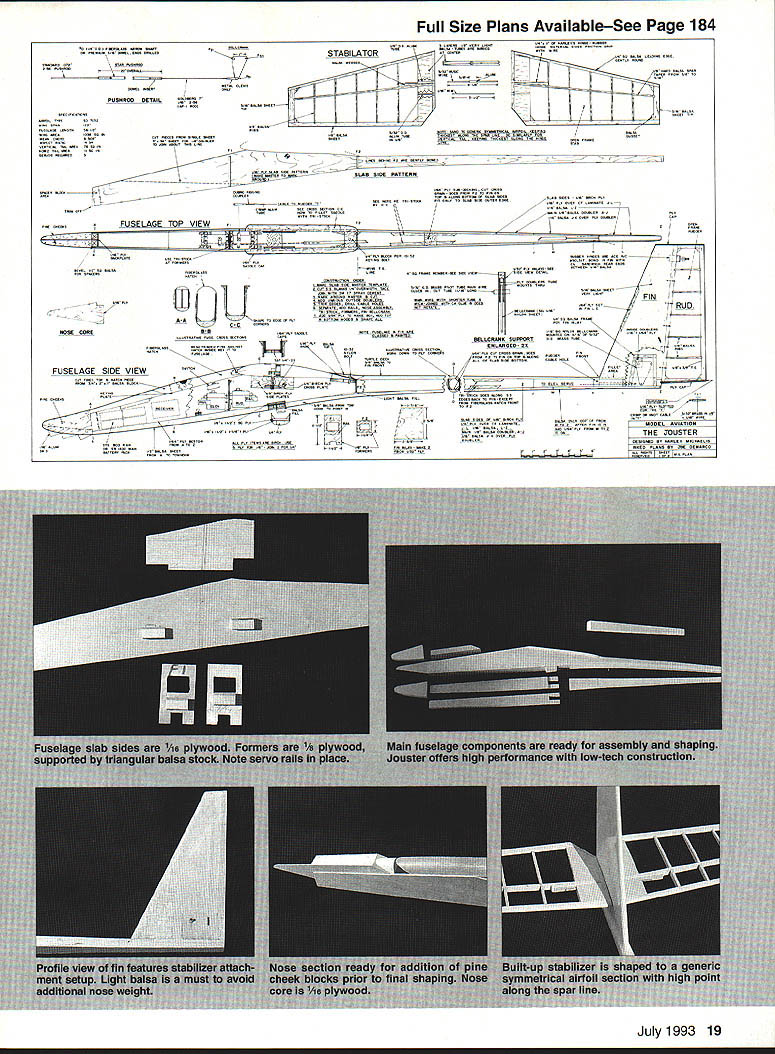
- Fuselage slab sides: 1/16" plywood; formers: 1/8" plywood supported by triangular balsa stock.
- All-moving stabilizer: rigid mount, pushrod, and triangular bellcrank for a well-defined neutral setting. Internal rubber grippers securely retain the stab halves for positive pitch control across speeds.
- Rudder is cable-operated.
- Landing aids: low-point integral "shark's teeth" at the nose dig into the ground to brake the model. Small, light canopy less likely to come off in sudden stops. With a level, slow approach and flaps neutralized just before touchdown, the Jouster typically "pancakes" and stays at the intended spot.
Power, weight, and balance
- Nose space accommodates a Sanyo 800‑mAh "stick" battery pack; SR makes a 1,400‑mAh pack of similar size and weight. Using these packs and a light tail makes it possible to achieve desired CG without lead in the nose.
- Typical completed weights: 64 to 72 ounces, giving wing loadings of about 9 to 10 ounces per square foot.
Plans and construction information
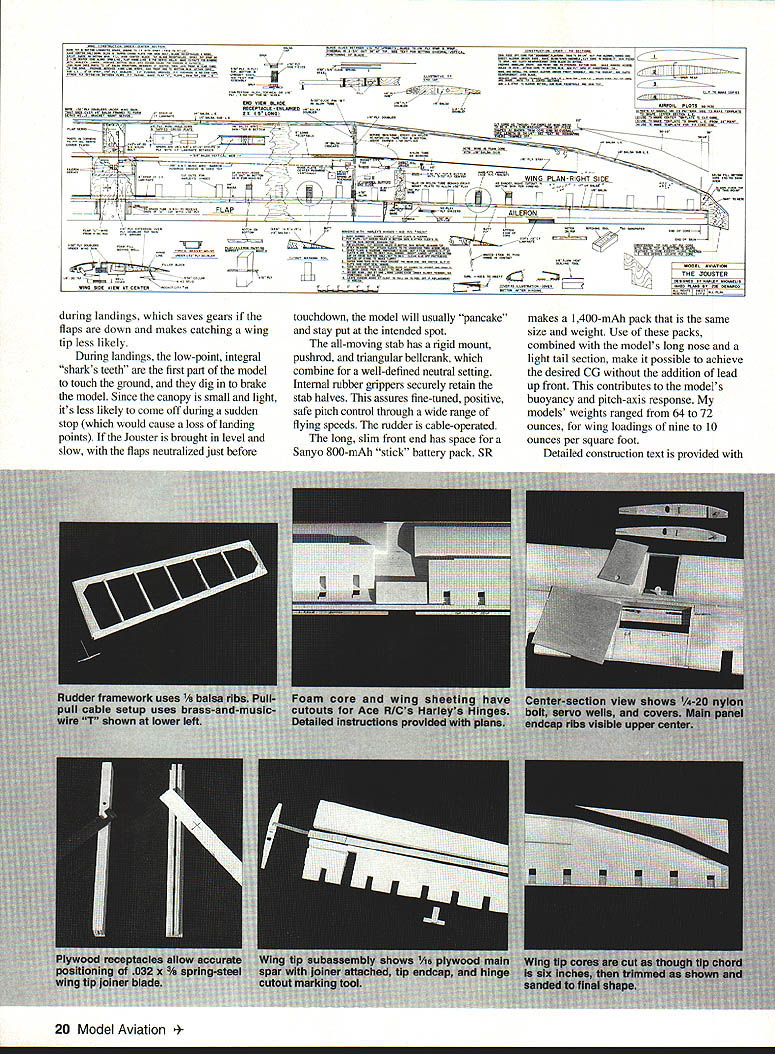
- Plans include step-by-step construction text, a materials list, and SD7032 plots for those who prefer to make templates and cut their own cores.
- Main fuselage components and assembly/shaping instructions are provided on the plan sheets.
About the Designer
I began model building at age 8, using bamboo rakes, cedar shingles, fence posts, and old cigar boxes. Early coverings were tissue and wrapping paper; adhesives included flour-and-water paste and LePage's 48-Hour Iron Glue.
I later pursued rubber power and free flight, and since 1967 have concentrated on RC sailplanes. My Mod-Pod, Hi-Pro, Miskeet, and Easy Eagle designs have been kitted. The Jouster is my 15th published design.
I am now retired and fully involved as a designer, builder, and competitor. My greatest satisfaction is discovering new things for others to enjoy. League of Silent Flight (LSF) #023. I am Level 4 and completed Level 5 competition tasks in 1975, though I lacked Level 3 witnesses for some tasks.
Sources
- SD7032 extruded foam cores: Harry Smith, 814 Home, Walla Walla, WA 99362; Tel.: (509) 525-1554. Price: $40, postage paid.
- Notched spring-steel blade set and molded polyester hatch: Harley Michaelis, 26 S. Roosevelt, Walla Walla, WA 99362; Tel.: (509) 529-2562. Spring-steel blade set: $2.50 postage paid; molded polyester hatch: $4.00.
Transcribed from original scans by AI. Minor OCR errors may remain.

