
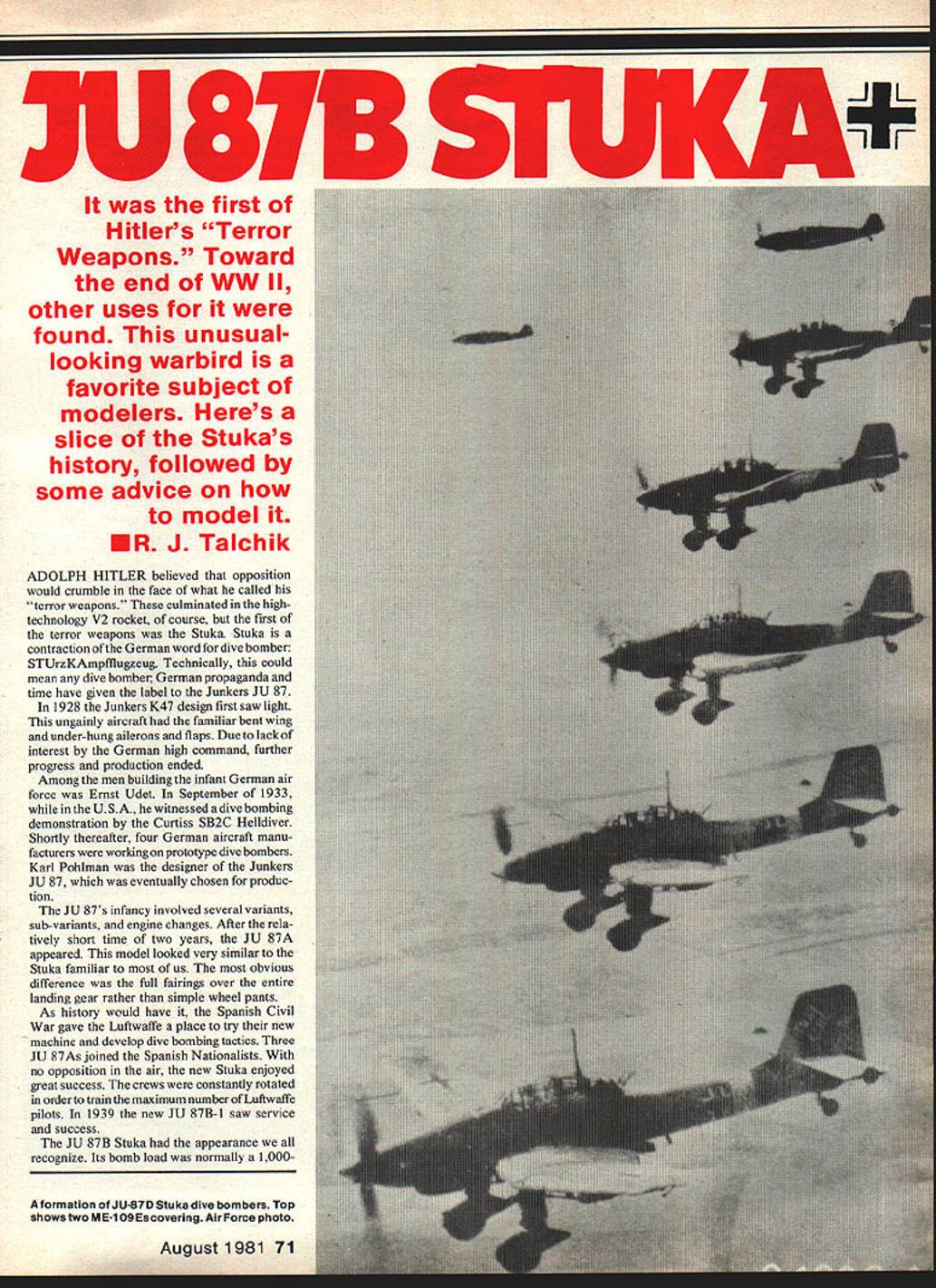
JU 87B Stuka
It was the first of Hitler's "terror weapons." Toward the end of WWII, other uses for it were found. This unusual-looking warbird is a favorite subject of modelers. Here's a slice of the Stuka's history, followed by some advice on how to model it. ■ R. J. Talchik
Introduction
Adolf Hitler believed that opposition would crumble in the face of what he called his "terror weapons." These culminated in the high-technology V-2 rocket, of course, but the first of the terror weapons was the Stuka. "Stuka" is a contraction of the German word for dive bomber, Sturzkampfflugzeug. Technically this could mean any dive bomber; German propaganda and time have given the label to the Junkers Ju 87.
Early development
In 1928 the Junkers K 47 design first saw light. This ungainly aircraft had the familiar bent wing and under-hung ailerons and flaps. Due to lack of interest by the German high command, further progress and production ended.
Among the men building the infant German air force was Ernst Udet. In September 1933, while in the U.S.A., he witnessed a dive-bombing demonstration by the Curtiss SB2C Helldiver. Shortly thereafter, four German aircraft manufacturers were working on prototype dive bombers. Karl Pohlman was the designer of the Junkers Ju 87, which was eventually chosen for production.
The Ju 87's infancy involved several variants, sub-variants, and engine changes. After a relatively short period, the Ju 87A appeared. This model looked similar to the Stuka familiar to most: the most obvious difference being full fairings over the entire landing gear rather than simple wheel pants.
Combat testing and Spanish Civil War
The Spanish Civil War gave the Luftwaffe a place to try their new machine and develop dive-bombing tactics. Three Ju 87As joined the Spanish Nationalists. With little opposition in the air, the new Stuka enjoyed great success. Crews were constantly rotated to train the maximum number of Luftwaffe pilots. In 1939 the new Ju 87B-1 saw service and success.
Design and performance
The Ju 87B Stuka had the appearance most recognize. Typical characteristics and performance:
- Bomb load: normally a 1,000-lb bomb mounted on a "swing" under the fuselage (the swing kept the bomb clear of the propeller arc); sometimes a 500-lb bomb on the swing and four small bombs on wing pylons. Maximum bomb load was about 1,500 lb.
- Armament: two forward-firing wing-mounted .30-caliber machine guns and a single .30-caliber rearward-firing machine gun.
- Protection: cockpit armor plating about 1/4 inch thick.
- Performance: top speed about 230 mph; with a 1,000-lb bomb load, normal operating speed about 175 mph.
- Range: approximately 370 miles.
The Stuka also had features that made life difficult for pilots and crews: loss of elevator control in a steep dive (in some cases), frequent landing gear failures, cracked propellers, frozen fuel tanks and oil coolers, and bombs that sometimes failed to detonate.
Early WWII operations
On September 1, 1939, Germany invaded Poland. Luftwaffe Stuka groups supported the Wehrmacht's first Blitzkrieg. Germany enjoyed virtually total air superiority, and Stukas operated as highly accurate, effective artillery; pockets of resistance could be removed with little risk. The Ju 87's air-driven siren in a dive produced a screeching howl, often leaving ground troops frozen and unable to seek cover. Hitler's terror weapon seemed to work.
In April 1940 Germany attacked Denmark and Norway. Denmark fell quickly; in Norway the battle was harder fought. Germany then attacked France, Belgium and the Netherlands. Belgian and Dutch air forces offered little opposition. The French air force, equipped in part with many obsolete aircraft, could only put up limited resistance—especially when Stukas were escorted by Messerschmitt Me 109s. Again, the terror weapon decimated the enemy at close hand.
In May 1940 Allied forces began evacuating Dunkirk. Hermann Göring, commander of the Luftwaffe, had guaranteed the air force would smash the French and British troops. When the Stuka was introduced to the RAF it was grossly overmatched. Me 109 escorts could not always protect them; Stuka losses were very heavy when confronted by British Spitfires and Hurricanes, which were roughly 100 mph faster and far more maneuverable.
In July and August 1940 Stukas were used in several ill-fated attacks on England; the terror weapon became a death trap for many German pilots. By the end of August the Ju 87s were relocated to the Pas-de-Calais area of France and never again operated over British airspace. The Luftwaffe learned that air superiority was a necessary condition to operate the Stuka. This left two main areas of operation for the type: the Eastern Front (Russia) and North Africa.
Eastern Front and later variants
In June 1941 Ju 87Bs shifted to the Russian front. At that time the Soviet air force was in poor condition and the Stuka again enjoyed great success. In January 1942 the new Ju 87D appeared on the eastern front.
In mid-1942 the Wehrmacht drove toward Stalingrad and the Russians began to offer stiff resistance; Stuka losses became very high. (African and Soviet operations reportedly lost about 150 Stukas per month.) The success of the Soviet T-34 tank led to development of the Ju 87G "Tank Buster." The G was essentially a D model fitted with a 37 mm cannon mounted under the wing (on strengthened gear/pylons) to attack armor. This proved a highly effective and mobile anti-tank weapon. In the latter part of the war the Ju 87G "Panzerknacker" often served more importantly as an anti-tank platform than as a dive bomber.
North Africa
When the Luftwaffe used the Stuka in North Africa, sand caused problems: air intakes required sand filters, and crews required desert survival kits. Both Ju 87Bs and Ds were used, and their ground crews left modelers with several attractive color schemes.
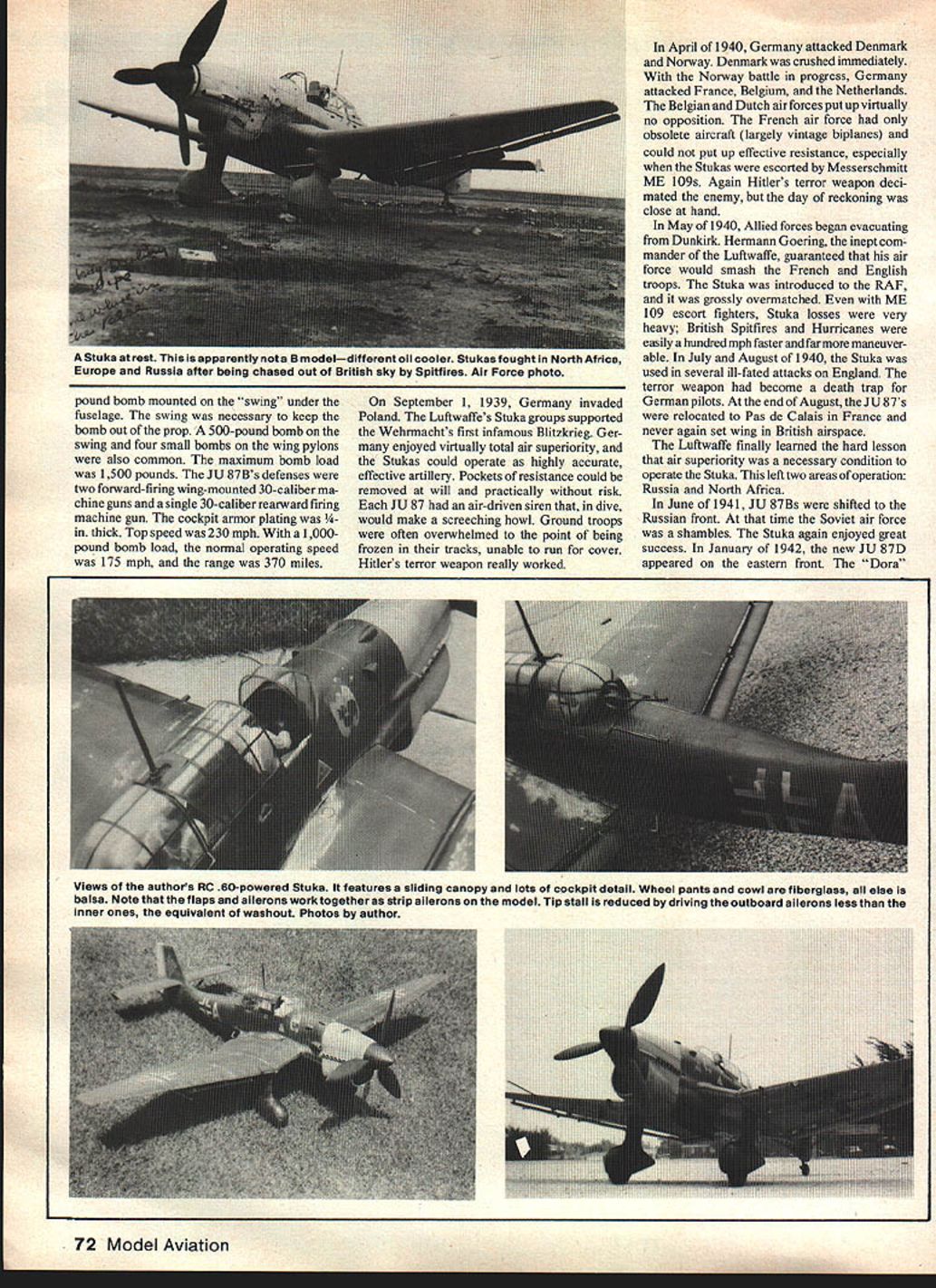
In North Africa the Stuka often operated as a low-level ground support aircraft for the Afrika Korps. When caught by Allied fighters such as P-40s, the Stukas suffered heavy losses. While Rommel and Montgomery pushed and counter-pushed in the desert, it is unlikely the Stuka alone made a decisive difference.
Assessment
The Stuka started WWII as Hitler's first terror weapon. By the end it was largely obsolete and increasingly ineffective without air superiority. To the aircraft buff, however, the Stuka remains one of the most distinctive-looking aircraft of all time.
The Stuka as a model
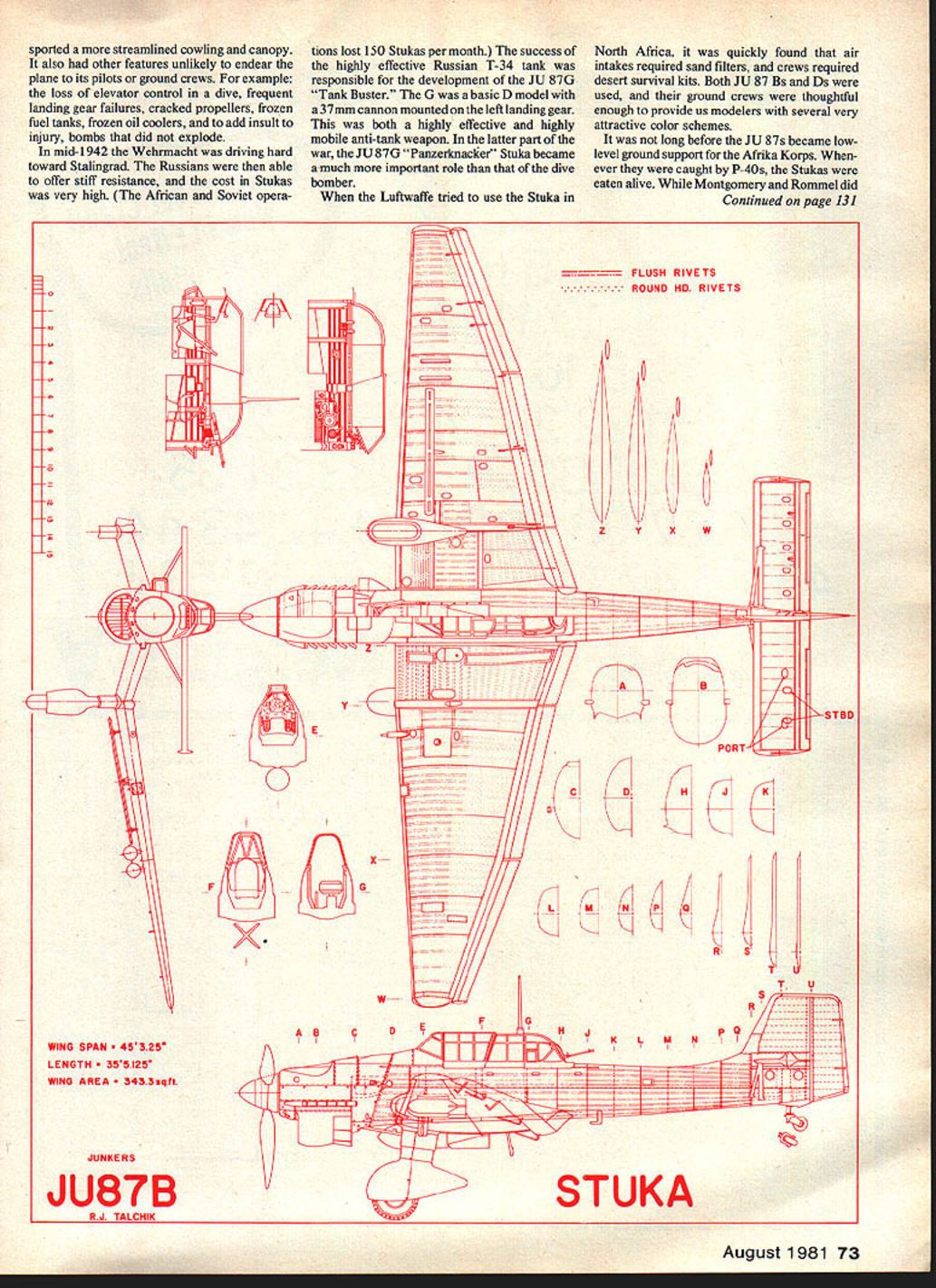
Several years ago I built a model of the Ju 87B. The drawing presented here results from my research. While this is not a construction article, I hope to pass along some of the knowledge I gained the hard way.
Recommended scale and size
- Ideal power: .60 engine for radio control.
- Recommended scale: 1/8 scale (1 1/2 in. to the foot).
- Resulting dimensions: wingspan about 68 in.; wing area about 772 sq. in.
- Weight: the model can weigh about 9 lb without problems; keep the tail light.
- Center of gravity: stabilizer is small—C.G. roughly 25% of the wing root chord.
Control surfaces and handling
- Ailerons: the Stuka ailerons are unique. Use both the ailerons and the outer flaps as strip ailerons.
- Tip-stall tendency: reduce outboard aileron throw relative to inboard to lessen tip-stall tendency.
Construction notes
- Canopy: a reasonably accurate canopy was available from Complete-A-Pac plans.
- Spinner: a 3 1/4 in. P-51 spinner is very close to scale.
- Wheel pants and cowling: these were made from fiberglass; otherwise construction was all balsa.
- Landing gear: make the landing gear stout.
The B & D kit that was once available could be built into a fairly accurate model. I have not examined other kits closely.
Sources and recommended references
- Profile Publications, #211 and #76.
- The Stuka Story, by Heinz Nowarra, Caier Publishing.
- Junkers Ju 87 Stuka, Aero Publishers, Inc.
- Revell 1/32 scale Ju 87B model.
Transcribed from original scans by AI. Minor OCR errors may remain.

