
Junior FF World Champs
We bring you a report by one of the U.S. contestants in this first-ever event. With 19 nations participating, it's not likely to be the last.
Melinda Anderson
Background
My adventure really began in August 1987 when Model Aviation magazine announced the possibility of a World Championships for Juniors to be held in Poland during the summer of 1988. FAI rules would apply. I responded to this announcement, knowing it would be a real challenge.
Months passed. Then one day we received a phone call telling us that the AMA Executive Council had voted funds to make it possible for a Junior team to participate. I knew what I wanted to build, and started building my airplanes just in case I would be lucky enough to be selected.
I was excited about the challenge, but I was in my senior year in high school and had second thoughts about having sufficient time to prepare properly for this high level of competition against the best in the world. Those second thoughts lasted all of five seconds, and I decided to "go for it"!
Taking Mr. Bill Gibbons' advice (he's chairman of the AMA Free Flight Team Selection Committee), I wrote to Bob White to ask for guidance about the preparations needed so that I could be really competitive. Bob White made an audiotape for me and mailed it. I used it often, to make sure I fully understood all that he suggested and to do the best I could to get ready for the forthcoming contests.
Preparing for the Championships
We expected the model-building portion of the task to be second nature and short-lived, but it didn't turn out that way. Progress was slow due to my commitments as senior class vice-president. In addition, responsibilities as a ski instructor ate up my weekends. Additional delays occurred as a result of discussions about airplane configuration and construction methods. Many experienced adult fliers who had been active in FAI programs were ready and willing to offer guidance, and we needed to absorb and use their valuable suggestions.
Selection of the team was delayed until April 1988, which made it difficult to really get my "motor" going at high speed. I had no firm idea whether I would make the team. I can smile about it now, but I can still remember what a thrill it was when I got the good news. I was going to Poland.
Then came more questions: what airfoil, what airframe layout, bunt or no bunt, what engine? Decisions were made, revised, and finally the last several airplanes were built and ready to test. With the help of my brother Glenn and Bob Gutai, we chose two new undercambered-airfoil aircraft, along with two airplanes that had flat-bottomed airfoils and more accumulated flying time. My dad reworked four Rossi 15s and, thanks to Bob Gutai, we had a Galbreath Rossi in the arsenal.
Last-minute setbacks and packing
Tests are not always perfect. One week before we were scheduled to leave for Poland, I strained an airplane straight down through some trees, then blew a wing on another airplane a couple of days later. Late hours and moonlight rebuilding sessions were the order of the day. Once repairs had been completed, packing trials were mandatory. As in every trip, you start by choosing everything you think you will need, then throw out 50% and start over again. Of course, my dad wanted to take the entire shop. We finally boiled everything down to what we felt were essentials, got it all packed—model boxes, suitcases—and it was time to head for the airport.
Journey to Poland
Kennedy Airport in New York was like a zoo—people everywhere. Our team members hadn't had any opportunity to meet each other prior to this gathering for departure. My mom and dad were with me, and of course I knew Bob and Mrs. Sifleet. The Pelatowskis and the Gaglianos were familiar faces from past contests. The rest of the team was a mystery, and it became a game trying to figure out who was who from the thousands of people who were all going somewhere. We decided on a common denominator—look for confused faces accompanied by piles of luggage and monster model boxes emblazoned with AMA stickers. Mike Keller arrived solo from California. Jimmy Buxton came from Pittsburgh. The Tracys, Adam and his dad, arrived. Then the whirlwinds blew in—the Hutchins family, who had been delayed in Dayton for a day because of a snafu in their original ticketing.
At the airline counter the ticket agent's desk was covered with dozens of baggage claim tickets, and he was going nuts trying to keep things straight. This situation created a major problem for us later.
Finally, with all the big stuff turned over to the airline, we got our boarding call and settled into our 747. As the aircraft was pushed away from the gate and the engines were fired up, dense white vapor filled the rear half of the cabin. We couldn't see at all, and I heard Dad tell Mom, "Grab Melinda and the bag with the bucks and the passports, and I'll show you how to get out of here in a hurry if we have to." After a lot of commotion, an announcement that no real problem existed, and a one-hour delay, the ground crew released the airplane and we got under way. In Frankfurt we changed planes and started the final hop to Poland.
Warsaw! The airport was not crowded compared to JFK and Frankfurt. Luggage and model boxes started to appear. We checked and counted, adding up the score, but Matthew Gagliano's model box was nowhere to be seen. We asked the authorities, but after much searching they drew a blank. Bob Sifleet knew a member of the Polish Aero Club who was on hand to meet us. Luckily this man spoke good English, which made our initial attempts to locate the missing box much easier. We concluded that it must have missed the connection in Frankfurt and would surely arrive on a later flight. We left word about our future location in Leszno, and the Polish modeler told us the box would be flown to Matt as soon as it appeared. He said the aero club would look after the details.
Road to Leszno
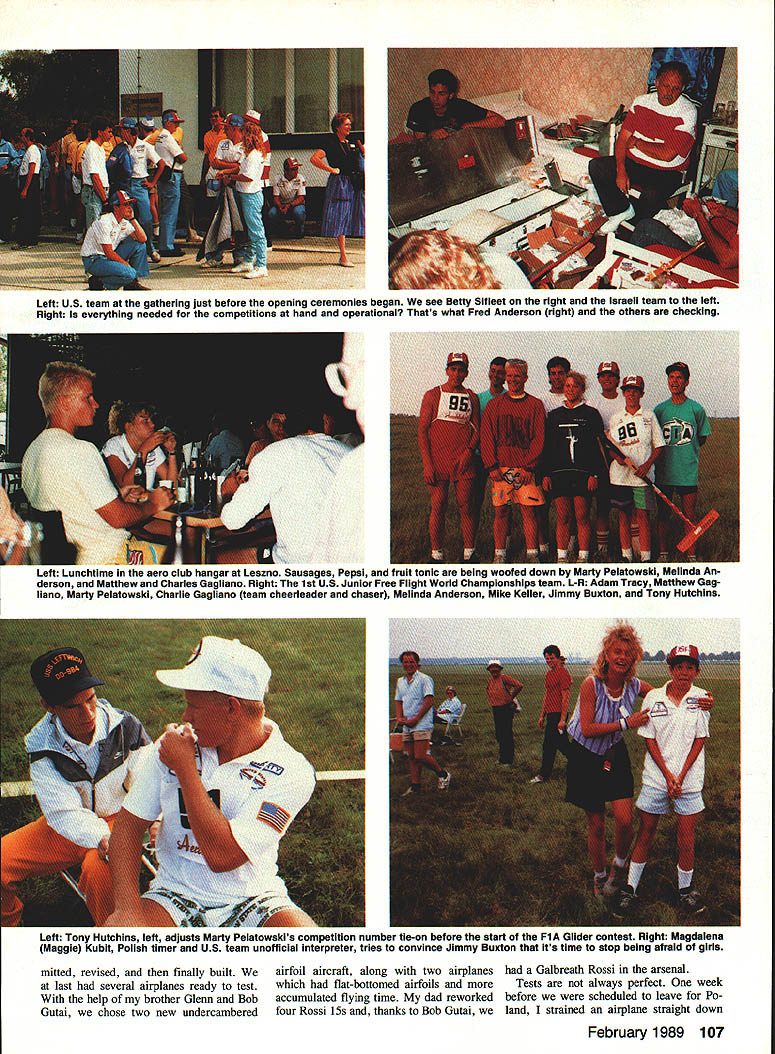
Our next challenge was to pack five small cars with all the bags and boxes, plus ourselves. Yes, we packed, unpacked, repacked, and finally did it. Fifteen people and 45 pieces of luggage were crammed into five small cars. The Polish Aero Club member was our guide, and he led the caravan out of Warsaw and put us on the road to Leszno.
Our guide left us at the outskirts of Warsaw, and we were on our own. Suddenly, Dan Tracy pulled over to the side of the road. His Polonez 150 had quit. So there we were, unable to speak a word of Polish and stopped cold on Highway 5. Raising the hood, we fooled with the ignition and fuel systems without success. We had just about arrived at the "What do we do now?" stage, when a young man and two young women pulled up alongside us with an identical car. This Polonez 150 must be popular, because the young man appeared to be an expert, and after a three-minute look-over he told us what needed to be done. The three of them and Dan were soon under the hood, and before we knew it, the car was running again. He had a trunk full of spare parts which he apparently used to keep it running. He worked on the Tracy vehicle, but to no avail. We had to resort to the Polish/English phrase book and got one of the two Polish girls to telephone the car rental agency for assistance. After what must have looked like a Chinese fire drill with the agency repairman, we got a new car and were on the road again.
Bob and Mrs. Sifleet, along with the Gaglianos and Mike Keller, had gone on ahead. They left about two hours before we got our car exchanged to make sure that the hotel space in Leszno was OK and to say that the remainder of the party would soon be along. Our reduced caravan of four cars took off together. We could figure out the road signs and speed limits, but one hour further along we were pulled over by the militia for speeding. Soon after dark we got separated from the Hutchins and Tracy cars—they seemed to run better and faster. The two slower cars carrying the Pelatowskis and the Andersons were dragging. Seven hours later, due in part to a flat tire at 2:30 a.m. on a dark, deserted road, plus becoming lost a few times, we pulled up at the Palace in Rydzyna and were happy to discover that our hosts were holding a late supper for us.
It was certainly most welcome. We ate and collapsed, grateful for both the food and the rest. When we awoke we found that others had also gotten lost. Tracy and Hutchins had made it as far as Rydzyna but could not find the Palace, which was located on a side road leading off the town square, and spent the remaining hours of darkness in the square.
Leszno and the Opening Ceremony
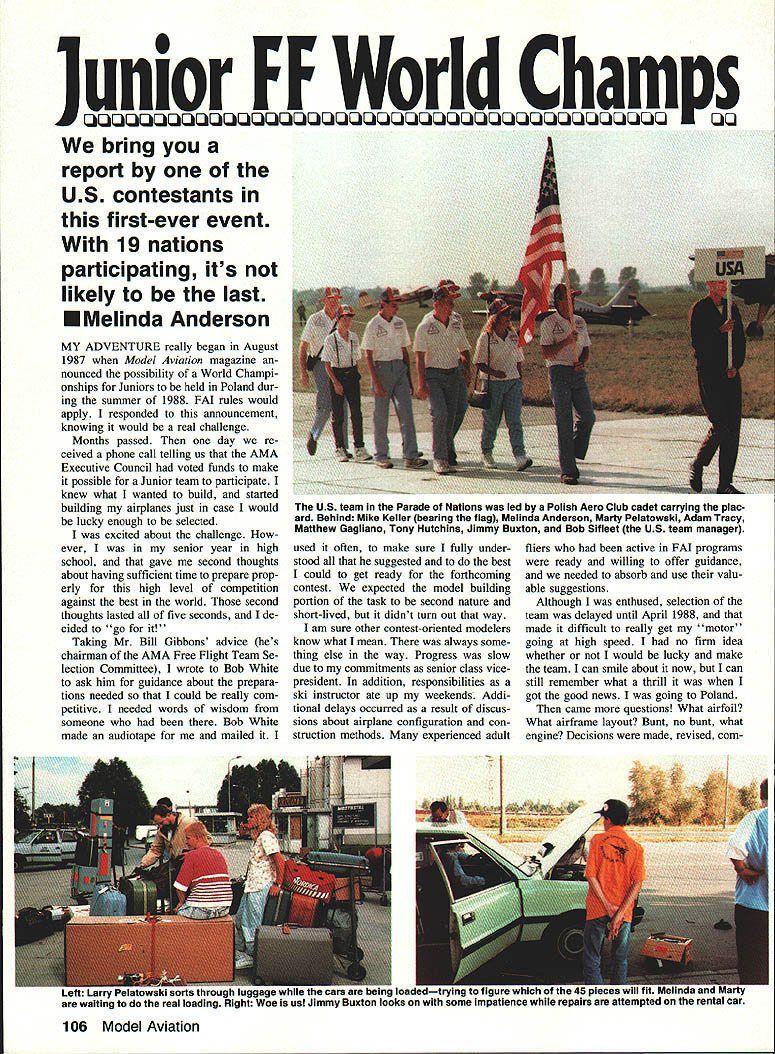
Tuesday morning, everyone was dragging. We ate breakfast and regaled one another with accounts of the previous night's exploits. But it was time to get down to the purpose of the trip. We spent that morning sorting out equipment and preparing for the opening ceremony that was scheduled to take place later at the Glider Center. We traveled to the field on buses. When we arrived, that's when we got the feeling that "This is for real!"
The ceremony was impressive and included a parade of nations, a speech by a general of the Polish Air Force, full-scale aircraft and glider flights, and introductions. A huge crowd of people was present. After the formalities we started to meet and greet contestants from other nations including Sweden, Denmark, and Poland. There were many young members of the Polish Aero Club on hand, too.
We ate dinner Tuesday evening at the Palace. We had still not received the missing model box, and Matt was worried. As we finished eating, word came in that the box had been misdirected to Istanbul, Turkey. Efforts were being made to get it back to Poland, and we all hoped it would arrive in time for the processing prior to the actual contest. Tuesday night there was a welcoming celebration complete with music, Polish folk dancers, and more ceremony. During the folk dancing show, Marty Pelatowski was dragged out to dance with the troupe. Following that came a dance for all the young people. It was very late when everyone finally went to bed.
Test flying and meeting other teams
Wednesday was for test flying. We went out to the field early. The Polish Aero Club promised to deliver Matt's model box to Leszno as soon as it arrived. Unfortunately, it did not show up until after Matt's event had been flown, so he was unable to compete. We all felt very badly that he was left out of the contest through no fault of his own, after all the hard work he had put in to get ready. However, Matt's brother Charlie threw himself wholeheartedly into the championships and helped everyone else.
As we started test flying, a large group of spectators gathered. They all seemed amazed that there was a girl flying F1C Power! There was one other girl competing, but she was in A-1 Glider. The weather was beautiful at the site. All of our planes were flying well, and the field was huge enough to accommodate a World Championships with room to spare. The crowd of onlookers began to include other contestants who drifted by to look us over and then stayed to get a closer look at the models, how they were built and powered, and to ask questions. Everything we had brought was closely examined. We were even asked by one of the Polish fliers about the large size of our model boxes. We explained the boxes had room for all of our support equipment in addition to the models.
Processing was to commence at 1:15 p.m. that afternoon. We complied and then went back to test flying. We also checked our launching area to determine the best locations in case it got windy. Then back to the Palace once more for dinner and an evening of checking and rechecking airplanes to get ready for the real competition that would start the following morning.
Trading of souvenirs had started the previous day, but by the second day it was serious—T-shirts, pins, patches and any small thing that caught someone's eye were exchanged and collected. We discovered that we had much in common with kids from other countries—not just airplanes and model aviation, but school matters, social activities, friends and problems. Some of the kids we met indicated that they were used to more freedom than we got at home—which surprised us, because we thought we were the ones who got off pretty easy.
A nightly friendly contest got started in the Palace courtyard with paper airplanes. Some great bonfires were enjoyed and we had a lot of fun doing it, even though the Palace maintenance staff appeared less than enthusiastic.
A-1 Towline Glider (Thursday)
Thursday morning we were up early for breakfast (tea, rolls, fish, and dill pickles). Rolls were the best I had eaten anywhere. With airplanes and support stuff assembled, it was out to the flying field. Other contestants were looking for us. Satellite City (Simi, CA) had provided us with dozens of small bottles of Hot Stuff adhesive, and we had passed out quite a few the previous day. When we arrived at the flying field, other contestants expected we might continue to give away the popular adhesive. We learned two Polish words during our stay—"lód" (ice cream) and "dziękuję" (thank you)—but everyone at the contest seemed to know "Hot Stuff."
Suddenly the loudspeaker announced that the first round of A-1 Towline Glider would commence in five minutes. For those of us who had never been to an FAI contest before, this was a thrilling moment. The contestants moved to the line, and with a large group at our station, we were all pretty excited. Marty Pelatowski and Mike Keller were there, and we again felt badly that Matt Gagliano could not join them with his planes. The weather was exceptional with a slight down-field breeze.
The flare went up, and Round One was on. Marty and Mike really started out well. Mike missed a max on his first flight by 58 seconds, but then he found good air and maxed Rounds Two through Six. He even lost one plane—it disappeared in the direction of Leszno. Luckily we had been supplied with identification stickers by the Polish Aero Club, and the plane was brought back to the field within an hour and a half. The people who found the plane had to find someone with a car to drive them out to the field—great luck.
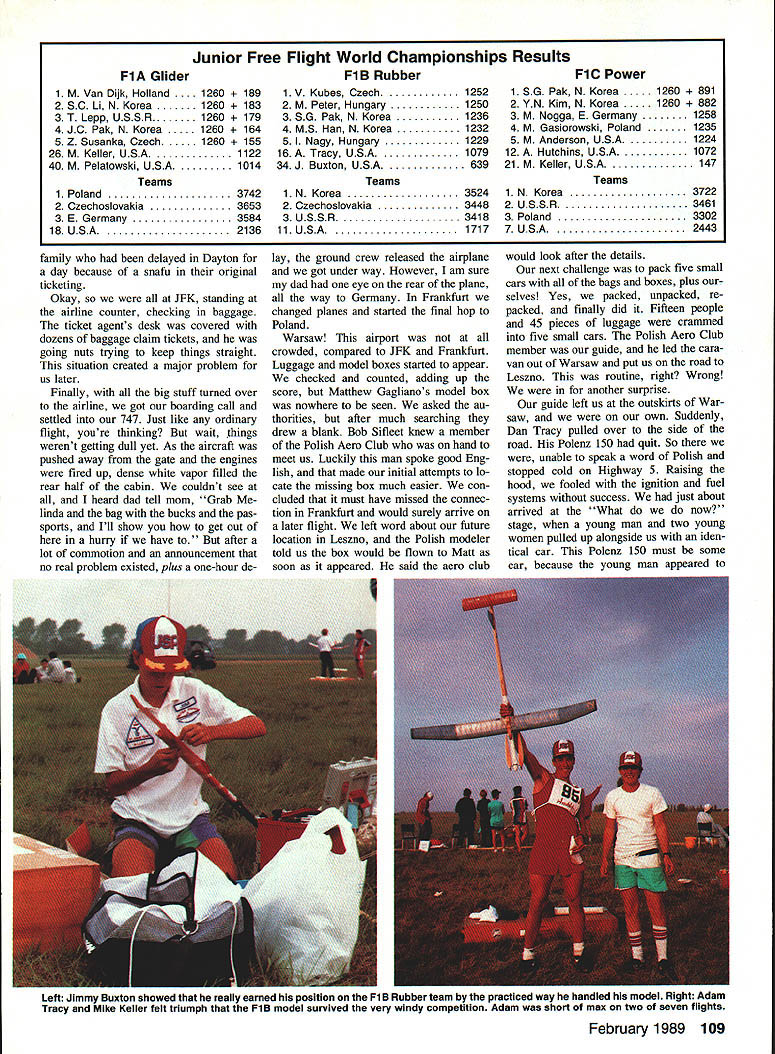
Mike dropped Round Seven and finished the day in 26th place overall with 1,122 seconds. Marty got maxes in Rounds One through Four, dropped number five (which proved to be a stinker for many), and finished 40th with 1,014 seconds.
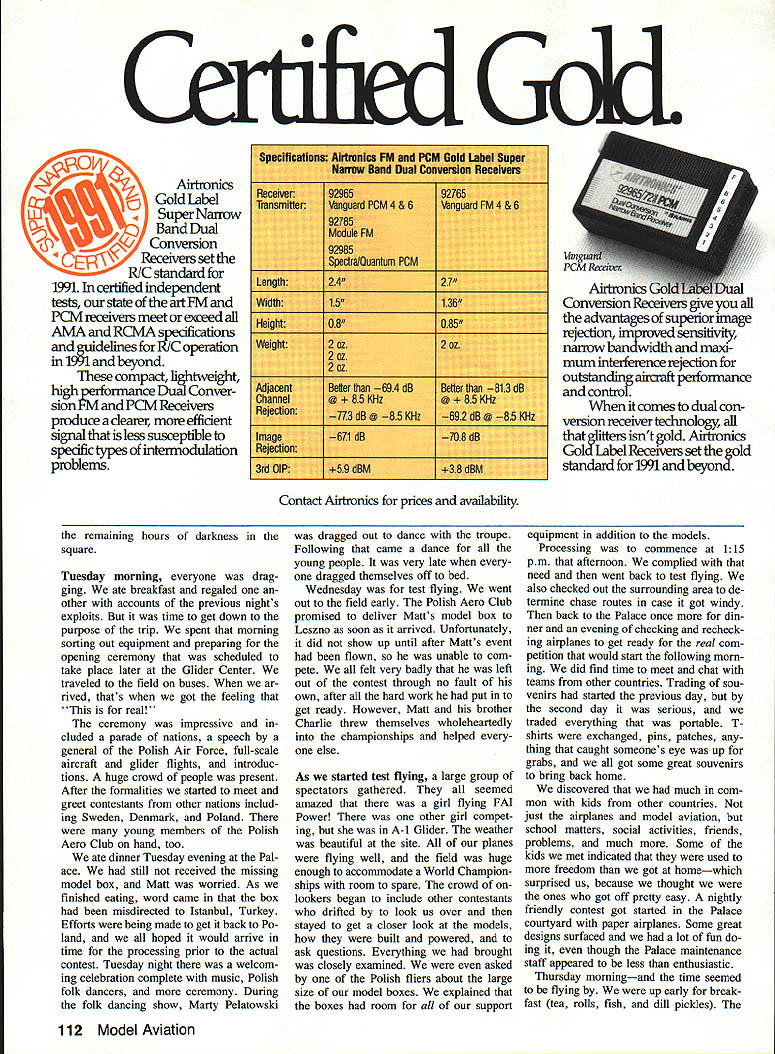
Fifty-three contestants flew this event. Individual gold, silver and bronze went to Holland, North Korea, and the Soviet Union, respectively. Team placings were Poland first, Czechoslovakia second, and East Germany third. Medals and trophies were presented on the field immediately following that day's competition.
F1C Power (Friday)
We headed for the field as soon as the sky started to become light. We had asked our team members who were not scheduled to fly that day to collect breakfast for us and bring it to the field. We had not had time, up till then, to really test our models and wanted to use this final free time to get in as many flights as we could. The sky was overcast and didn't look pure. We were just set up to fly when it began to rain cats and dogs. This lasted about 30 minutes, then the sky cleared nicely and we were ready to go.
We flew several test flights—and then it happened. Either it was a bad launch or something else occurred in the flight, but my plane went out the window, rolled on its back, dove to earth (DTE) carrying a lot of speed, and blew a wing. This was the same wing I had lost back home before leaving. Not a terrific setback, but my other planes were working well.
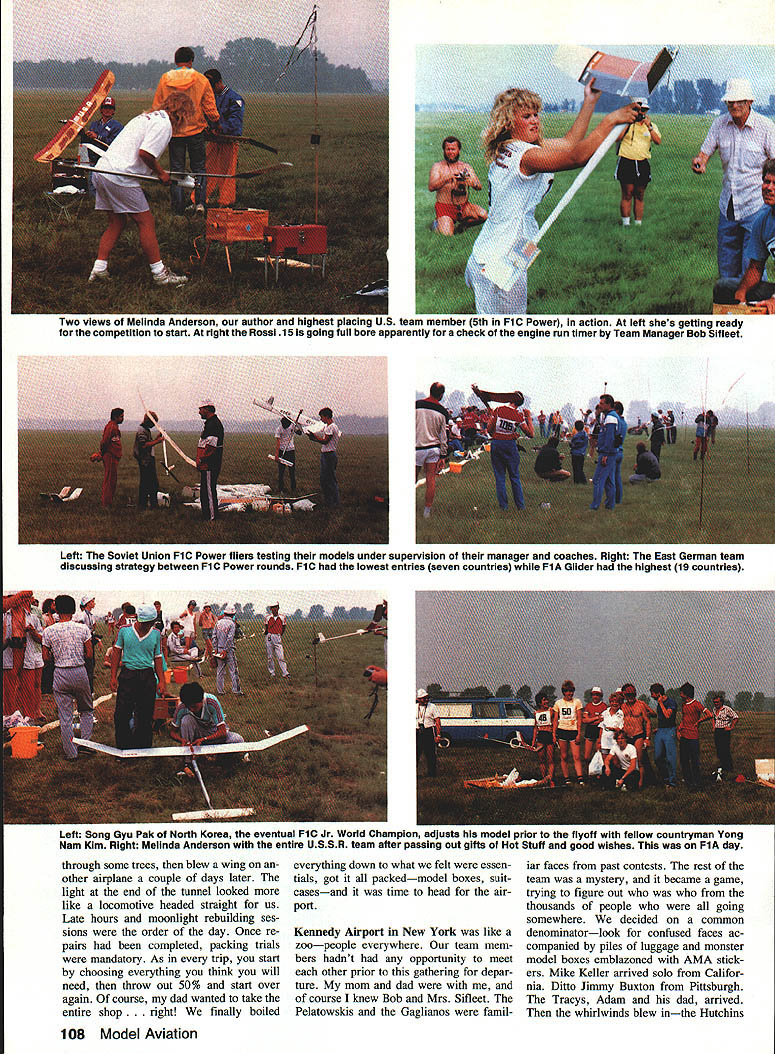
Round One began. I was first to fly and proceeded to test the trim on my airplane by flying a 10-second power run. Almost a minute later the trim was perfect and the aircraft slowly crested into the sky. After a long while it slowly returned to earth—a satisfying result. Tony Hutchins flew a max, and Mike Keller flew but had to settle for a 147-second flight. As we discovered later, Mike was having motor trouble, which continued to plague him for the rest of the day.
The pressure mounted for me. I still had to log an official flight in that round and could not overrun. We had reservations about the consistency of the timer. I made an engine test run on the ground and backed off the timer for a 6.8-second run to be sure we were within the necessary limit. The flight hooked up and I scored a max.
Rounds Two and Three were great, but Round Four provided some nail-biting moments. When it was over, I had three more maxes on the score sheet. We still experienced some timer problems, but we decided to hang tough. A further problem surfaced when the folding points kept working their way out of the hub. Thanks to titanium hubs, no damage was done, but we had to reset one pin about every flight. The propeller worked well, keeping the engine at a consistent 29,400 rpm.
Tony had maxed Round One and picked up another max in Round Four but dropped Rounds Two and Three. The day got hotter and good air harder to find. Luckily none of us had to chase any planes that day because a two-man team from Denmark, who had flown the day before, offered to do all chasing on their motorcycle.
Lunchtime came and went, and Round Five was a team toughie. I flew first with a really good launch, power, climb, and transition—but we missed the thermal and missed a max by 20 seconds. It was a real letdown for a moment, but I knew "It's not over 'til it's over." We regrouped for Rounds Six and Seven. The scoreboard indicated that most other teams had not maxed out, so we were still in contention.
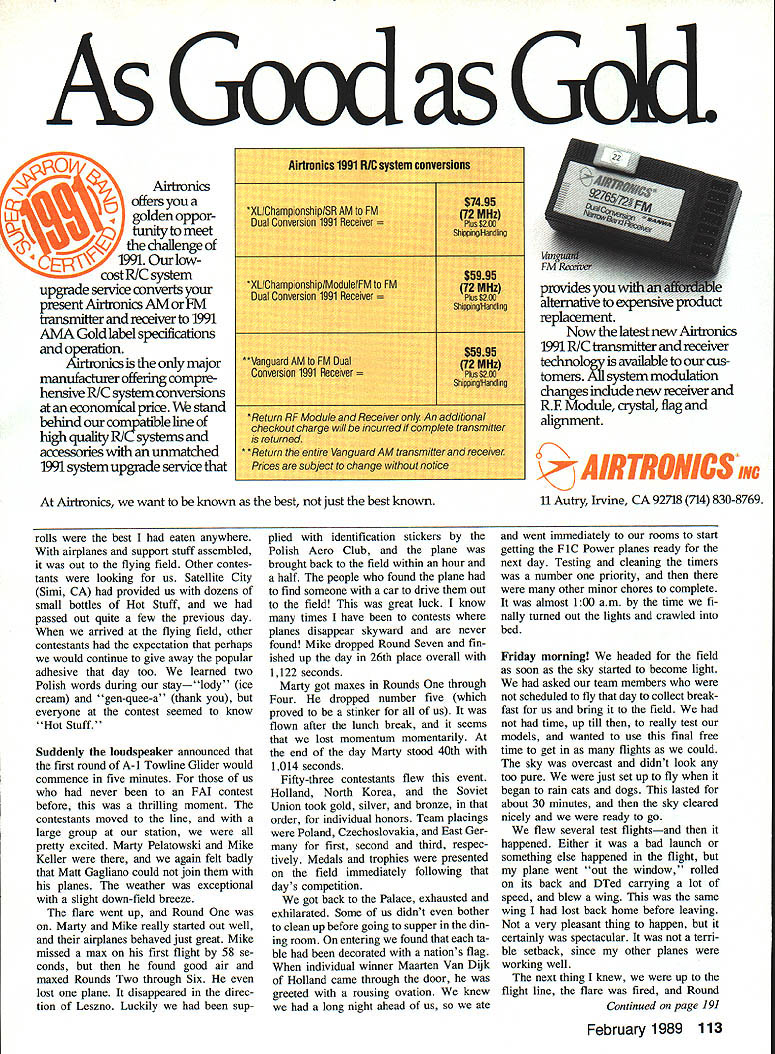
In Rounds Six and Seven I flew maxes again. That gave me fifth place overall with 1,224 seconds. Tony Hutchins piled up 1,024 seconds after a good seventh-round effort and placed 12th. Mike Keller's timer problem put him down to 21st place. We felt we had done the best we could—and after all, that's the name of the game.
When the flyoff had been completed, the North Koreans were in first and second place; East Germany took the individual bronze. In team competition, first, second and third went to North Korea, the U.S.S.R., and Poland, respectively. The awards ceremony took place immediately after the contest, and we all cheered for several minutes.
Life at the Palace and snacks
Back at the Palace, mealtime was an adventure for the American kids—especially me. I'm a Diet Coke kid who experiences severe withdrawal when I can't get it. The Palace offered terrific breads and soups, but liver—ugh! I learned to enjoy the fruit-flavored tonic they served. We discovered Pepsi was available, even though it was warm; when we finally got cold Pepsi it felt like winning gold.
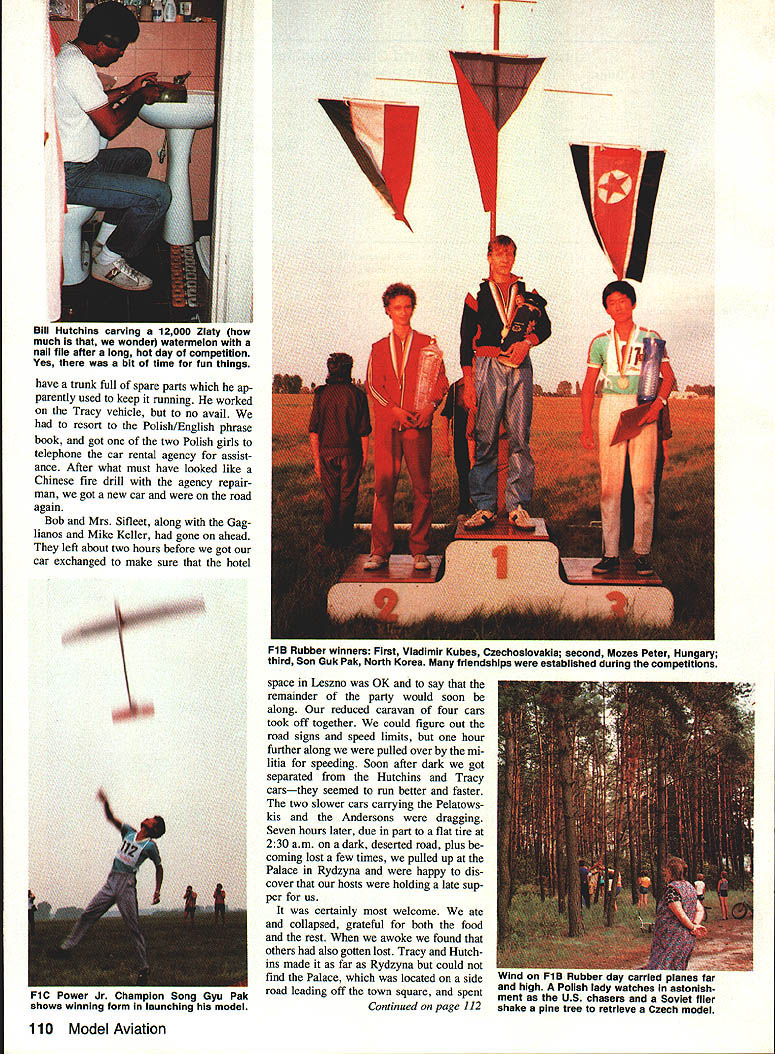
Bill Hutchins and Larry Pelatowski had almost bought out a fruit and vegetable stand. They put watermelons to cool in a bathtub of cold water while we ate dinner. Later that night as we got planes ready for the F1B (Wakefield Rubber) event the next day, Bill sat on the toilet seat in our room, carving huge chunks of watermelon with a nail file and handing out chunks to anyone who walked past the open door.
F1B Wakefield Rubber (Saturday)
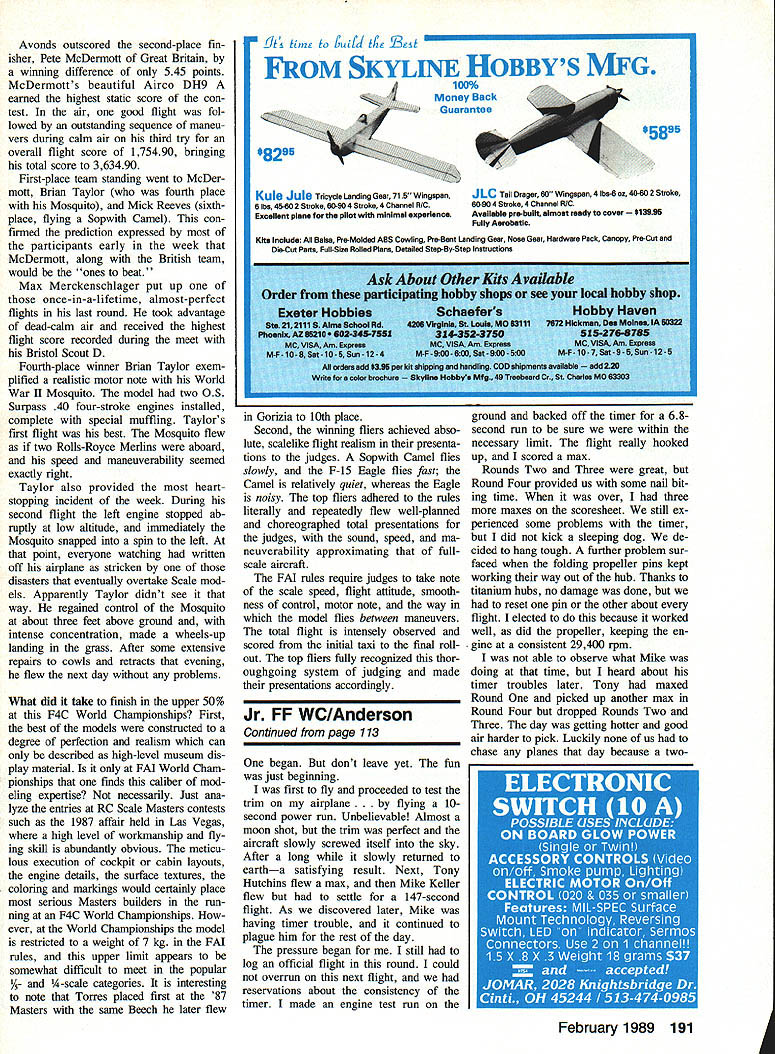
Saturday we awoke to the sound of wind in the trees—a bad sign. This was the day for Adam Tracy and Jimmy Buxton in F1B. The wind stayed strong all day, and we knew early flights could go out of sight. Experienced fliers at major contests get very good at figuring out where winds are likely to carry planes. If they didn't have that perception and skill, they would be spending a lot of time building new aircraft.
We set up a car/radio relay system to keep track of where planes were heading. We mashed potatoes in fields, climbed into barnyards, up trees, and down slopes. We got some very interesting looks from Polish neighbors who saw all this happening, but we also got a lot of help from them in locating and retrieving our errant aircraft. We shook planes out of trees and picked them out of cornfields. For a while we hoped they would postpone the contest until Sunday (the reserve day) for less wind. They didn't.
Adam Tracy maxed Rounds One through Four. Round Five was a killer—he got only 64 seconds due to heavy winds. His Round Six was 114 seconds, then he got another max in Round Seven. He finished in 16th place with a total of 1,078 seconds.
Jimmy Buxton's planes were all good fliers, but a combination of heavy winds and questionable motors gave him problems on Day One. He finished in 34th place with a total of 639 seconds.
Closing events (Sunday)
Sunday was a full day. After breakfast we boarded a bus for a visit to the 14th-century castle at Rydzyna. The Palace there is a 16th-century Baroque structure and had been almost completely destroyed during World War II. The Polish people started a restoration effort in 1976, and it is now nearly complete. Surrounded by a moat, it is used as a vacation resort and convention center. The castle is from the medieval era, used as a museum, and is absolutely beautiful. The castle is an attraction of national importance, and it appeared that half of Poland was there on their day off. Wonder of wonders, we found we could buy french fries at a kiosk just outside the castle grounds. Then we were back on the bus, snoozing en route to the Palace in Leszno.
We were taken to the field once more for a full-scale flying show by the Polish Aerobatics Team, who had just returned from the European competitions. Dinner at the Palace followed, and then it was off to the closing ceremonies. These were spectacular. Everyone received recognition from the FAI and the Polish Aero Club. There was a show with lots of music, dancing, stage performances, and a giant fireworks display. It was all very impressive and enjoyed by everyone.
Acknowledgments
I would like to thank AMA for providing funds and the privilege and opportunity to represent the U.S.A. in this world-class event. Thanks are also due to Messrs. Sifleet, Hutchins, Tracy, Pelatowski and to my parents for their encouragement, assistance, and patience during the trip.
I would also like to thank the following FAI adult fliers for their contributions of time and knowledge in assisting me to reach a successful conclusion to this adventure: Messrs. Gutai, Archer, Bogart, Mateer, Poti, Galbreath, and Brandt. I could not have done it without them.
The entire U.S.A. contingent would like to thank the following people and companies for their generous donations and assistance:
- Bob and Bill Hunter, Satellite City — Hot Stuff
- Doug Galbreath, The Printer — Team cards
- Gene Killey, Cel-Con — Battery packs and chargers
- Joe Skosson, Advance Tool — Machining
- Betty Kerr — Knitted team sweater
- Gatorade — for their donation (our "vintage")
Suggestions for next time
- Select the team no later than the end of the preceding summer, to allow competitors ample time to prepare.
- Review the eligible fliers from previous championships. They have "been there" and hence will be very competitive (provided they have time to prepare and can get the best equipment available).
- Provide each competitor with an adult supervisor in his/her region. This will supply experienced assistance and guidance in building, trimming, etc.
- Request sufficient budget in advance for adult assistance during the contest.
- Develop a program for Junior fliers which will provide incentives and encouragement for them to get involved in this great program.
It's up to you!
Closing
We met a lot of wonderful people and had an opportunity to see the other side of the world, and I must say: it feels good to be an American.
Transcribed from original scans by AI. Minor OCR errors may remain.

