
Junior Free Flight
- Brian and Janna VanNest
After experiencing delayed flights and other transportation problems, the eight-man U.S. team met up in Lučenec, Slovakia, for the Junior Free Flight World Championships held August 14–17.
The town offered friendly people, gentle rolling hills, and a lot of rain. Something called the "500-year flood" occurred during our stay; Prague, in the Czech Republic (about six hours away), evacuated 2.5 million people. We had rain at least every night or day, and the worst was on F1A day. Tennis shoes never really dried out before we put them on for the next day of flying.
A total of 17 countries participated, including Korea for the first time. The contest site was in Blokovce, on a small flying field approximately 10 minutes from our hotel in Lučenec.
We (Janna and Team Manager Brian) traveled with supporters Bob and Connie Piserchio of San Diego, California, and arrived four days before the contest. We found the flying field, market, Internet café, bank, gas station, and a few choice restaurants. We located all the major shops, which was a good idea since a saw was needed to get a model out of a tree on practice day. The saw was needed again on the last flight that brought Austin Gunder to his Hall of Fame.
F1A Day
Rain was expected throughout the day.
Team members:
- Michael Avallone (Grand Rapids, MI)
- Dallas Parker (North Hills, CA)
- Ben Coussens (Valencia, CA)
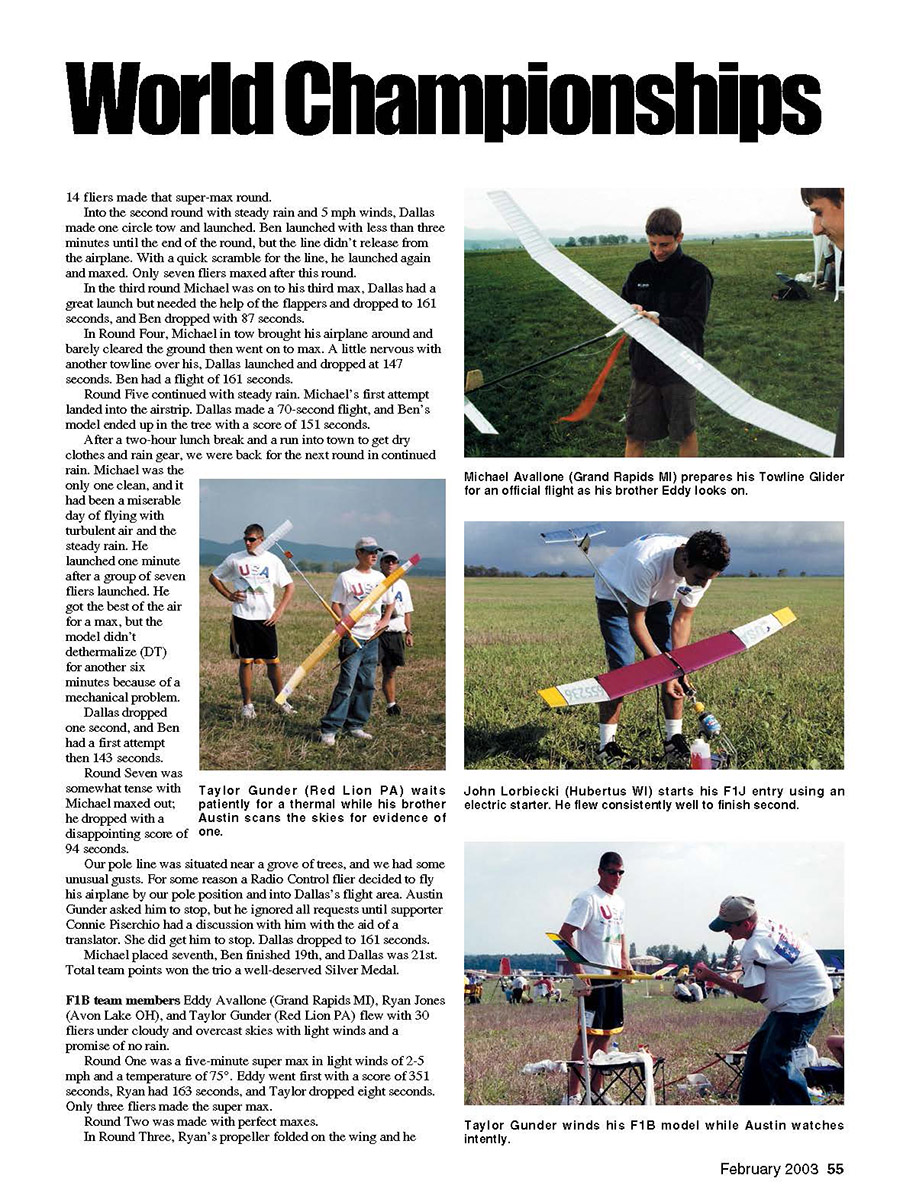
- Ryan Jones (Avon Lake, OH) — launched an F1B model for an official flight
Round 1: a four-minute super-max was flown in light rains. Michael squeaked in a max, Dallas had a line tangle and refl ew with a max, and Ben dropped seven seconds in slightly heavier rain. Only Ryan launched his F1B model for an official flight. Fourteen fliers made that super-max round.
Round 2: steady rain and 5 mph winds. Dallas made one circle tow and launched. Ben launched with less than three minutes left in the round, but the line didn’t release from the airplane; after a quick scramble he launched again and maxed. Only seven fliers maxed after this round.
Round 3: Michael recorded his third max. Dallas had a great launch but needed the help of the flappers and dropped to 161 seconds. Ben dropped with 87 seconds.
Round 4: Michael, in tow, barely cleared the ground then maxed. Nervous with another towline over his, Dallas launched and dropped at 147 seconds. Ben flew 161 seconds.
Round 5: continued steady rain. Michael’s first attempt landed into the airstrip. Dallas made a 70-second flight. Ben’s model ended up in a tree with a score of 151 seconds.
After a two-hour lunch break and a run into town to get dry clothes and rain gear, we returned for the next round in continued rain. Michael was the only one clean that round. It had been a miserable day of flying with turbulent air and steady rain. Michael launched one minute after a group of seven fliers and got the best of the air for a max, but the model didn’t dethermalize (DT) for another six minutes because of a mechanical problem. Dallas dropped one second, and Ben had a first attempt then 143 seconds.
Round 7: somewhat tense. Michael maxed out earlier but then dropped with a disappointing 94 seconds. Our pole line was situated near a grove of trees and we experienced unusual gusts. For some reason a radio-control flier decided to fly his airplane by our pole position and into Dallas’s flight area. Austin Gunder asked him to stop, but he ignored requests until supporter Connie Piserchio intervened with the aid of a translator; she got him to stop. Dallas dropped to 161 seconds.
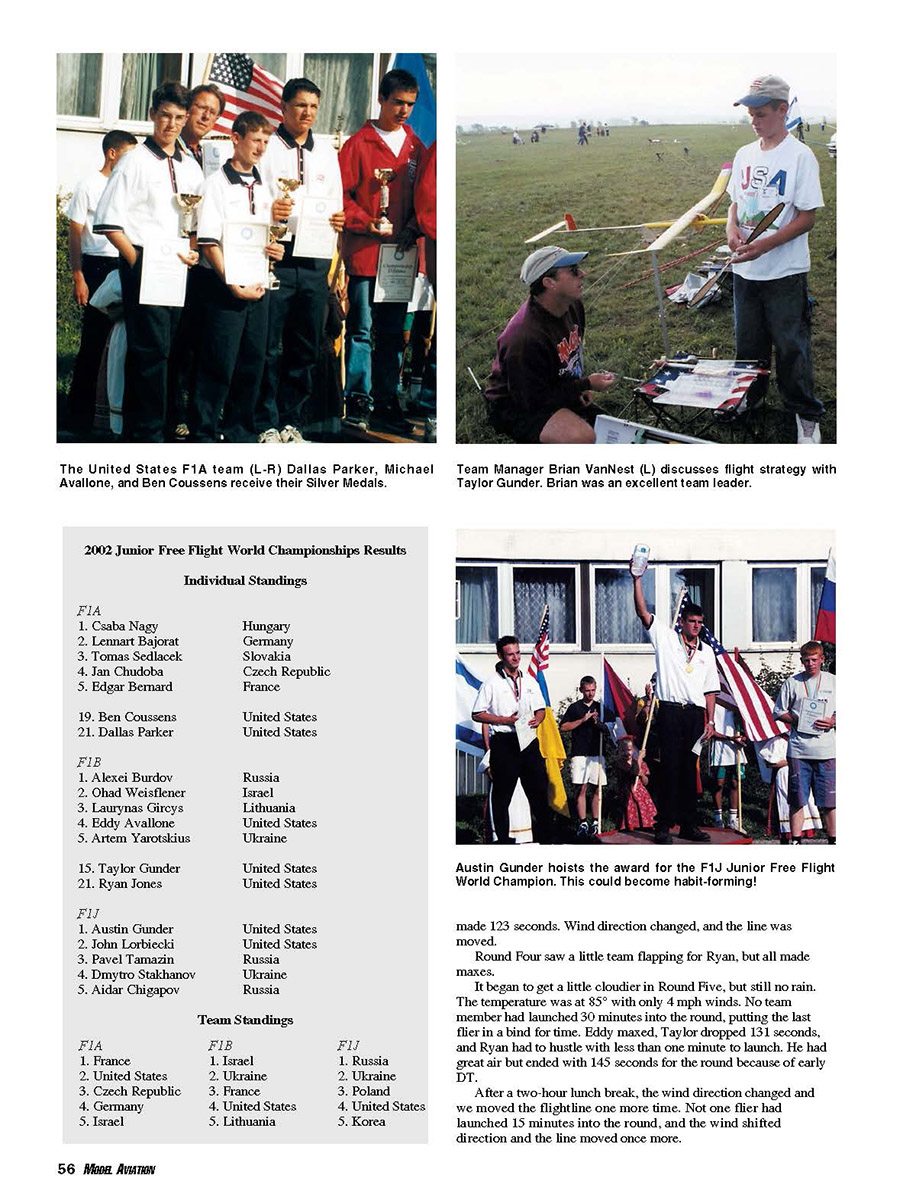
Finals: Michael placed 7th, Ben finished 19th, and Dallas was 21st. Total team points earned the trio a well-deserved Silver Medal.
F1B
Team members:
- Eddy Avallone (Grand Rapids, MI)
- Ryan Jones (Avon Lake, OH)
- Taylor Gunder (Red Lion, PA)
Thirty fliers contested F1B under cloudy, overcast skies with light winds and a promise of no rain.
Round 1: a five-minute super-max in light winds of 2–5 mph at about 75°F. Eddy went first with 351 seconds, Ryan had 163 seconds, and Taylor dropped eight seconds. Only three fliers made the super-max.
Round 2: perfect maxes for the team.
Round 3: Ryan’s propeller folded on the wing and he scored 123 seconds. Wind direction changed and the line was moved.
Round 4: a little team flapping for Ryan, but all made maxes.
Round 5: it began getting cloudier but still no rain. Temperature rose to 85°F with 4 mph winds. No team member had launched 30 minutes into the round, putting the last flier in a bind for time. Eddy maxed, Taylor dropped 131 seconds, and Ryan had to hustle with less than one minute to launch; he had great air but ended with 145 seconds because of an early DT.
After a two-hour lunch break the wind direction changed and we moved the flightline. Not one flier had launched 15 minutes into that round; the wind shifted again and the line moved once more.
Round 7: the last round. Eddy and Ryan maxed; Taylor dropped 136 seconds. Eddy placed 3rd, Ryan 21st, and Taylor 15th. Their combined team score won the United States the F1B Gold Medal.
F1J
F1J was contested with 13 fliers. Conditions were hot and hazy with southeast winds at 4–6 mph.
- Round 1: two-minute max.
- Round 2: three-minute max.
- After three rounds Austin Gunder was in first place and John Lorbiecki was second; they were battling for the title.
- Round 4: both maxed.
- Round 5: John dropped with 87 seconds; Austin maxed.
- Round 6: John must-maxed; Austin dropped only two seconds.
- Round 7: the decider. With a saw rescue on his last flight, Austin managed to max and clinch the championship. John was runner-up. The United States won the F1J team title.
Supporters and Thanks
Not enough can be said for the help of the supporters, otherwise known as the chase crew:
- Jim Parker
- Tom Coussens
- Anthony Avallone
- Craig Gunder
- Charley Jones
- John Lorbiecki Sr.
- Kyle Jones
- Martha Gunder
- Jerilyn Jones
This group helped retrieve airplanes in soggy tennis shoes, wet clothes, muddy fields, and 10-foot-high cornfields. Special thanks to Bob Piserchio for his help with the frontline crew and to Connie Piserchio for being our team nurse.
The Junior World Championships would not have been possible without the organizers' hard work and dedication. The U.S. contingent thanks Stefan Hubert and his crew for doing a superb job.
The next Junior Free Flight World Championships will be held in France in 2004. Junior fliers interested in entering the next program should call Brian VanNest at (760) 873-5073 or e-mail bisheaf1A@aol.com.
Brian and Janna VanNest 2346 Cheyenne Dr. Bishop, CA 93514
Transcribed from original scans by AI. Minor OCR errors may remain.

